Pigeon droppings can make people sick, mainly when dried droppings turn to dust and are breathed in. The diseases linked to them include histoplasmosis, cryptococcosis and psittacosis, plus stomach illness from germs picked up on hands. A few fresh droppings on a path are a low risk. A thick, dry build-up in a roof void, on a ledge or under solar panels is where the real concern sits, and where disturbing it without precautions is a mistake.
This guide explains what the illnesses are, who is most at risk, how to clean up safely, and when to speak to a doctor.
TL;DR
- The risk comes mostly from breathing in dust from large, dried accumulations of droppings, or from swallowing germs via unwashed hands.
- Diseases linked to bird droppings include histoplasmosis, cryptococcosis, psittacosis and gastrointestinal illness.
- Young children, older people, pregnant women and anyone with lowered immunity are most at risk.
- Wet droppings before removing them, never sweep or blow them dry, and wear a P2 respirator for anything beyond a small spot.
- Flu-like symptoms within days to weeks of exposure are a reason to call your doctor and mention the droppings.
Table of Contents
- How pigeon droppings can make you sick
- The diseases linked to bird droppings
- How serious is the real-world risk?
- Who is most at risk
- Is it safe to clean up pigeon poop?
- When to see a doctor
- Stopping the problem at the source
- Canberra bird proofing and pest protection from Bugs Patrol
- Our perspective
- FAQ
- Sources
How pigeon droppings can make you sick
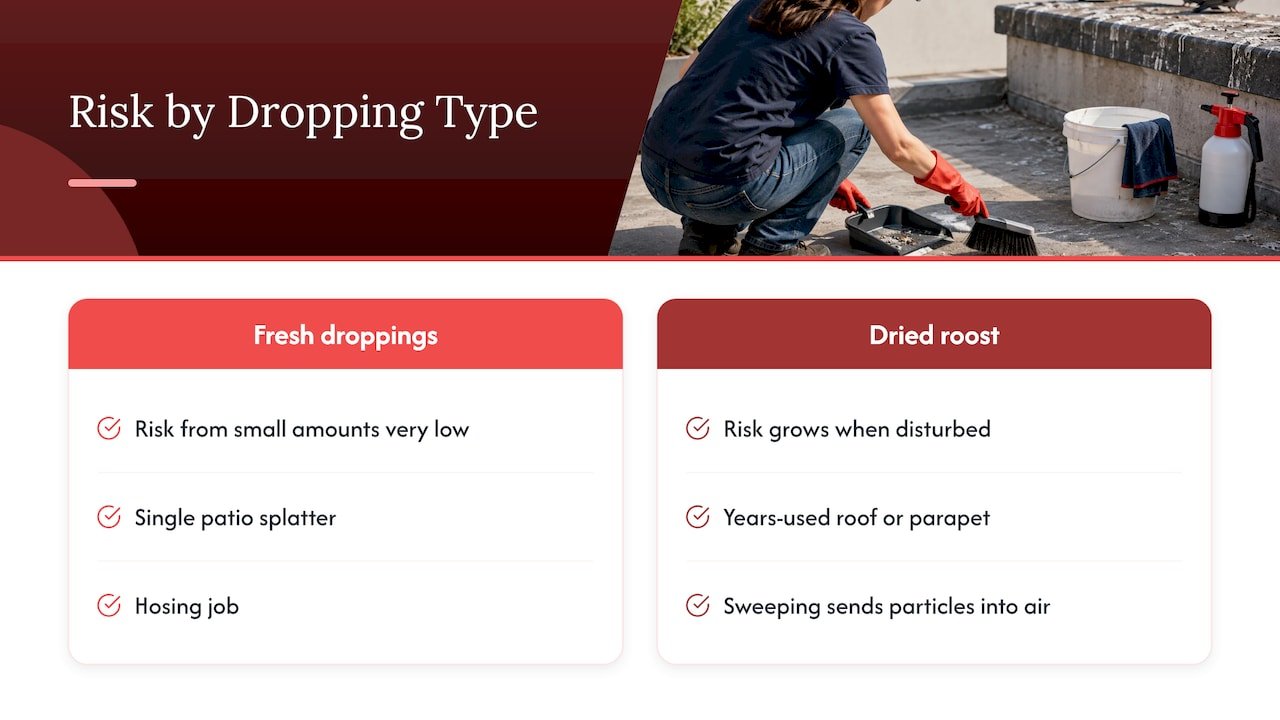
There are two main routes. The first is breathing in fungal spores or bacteria. The second is swallowing germs by accident, usually from contaminated hands. WorkSafe Queensland says the risk from disturbing small amounts of fresh droppings is very low, but it grows when large accumulations of concentrated, dried droppings are disturbed.
That difference matters for homeowners. A single splatter on the patio is a hosing job. A pigeon roost that has been used for years behind a parapet, in a roof cavity or beneath a solar array is a different job. Dry droppings crumble, and every sweep or leaf-blower pass puts fine particles into the air you are about to breathe.
It is also worth knowing that droppings are not the only source. The psittacosis bacteria can come from dried droppings, feathers and respiratory secretions of infected birds, according to the Australian Centre for Disease Control. The disease does not usually spread between people.
The diseases linked to bird droppings
The main conditions are summarized below. Most healthy people who are exposed do not become seriously ill, but each can be severe in the wrong person.
| Condition | Cause | How it reaches you | Typical concern |
|---|---|---|---|
| Histoplasmosis | Fungus Histoplasma capsulatum growing in enriched soil | Breathing in spores | Lung illness, more serious with weak immunity |
| Cryptococcosis | Fungus Cryptococcus neoformans | Breathing in contaminated dust | Lung infection; can cause meningitis |
| Psittacosis (parrot fever) | Bacteria Chlamydia psittaci | Breathing in dust from droppings, feathers, secretions | Flu-like illness, sometimes pneumonia |
| Gastrointestinal illness | Germs such as Salmonella and Campylobacter | Hand-to-mouth contact | Stomach upset, diarrhea |
Histoplasmosis
Histoplasmosis is often described as a pigeon disease, but the detail is more precise. The University of Minnesota’s health and safety office explains that fresh bird droppings do not contain the fungus. Instead, the manure feeds the fungus already in the soil, and soil generally needs three years or more of enrichment before it reaches significant levels. That is why old roosts and soil beneath long-used perching spots are the places to treat with respect.
Health Canada says symptoms begin about 10 days after infection and can include fatigue, fever and chest pain. Most infections cause no symptoms or a mild respiratory illness, and people with weakened immune systems are generally more at risk.
Cryptococcosis
WorkSafe Queensland states that cryptococcosis is caused by a fungus found particularly in soil contaminated with bird droppings, especially pigeon droppings. Infection is rare in otherwise healthy people, but people with low immunity are at increased risk, and it commonly causes meningitis.
The Minnesota guidance adds that this fungus has been found in as many as 84 percent of samples taken from old roosts, and that even old, dry droppings can be a significant source. A short inhalation of heavily contaminated dust may be enough to cause infection. Australia has its own variant of the organism: a review in Microbiology Spectrum reports that the gattii form is endemic in eucalyptus-growing regions of Australia and Papua New Guinea.
Psittacosis
Psittacosis is the one with the strongest Australian public health footprint. The Tasmanian Department of Health says the bacteria may survive in dust for several months, and that person-to-person spread has not been documented.
The everyday exposure is not what most people expect. NSW Health notes that outbreaks in Australia have been linked to breathing dust stirred up by lawn mowers after wild bird droppings contaminated it. The national public health guidelines also record that mowing without a grass catcher and gardening have been associated with transmission. If birds roost heavily over your lawn or garden beds, the yard counts as an exposure area too.
Birds themselves give you no warning. NSW Health points out that birds can carry the organism without showing signs of illness, so you cannot judge risk by looking at the flock.
Stomach illness and other germs
Wildlife Health Australia lists Salmonella, Campylobacter, Giardia, Cryptosporidium, Chlamydia psittaci and avian influenza among the important zoonotic pathogens in Australian wild birds, with inhalation, direct contact and ingestion as the main routes. For a household, the practical message is simple: droppings on outdoor furniture, children’s play equipment, pet bowls or food-prep areas should be cleaned properly, and hands washed afterwards.
How serious is the real-world risk?
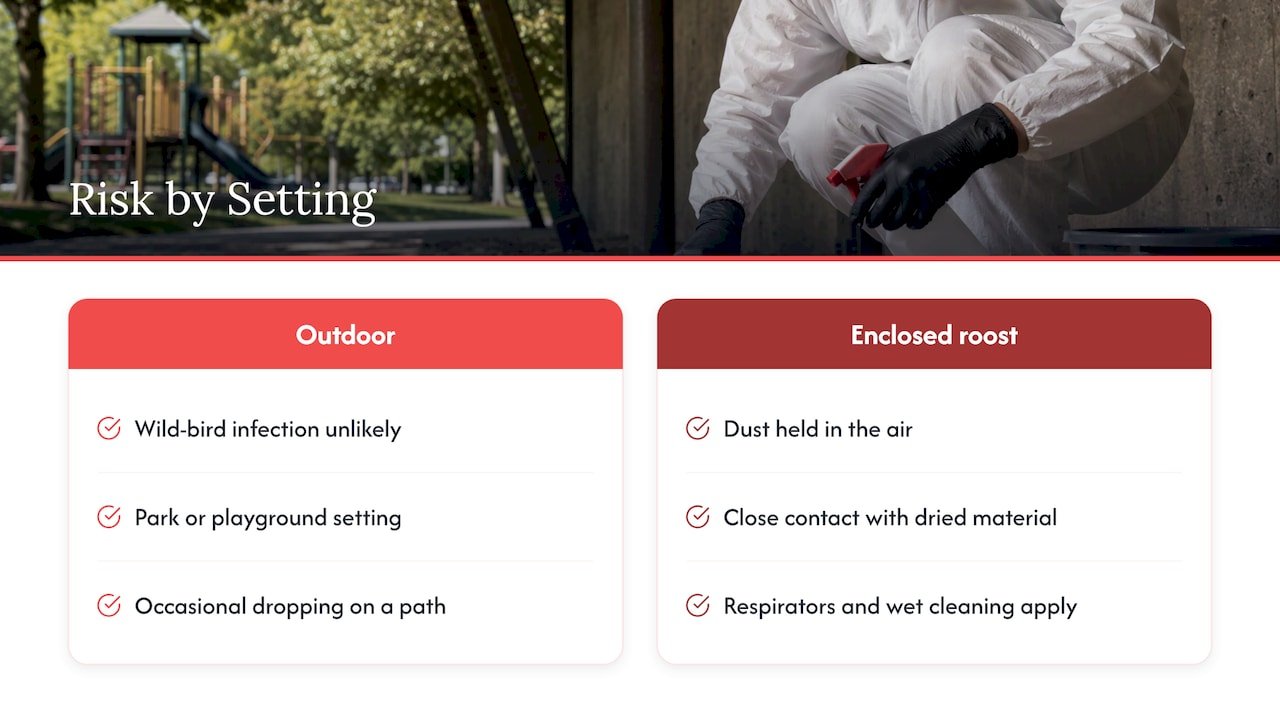
It helps to keep proportion. SA Health says human cases of histoplasmosis and psittacosis are extremely rare and mainly involve people who closely associate with caged or captive birds. It also says infection from wild bird droppings in an outdoor setting such as a park or playground is unlikely.
That is reassuring for an occasional dropping on a path. It is not a reason to ignore an indoor roost. Enclosed spaces such as roof cavities, plant rooms, balconies and the gap beneath solar panels hold dust in the air and put you in close contact with dried material. These are the situations where the official guidance on respirators and wet cleaning applies.
Droppings also bring non-infectious problems. They are acidic and mark paint, stain masonry and can block gutters and downpipes. Droppings built up on steps and walkways create a slip hazard, a point also raised by Anticimex in its notes on bird-related dangers. Mites and bird nest debris can add to the mess, and a blocked gutter can cause water damage long before anyone gets sick.
Who is most at risk
WorkSafe Queensland lists the following as most at risk from histoplasmosis or psittacosis:
- young children
- older people
- pregnant women
- people with a medical condition, or having treatment, that lowers immunity
Workers who disturb accumulations of dried droppings are also at risk. NSW Health adds that older people generally experience more severe psittacosis.
If anyone in your household is in one of these groups, do not do the heavy clean-up yourself. NYC Health, for example, advises that people with a compromised immune system, including from HIV/AIDS or cancer, should not clean up droppings. Wildlife Health Australia recommends that at-risk people ask their GP or state medical authority about zoonotic disease risks.
Is it safe to clean up pigeon poop?
For a small, fresh patch on a hard surface, yes, with ordinary care. NYC Health says routine cleaning of droppings, such as from a windowsill, does not pose a serious health risk to most people. Wet it, wipe it up with disposable gloves, bag it, and wash your hands.
Large or old accumulations need a different approach. The steps below follow the WorkSafe Queensland guidance for larger clean-ups.
- Keep people and pets out. Seal doors, windows and air vents so dust does not travel into living areas.
- Do not disperse dust. No dry sweeping, no leaf blowers, no compressed air, no household vacuum.
- Wet the droppings and keep them wet while you remove them.
- Wear a properly fitted particulate respirator. For major work, add gloves, protective clothing, safety eyewear and boot covers.
- Clean with water and detergent first, then apply disinfectant.
- Seal the waste in a securely closed container or bag.
- Wash your hands and clothes straight afterwards.
The Australian Centre for Disease Control recommends a dust mask or P2 respirator, wetting surfaces before cleaning and washing hands after contact. Wildlife Health Australia also names the P2 class as the preferable choice when handling droppings. A flimsy paper mask is not the same thing. If you are working out what to buy, a guide to choosing the right personal protective equipment is a good starting point for understanding gloves, eye protection and respirator types.
One more honest point from the University of Minnesota: if droppings sit somewhere nobody goes, leaving them alone can be the best course. The aim is to avoid creating dust, not to remove every dropping at any cost. The real fix is stopping new droppings, which means stopping the birds from roosting there.
Rodent droppings are a separate job
If the mess in the roof is small, dark and pellet-shaped, it may be rodents, not birds. The method is similar (wet, do not sweep, protect yourself) but the details differ, so see our rodent droppings cleanup safety guide.
When to see a doctor
Symptoms rarely show up straight away, so it is easy to link them to the wrong thing. NSW Health says psittacosis symptoms appear from about five days to four weeks after exposure, commonly around 10 days. They include headache, fever, chills, weakness, muscle aches, a dry cough, chest pain and breathlessness, and severe cases can develop pneumonia. The illness is treated with antibiotics, for up to two weeks according to NSW Health.
The Mayo Clinic notes histoplasmosis symptoms often start 3 to 17 days after breathing in spores. It advises calling your healthcare professional if you get flu-like symptoms after exposure to bird or bat droppings, and says a checkup is very important if your immune system is weakened.
In practice: if you develop a fever, cough, chest pain or breathing trouble in the weeks after cleaning droppings or working in a roof space with a roost, see your GP and tell them about the exposure. Do not wait it out. Call emergency services (000) for severe breathlessness. If you suspect avian influenza exposure from a sick or dead bird, follow your state or territory health department’s advice.
Stopping the problem at the source
Cleaning is only half the story. If pigeons are roosting on your property, droppings return within days. The usual causes are:
- ledges, beams, signs and parapets that offer flat perches
- gaps in roof tiles, eaves and soffits that lead to nesting spots
- open gutters collecting debris and water
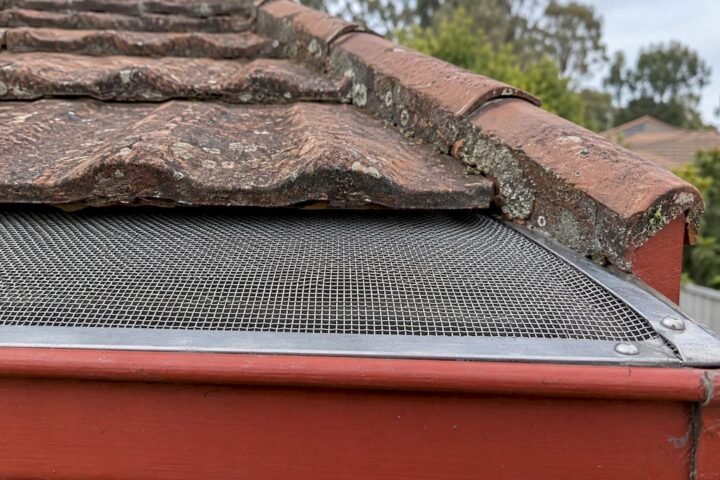
- gaps under solar panels, which give birds a sheltered nesting space
- food sources such as pet food, open bins and people feeding birds
Bird proofing is built around physical exclusion: netting, spikes and deterrents on perches, and mesh or proofing around solar panels. Before you do anything to the birds themselves, check the rules. Native birds are protected and the rules differ by state and territory, so read our guide to pigeon control laws in Australia. For roof problems, see birds in the roof and our wider look at bird droppings health risks in Canberra.
Canberra bird proofing and pest protection from Bugs Patrol
If you have a roost to deal with, we handle bird control for homes and businesses across Canberra, including bird spikes and deterrents and solar panel bird proofing. Our licensed technicians focus on treatments that are safe for families and pets, and we offer fast response, including emergency service.

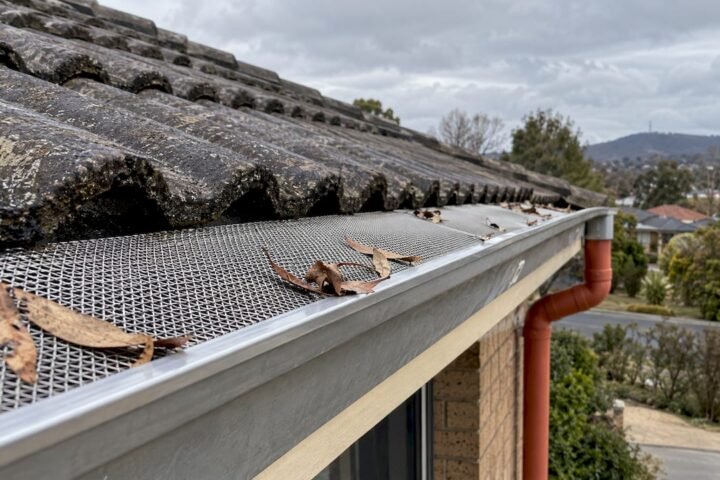
Gutters clogged with debris attract birds and hold moisture, so we also install gutter guards. If you want ongoing cover for the rest of your property’s pests, our maintenance plans start at $29.98 per month for Bronze General Pest or Bronze Termite, with Silver Combined at $55.98 per month and Gold Complete at $79.98 per month. Bird work is quoted separately, so get in touch for an assessment.
Our perspective
Most of the calls we get about pigeons start with the same sentence: “I just want it cleaned up.” We understand that. But the clean-up is the easy part to get wrong and the least useful part to do first.
If droppings are in a roof void, a solar array or a plant room, the safest sequence is to stop the birds returning, then remove the build-up with the right controls: wet methods, sealed-off areas, respirators and proper disposal. Clean first and the birds are back in a fortnight. Proof first and the problem has an end date.
That is why we pair bird proofing with gutter guards and a general pest check. Roosting birds, blocked gutters, rodents and other pests tend to show up together, and a Canberra home is easier to keep safe when one licensed technician looks at the whole picture. Our approach is built around families, children and pets, so we plan treatments with that in mind.
If you or someone at home has lowered immunity, is pregnant, or is very young or elderly, leave the heavy work to a professional and keep them out of the area until it is done.
navin
FAQ
Are pigeon droppings dangerous?
They can be, mostly when large amounts of dried droppings are disturbed and the dust is breathed in. WorkSafe Queensland rates the risk from small amounts of fresh droppings as very low. Take real precautions for old roosts, enclosed spaces and anything you cannot clean with a damp cloth.
What diseases can you get from bird droppings?
The main ones are histoplasmosis, cryptococcosis and psittacosis, along with gastrointestinal illness from germs such as Salmonella. Most healthy people who are exposed do not become seriously ill. Children, older people, pregnant women and people with lowered immunity are the groups to protect.
Is bird poop dangerous to touch?
Touching a dropping briefly is not the main concern. The risk is germs reaching your mouth, so wear gloves for cleaning and wash your hands with soap afterwards, especially before eating or handling food. Keep droppings off children’s toys, play areas and pet bowls.
Can I vacuum or sweep pigeon droppings?
No. Dry sweeping and household vacuuming can put dust and bacteria into the air. The Tasmanian Department of Health specifically says vacuuming is not recommended for bird cages for this reason. Dampen the droppings first, remove them while wet and bag them.
How do I know if I have been affected?
Look for flu-like symptoms such as fever, headache, dry cough, chest pain or breathlessness, starting from a few days up to about four weeks after exposure. See your GP and mention the droppings. Do not guess and do not wait if breathing is difficult.
Sources
- Work with bird and bat droppings, WorkSafe Queensland
- Psittacosis (ornithosis), Australian Centre for Disease Control
- Psittacosis (ornithosis) fact sheet, NSW Health
- Psittacosis (Parrot Fever) fact sheet, Tasmanian Department of Health
- Psittacosis CDNA National Guidelines for Public Health Units
- Feral pigeons, management and control, SA Health
- Bird and Bat Droppings, University of Minnesota Health & Safety
- Diseases Transmitted by Birds, Microbiology Spectrum
- Zoonoses and Australian wild birds, Wildlife Health Australia
- Pigeons, Health Canada
- Pigeon-Related Diseases, NYC Health
- Histoplasmosis symptoms and causes, Mayo Clinic
- Choosing the right personal protective equipment
Recommended
- Mould Health Risks: Symptoms, Who’s Vulnerable and What to Do
- Pigeons on Roof? Humane Fixes You Can Start Today
- Pigeon Control Laws in Australia: What You Can and Can’t Do