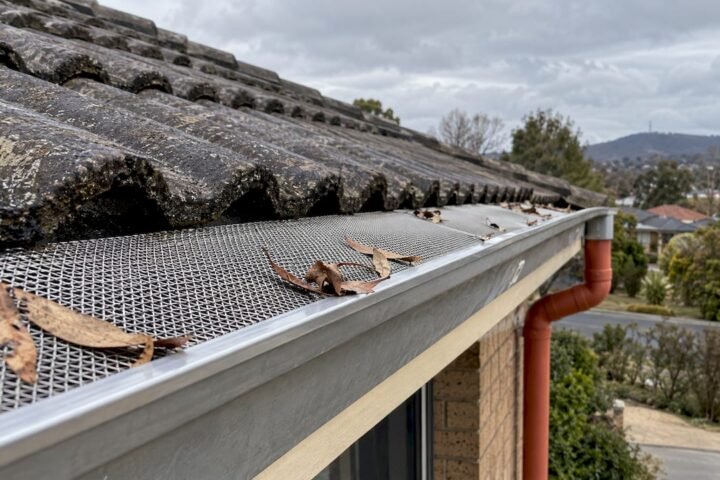
A bushfire gutter guard is a non-combustible metal mesh that covers the whole gutter, fixed tightly to the gutter line and roof, with openings small enough to stop embers reaching leaf litter. Australian guidance points to steel or aluminium mesh with an aperture under 2mm. It is one layer of protection, not a guarantee. This guide explains what to look for, how it connects to your Bushfire Attack Level (BAL), and how to keep it working.
TL;DR
- Embers, not the flame front, cause most house losses, and gutters full of dry leaves are an easy place for them to land.
- Look for non-combustible metal mesh covering the full gutter, with openings under 2mm, tightly fixed to the gutter and roof.
- Gutter guard works best alongside sealed roofing, ember-proofed gaps and a non-combustible fascia, not on its own.
- Mesh reduces the cleaning load but does not end it: debris and ash still collect, and you should check it before every fire season.
- Your BAL, set under AS 3959, decides what is required on new builds and major work. Retrofits are guided by the same principles.
Table of Contents
- Why gutters matter in a bushfire
- What makes a gutter guard “bushfire rated”
- How BAL ratings fit in
- What a gutter guard can and cannot do
- Other ember-protection measures to pair with it
- Installing and maintaining the guard
- Our perspective
- Getting a guard installed in Canberra
- Protect the whole roofline
- FAQ
- Sources
Why gutters matter in a bushfire
Most people picture a wall of flame reaching a house. The reality is quieter. The NSW Rural Fire Service states that 85% of houses are lost from ember attack, and that embers can land more than 100 metres ahead of the fire front. A house that looks well back from the bush can still be hit.
Gutters are a natural trap. Leaves, bark and twigs collect there through the year and dry out over summer. A single ember settling on that litter can start a small fire right at the edge of your roof, next to the eaves and fascia. That is the weak point a rated gutter guard is built to address.
The risk depends on what the gutter is attached to. CSIRO’s Bushfire Best Practice Guide explains that with a fully non-combustible roof and roof cavity, burning debris in a gutter is very unlikely to ignite the interior of the home. With combustible fascias or roof framing, gutter design and protection become very important. Many Canberra homes have timber fascias and older eaves, so this is worth checking on your own house.
What makes a gutter guard “bushfire rated”
There is no single sticker that makes a product bushfire proof. In practice, “bushfire rated” or “ember guard” mesh describes a guard built from non-combustible material with openings small enough to keep embers out. Guidance from several official bodies lines up on the main points.
Material: non-combustible metal
The NSW RFS recommends that gutter and valley leaf guards should be non-combustible and provided and installed in accordance with AS 3959. Its Building Best Practice Guide says the same: if leaf guards are installed, they shall be non-combustible. That rules out plastic, foam and brush-type inserts. Steel and aluminium mesh are the usual metal choices.
Opening size: under 2mm
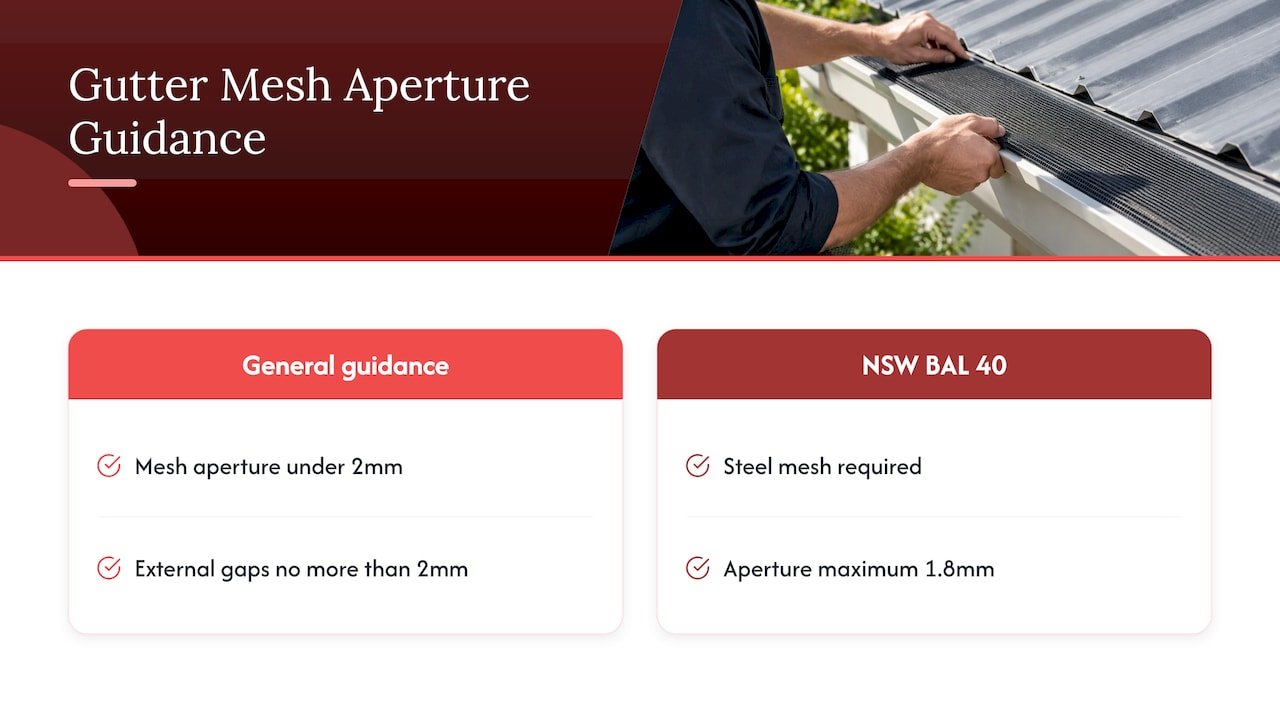
CSIRO notes that metal mesh with an aperture of less than 2mm, tightly fixed to the gutter line and roof, further reduces the chance of embers igniting fine debris. YourHome, the government’s design guide, advises that gaps at external openings should be no more than 2mm and that vents and weepholes should be protected with ember mesh under 2mm.
The NSW Government’s Bushfire Resilient Homes Toolkit (February 2025) is more specific for the highest rating. It states gutter guards should be made of steel mesh with a maximum 1.8mm aperture as part of reaching BAL 40. So the number to hold in your head is “under 2mm”, and for the strictest retrofit goals, 1.8mm or finer.
Coverage and fixing
CSIRO describes the aim as non-combustible gutters entirely covered with metal mesh. Gaps at the ends, along the roof edge or around downpipes defeat the purpose. A guard that lifts in wind or sits loosely on the gutter lip can let embers through at the edge. Tight fixing along the full run, including valleys, matters as much as the mesh itself.
What to check on any product
| Check | What to look for |
|---|---|
| Material | Non-combustible metal such as steel or aluminium, no plastic or foam parts |
| Aperture | Under 2mm; 1.8mm or less for steel mesh at BAL 40 retrofits |
| Coverage | Whole gutter run covered, including corners, valleys and ends |
| Fixing | Tight to the gutter line and roof, no lifting gaps |
| Gutter itself | Non-combustible gutter, in good repair |
| Roof and eaves | Sealed roofing and non-combustible fascia where possible |
How BAL ratings fit in
A Bushfire Attack Level measures the expected exposure of a building site to ember attack, radiant heat and flame contact. AS 3959:2018 applies to sites where the BAL has been determined as BAL-LOW, BAL-12.5, BAL-19, BAL-29, BAL-40 or BAL-FZ. The same preview notes that although there are no specific construction requirements at BAL-LOW, this does not imply buildings are not at risk.
Two practical points follow.
- Your BAL is set by the authority, not by the gutter guard. A guard supports the rating of the whole building. The NSW Toolkit says upgrading guttering must be combined with gutter guards, sealed roofing and a non-combustible eaves fascia to achieve a BAL 40 rating.
- Requirements differ by state and territory. Much of the published guidance comes from NSW agencies. Canberra homes should confirm the BAL assessment and any rules with the ACT’s planning and emergency services authorities, or a certified bushfire assessor, before relying on a general rule.
If you are building or doing major renovations in a bushfire-prone area, your certifier will tell you what your BAL requires. For an existing home, the standard’s principles are a sensible benchmark even where retrofitting is voluntary.
What a gutter guard can and cannot do
This is the part that is easy to skip and worth reading closely, because it is how you get the most from the guard.
CSIRO states that fully covered metal mesh helps limit debris build-up and the size of any fire that can occur in gutters. It also notes that a fire event brings new debris and embers that will at least partly refill gutters. In other words, the guard cuts the fuel load dramatically in the months before a fire, and the mesh keeps the largest part of the debris out, but a real fire day can still deposit material on top.
That is why the guard sits inside a wider plan. AS 3959:2018 itself says that although it is designed to improve building performance, there can be no guarantee a building will survive a bushfire on every occasion, given the unpredictable nature of fire and extreme weather. Treat the gutter guard as a strong, practical layer, and add the others.
Other ember-protection measures to pair with it
The NSW RFS lists gutter guards among many basic steps on its Prepare your home page. The same list includes:
- Cleaning gutters of leaves and twigs
- Repairing damaged or loose roof tiles
- Fitting fine metal mesh screens on windows and doors
- Fitting seals around doors and windows
- Enclosing the areas under the house
- Repairing gaps in external walls
- Attaching a fire sprinkler system to gutters
- Keeping lawns short
The technical guidance adds detail. The NASH Bushfire Design and Detailing guide (2023) says gaps of 2mm or more must be sealed with a non-combustible material or screened with corrosion-resistant ember guard with apertures under 2mm, and that roof and wall membranes must have a flammability index not greater than 5. The NSW RFS guide also says sarking with a flammability index of not more than 5 should go under existing roofing when it is replaced.
A sensible order for most owners: start with the gutters and roof edge, because that is where embers collect, then deal with vents, weepholes, gaps and subfloor openings.
Installing and maintaining the guard
Installation is a job for a trained installer. It means working at height along the whole roof edge, and the fixing quality decides whether embers can get under the mesh. The NSW RFS also warns that on two-storey homes, upper-storey gutters make debris removal harder, and that rushing gutter maintenance in hard-to-reach areas when a fire is imminent may cause accidents and injury. Do the work well before the season, not in the final hours.
A simple yearly routine
- Before the fire season: remove leaves, bark and twigs from the roof, valleys and gutters. The RFS says ongoing maintenance should include removing litter from the roof, valleys and gutters in advance of the bushfire season.
- Check the guard itself: CSIRO advises routinely checking the integrity of gutters and gutter shielding, and repairing or replacing damaged materials.
- Brush the top of the mesh: fine mesh stops debris getting in, but fine litter can settle on top. A soft brush from a safe position clears it.
- Look at the rest of the roof: loose tiles, rusted sections and gaps at the eaves.
- After storms and heavy leaf drop: repeat the check, especially under deciduous trees, which Canberra streets have plenty of.
CSIRO also advises routinely removing combustible material from rooftops, vents and gutters as general ongoing maintenance. Use a stable ladder with someone holding it, or hire a professional for steep or two-storey roofs.
Our perspective
We install metal gutter guards across Canberra, and we see the same thing on many homes: the gutter is the first place leaf litter piles up, and it sits right against the eaves. That is why we treat the gutter line as the place to start when an owner asks about bushfire protection.
Our view is simple. Choose non-combustible metal, cover the whole run, fix it tightly, and judge any mesh against the under-2mm guidance from the RFS, CSIRO and YourHome. Then keep the roof clean. A guard that is properly fitted by a licensed, insured technician takes a lot of the ladder work out of your year and removes the fuel before it dries out.
We are also a pest control company, so we look at the whole roofline. Birds nesting in gutters and leaf litter add fuel, and we handle bird proofing, solar panel bird proofing and rodent work alongside gutter guard installation. One visit can deal with the gutters and what lives around them.
navin
Getting a guard installed in Canberra
If you want a metal gutter guard fitted, our gutter guard installation service covers homes across Canberra. We also have suburb pages for Gungahlin, Kambah, Watson and others. For a plain-English look at how guards perform day to day, read our guide on whether gutter guards work, and our notes on the benefits of gutter guards in Canberra.
Before booking, have these ready: your BAL assessment if you have one, the gutter profile and material, whether your fascias are timber or non-combustible, and whether the roof is single or two storey.
Protect the whole roofline
Gutters are only part of the picture. Our team handles bird control and solar panel bird proofing, which keeps nesting material out of gutters and under panels, and our maintenance plans cover ongoing pest protection. Plans start at 29.98 AUD per month for Bronze General Pest or Bronze Termite, with Silver Combined at 55.98 AUD per month and Gold Complete at 79.98 AUD per month.

To discuss gutter guard or any other roofline job, get in touch with BugsPatrol. We offer fast response and same-day emergency service.
FAQ
Is a gutter guard enough to make my house bushfire-safe?
No. It is one useful layer. AS 3959:2018 states there can be no guarantee any building will survive a bushfire. Pair the guard with a sealed roof, ember-proofed gaps and vents, and regular clearing of leaf litter.
What mesh size should a bushfire gutter guard have?
Australian guidance points to non-combustible metal mesh with openings under 2mm. The NSW Government’s toolkit gives a maximum 1.8mm aperture for steel mesh when working towards BAL 40. Check the specification of any product against these figures.
Do I need a bushfire-rated guard if my property is BAL-LOW?
AS 3959 sets no specific construction requirements at BAL-LOW, but it states this does not mean buildings are not at risk. Many owners still choose non-combustible mesh because embers can travel over 100 metres ahead of a fire front.
How often should I clean gutters with a guard fitted?
Check them at least before every bushfire season and after storms or heavy leaf drop. CSIRO advises routinely removing combustible material from roofs and gutters and checking the guard for damage. Fine litter can settle on top of mesh, so a gentle brush-off helps.
Sources
- What you need to know, NSW Rural Fire Service (building on bush fire prone land)
- What you need to know, NSW Rural Fire Service (building in a bush fire area)
- Roofs, Bushfire best practice guide, CSIRO
- Ongoing maintenance, Bushfire best practice guide, CSIRO
- Your bushfire resilient home: a toolkit for residents, NSW Government
- Bushfire protection, YourHome
- Building Best Practice Guide, NSW Rural Fire Service
- Bushfire Design and Detailing, NASH
- Prepare your home, NSW Rural Fire Service
- AS 3959:2018 preview, Standards Australia Store
- AS 3959:2018 Construction of buildings in bushfire-prone areas