Mildew is a type of mould. The two words describe the same family of fungi, and in practice “mildew” usually means the flat, surface-level growth you find on a shower wall or window frame, while “mould” is used for growth that is deeper, darker or spreading through a material. The US EPA puts it the same way: mildew refers to certain kinds of mould that tend to grow in a flat habit. For a Canberra homeowner, the useful question is not which name applies. It is whether the growth sits on the surface and wipes off, or whether it has got into the material and points to a moisture problem you need to fix.
TL;DR
- Mildew is a kind of mould. The word usually describes flat, surface growth, often white, grey or yellow, that wipes away.
- Mould more often goes deeper into porous materials such as plasterboard, timber and carpet, and comes in darker colours.
- Colour alone cannot tell you the species or how harmful it is. Australian health guidance says to focus on moisture and on the extent of the growth.
- Both are caused by excess moisture, so cleaning without fixing the leak, condensation or ventilation problem means they come back.
- Hidden mould, a musty smell with no visible source, or health symptoms are reasons to call a professional.
Table of Contents
- The short answer: is mildew mould?
- Mould vs mildew side by side
- How to tell what you are looking at
- Black mould vs mildew: does colour mean danger?
- Which is worse for your health?
- What actually kills mould and mildew?
- When to stop wiping and call a professional
- Preventing both: control the moisture
- Perspective
- Have a damp problem or recurring growth?
- FAQ
- Sources
The short answer: is mildew mould?
Yes. Mould is a group of fungi that grows in moist places and releases tiny spores into the air. The SafeWork NSW guidance describes mould (also called fungi or mildew) as an organism from the fungi kingdom that feeds on organic material, and lists the places it grows: wood, paint, walls, fabric, ceilings, bathroom tiles, carpets, insulation and around windows and pipes.
So why do two words exist? Everyday usage has split them. RACV explains that mildew typically forms on the surface of materials in wet areas, is less invasive and can often be wiped away, while mould tends to permeate and spread through porous materials. That is a handy rule of thumb for homeowners, even though a scientist would call both mould.
There is one more wrinkle. Outside the house, “mildew” is also the name gardeners use for powdery or downy growths on living plants. That is a plant disease, not the bathroom problem this article covers, and it is a different matter from what you find on your walls.
Mould vs mildew side by side
Use this table as a first look. It describes typical patterns, not a diagnosis.
| Feature | Mildew (typical) | Mould (typical) |
|---|---|---|
| Growth habit | Flat, on the surface | Fuzzy, raised or spreading into the material |
| Common colours | White, grey, yellow | Black, green, blue, brown, orange, or white |
| Texture | Powdery or downy | Fuzzy, slimy or patchy |
| Where it appears | Shower tiles, grout, window sills, bathroom walls | Ceilings, walls, behind furniture, carpet, timber, wardrobes |
| Does it wipe off? | Often yes | Often leaves staining or returns because roots are in the material |
| What it signals | Humidity or condensation | Longer-term dampness, a leak or poor ventilation |
The colour guidance matches the RACV description: mildew is usually pale in its early stages, mould usually darker. The enHealth guidance adds an important caveat: common moulds are black, green or white, but they can also be grey, orange or brown. White growth can be mould, and dark growth can be early.
How to tell what you are looking at
Three quick checks give you a working answer.
1. Look at the texture and the pattern
A thin, powdery or slightly fluffy film lying on top of tile, grout or a painted sill usually fits the mildew description. Fuzzy clusters, dark blotches that keep spreading, or paint that bubbles and plasterboard that feels soft point to growth that has got into the material.
2. Try a wipe
Wipe a small patch with a cloth and household detergent. The enHealth guidance says household detergent or white vinegar is usually enough to clean mould on hard surfaces. If the patch lifts and stays gone for weeks, you most likely had a surface problem. If it leaves a stain, returns within days or sits on a porous surface like plasterboard, treat it as the deeper kind.
3. Think about where and why
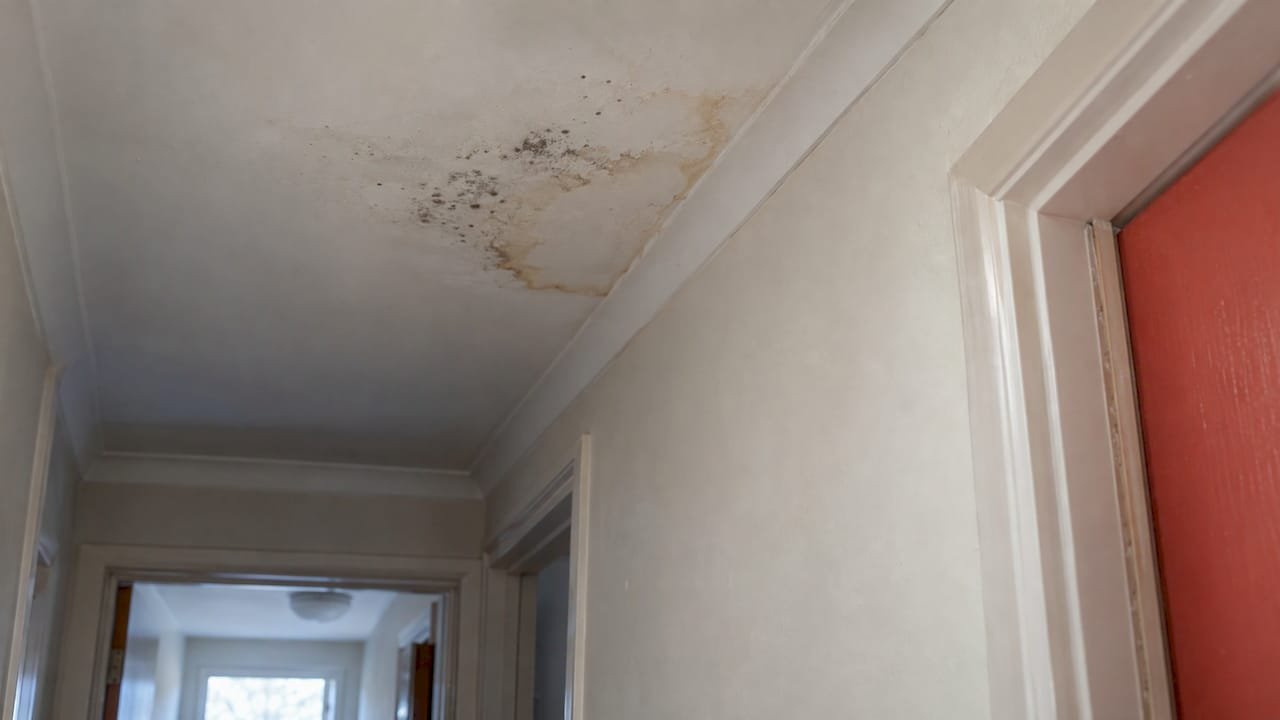
Location tells you more than colour. Mildew-like growth in a bathroom after hot showers points to humidity. Growth on an external-facing bedroom wall points to condensation or a cold surface. A patch on a ceiling below the roof or under a bathroom points to a leak. If you want a closer look at ceiling patches specifically, our guide to the 1 square metre rule for ceiling mould explains how to judge size and what to do next.
Black mould vs mildew: does colour mean danger?
Searches for “black mould vs mildew” usually come from worry: is the black stuff the dangerous one? The honest answer is that colour is not a safe guide.
ABC News reported in 2026 that a Brisbane water damage technician said the colour of mould cannot tell you how harmful it is or what species it is, and that identifying it with certainty needs a lab. The same report notes that Stachybotrys chartarum, often called black mould, has a reputation as particularly toxic, but other species can also release mycotoxins.
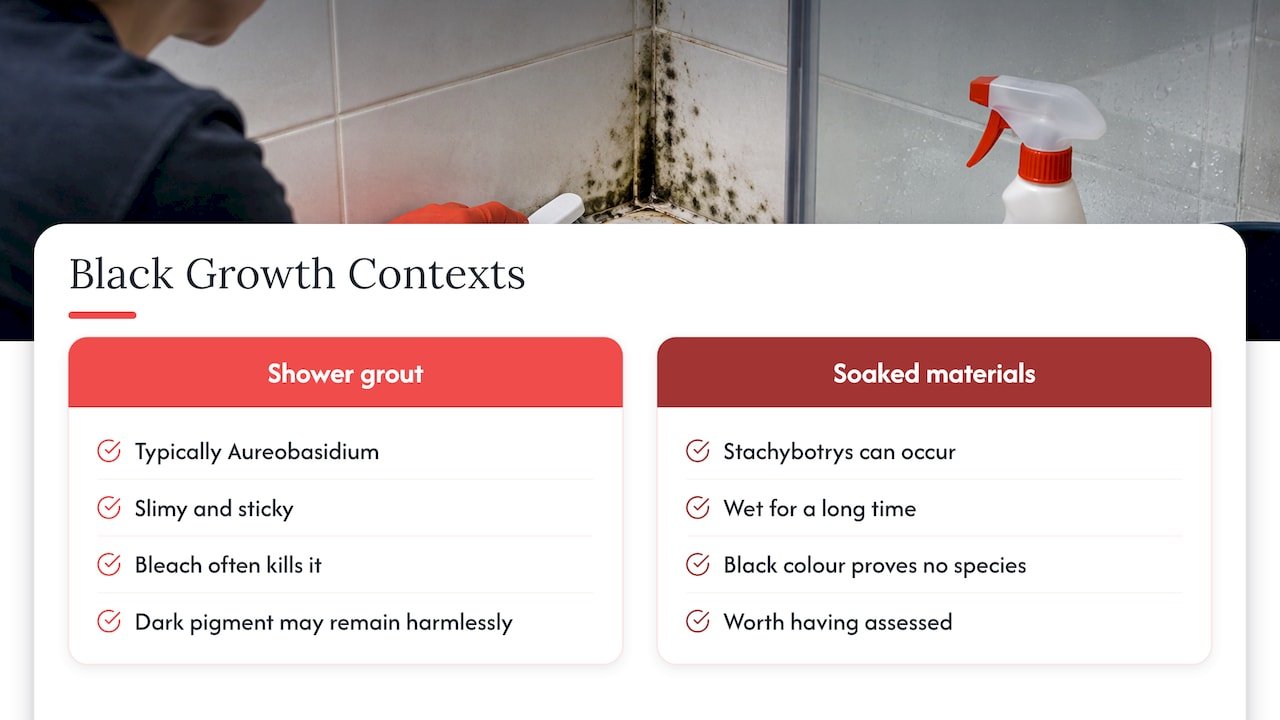
The other side of the story is equally useful. An earlier ABC explainer points out that the black staining in shower grout is typically a different fungus, Aureobasidium, which is slimy and sticky. Bleach often kills it, though the dark pigment may remain harmlessly. By contrast, Stachybotrys is the species that turns up on building materials that have been wet for a long time.
Practical takeaway: black grout in a shower is probably a cleaning job. Black growth on a ceiling, behind a wall lining or on materials that have been soaked is a sign of a longer moisture problem and is worth having assessed.
Which is worse for your health?
Neither word gives you a reliable ranking. What Australian health bodies say is more useful:
- The ACT Government says there are hundreds of thousands of mould species and most are not hazardous. It also says there is no exposure limit or health guideline value for mould.
- Exposure to indoor mould and dampness is associated with nasal congestion, sneezing, coughing, wheezing and respiratory infections, and can worsen asthma and allergic conditions, according to enHealth.
- NSW Health notes that most people have no problems from contact with mould, because everyone breathes in spores. For people with asthma, inhaling spores may trigger an attack.
- The WA Department of Health lists children, pregnant people and those with weakened immune systems, atopy or respiratory disease as more vulnerable.
- In serious cases, prolonged exposure can lead to illnesses such as hypersensitivity pneumonitis, according to the Australian Centre for Disease Control.
If anyone in your home has asthma, allergies, a weakened immune system, or is a baby or pregnant, treat any mould patch promptly and speak to your GP about symptoms. We cover the details in our guide to mould health risks and who is vulnerable.
NSW Health also says symptoms alone are not a reliable indicator of mould, because they are diverse and non-specific. The surfaces in the home need to be inspected to see how far the growth extends.
What actually kills mould and mildew?
For small patches on hard surfaces, you do not need harsh chemicals. The enHealth guidance says household detergent or white vinegar is usually sufficient. A few habits make the clean-up work properly:
- Fix or switch off the moisture source first. A leaking pipe will outlast any amount of scrubbing.
- Open windows and run the exhaust fan while you clean.
- Wipe hard surfaces with detergent or vinegar, then dry them fully.
- Throw away or professionally clean soft items that stay mouldy, such as saturated carpet or ceiling tiles.
- Re-check the area over the next few weeks.
Bleach is the product most people reach for, and it has limits on porous surfaces. Our comparison of vinegar vs bleach for mould in Australian homes goes through where each one makes sense.
Does mildew eventually turn into mould? Not in the sense of one species changing into another. What happens is that a surface film left in a damp place keeps growing and can work into the material, at which point it behaves like the deeper mould described above. Cleaning early prevents that.
When to stop wiping and call a professional
Some situations are beyond a cloth and a bottle of vinegar:
- You can smell it but cannot see it. The WA Department of Health advises consulting a professional if you suspect hidden mould, for example a persistent musty smell with no visible source, or if you are concerned about health symptoms.
- The patch is large or keeps returning. Growth that comes back within days of cleaning usually means moisture is still getting in.
- It is on ceilings, inside wall linings or under flooring. These are porous materials where growth runs below the surface.
- There has been a flood, roof leak or burst pipe. Materials that stay wet for a long time are where the heavier growth appears.
- Someone in the home is vulnerable. See the health section above.
NSW Health says that if you think you have mould but cannot find the source, you could employ an occupational hygienist. For treatment and moisture-related pest issues around the house, a licensed pest and property protection company can inspect and treat the affected areas.
After remediation, it is worth confirming the job is done. WA Health guidance describes post-remediation verification, sometimes called clearance testing, as an important final step to confirm a building has returned to a normal mould ecology before people move back in. If you want to understand what that step proves, this explanation of post-remediation mould testing is a good place to start.
Preventing both: control the moisture
Because mould and mildew both depend on moisture, prevention is the same for both. RACV lists the usual causes as poor ventilation, condensation, water leaks (including hidden ones), rising damp, and plumbing or roofing problems. Australian guidance from NSW Health focuses on fixing building faults such as leaking pipes and roofs, improving ventilation with exhaust fans, and reducing humidity by opening windows and limiting indoor plants.
In Canberra, a few things stand out:
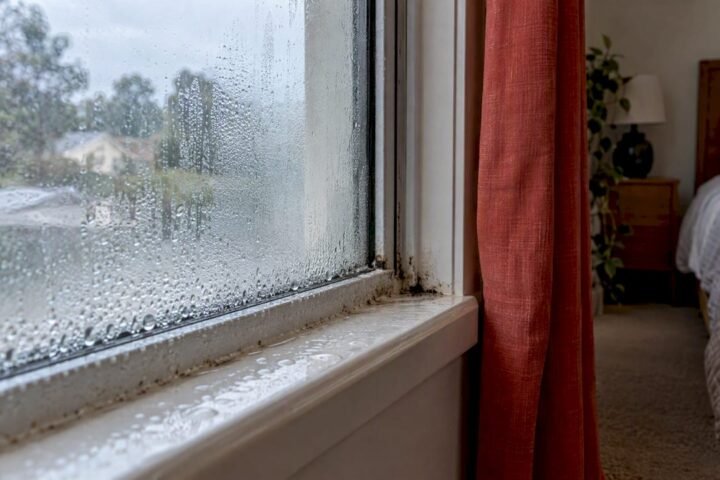
- Cold winters and condensation. Frosty nights make window glass, frames and external walls cold, so warm indoor air condenses on them. Wiping the water off helps, but ventilation is the real fix. Our article on why wiping alone won’t stop window mould walks through it.
- Blocked gutters and roof drainage. Overflowing gutters can push water into eaves and ceilings. NSW Health lists repairing roofs and blocked gutters as part of prevention, and gutter guard installation helps keep debris out of the system.
- Bathrooms and laundries. Run the fan during and for a while after showers, and leave the door ajar so steam does not drift into bedrooms.
- Wardrobes and closed spaces. Stale, humid air in a wardrobe grows mildew-like patches and also attracts other pests. Our guide on fixing wardrobe humidity to stop silverfish shows how one fix helps with both.
- Furniture pushed against external walls. Leave a gap so air can move behind it.
Damp conditions also invite unwanted visitors. Moisture-damaged timber is something to have checked for termites and borers, which is why we often look at both problems in the same visit.
Perspective
In our work across Canberra homes, the mould and mildew question rarely turns out to be about the word on the patch. It is about why the surface was damp in the first place. We see the same pattern again and again: a homeowner cleans the visible growth, it returns in a few weeks, and the real cause turns out to be a blocked gutter, a slow leak, a poorly ventilated bathroom or a cold external wall.
That is why we approach it as property protection, not just surface cleaning. Moisture that feeds mould and mildew also creates the conditions that attract termites, silverfish and other pests, so a proper look at the whole property saves time and repeat visits. Our licensed technicians use modern detection methods, including thermal imaging for termite inspections, and we focus on effective, responsible treatments for families, children and pets.
Our advice is simple. Wipe small surface patches early, fix the moisture source, and bring in a professional as soon as the growth is large, hidden or recurring. Acting early is almost always cheaper and safer than waiting for the damage to spread.
navin
Have a damp problem or recurring growth?
If mould or mildew keeps coming back, or you are worried about what damp is doing to your roof space, timber or subfloor, we can help. BugsPatrol has serviced 5,000+ Canberra homes, and our team deals with mould treatment alongside pest control, termite inspections, gutter guards and emergency call-outs. Our technicians are licensed and insured, and our treatments are guaranteed for effectiveness.

For ongoing protection, our maintenance plans start at $29.98 per month for Bronze General Pest or Bronze Termite, with Silver Combined at $55.98 per month and Gold Complete at $79.98 per month. To book an inspection or ask about a damp area, visit BugsPatrol.
FAQ
What is worse, mould or mildew?
Mould is generally the bigger concern because it tends to go deeper into materials and often signals a longer-running moisture problem. That said, health bodies say there is no exposure limit for mould and that effects depend on the person, so any indoor growth is worth cleaning or treating, especially if someone has asthma or allergies.
How do I tell if I have mould or mildew?
Look at the pattern and the surface. Flat, powdery, pale growth on tiles or sills that wipes away is usually described as mildew. Dark, fuzzy or spreading growth on ceilings, walls or fabric, or growth that stains and returns, is usually described as mould. Colour alone cannot confirm the species, so judge by how deep it goes and why it is there.
What kills mould and mildew on household surfaces?
According to enHealth guidance, household detergent or white vinegar is usually enough for hard surfaces. Dry the area completely afterwards and fix the moisture cause. For large areas, ceilings, wall linings or hidden growth, ask a professional rather than trying to treat it yourself.
Is black mould always toxic?
No. The black staining in shower grout is often a different fungus from the species known as toxic black mould, according to ABC reporting. But because colour cannot identify a species, black growth on ceilings or water-damaged materials should be taken seriously and assessed if it is more than a small patch.
Can I stay in a home with mould?
For small, cleaned patches, usually yes, while you fix the moisture source. If the growth is extensive, if you have hidden mould, or if someone in the home has asthma, allergies, a weakened immune system or is pregnant, speak to your GP and get the property assessed promptly.
Sources
- Mould or mildew: what’s the difference? (RACV)
- What is the difference between mold and mildew? (US EPA)
- Mould at work (SafeWork NSW)
- enHealth guidance: potential health effects of mould in the environment
- Five ways to prevent mould in your home (ABC News, 2026)
- What do the different colours of mould in my house mean? (ABC News, 2023)
- Mould (ACT Government)
- Mould (NSW Health)
- Indoor Mould: Health Risk Assessment and Management (WA Department of Health)
- Preventing mould exposure (Australian Centre for Disease Control)
Recommended
- Vinegar vs Bleach for Mould: What Works in Australian Homes
- Mould Health Risks: Symptoms, Who’s Vulnerable and What to Do
- Wiping Alone Won’t Stop Window Mould in Australia
- 1 Square Metre Rule for Ceiling Mould in Australian Homes