Brush and foam guards are the two cheap, drop-in options for gutters. Foam blocks leaves well but clogs with fine grit and seed. Brush lets fine debris through but traps leaves and twigs in the bristles. Neither is a fit-and-forget answer for a Canberra street of eucalypts, liquidambars and ornamental pears, which is why many homeowners end up with a fixed aluminium or metal guard installed once. We install those across Canberra, and this guide shows you how the three compare so you can choose with the numbers in front of you.
TL;DR
- Foam inserts stop leaves but hold fine debris and moisture, so they clog and break down under sun. Expect roughly 3 to 5 years.
- Brush inserts let fine debris wash through, but leaves and twigs lodge in the bristles and the brush has to be pulled out and cleaned.
- Typical Australian cost is about $10 to $20 per metre for brush or foam, and you pay it again at each replacement.
- Foam and brush are combustible. If your home has a mapped Bushfire Attack Level, only non-combustible guards such as aluminium or steel are appropriate.
- A fixed metal guard fitted by a professional is the long-term answer. Gutter guard installation in Canberra is what we do.
Table of Contents
- How each guard works
- Foam vs brush: the head-to-head comparison
- Where foam falls short
- Where brush falls short
- What they really cost over ten years
- Bushfire rules and the combustibility question
- How to choose for your own roof
- Why a fixed metal guard is the better answer
- Our view
- Getting it done
- FAQ
- Sources
How each guard works
Foam guards
A foam guard is a strip of porous foam cut to the width of your gutter. You push it in so it fills the channel from the front edge to the back. Water soaks through the foam and drops into the gutter, while leaves and larger debris sit on top. Because it fits by pressing it in, it is the guard most people buy from a hardware store and fit themselves.
Brush guards
A brush guard looks like a long bottle brush, with stiff bristles radiating from a central wire core. It is laid along the gutter. Water runs between the bristles, and leaves are meant to rest on top of them. Brush guards are sold in lengths of about a metre, and they can be bent and snipped to go round corners and downpipe outlets.
Both are inserts: they sit inside the gutter rather than covering it. That matters, because anything that lands in the gutter lands on or in the guard, and the guard itself becomes the thing you have to maintain.
Foam vs brush: the head-to-head comparison
The figures below come from Australian cost and performance guides. They are typical ranges, not quotes, and prices vary with gutter length, access and region.
| Factor | Foam | Brush |
|---|---|---|
| Leaf protection | Good | Moderate |
| Fine debris (grit, pollen, seed) | Trapped inside the foam | Passes through into the gutter |
| Water flow | Reduced when dirty | Good in heavy rain |
| Typical cost | $8 to $15 per metre installed | $10 to $20 per metre installed |
| Typical lifespan | 3 to 5 years | 5 to 8 years |
| Upkeep | Replace when it breaks down | Pull out and clean, about yearly |
| Fire behaviour | Combustible | Combustible |
The cost and lifespan ranges are from an Australian gutter guard comparison, and a separate cost guide puts brush or foam at $10 to $20 per linear metre. They are consistent enough to plan around.
Where foam falls short
Foam does its job on leaves. The trouble is everything smaller than a leaf. Sand, dust, pollen and seed work into the pores of the foam, and when it is dirty, water flow drops. Seeds then germinate in the damp foam, and organic matter decomposes inside it. Sunlight is hard on it too: Australian UV breaks down most foam within a few years, which is why the 3 to 5 year lifespan is the figure you see repeated.
That is a particular issue in Canberra, where we get hard frosts, hot dry summers and heavy leaf and blossom drops in autumn and spring. A foam strip that is soaked, frozen, baked and then soaked again has a hard life.
One gutter cleaning company notes that foam guards trap debris and can block faster than open gutters in most Australian conditions. You do not need to take that as a universal rule to see the pattern: a guard that holds fine debris in its body has to be replaced rather than cleaned.
The pest angle
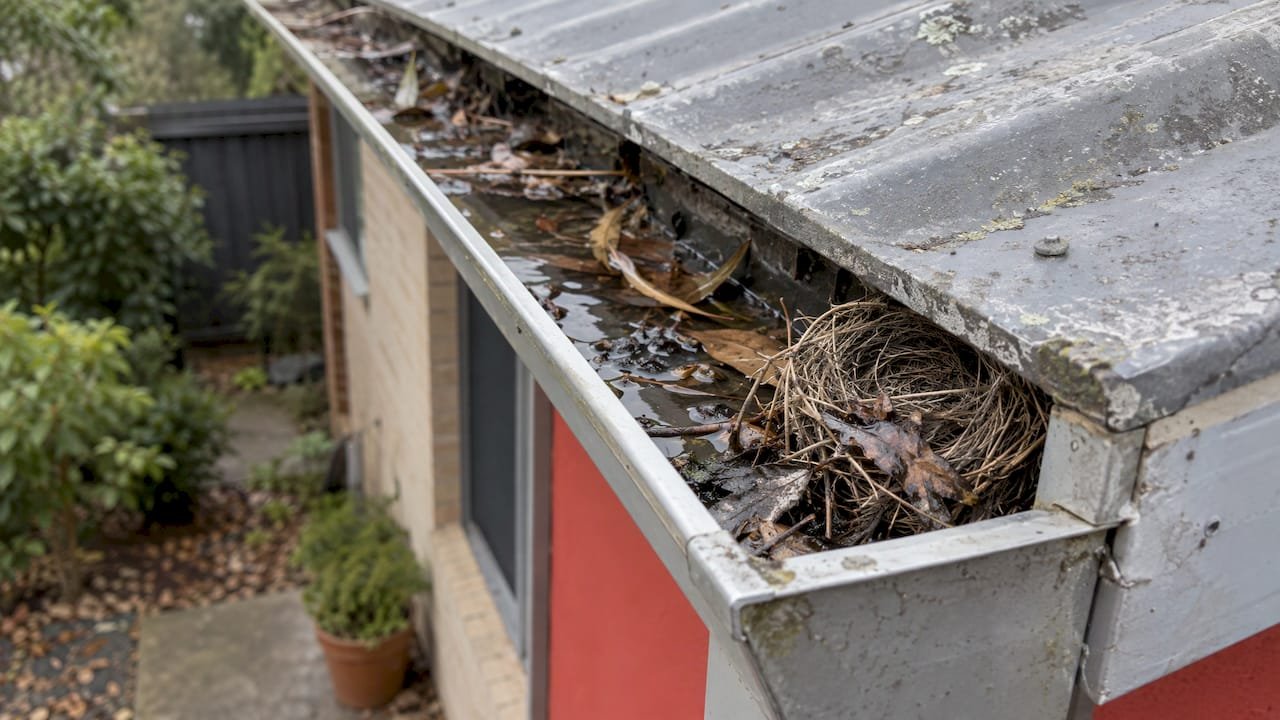
A blocked gutter holds standing water and rotting leaf litter. That is the kind of damp, sheltered spot that attracts mosquitoes, and gives rodents and cockroaches an easy route along the roofline. It is also where birds nest. Gutters are part of how a house stays pest-free, which is why a pest control company installs guards in the first place.
Where brush falls short
Brush guards avoid the fine debris problem, because grit and pollen wash through the bristles. The cost is that leaf litter and twigs lodge between the bristles, and the debris that gets through ends up in the gutter beneath. Over time the bristles flatten and compress, and sun degrades them.
The practical consequence is the yearly routine. A brush has to be lifted out, shaken or washed, and put back. If you have a two-storey home, a long run of gutter or a tight roof pitch, that is a job on a ladder every year. The same cleaning source says brush guards can be harder to clean than an unguarded gutter because debris sits in the bristles.
What they really cost over ten years
The sticker price per metre is the smaller number. The bigger one is what you pay across a decade.
Take a home with 50 metres of gutter. At the quoted ranges:
- Foam at $8 to $15 per metre is about $400 to $750 to install. With a 3 to 5 year life, you replace it two or three times in ten years. One Australian comparison puts the ten-year total for foam at $1,600 to $1,950 for a home of this size.
- Brush at $10 to $20 per metre is about $500 to $1,000 to install, plus yearly cleaning and probably one replacement. The same comparison arrives at $2,000 to $2,500 over ten years.
These are Perth figures, so treat them as a guide to the shape of the cost, not a Canberra quote. The pattern is what carries over: a cheap guard that is replaced or cleaned repeatedly costs far more than its first price suggests.
Compare that with a fixed metal guard, which is a one-off installation. You are not paying for a replacement cycle, and there is nothing to pull out and wash each year. For a ten-year view, we think that is the most sensible spend. For details on materials, our guide to stainless versus plastic gutter guards shows how the choices hold up in Australian conditions.
Bushfire rules and the combustibility question
This is the part of the foam vs brush decision that should settle it for many properties.
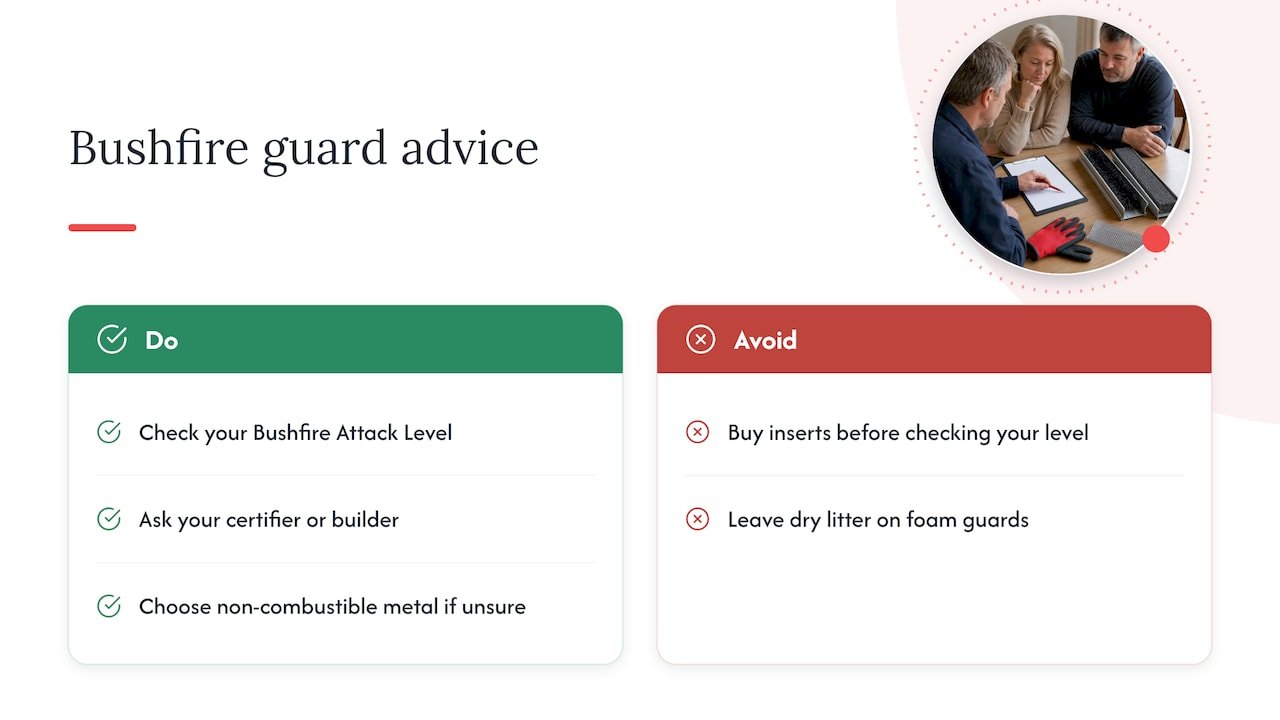
Foam and brush guards are made of plastics and foam, and they burn. Under the Australian Standard for construction in bushfire-prone areas, AS 3959, homes built to a Bushfire Attack Level generally need non-combustible gutter or valley guards. In practice that means metal: aluminium, steel or similar.
Canberra has a lot of suburbs backing onto reserves, grassland and bush, and ACT bushfire-prone mapping affects many of them. If your home is on the fringe of a nature reserve, or you are building or renovating, check your Bushfire Attack Level with your certifier or builder before you buy any insert. If you are in doubt, a non-combustible metal guard avoids the question entirely.
Even where the standard does not apply to you, a dry plastic or foam guard full of dry leaf litter is the last thing you want along your roofline in January.
How to choose for your own roof
Work through these five points in order.
- Check your bushfire status. If your property has a Bushfire Attack Level, foam and brush are out. Go to metal.
- Look at your trees. Eucalypts shed bark, twigs and gumnuts, which lodge in brush. Deciduous trees such as ornamental pears and liquidambars drop masses of leaves in autumn, which foam handles but clogs on. Wattles and blossoms shed fine material that clogs foam.
- Be honest about maintenance. Are you going to pull out brush every year, or replace foam every few years? If the answer is no, an insert will fail you.
- Think about your roof and gutter. Steep pitches, long runs and second storeys make DIY fitting and maintenance harder. Different gutter profiles (quad, half-round, box) take different guards, so measure before buying anything.
- Add up ten years. Use the cost table above to compare. Replacement cycles and cleaning are the real expense.
If you are a landlord, property manager or agent, a guard that does not need yearly attention is also easier to manage. Fewer call-outs, no tenants asked to climb ladders, and a roofline that looks tidy at inspection.
Why a fixed metal guard is the better answer
Foam and brush both solve the problem partly and then hand you a new chore. A fixed metal guard is made to sit over the gutter, so leaves ride off or sit on top rather than falling in, and the material does not break down in sun or burn.
We install aluminium and metal guards across Canberra, and our team covers suburbs such as Gungahlin, Kingston and Watson. You can see our aluminium gutter guard installation page for the metal option in detail.
It is also worth saying that no guard removes the need to look at your roofline. Fine debris, such as ash, pollen and seed, can still build on top of any guard over time, so a periodic check is sensible with every type.
Our view
We are a pest control company, and we put gutter guards in for a pest control reason. A gutter full of wet leaf litter is a home for mosquitoes, a runway for rodents and a nesting spot for birds. When we look at the foam and brush inserts people fit themselves, the pattern is the same: a few good seasons, then a guard that needs replacing or pulling out.
Our technicians are licensed and insured, and we have serviced more than 5,000 Canberra homes over 10+ years. That experience is why we recommend a fixed metal guard installed properly the first time. You deal with the gutter once, and you stop paying for a cycle of replacements.
The same goes for the rest of your roofline. Gutter guards, bird proofing and solar panel bird proofing are all about keeping the things you do not want out of the places you cannot easily reach. We would rather do that once, and do it properly.
navin
Getting it done
If you would like a metal guard fitted on your gutters, our gutter guard installation service covers Canberra and surrounding suburbs. Our technicians are licensed and insured, and all our treatments are guaranteed for effectiveness.

If you are already dealing with pests around the roofline, such as birds nesting in or near gutters or rodents using them as a pathway, we can look at that at the same time. See our bird control services, or our rodent removal service. For ongoing protection of the whole property, we offer maintenance plans from $29.98 per month on our subscriptions page.
FAQ
Is a brush or foam gutter guard better?
Neither wins outright. Foam keeps out leaves well but traps fine debris and breaks down in sun within a few years. Brush lets fine debris through and flows well in heavy rain, but needs pulling out and cleaning about yearly. If you want something you do not have to maintain, a fixed metal guard is the better long-term choice.
How long do foam and brush gutter guards last?
Australian cost guides put foam at about 3 to 5 years and brush at about 5 to 8 years. Sun exposure, tree type and how often you clean them all change that. Budget for replacement in your ten-year costs.
Can I use foam or brush guards in a bushfire-prone area?
Under AS 3959, homes built to a Bushfire Attack Level generally need non-combustible gutter or valley guards. Foam and brush are combustible, so they do not suit those properties. Check your property’s Bushfire Attack Level with your certifier or builder, and choose a metal guard if it applies.
Do gutter guards stop pests?
A guard reduces the leaf litter and standing water that attract mosquitoes, rodents and nesting birds, so it makes the roofline less appealing. It is one part of pest prevention, alongside regular inspections of the roof and surrounds. Our technicians can look at both in one visit.
Sources
- Gutter Guard Comparison: Mesh vs Foam vs Brush
- Gutter Cleaning Cost in Australia: 2026 Price Guide
- Gutter Guard vs Gutter Cleaning: Which Saves You More Money?
Recommended
- Canberra Gutter Guards: What They Stop and What They Don’t
- Stainless vs Plastic Gutter Guards: What Lasts in Australia
- Gutter Guard Installation
- Bushfire Gutter Guard in Australia: What Rated Mesh Is