An annual pest control plan is a standing arrangement with a licensed provider. It covers scheduled treatments and inspections across 12 months, so pests are dealt with before they become an emergency. For most Canberra homes, the right plan combines a general pest treatment with a termite inspection at least every 12 months. Higher-risk properties add more frequent visits. Our plans start at $29.98 per month, and this guide explains what to look for, how to choose between one visit and several, and how to get the most from the plan you pick.
TL;DR
- An annual plan bundles scheduled treatments, inspections and priority service into one predictable payment, instead of paying for call-outs one at a time.
- A termite inspection at least every 12 months is the baseline in official Australian guidance, and more often for properties near trees or bush.
- One general treatment a year suits many homes. Properties with past infestations, gardens backing onto bushland, or food handling usually need more visits.
- Our Canberra plans run from $29.98 per month (Bronze) to $79.98 per month (Gold Complete).
- Spring is the best time to start, because pest activity builds weeks before most households notice it.
Table of Contents
- What an annual pest control plan actually is
- What should be in a plan
- One visit a year or more? How annual compares with quarterly
- When to start: why spring beats summer
- What it costs: Canberra plan prices
- The termite question
- Keeping the plan working between visits
- Safety for children, pets and the environment
- Other services a plan can sit alongside
- Choosing your plan
- FAQ
- Sources
What an annual pest control plan actually is
There are two common ways to buy pest control. You can call someone when you see a problem, or you can set up a plan that keeps problems from getting started. An annual plan is the second option. You agree a scope with the provider (which pests, which areas, how many visits), and the work happens on a schedule across the year.
The benefit is practical. Pests such as termites are hidden by nature, so waiting until you see them usually means waiting until damage has started. A plan puts a technician on your property at regular intervals whether or not you have noticed anything.
Plans come in two broad forms:
- A single prepaid annual service. One treatment and inspection per year, paid up front or spread across the year.
- A subscription. A monthly payment that covers a set package of visits and services over 12 months.
We offer the subscription form for Canberra homes and businesses, which spreads the cost into a small monthly amount.
What should be in a plan
A good plan states, in writing, what you are getting. Food safety guidance is a useful checklist even for homes, because it is written for people who must prove their pest control works. Food Standards Australia New Zealand says a pest management plan should set out which pests are being treated, which areas are inspected and treated, the types of treatment used (baits, sprays, traps and so on), where pest control devices and pesticide storage sit, and how often inspections and treatments happen.
Translated for a home, ask for these items:
- Target pests. Ants, cockroaches, spiders, rodents, termites, wasps and so on. A plan that says “general pests” should list them.
- Areas covered. Interior, roof void, subfloor, garden, outbuildings.
- Visit schedule. How many visits, and roughly when.
- Treatment methods. Baits, sprays, traps, barriers, and how they are applied around children and pets.
- Termite inspection. Whether it is included, what technology is used and whether you receive a written report.
- Call-out terms. What happens if pests return between visits, and how quickly someone attends.
- Guarantee. What is guaranteed and for how long.
Our treatments are guaranteed for effectiveness, and our technicians are licensed and insured. For the exact inclusions of each plan, see our subscription plans page.
One visit a year or more? How annual compares with quarterly
This is the question that decides most plan choices. The honest answer is that frequency should follow risk, not habit.
One general treatment a year is a sensible baseline for a typical home with no history of infestation. It deals with the pests that build up over a season and gives a technician a regular look at the property.
Quarterly or six-monthly visits make sense when something raises the risk:
- A past infestation of cockroaches, rodents or bed bugs.
- A garden that backs onto bushland, a creek, or mature trees.
- Food preparation, childcare, aged care or hospitality use.
- Multi-unit buildings, where a pest in one unit can reach others.
- Pet or child households that want activity caught at the earliest point.
The logic mirrors official termite guidance. The Queensland Building and Construction Commission recommends termite inspections at least every 12 months, and more often in high-risk areas such as properties near trees or bush. That is the same principle: a minimum interval, with extra visits as exposure goes up.
| Situation | Suggested rhythm | Why |
|---|---|---|
| Typical suburban home, no pest history | One general treatment a year, plus a termite inspection every 12 months | Catches seasonal build-up and hidden termite activity |
| Home near bush, creek or large trees | General treatment plus termite inspections more often than yearly | Higher exposure to termites and rodents |
| Home with a past infestation | More frequent follow-up visits for the first year | Confirms the problem has not returned |
| Café, restaurant or food business | Scheduled visits with written records | Food safety guidance expects documented inspection frequency |
| Investment property | Annual treatment and inspection report | Keeps a record for tenants, managers and future buyers |
If you are unsure, a technician can look at your property and recommend a frequency. Our general pest control service is the usual starting point.
When to start: why spring beats summer
Most people think of summer as pest season. The data points earlier. A decade-long analysis of Sydney pest records by Pest2Kill, reported by Starts at 60, found that household bookings rose 136 per cent between August and November. Spider enquiries rose 5.5 times over the same period, and 30 per cent of the year’s termite enquiries landed between September and November as swarming season began. The same report says pest pressure builds across several species at once, weeks before most households notice.
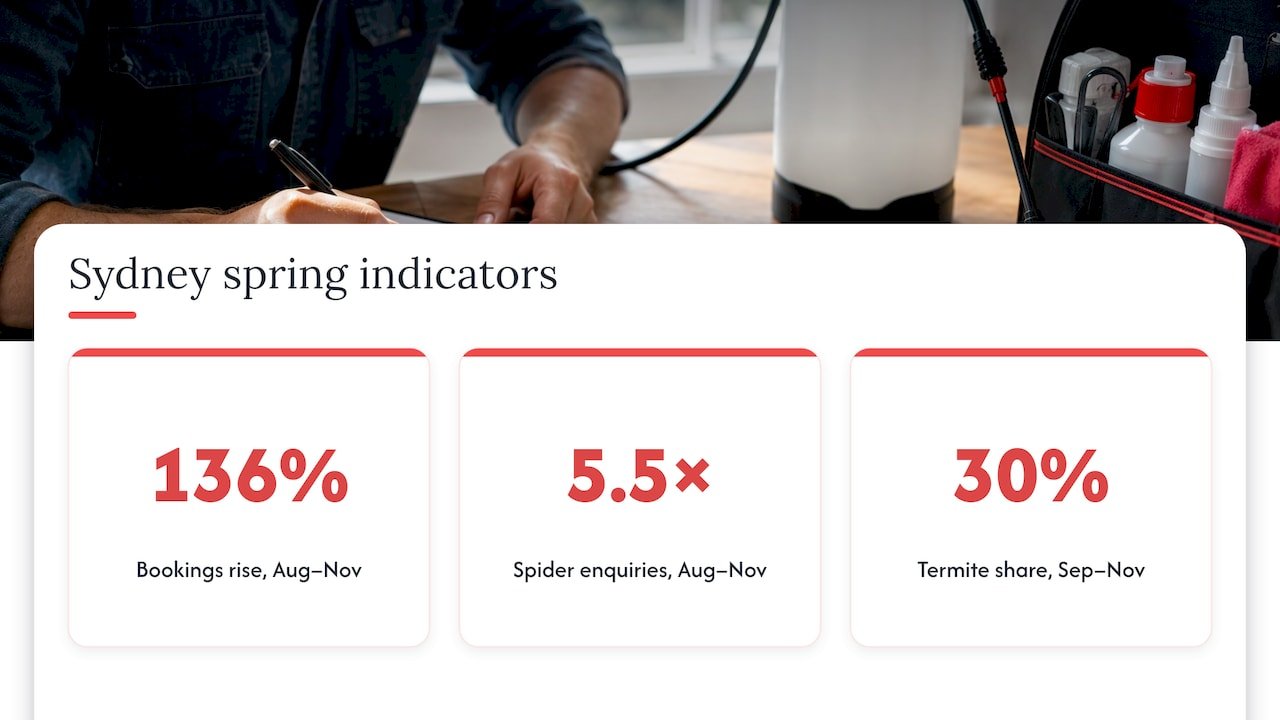
That is Sydney data, not Canberra, and our winters are colder. Still, the pattern of activity building through spring as the weather warms applies across southeast Australia. Our own ACT pest calendar sets out what is active in Canberra in each season, and our guide to seasonal pest control shows how that shapes timing.
There is a cost angle too. The Starts at 60 report cites Home Building Australia saying that summer brings higher demand, longer booking times and occasional seasonal price increases, and that booking preventative treatment before peak summer can help avoid emergency call-outs. A plan locked in before the rush gives you a booked slot and a predictable monthly cost.
Starting in autumn or winter is also fine. Rodents look for shelter when it gets cold, and a termite inspection can be done in any month. The best start date is the next one you can get, not the perfect one.
What it costs: Canberra plan prices
Pest control prices vary by property size, pest type, access and frequency, so any single national figure is a rough guide at best. For our own residential plans, the published monthly prices are:
| Plan | Price |
|---|---|
| Bronze Termite | $29.98 per month |
| Bronze General Pest | $29.98 per month |
| Silver Combined | $55.98 per month |
| Gold Complete | $79.98 per month |
The names show the logic. The Bronze plans each cover one area (termite or general pest), Silver combines the two, and Gold Complete is our top tier. For a side-by-side view of what each tier includes, see the subscription page.
Prices for one-off services, such as rodent removal, bird proofing or gutter guards, are quoted after we know the property, so they do not have a published figure.
Commercial plans are priced differently
Businesses are quoted by site risk, industry, size, how often visits happen and how much documentation is needed. A restaurant that must keep inspection records is a different job from a small office. If you run a business, our guides on what drives commercial pest control pricing in Canberra, what to look for before signing a contract and what a restaurant pest control plan should include go into the detail.
The termite question
Termites are the pest that most justifies a standing plan, because the damage is hidden and the cost of missing it is high. Two points from official guidance matter here.
First, the inspection interval. As noted above, the QBCC recommends at least every 12 months. Our own explainer on termite inspection frequency covers how this applies to Australian homes generally.
Second, the inspector. The Victorian Building Authority recommends using a properly qualified, experienced and insured inspector, and says suspected termite activity warrants a full inspection. Those are sensible tests for any provider, ours included. We use thermal imaging as part of our termite inspections, and our technicians are licensed and insured.
If you are building or have just bought, our guide to termite prevention for a new home in Canberra explains what to set up from the start. If you have found something in the garden, read about harmless garden termites and when to call an inspector. For a booked inspection or treatment, go to our termite control page.
Keeping the plan working between visits
A plan works best when the property helps. Queensland guidance tells owners to inspect between professional visits and to avoid bridging termite barriers with garden beds, wood chips or attached unprotected structures. It gives two measurements worth knowing: a 75 mm minimum clearance from weep holes to garden beds, concrete or paving, and a 25 mm inspection zone between freestanding structures and the house (QBCC guidance). Those figures come from Queensland, so check the requirements that apply to your own building with your inspector.
Some habits that cost little:
- Keep soil, mulch and paving clear of the base of walls and weep holes.
- Fix leaking taps and downpipes, which draw both termites and cockroaches.
- Store firewood and timber off the ground and away from the house.
- Keep food in sealed containers and clear pet food bowls overnight.
- Clear gutters. Blocked gutters hold water and attract pests, which is one reason some owners add gutter guards.
- Tell your technician about anything you notice between visits.
Before a visit, there are a few preparation steps that help the treatment work. Our pest control preparation guide lists them.
Safety for children, pets and the environment
Safety is the question families ask first. The answer is in the product label, which is a legal document in Australia. APVMA labelling for a sprayed insecticide, for example, requires treated areas to stay inaccessible until the spray has dried. It also says pets and animals should be removed, food and water covered or removed, and fish ponds or aquariums protected before spraying (APVMA label). Labels also warn that some insecticides are dangerous to fish and aquatic organisms and must not contaminate drains, rivers, streams or waterways.
In practice, before any visit:
- Tell the technician about children, pets, pregnant household members, aquariums and any health conditions.
- Follow the instructions you are given on re-entry, and keep pets and children out of treated areas until told it is safe.
- Cover or remove food, water bowls and fish tanks as advised.
- Keep the product label or treatment record the technician gives you.
Our focus is on effective and responsible treatments for families, children and pets. If someone in your household has a specific medical condition, ask your doctor before treatment day.
Other services a plan can sit alongside
A plan covers the recurring work. Some jobs are one-offs that sit beside it:
- Rodent removal when mice or rats are in the roof or walls.
- Bird control and solar panel bird proofing, where birds nest under panels or roofs.
- Wasp, spider, bed bug and fly control, listed on our main services page.
- Fire ants, fox trapping, lawn grubs and aphids, on our all services page.
Our view: pay for prevention, not panic
After more than 10 years and over 5,000 Canberra homes serviced, we see the same pattern. The expensive jobs are rarely the ones where a customer called early. They are the ones where something has been building out of sight for a season or more.
That is why we built our plans around scheduled visits and a termite inspection each year, using thermal imaging so that we are not relying on a knock on the wall. A technician who knows your property by its second visit is faster and more accurate than one seeing it for the first time.
We also think a plan should be easy to understand. Four tiers, a monthly price, and a clear list of what each includes. If your property is higher risk, we will tell you what frequency we think suits it and why, so the plan you choose fits the property in front of us.
Our treatments are guaranteed for effectiveness, and our technicians are licensed and insured. For us, a plan is not a subscription for its own sake. It is how we stay ahead of the problem on your behalf.
navin
Choosing your plan
Start with the pests you most worry about, then match the plan:
- Worried about termites only: Bronze Termite, at $29.98 per month.
- Mostly ants, spiders, cockroaches and the usual household pests: Bronze General Pest, at $29.98 per month.
- Want both covered: Silver Combined, at $55.98 per month.
- Want the most complete cover we offer: Gold Complete, at $79.98 per month.
If you are a real estate agent, property manager or body corporate, a plan with an inspection report gives you a record for each property. You can see all options and sign up on our subscription plans page, or contact us through the BugsPatrol website to talk through your property first.
We service Canberra and surrounding suburbs, including Kingston, Watson and Greenway.
FAQ
Is one pest treatment a year enough?
For a typical home with no history of infestation, one general treatment plus a termite inspection every 12 months is a reasonable baseline. Properties near bush, with past infestations or with food handling often need more visits. A technician can recommend a frequency after seeing the property.
Can I start an annual plan in the middle of the year?
Yes. A plan runs for 12 months from when you start, so there is no need to wait for a particular season. Spring is a good time because pest activity builds then, but a termite inspection and general treatment are worthwhile in any month.
Do annual plans cover termites?
It depends on the plan. Some plans cover general pests only, some cover termites only, and some combine both. In our range, Bronze Termite covers termites, Bronze General Pest covers general pests, and Silver Combined and Gold Complete bring them together. Check the plans page for the inclusions.
Are the treatments safe for children and pets?
Treatments are applied according to the product label, which sets out re-entry times and precautions for pets, food, water and fish tanks. Tell your technician about everyone in the household before the visit, and follow the instructions you are given.
Sources
- Appendix 7: Pest management, Food Standards Australia New Zealand
- Termite management systems, Queensland Building and Construction Commission
- Termites, Victorian Building Authority
- Spring is actually pest season, Starts at 60
- APVMA product label
Recommended
- Restaurant Pest Control Plan: What to Include and What It Costs
- One-Off Spray vs Year-Round Plan for Canberra Homes
- What Drives Commercial Pest Control Pricing in Canberra
- Commercial Pest Control Contracts in Canberra: What to Look for Before You Sign