Feral pigeons are not protected in Australia the way native birds are, so you can deal with them on your own property. But “not protected” does not mean “anything goes”. Animal welfare rules still apply to every method, the rules for native birds are strict, and the methods that work best are not the lethal ones. This guide explains where the law draws the line, with a focus on Canberra and the ACT, and what a sensible control plan looks like.
TL;DR
- Feral pigeons (rock doves, Columba livia) are a non-native species. In the ACT they sit on the Exempt List, so you don’t need a licence to keep them.
- Native birds are protected. In the ACT it is illegal to take, keep, kill or release most native animals without a licence, so you must be sure what species you have before you act.
- Lethal control gives only short-term relief, often 4 to 6 weeks. Exclusion and removing food and nesting sites are what last.
- Cleaning pigeon droppings and nests needs a respirator, goggles and protective clothing.
- Netting, spikes, wires and gel are installed by licensed technicians. In Canberra, our team can do this for homes, businesses and solar panels.
Table of Contents
- Are pigeons protected in Australia?
- How the law treats native birds
- Are you allowed to get rid of pigeons?
- Why lethal control rarely solves the problem
- What actually works: a practical plan
- What this means for a Canberra property
- Our perspective
- Getting help in Canberra
- What to ask before you hire anyone
- FAQ
- Sources
Are pigeons protected in Australia?
It depends on which bird you mean. Australia has no single national law covering all birds. Wildlife protection is mostly a state and territory matter, so the answer comes from the law where you live.
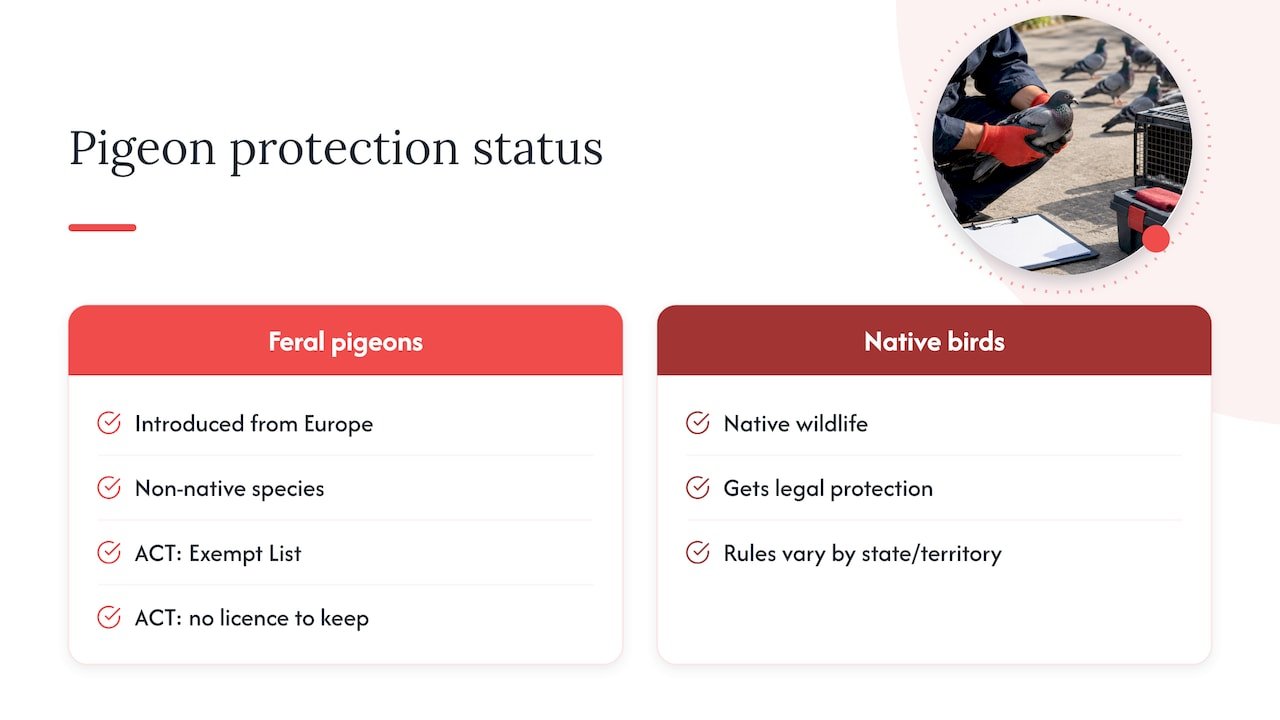
The feral pigeon, the grey city bird with the shimmering neck, was introduced from Europe. It is not a native species, and that is the key point. Native wildlife gets legal protection. Introduced species generally do not.
In the ACT, the government’s guidance on keeping animals lists domestic pigeons, rock doves and feral pigeons as non-native birds on the Exempt List, which means no licence is needed to keep them. That tells you how the territory sees the species: it is not something the law is trying to conserve.
So, to answer the question people type most often: feral pigeons are not protected in the way native birds are. Native birds are.
How the law treats native birds
This is where homeowners get into trouble. Canberra has plenty of native birds that can look like pests when they roost on a roof or nest in a gutter: galahs, cockatoos, magpies, currawongs, spotted doves and others. Some of them are noisy, messy and persistent, and none of them are fair game.
Native animals in the ACT are protected under the Nature Conservation Act 2014. It is illegal to take, release, keep, kill, import or export most native animals without a licence. The same pattern holds in every other state and territory, under different legislation.
In practice that means:
- Identify before you act. A bird at your bird feeder is not automatically a feral pigeon. Look at the shape, colour and behaviour, or ask a licensed technician to confirm.
- Never use traps, baits or shooting without knowing the species. A method that is lawful against a feral pigeon may be an offence against a native bird.
- Native birds in your roof are a different job. Deterring them uses exclusion and habitat changes only, and you should ask the relevant authority if you are unsure what is allowed.
If you are not certain, treat the bird as protected until a professional tells you otherwise.
Are you allowed to get rid of pigeons?
Yes, with limits. As a property owner you can take reasonable steps to stop feral pigeons roosting, nesting and fouling your property. What the law cares about is how you do it.
Animal welfare rules apply to every method
Even for a non-native pest, cruelty is an offence. You can’t poison, trap or kill pigeons in a way that causes unnecessary suffering. Each state and territory has its own animal welfare legislation, and some methods, such as certain baits and traps, are restricted or need specific authority. Poisons and chemical baits are also regulated, so they are not something to buy and scatter yourself.
That is why licensed pest management technicians are the ones who use chemical control and shooting where lethal control is used at all. These are skilled, regulated jobs, not DIY tasks.
Council and local rules
Shooting in a suburban setting raises firearms, safety and local government questions long before it raises pigeon questions. In built-up areas like Canberra’s town centres and suburbs, it is rarely a realistic option for a homeowner. If you manage a commercial or strata property with a serious flock, talk to a licensed operator about what is lawful and sensible at your site.
Keeping pigeons is a separate question
People also ask whether they can keep pigeons or take them from the street. In the ACT, pigeons on the Exempt List don’t need a licence to keep. Native birds are the opposite: taking or keeping most of them without a licence is illegal. Check the rules in your own state or territory before keeping any bird, and remember that a flock of birds you feed becomes a flock that stays.
Why lethal control rarely solves the problem
The temptation is to “get rid of them” quickly. The evidence says that is a poor use of money. Western Australia’s health department explains that lethal control only ever achieves a short-term reduction, in most cases 4 to 6 weeks.
The reason is simple. If food, water and a good roosting spot are still there, other pigeons move in. You remove the birds and keep the attraction. Within weeks you are back where you started, having paid for the same job twice.
The same guidance steers people toward non-lethal, long-term strategies: cutting food sources and physically excluding birds from buildings. That is the approach we recommend too.
What actually works: a practical plan
The best results come from stacking several measures. Do them in this order.
1. Cut off the food
Food is the main reason pigeons settle at a site. Official advice lists removing pet bowls and bird feeders among the first steps. Add these:
- Feed pets indoors, or pick up bowls after meals.
- Cover bins and clean up spilled food around outdoor dining areas.
- Ask neighbours and staff to stop feeding birds. One generous person can undo your work.
2. Seal the entry points
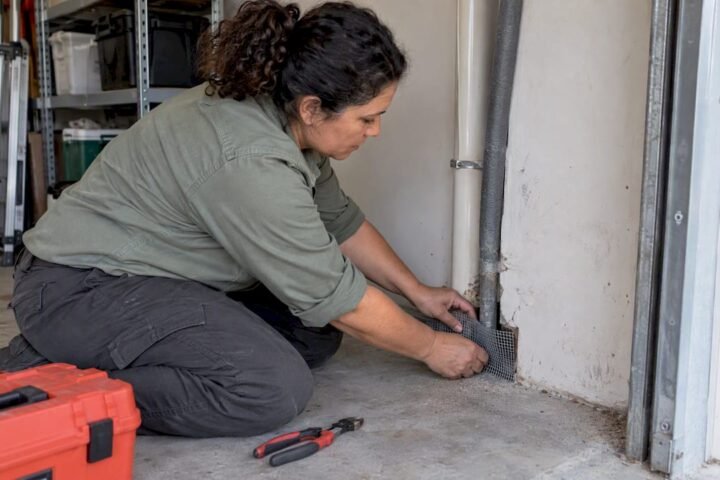
Pigeons nest in roof voids, eaves, ledges and the gaps around air conditioners. Closing those gaps is the single most lasting fix. The WA health department lists sealing entry points and destroying nests as priorities. Take care here: if you find eggs or chicks, confirm the species before you touch the nest.
3. Install physical deterrents
A licensed technician can install mesh, wires, spikes and gel where pigeons land. What suits each spot differs:
| Problem area | Typical solution |
|---|---|
| Ledges, signs, parapets | Bird spikes or tensioned wire |
| Under solar panels | Mesh proofing along the panel edge |
| Open eaves, roof voids, carports | Netting or sealing |
| Gutters clogged with nests and debris | Gutter guards |
| Balconies and pergolas | Netting, spikes or a combination |
We cover these jobs on our bird control page, including bird spikes and deterrents and solar panel bird proofing.
4. Clean up safely
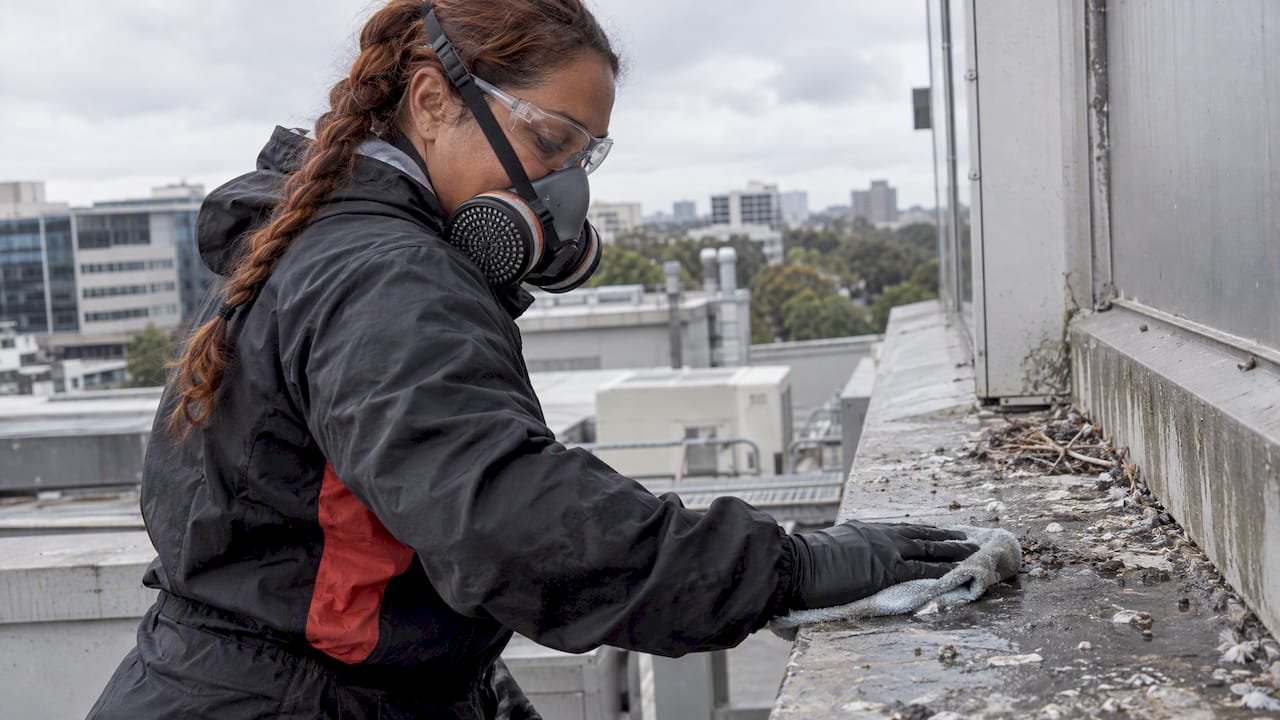
Droppings and nesting material carry health risks, and the cleaning is not a casual job. Official advice is to wear a respirator, goggles and protective clothing when cleaning bird sites. Don’t sweep dry droppings into the air. Our guide on bird droppings and health risks in Canberra explains why it matters.
5. Keep it maintained
Proofing is not a one-time event on a busy site. Netting can be damaged by weather, and new gaps open up. A regular check keeps you from starting again.
What this means for a Canberra property
Canberra’s mix of older brick homes, townhouse complexes, commercial strips and a growing number of rooftop solar systems gives pigeons plenty of places to settle. Solar panels are a particular favourite because the gap under the panels is warm, sheltered and hard to reach. Nests there can block airflow, and droppings are hard to clean.
Common situations we are called to:
- A home with pigeons roosting under solar panels. Mesh proofing along the edge and a clean-out of what is already there.
- A body corporate or strata complex with birds on balconies. A combination of netting, spikes and a rule against feeding.
- A shopfront or warehouse with birds on ledges and signs. Spikes or wire, plus cleaning.
- Gutters full of nesting debris. Cleaning and gutter guard installation to stop birds and leaves getting in.
If you are a real estate agent or property manager, bird fouling and nesting are things that show up in presentation and maintenance, and they are easier to deal with before a sale or lease than after.
Our perspective
We have serviced more than 5,000 Canberra homes over more than 10 years, and bird problems follow a pattern. Owners call after a bad week, they want the birds gone, and they ask about trapping or culling first. We understand the instinct. But what we tell almost everyone is the same: the birds are a symptom, and the building is the problem.
Our view is that exclusion is the honest answer. If a pigeon can land, roost and nest on your property, it will. If it can’t, it goes somewhere else. We would rather install proofing once and have you not need us again than sell you a repeat visit every couple of months.
We also take the legal point seriously. Our licensed technicians check what bird they are dealing with before any work starts, because a protected native bird needs a completely different approach from a feral pigeon. We focus on treatments that are effective and responsible around families, children and pets, and we guarantee our treatments for effectiveness.
One more thing we would tell any owner: don’t skip the cleaning. Old droppings and nesting material are a health risk, and a new proofing system over an unclean site only hides the problem.
— navin
Getting help in Canberra
If pigeons are settling on your home or business, we can inspect the site, identify the birds, and recommend proofing that fits the building. Our bird control service covers bird spikes and deterrents and solar panel bird proofing, and we also offer gutter guard installation. No price is published for these jobs because they depend on the size and layout of the site, so we quote after looking at it.
If you also want ongoing protection against other pests, our maintenance plans start at 29.98 AUD per month for Bronze General Pest or Bronze Termite, with Silver Combined at 55.98 AUD per month and Gold Complete at 79.98 AUD per month. Bird proofing is a separate service from those plans, so ask us when you book.
For urgent problems, you can reach us through our main page.
What to ask before you hire anyone
Whoever you choose, a few questions will protect you legally and financially:
- Are you licensed and insured? Pest management is a regulated trade.
- How will you identify the bird? The answer should involve actual species identification, not an assumption.
- What is your plan beyond removing the birds? If the answer is only trapping or culling, expect the birds to return, given the 4 to 6 week pattern noted above.
- What is guaranteed? Ask what happens if birds get back in.
- What about cleaning? Droppings and nests should be dealt with safely.
Be wary of anyone who tells you all birds are vermin, or who offers to “get rid of” birds without asking what species they are. That is how people end up on the wrong side of wildlife law.
FAQ
Are pigeons protected in Australia?
Feral pigeons are not protected like native birds. In the ACT they are on the Exempt List of non-native birds. Native birds are protected, and in the ACT it is illegal to kill or keep most of them without a licence. Animal welfare rules still apply to how you treat any bird.
Are you allowed to get rid of pigeons?
Yes, you can take steps to stop feral pigeons roosting and nesting on your property. Non-lethal methods such as removing food and sealing entry points are the most effective. Where lethal control is used, it is carried out by licensed pest management technicians, not by owners.
How do I permanently get rid of pigeons?
There is no instant fix, but you can make your property unattractive for good. Cut off food, seal gaps, and install mesh, spikes or wire where birds land. Lethal control alone tends to last only 4 to 6 weeks, so proofing is what makes the difference.
Can I take pigeons from the street or keep them?
In the ACT, feral and domestic pigeons don’t need a licence to be kept. Native birds are a different matter, and taking them is generally illegal without a licence. If you find an injured native bird, contact a licensed wildlife carer or the relevant authority rather than keeping it.