Termite season in Australia runs through the warmer months, and the most visible part, swarming, peaks from spring into early summer. Termites themselves are active in and around your home all year. What changes with the seasons is when winged reproductives leave the nest and when you are most likely to notice them. If you see a cloud of winged insects indoors, or a pile of shed wings on a windowsill, that is your cue to book an inspection, not to reach for the spray.
This guide covers when the season runs, how it differs between regions, what triggers a swarm, how to tell swarmers from flying ants and what to do in the weeks after you spot one. We write it from Canberra, so we also cover what the season means for homes in the ACT.
TL;DR
- Swarming is most common in spring and early summer, with a second flight period in autumn for some species, and it is triggered by warm spells followed by humid, rainy weather.
- Termite risk rises the further north you go, but the pests are a national problem: termites affect as many as one in three Australian homes over their lifetime, according to one estimate.
- Winged insects indoors, mud tubes, hollow-sounding timber and discarded wings all point to activity. Do not spray or pull out timber: call an approved pest controller.
- A professional inspection at least every 12 months is the standard recommendation, and most home insurance does not cover termite damage.
- Spring is the best time to inspect, check your barrier and fix moisture problems before the warm months.
Table of Contents
- When is termite season in Australia?
- How the season differs across Australia
- What triggers a termite swarm?
- Termites or flying ants? How to tell the difference
- Signs of termite activity beyond swarms
- What to do if you find swarmers indoors
- How much damage can termites do, and how fast?
- Reducing your risk before the season starts
- Our perspective
- Booking help in Canberra
- FAQ
- Sources
When is termite season in Australia?
The short answer is spring to early autumn. Swarming is tied to warmth and humidity, so the season starts when the weather warms and tails off as it cools. Pest controllers in Victoria describe the season as running from spring to early autumn in practice, and the exact timing shifts with the local climate and the year’s weather.
Two patterns are worth knowing:
- Spring and early summer are the main window. Records from a Sydney pest controller covering nearly 100,000 treatments over ten years, reported by Starts at 60, show about 30 per cent of the year’s termite enquiries arrive between September and November, as swarming gets under way.
- Some species fly again in autumn. Naturalist writing on Australian termites notes two main flight periods: late spring to early summer, and autumn. Nests of the same species in a district often release their winged termites around the same time, which is why a swarm can appear across a whole street on the same evening.
That is why we tell Canberra homeowners to think of the year as a cycle, not a single season. Swarms are the visible event. The damage happens quietly in the months between.
How the season differs across Australia
Temperature is the biggest driver. The CSIRO’s national Termite Incidence Survey and Hazard Map found that the dominant factor for termite hazard is temperature, with the highest hazard in the hottest regions of northern Australia and Perth. Rainfall comes second: hazard is higher in humid coastal areas than in more arid locations.
The CSIRO also notes that termite risk on the mainland generally increases in a northerly direction, with the highest risk in the subtropics and tropics.
| Region type | What it means for the season |
|---|---|
| Tropics and subtropics (for example far north Queensland) | Highest hazard, with warm, humid conditions for much of the year. A Brisbane-focused pest source reports swarms mainly from November to March when temperatures rise, so check local guidance. |
| Temperate east coast (Sydney and surrounds) | Enquiries bunch up in spring, from September to November. |
| Cooler inland and southern regions, including Canberra | A shorter, more concentrated warm season, usually centred on spring and summer. Winters are quiet above ground. |
A cooler climate does not make a home safe. The CSIRO’s measure of hazard is about likelihood, not immunity, and a single active nest near your house is enough. If your block backs onto bushland, has old stumps, leaky pipes or timber in contact with soil, your own conditions matter more than the regional average.
What triggers a termite swarm?
Swarmers (alates) are the winged reproductive termites that leave a mature nest to pair up and start new colonies. The CSIRO describes them as dispersing in humid periods during warmer months, often around dusk.
The usual recipe is a run of warm days followed by light rain. Backyard Buddies describes termites as sensitive to changes in air pressure and says that several successive days of above-average temperatures followed by light rain tends to set swarming off, most often in spring.
In practice, that means:
- The first warm, muggy evening after a cold snap is a common swarm night.
- Swarmers are drawn to light, so you often find them around windows, light fittings and door frames.
- They live only briefly after leaving the nest, which is why you tend to find drifts of discarded wings rather than live insects.
A swarm tells you a mature colony is close, within or near your property. It does not tell you the colony is in your house. Only an inspection can answer that.
Termites or flying ants? How to tell the difference
Both appear on warm, humid evenings, so people confuse them. The CSIRO says termite alates differ from flying ants by their straight antennae and their readiness to shed their wings.
A quick field check:
- Antennae. Straight and bead-like suggests termite. Elbowed suggests ant.
- Wings. Termite swarmers drop their wings easily, and you will often find small piles of them. Ants keep theirs.
- Waist. Termites have a broad, thick body with little waist. Ants have a clearly pinched waist.
- Location. Wings gathered on a sill indoors, or insects emerging from a wall or skirting, deserve a call.
If you cannot tell, take a clear photo and keep a few of the insects in a sealed container. It makes the inspection faster. For the Canberra species and the harmless garden types you might find, our guide on spotting harmless garden termites and when to call an inspector helps you sort out what you are looking at.
Signs of termite activity beyond swarms
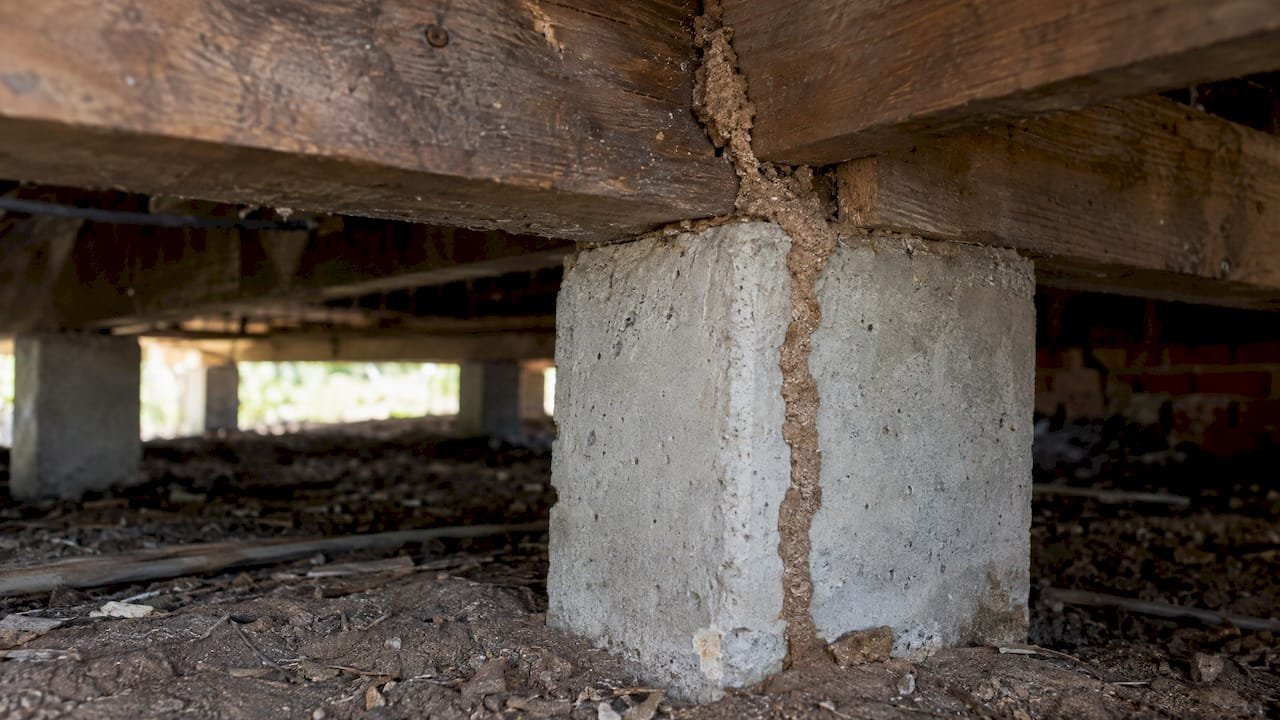
Swarms are the dramatic sign, but most infestations are found by other clues. The Queensland Building and Construction Commission lists the common signs: mud shelter tubes, hollow-sounding timber, blistered or cracked paint or plaster, sagging floors, doors or ceilings, damaged timber, discarded wings and frass.
What to look for room by room:
- Subfloor and foundations: pencil-width mud tubes running up piers, walls or slab edges. Our guide to termite mud tubes and what to do about them shows what they look like.
- Skirting boards and door frames: timber that sounds papery or hollow when you tap it, or paint that bubbles for no clear reason.
- Windowsills: small piles of translucent wings after a warm evening.
- Garden: stumps, fence posts, retaining walls and mulch piled against the house.
Termites eat timber from the inside, so the surface can look sound while the structure is weakened. That is why a visual look is not a substitute for an inspection by a licensed professional.
What to do if you find swarmers indoors
Stay calm, and do these things in order:
- Do not spray the swarmers or the area. The Victorian Building Authority advises against using surface spray or ripping out affected material, and says to engage an approved pest controller instead. Surface spray can scatter the workers and make the colony harder to locate and treat.
- Collect a sample. Keep a few insects and wings in a sealed jar or bag.
- Switch off the lure. Turn off lights near the entry point and vacuum up the wings.
- Leave damaged timber in place. Photograph it and note where it is.
- Book a licensed inspection. Tell the inspector when and where you saw the swarm.
If the swarmers came in from outdoors through an open window on a warm evening, the colony may well be in a neighbouring yard or in a tree stump. It still warrants an inspection. A swarm inside the house, with wings on the floor and insects coming from a gap, is more urgent.
How much damage can termites do, and how fast?
No one can give you a speed that fits every colony, because it depends on the species, the colony size and the timber. What is clear is the scale of the problem. Airtasker estimates, as reported by Domain, that termites affect as many as one in three Australian homes over their lifespan and cost homeowners $1.5 billion each year.
The same report notes that most standard home insurance policies in Australia generally do not cover termite damage, because it is often considered preventable through routine maintenance. For a homeowner, that makes prevention and regular inspection the main protection, not the policy.
The CSIRO also cautions that renovations or garden alterations can affect a termite barrier, which is another reason to inspect after building work, landscaping or new paving.
Reducing your risk before the season starts
The best time to act is late winter and early spring, before the first warm, humid week. The official advice is consistent. The Victorian Building Authority and the Australian Government’s YourHome guide both point to removing dampness and fixing plumbing, drainage and roof leaks, keeping garden beds, mulch and stored materials away from walls, and ensuring subfloor ventilation, as covered in YourHome’s maintenance guidance.
A practical spring checklist:
- Fix dripping taps, leaking air-conditioner drains and damaged downpipes.
- Direct stormwater away from the foundations.
- Keep soil, mulch and garden beds clear of weep holes and below the damp-proof course.
- Clear subfloor vents and remove stored timber, cardboard and old formwork.
- Cut back vegetation that holds moisture against walls.
- Remove old stumps and dead tree roots near the house.
If you want a weekend plan, our guide to weekend termite fixes and a yearly AS 3660 plan walks through the jobs in order. Building new? Read our notes on termite prevention for a new home in Canberra.
Inspections and barriers
YourHome says that physical barriers, adequate clearance and yearly inspections are the most effective strategies for long-term termite protection. The Victorian Building Authority recommends professional inspections every 12 months, especially in high hazard areas, and advises an inspection before you buy a home.
Spring suits an annual inspection well, because it comes before the main swarming window. Our resources can help you prepare:
- Termite inspection checklist for homeowners and buyers
- Why inspections need to happen at least every 12 months
- Bait or barrier: which suits your home
- Whether termite barriers expire in Canberra
Our perspective
We service Canberra homes, and the pattern we see is simple: people notice termites in spring because the swarmers announce themselves, but the colony has usually been working for much longer. Treating the swarm as the problem is the common mistake. The swarm is the warning.
That is why we put inspection first. Our technicians use thermal imaging as part of termite inspections, which helps us look for activity behind walls without cutting into them. We are also upfront that no single tool finds everything, so we pair it with a careful visual and tap inspection of the whole property.
Our view is that a yearly inspection, a maintained barrier and a clean, dry perimeter beat any reaction after the fact. If you have already seen swarmers, a prompt inspection tells you where you stand, and a licensed treatment plan lets you deal with the colony properly. We design our treatments to be effective and responsible around families, children and pets, and we stand behind them with a guarantee.
If your home is older, backs onto bush or has had renovations, spring is the time to book. The warm months are when the pressure builds.
navin
Booking help in Canberra
If you have seen swarmers, found mud tubes or simply want your yearly check done before the warm months, our team can inspect and, where needed, treat your property. We offer termite control across Canberra, with local pages for suburbs including Belconnen, Phillip, Franklin and Taylor.

If you prefer to spread the cost, our maintenance plans include Bronze Termite at $29.98 per month, Bronze General Pest at $29.98 per month, Silver Combined at $55.98 per month and Gold Complete at $79.98 per month. Check the plan page for what each one includes.
FAQ
How can I identify termites?
Look for mud shelter tubes, timber that sounds hollow when tapped, blistered paint or plaster, sagging floors or doors, discarded wings and frass. Winged insects with straight antennae that shed their wings are likely termite swarmers. A licensed inspector can confirm the species and locate the nest or entry point.
How do I get rid of termite swarmers?
Do not spray them or tear out timber. The Victorian Building Authority says to engage an approved pest controller. Vacuum up the wings, keep a sample and book an inspection so the colony behind the swarm can be found and treated.
What is the difference between termites and flying termites?
They are the same insect at different stages. Flying termites (alates) are the reproductive members of a colony that leave the nest to start new ones, usually in humid weather in the warmer months. Workers and soldiers have no wings and stay hidden in the nest, timber or soil.
How fast do termites spread?
It depends on the species, the size of the colony and the conditions, so no single figure applies. Damage often goes unnoticed because termites feed from inside timber. Since the cost can be large and insurance generally does not cover it, annual inspection is the safest approach.
Sources
- Termites | Victorian Building Authority
- Spring Is Actually Pest Season, Starts at 60
- Termites | by map and compass
- Termite Incidence Survey and Termite Hazard Map, CSIRO
- Managing Termites, CSIRO
- Termites, Backyard Buddies
- Weather events present perfect swarm for termite invasions, QBCC
- Never seen it so bad, Domain
- Repairs and maintenance, YourHome
Recommended
- Termite Season in Canberra: When ACT Homeowners Face the Highest Swarm Risk
- Weekend Termite Fixes for Australian Homes and Yearly AS 3660 Plan
- Every 12 Months Minimum: Termite Inspections for Australian Homes
- Termite Treatment Options: What Canberra Homeowners Need to Know