Cluster flies are sluggish, gray-and-gold flies (genus Pollenia) that gather in roof voids and wall cavities over the cooler months, and they pose little direct health risk but a lot of nuisances. The fastest fix indoors is vacuuming, not spraying. For lasting control, seal entry points and time any exterior treatment to the fly’s lifecycle, or bring in a licensed pest professional if the problem returns each year.
TL;DR:
- Treatment should be timed in late summer before autumn cluster fly congregation begins to maximize effectiveness and reduce the need for chemical intervention later.
- Sealing entry points around windows, vents, and cable penetrations with caulk or steel wool prevents flies from entering and reduces infestations overall.
- Vacuuming and physical removal are the safest and most effective methods for handling flies already inside, with sticky traps aiding in catching emerging flies.
- Professional pest control is recommended if infestations persist yearly, involve large clusters, or involve inaccessible entry points, as timing and targeted exterior treatments are crucial.
- Relying solely on sprays or scent repellents is ineffective; emphasis should be on exclusion, timely exterior treatment, and inspection to break the seasonal cycle.
Table of Contents
- How to tell cluster flies apart from other common flies
- Why cluster flies show up in spring and autumn
- Are cluster flies a health risk or just a nuisance?
- What you can do indoors right now
- Sealing your home against next season’s flies
- When it is time to call a licensed pest professional
- Why timing beats spraying every time
- Fly control and home proofing from BugsPatrol
- Sources
- FAQ
How to tell cluster flies apart from other common flies
Cluster flies are slightly larger than house flies, with dark gray bodies and fine golden hairs across the thorax. Their flight is slow and clumsy compared with a house fly’s quick darting, and that sluggishness is often the first clue homeowners notice when a fly bumps repeatedly against a windowpane instead of buzzing around erratically.
Behavior gives away the rest. Cluster flies gather in tight groups on sun-warmed exterior walls in autumn, then reappear indoors around windows, light fittings and switch plates on sunny days in winter and early spring. Unlike house flies or blowflies, they show no interest in food scraps, bins or garbage, because adults are not attracted to food or garbage the way filth flies are.
A few quick checks help confirm the identification:
- Speed: cluster flies fly and walk more slowly than house flies.
- Clustering: groups form on sunny walls or windowsills rather than scattering.
- Smell when crushed: many people describe a faint buckwheat-honey odor, unlike the sharper smell of a crushed blowfly.
- Location: sightings cluster around roof voids, wall cavities and upper-story windows, not kitchens or bins.
Blowflies, by contrast, are shinier, often metallic green or blue, move quickly, and head straight for food or carcasses. House flies are smaller, grayish, and equally food-driven. If the flies in your home ignore the kitchen bin and instead pile up near a north-facing window in July, cluster flies are the likely culprit.
Why cluster flies show up in spring and autumn
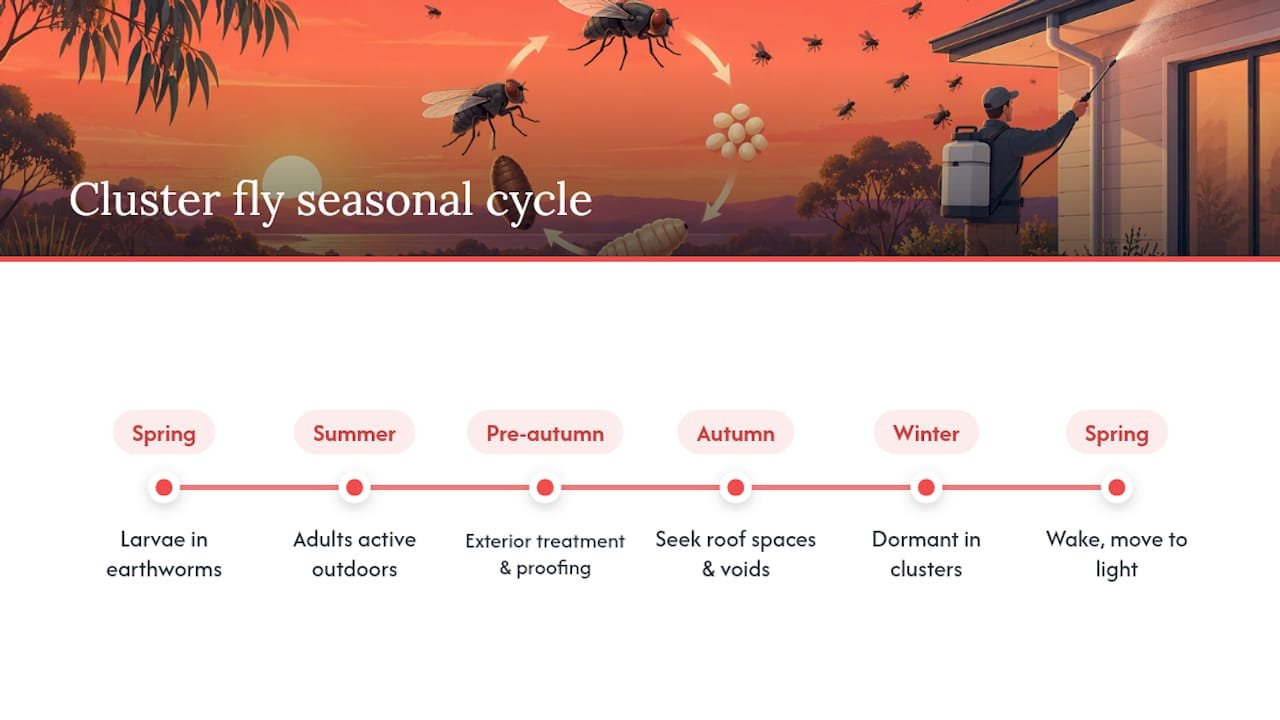
The cluster fly’s life cycle explains almost everything about when and where you see them. Larvae are parasites of earthworms, developing inside the worm’s body before pupating in soil, which is why larvae depend on earthworms rather than on decaying matter or garbage. Properties with moist, earthworm-rich lawns tend to produce more adult flies over a season.
Adults emerge through spring and summer and go about their business outdoors, largely unnoticed. As autumn temperatures drop, they seek sheltered, sun-warmed surfaces such as roof spaces, wall voids and eaves, where they cluster together and enter a dormant state to survive winter. On warm winter days, or as spring warmth returns, dormant flies stir and head toward light, which is why they reappear indoors around windows and light fixtures well before outdoor temperatures have properly warmed.
This pattern matters for control. Because larvae accumulate fat reserves and respond to warmth as a trigger to move, exterior treatments and proofing work need to happen before the autumn congregation begins, not after flies have already settled into voids. Miss that window and you are managing symptoms indoors rather than preventing the problem.
Are cluster flies a health risk or just a nuisance?
Cluster flies are not filth flies and are not recognized as disease carriers, since they are seasonal nuisance pests rather than disease vectors that breed in earthworms rather than waste or carrion. The real problems are practical, rather than medical
Large numbers dying inside a roof void or wall cavity can leave stains, odor and, over time, attract dermestid beetles that feed on the dead insects. That secondary infestation is often more troublesome than the flies themselves, which is one reason indiscriminate spraying inside voids is not a great idea.
What you can do indoors right now
Vacuuming is the safest and most effective immediate step, since vacuuming and physical removal are the recommended remedy for flies already inside living spaces. Run the vacuum over window sills, curtain folds and ceiling corners, then empty the canister or bag outside straight away so flies cannot crawl back out.
- Vacuum daily during active periods, focusing on windows, light fittings and any visible cluster.
- Set sticky traps or glue boards near windows and known void access points to catch flies as they emerge.
- Avoid heavy indoor spraying, since space sprays or foggers only give temporary relief and do not reach flies sheltering inside voids, and residue near children, pets or food areas carries its own risk.
- Seal obvious gaps around outlets and window frames as a short-term barrier while you plan longer-term proofing, drawing on general fly control tips for the room-by-room basics.
Pro Tip: Check the vacuum bag or canister for a smell after a heavy day of collection. A strong odor usually means it is time to empty it, since decomposing flies attract secondary pests faster than you would expect.
Indoor chemical use makes sense only for small, contained clusters in a room you can ventilate immediately afterward, and using a natural topical insect spray formulation can provide safer relief around children and pets. It is not a fix for flies still breeding or sheltering behind plasterboard.
Sealing your home against next season’s flies
Proofing is the closest thing to a permanent fix, because it stops adults from entering in the first place rather than treating them once they are inside. Focus on the same entry points every cluster fly infestation exploits:
- Windows and door frames, sealed with silicone caulk where gaps have opened up.
- Roof vents, eaves and soffits, checked for torn or missing insect screening.
- Cable and pipe penetrations, packed with steel wool before foam sealant to stop flies squeezing through.
- Light fittings and switch plates, a common indoor entry point once flies are already inside a wall void.
Screening with a fine insect mesh over vents and roof gaps keeps adults from finding their way into voids before autumn. An annual check of the roof space, ideally in late summer, catches gaps before the congregation period begins.
Exterior residual treatments, of the kind professionals apply around foundations, eaves and wall exteriors, work best when timed to hit adults just before they move indoors for winter, since preventative barrier treatments are most effective when applied before the last seasonal generation emerges. Apply them too late, once flies are already clustering at entry points, and the treatment window has effectively closed.
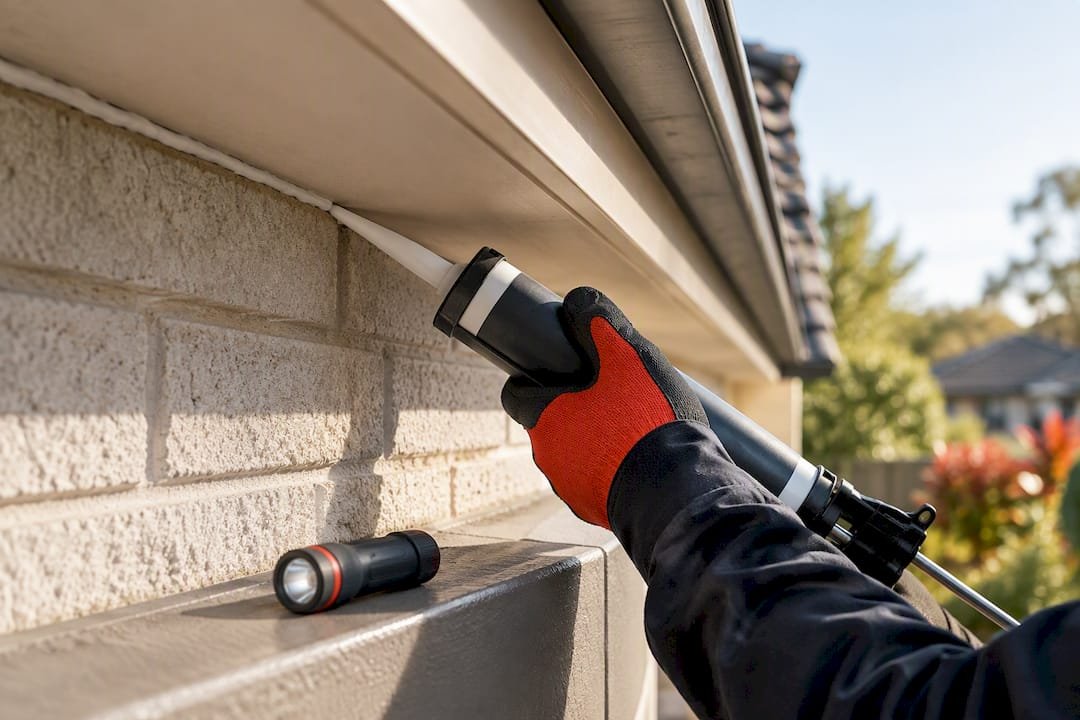
Because larvae rely on earthworms in soil, trying to eliminate them from your lawn is not practical and will not meaningfully cut fly numbers. Exclusion and timed exterior treatment are far more reliable than any landscape intervention.
Pro Tip: Book your roof void and eaves check for late summer, several weeks ahead of the first cool autumn nights, so any sealing or treatment work is finished before flies start looking for shelter.
When it is time to call a licensed pest professional
DIY measures handle a light, occasional problem. A few signs point to a bigger job than vacuuming and caulk can solve: the same infestation returning every autumn, large aggregations you can hear or see in the roof space, or entry points you simply cannot reach or seal yourself.
Professional chemical use in the Australian Capital Territory is not a casual affair. Commercial pest control operations using agvet chemicals require an environmental authorisation under the ACT Environment Protection Act, and the products themselves fall under APVMA registration nationally. That framework exists because timing and application matter for both effectiveness and safety, and it is part of why a narrow DIY spraying window so often fails where a scheduled professional visit succeeds.
A typical professional visit includes an inspection of roof voids and likely entry points, a targeted exterior residual application timed to the fly’s lifecycle rather than to whenever the calendar allows, exclusion recommendations, and follow-up advice for the next season. For broader context on safe commercial chemical use in the region, see this overview of commercial fly control practices in Canberra.
Why timing beats spraying every time
The biggest misconception about cluster flies is that more insecticide solves the problem. It does not. Spraying a cluster of dormant flies inside a wall void kills the flies you can see and leaves the rest to decompose behind plasterboard, which is how a fly nuisance turns into a dermestid beetle problem months later.
What actually works is unglamorous: knowing the calendar. A property treated in late summer, before the autumn congregation starts, needs far less chemical intervention than one treated reactively in June after flies have already moved in. Homeowners who treat cluster flies as a scheduling problem, not a spraying problem, spend less money and see fewer flies for longer.
— navin
Fly control and home proofing from BugsPatrol
Chasing cluster flies room by room each winter costs more time than getting ahead of them once, before autumn. Licensed technicians handle the parts that are hard to do yourself: locating roof void entry points, timing exterior treatment to the fly’s lifecycle, and sealing the gaps that let flies back in next year.

A typical visit covers:
- An inspection of roof voids, eaves and known entry points.
- A targeted perimeter treatment timed ahead of the autumn congregation.
- Practical sealing advice for windows, vents and cable penetrations.
- Follow-up guidance so the same infestation does not return next season.
For homeowners who want that check built into an annual routine rather than a once-off callout, the Gold Complete, Silver Combined and Bronze General Pest subscription plans include scheduled inspections. Book a fly control visit with BugsPatrol before the next cool snap sends flies looking for shelter.
Sources
- Cluster fly — Wikipedia
- Pest and weed control operators – Access Canberra
- Cluster flies — Penn State Extension
- PestWatch: Cluster flies — professional guidance
FAQ
What smell do cluster flies hate?
There is no strong published evidence pointing to a specific scent that reliably repels cluster flies, so treat any “fly-repelling smell” claim with caution. Sealing entry points and vacuuming remain the tested approach rather than relying on scent alone.
How do I quickly get rid of cluster flies indoors?
Vacuum affected windows, sills and ceiling corners and empty the canister outside immediately, since vacuuming is the recommended immediate remedy for flies already inside a room. Sticky traps near windows catch stragglers, but avoid heavy indoor spraying, which only offers short-term relief.
Will cluster flies go away on their own?
Indoor sightings usually ease once the weather stabilizes and dormant flies either die off or find their way back outside, but the underlying entry points remain open for next season. Without sealing and timed exterior treatment, the same seasonal pattern tends to repeat each autumn and spring.
What kills cluster flies outside?
Professional exterior residual treatments applied around foundations, eaves and wall surfaces work best when timed just before the last seasonal generation moves indoors to overwinter. Because larvae depend on earthworms in soil, altering lawn conditions is not a practical way to reduce outdoor numbers.