Living next to the Murrumbidgee River corridor sounds idyllic, and for most of the year it is. But if you own a home in Greenway, that green belt running along your suburb’s edge is also quietly working against you. The river attracts wildlife, retains moisture, and creates the exact conditions that certain pests need to thrive year-round.
Effective greenway pest control is not simply about reacting when you spot something. It is about understanding why this suburb faces a fundamentally different pest landscape than most of Canberra. European wasps, black rats, and subterranean termites all behave differently here, driven by soil conditions, seasonal water access, and the natural food chains that riparian corridors support.
This guide breaks down exactly what South Canberra residents near the Murrumbidgee should be watching for and when. You will learn which pests are most active in each season, why river-adjacent suburbs face elevated pressure, what early warning signs look like, and what practical steps you can take before a minor problem becomes a serious infestation. Local geography creates the risk; local knowledge helps you stay ahead of it.
Why Greenway Faces a Different Pest Profile Than Most Canberra Suburbs
Greenway sits at the southern edge of Canberra’s urban footprint, directly adjacent to the Murrumbidgee River Corridor, a 9,800-hectare network of nature and recreation reserves that functions as a permanent wildlife highway through the ACT. That proximity is the single biggest reason pest pressure here differs from suburbs further north.
Permanent food, water, and shelter sustain pest populations year-round. The corridor does not switch off in winter. Riparian vegetation, standing water, and undisturbed soil banks provide continuous habitat for the three pests that matter most to Greenway homeowners: European wasps, black rats, and subterranean termites. Seasonal slowdowns that reduce pest activity in more isolated suburbs are less pronounced here because the corridor maintains baseline conditions across all four seasons.
Soil moisture and vegetation density work in pests’ favour. Riparian soils adjacent to the corridor tend to retain more moisture than inland ground, creating conditions that benefit soil-dwelling pests. Higher moisture benefits subterranean termite colonies, which depend on consistent soil hydration to extend their foraging networks. The same conditions support burrowing rodents and ground-nesting wasps looking for stable, sheltered soil.
The microclimate softens Greenway’s cooler winters. Southern Canberra records lower winter temperatures than the city centre, but the corridor’s vegetation and water presence are understood to moderate local conditions, potentially extending activity windows relative to more exposed suburbs.
The green-space boundary is a direct ingress point. Where Greenway properties back directly onto corridor reserves, the green-space boundary creates a direct interface through which pest populations can move into residential areas.
For these reasons, pest control across Canberra’s southern suburbs requires a seasonal calendar and species focus that differs from ACT-wide service protocols. Generic advice built around broader metropolitan patterns will miss the corridor-specific timing and behaviour that Greenway residents actually face.
European Wasps: The Corridor’s Most Dangerous Summer Resident
Of all the pests the corridor pushes into Greenway, Vespula germanica (the European wasp) poses the most immediate physical danger to residents.
Why the corridor concentrates them here: The Murrumbidgee’s permanent water source supports high densities of insects and spiders, which European wasps hunt aggressively. Colonies establish in spring, then expand continuously through late summer.
What makes them hard to find: Unlike native species that build visible paper nests on eaves or branches (see our guide on identifying and managing a paper wasp nest), European wasps nest underground or inside wall and ceiling cavities. The only visible sign is a small entry hole with steady wasp traffic. The corridor’s undisturbed soil banks and dense riparian vegetation give colonies ample room to establish before a resident notices anything unusual.
What to watch for on your property:
- Repeated wasp movement near ground-level gaps in retaining walls
- Traffic entering or exiting subfloor vents
- Wasps disappearing into the base of dense shrubs along fence lines
These are the entry points most commonly associated with properties bordering green space in Greenway.
Why DIY treatment is genuinely dangerous: Disturbing a nest triggers an immediate, coordinated defensive response. An incomplete treatment does not destroy the colony; it displaces and destabilises it. Professional equipment and application methods are necessary to treat the nest in a single intervention.
Other wasp species in the area: Canberra supports six additional species including the Common Wasp, Asian Paper Wasp, European Paper Wasp, Native Paper Wasp, Sand Wasp, and Mud Nesting Wasps. Each nests differently, which changes where on your property you are likely to encounter them and how a licensed technician will approach treatment.
Black Rats Along the Riverbank: Why Rodent Pressure Peaks in Autumn
While European wasps dominate summer, autumn brings a different threat moving in from the corridor: black rats (Rattus rattus), also called ship rats, are agile climbers that nest in roof cavities, wall voids, and dense canopy vegetation rather than at ground level.
As seasonal conditions in the corridor change toward autumn, resident rat populations are known to shift toward nearby buildings in search of warmth and shelter, a pattern consistent with the species’ opportunistic behaviour. Properties bordering the Murrumbidgee are the first point of contact.
What makes Greenway properties especially exposed is that black rats’ well-documented climbing ability means the corridor’s tree canopy can serve as an aerial pathway toward rooflines on adjoining properties. Ground-level exclusion measures that might be adequate in suburbs with less adjacent vegetation offer limited protection here, because rats rarely need to touch the ground to gain entry.
Signs to look for inside and around the roof space:
- Gnaw marks on roof timbers and wiring near eaves
- Greasy rub marks along wall junctions, a sign pest managers commonly look for, left by fur repeatedly contacting the same surface
- Scratching or scurrying sounds in ceilings at night
- Droppings concentrated along travel routes rather than scattered randomly
The risks compound quickly once rats are established in a roof. Gnawed wiring and cabling pose a serious risk, and this is widely cited as a concern associated with roof-void rodent activity. An untreated infestation tends to grow rather than resolve on its own.
For household pest control in Greenway and the broader Tuggeranong area, baiting alone is not sufficient. Without physical exclusion sealing the re-entry points the canopy corridor provides, new rats replace any that are removed. A combined strategy addressing both roof void baiting and structural gaps is what breaks the cycle.
Subterranean Termites: How River Corridor Soil Conditions Fuel Colony Growth
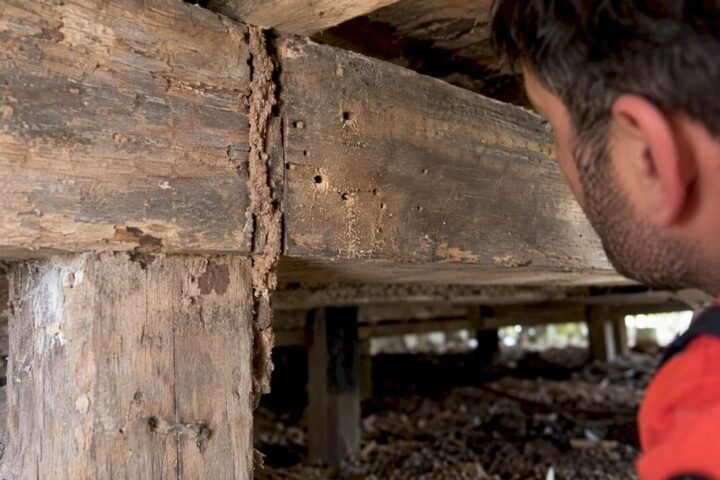
Rodents target what they can reach. Subterranean termites target what they can’t be seen destroying, and the Murrumbidgee Corridor gives them ideal conditions to do exactly that.
Coptotermes acinaciformis, Australia’s most destructive structural termite species, depends on consistent soil moisture to construct and extend its mud tube networks. Research on C. acinaciformis confirms the species actively prefers topsoil at moisture levels of 10–20%, with soil transport rates increasing at higher moisture levels. Given the corridor’s permanent water features and riparian vegetation, soil moisture near the riverbank is likely to remain within or close to this range through much of the year, making the corridor a reliable source of active colonies within foraging distance of Greenway homes.
When to watch for activity
Swarming activity in temperate south-eastern Australia is generally associated with warming spring and early summer soil temperatures, making the October–January period one to watch closely. In persistently moist conditions such as those found near riparian zones, foraging activity is less likely to curtail sharply with the change of season. The most visible warning sign is alates, the winged reproductives that emerge after spring rain. Discarded wings near window sills, light fittings, or subfloor access points are not incidental. They indicate an established colony is nearby and reproducing. Treat them as urgent.
Why a visual check is not enough
Most active termite workings are concealed inside wall cavities, roof timbers, and subfloor framing. Industry guidance consistently recommends annual professional termite inspections for properties near natural areas and water features, which describes much of Greenway. A professional termite inspection in Canberra uses methods that detect activity a visual check will miss entirely.
BugsPatrol provides both liquid barrier treatments and baiting systems. The right option depends on soil type, construction method, and how close the property sits to the corridor, all of which a licensed inspection will determine.
A Seasonal Watch Calendar for Greenway Residents
Knowing when each pest peaks is as important as knowing which species to watch for. These four windows define the risk cycle for Greenway properties bordering the corridor.
Spring (September to November) Spring’s warming temperatures and rainfall coincide with termite alate emergence and European wasp queens beginning new nest construction, the two most time-sensitive pest events of the year. Rodent activity tends to increase again through spring as conditions improve. This is the highest-value window for a preventive inspection: colonies are small, nests are new, and intervention costs less than it will in three months.
Summer (December to February) European wasp colonies reach peak size and peak aggression. Encounters near outdoor entertaining areas, bins, and subfloor vents are most likely during this period. Simultaneously, subterranean termite foraging typically reaches its greatest intensity through summer, when soil temperatures are highest. If you are unsure whether termite workings are live, this guide to recognising whether a termite nest is active explains the key signs.
Autumn (March to May) As corridor conditions shift and temperatures drop, black rats move toward residential roof spaces. This is the critical window for physical exclusion and baiting programs; waiting until winter means the rats are already established.
Winter (June to August) Activity slows but does not stop. Termite colonies in protected subfloors may remain active through winter, particularly where the structure retains heat, and overwintering rodents continue gnawing timbers and cabling inside roof voids.
The corridor’s year-round ecological activity means pest pressure rarely reaches zero between seasons.
What Greenway Residents Can Do Before Calling a Professional
Knowing when pests are most active is only half the equation. These six steps give Greenway homeowners a practical edge before a licensed inspection becomes necessary.
- Reduce harborage around the property boundary. Clear dense ground cover to at least one metre from the house wall, store firewood elevated and well away from the structure, and keep compost bins sealed. Each of these removes a direct attractant for European wasps and black rats moving in from the corridor.
- Seal entry points proactively. Inspect roof line junctions, fascia boards, weep holes, and subfloor vents, any gap large enough to admit a finger is generally large enough to admit a black rat. The corridor’s canopy gives rats elevated access, so these openings are the primary entry route for properties bordering green space.
- Do not disturb suspected wasp nests or termite workings. European wasps respond aggressively to interference (covered above), do not attempt to treat a nest yourself. Disturbing termite workings can cause a colony to retreat and re-emerge elsewhere in the structure, complicating any subsequent treatment. Leave both alone and contact a professional.
- Record wasp activity around your property. Repeated sightings in the same zone are a more reliable signal than a single encounter and help establish whether professional intervention is warranted.
- Book an annual inspection rather than waiting for visible damage. Both termite workings and roof-void rodent infestations are frequently well-established before any visible signs appear. Early intervention is consistently less disruptive and less costly than reactive treatment.
- Consider a year-round protection plan. BugsPatrol’s rolling cover includes scheduled inspections, 12-month warranties, and no upfront fees, a practical fit for properties facing persistent, corridor-driven pressure across multiple pest species. The company’s local approach extends across Greenway and the broader Tuggeranong area, covering everything from termites and rodents to, as outlined in our 4-step bird control services Greenway process, less obvious but equally disruptive pest pressures.
The Corridor Creates the Risk, Local Knowledge Manages It
The steps covered above give you a practical foundation, but self-preparation only goes so far when the underlying pressure comes from the Murrumbidgee Corridor itself.
Those seasonal differences from inland suburbs translate directly into a cost gap between early and late intervention. A wasp colony found in October is a straightforward treatment; the same colony found in February, at peak size, is a significantly larger job. Termite workings discovered during a routine inspection are repairable; workings discovered after structural timber fails are not.
BugsPatrol’s experience across Greenway and the broader Tuggeranong region means inspections here are calibrated to corridor-specific risks, not a standard metropolitan checklist. Soil type, construction method, proximity to the riparian boundary, and seasonal timing all inform how treatments are applied. If you want to understand why that local approach makes a difference for ACT homeowners, BugsPatrol’s approach to south Canberra properties explains it directly.
Residents seeking a Greenway pest control assessment, or wanting to discuss year-round household pest control coverage, can contact BugsPatrol for a licensed inspection. The corridor will keep generating pressure; the question is whether you meet it early or late.
Conclusion
Greenway’s position along the Murrumbidgee Corridor creates a pest environment that demands local knowledge, not generic solutions. The corridor-specific pest cycles covered above all share one trait: early action costs far less than reactive treatment.
A licensed inspection calibrated to corridor-specific risks changes that equation entirely. Contact BugsPatrol to schedule a Greenway pest assessment and get ahead of the season before pressure builds. The corridor is consistent; your response to it does not have to be reactive.