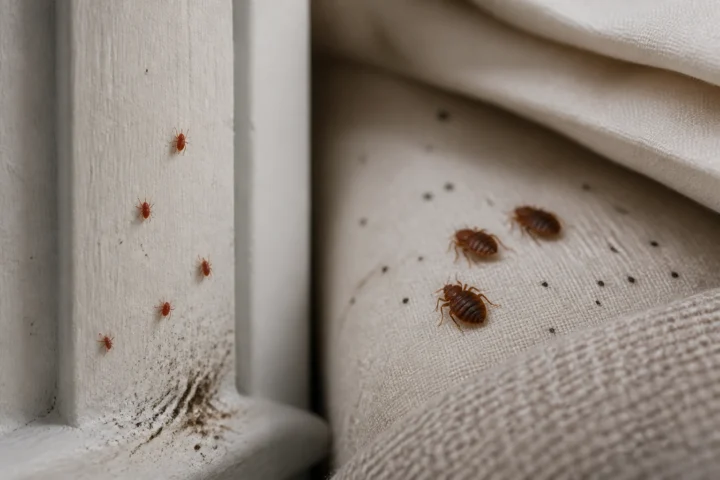
A flea problem in the house usually lasts weeks to months, because most of the population is not the adult fleas you see. It is eggs, larvae and pupae hidden in carpet, floor cracks and pet bedding. The full life cycle can run anywhere from 2 weeks to 8 months, depending on temperature, humidity, food and flea species. This guide walks through each stage, where it hides, how long you can expect an infestation to last and how to stop the cycle.
TL;DR
- Fleas pass through four stages: egg, larva, pupa and adult. Most of the indoor population is in the first three.
- In most homes the cycle takes about 3 to 8 weeks, but pupae can sit dormant in cocoons for months and hatch when they sense a host.
- Larvae hide deep in carpet fibers, floorboard cracks and bedding, away from light.
- Breaking the cycle means treating every pet, cleaning the home repeatedly and following up on a set schedule, usually over several weeks.
- If fleas keep returning, a licensed technician can treat the harborage areas that are hard to reach yourself.
Table of Contents
- The four stages of the flea life cycle
- How long does the cycle last in a house?
- How long will my house have fleas?
- Flea larvae in carpet: what to look for
- Why adult fleas are only the visible tip
- How to break the flea life cycle in the house
- A realistic timeline
- After a professional flea treatment
- Get the home treated properly
- Keeping fleas from coming back
- FAQ
- Sources
The four stages of the flea life cycle
The CDC describes four life stages for most fleas: egg, larva, pupa (inside a cocoon) and adult. What matters in a house is that only one of them, the adult, lives on your pet. The other three live in your home.
Eggs
An adult female lays 4 to 8 eggs in a cluster after a blood meal, usually on the host animal. The eggs are light colored and oval, and they take 2 days to 2 weeks to hatch. Cornell’s veterinary college says a female can lay about 40 eggs a day on an animal’s skin.
The eggs are not sticky. They roll off the pet as it walks, scratches and sleeps, so they end up wherever your pet spends time: the couch, the bed, the hallway runner. Each egg is only around 0.5 mm, white and smooth, so you will rarely spot one.
Larvae
Newly hatched larvae are 1 to 5 mm long, slender, white and segmented, with sparse short hairs. They do not feed on blood. They eat organic debris and adult flea feces (often called flea dirt), which is essential for their development.
Larvae avoid light, so they burrow down into carpet pile, floorboard gaps and soil outdoors. AEPMA, the Australian pest management association, says larvae go through four moults over 1 to 3 weeks, and that development is faster in warmer conditions.
Pupae
The final-stage larva spins a silken cocoon. Inside, it transforms into an adult over 1 to 2 weeks, but it can stay dormant in the cocoon for many months. Cornell notes that pupae can remain undisturbed for months and cannot be killed by insecticides, freezing or drying.
That explains the classic frustration: you treat, the house looks clear, and a week or two later fleas appear again. The CDC says adult fleas will not emerge until there is a clear sign of a host, such as movement or body heat. Coming home from a holiday to a sudden flurry of fleas is this exact process.
Adults
Once on a pet, adult fleas feed and lay eggs for the rest of their lives. Without a host, adults survive only a few days to 2 weeks. On a short-haired cat or dog, the Texas A&M extension service puts the average at about 8 days, although a female that keeps feeding keeps laying.
How long does the cycle last in a house?
The honest answer is a range, and the range depends on conditions.
| Source | Reported timing |
|---|---|
| Victorian Department of Health | 2 weeks to 8 months |
| PetMD | 12 to 350 days overall; most cycles finish in 3 to 8 weeks |
| MU Extension | As little as 20 to 35 days under normal conditions; adults can wait up to five months in the cocoon |
| DermNet | 2 weeks to 2 years, usually within 8 weeks |
The sources differ because the biology is flexible. Fleas speed up when it is warm and humid and stall when it is cool or dry.
What speeds it up or slows it down
- Warmth. MU Extension says development is fastest around 85°F (about 29°C) and 85 percent relative humidity, and that sustained temperatures below 55°F (about 13°C) inhibit it. An Australian trade publication notes larvae need above 15°C to complete development.
- Humidity. Larvae dry out easily. Prolonged relative humidity below 50 percent is lethal to them, so they survive indoors mainly in protected pockets deep in carpet, floor cracks and damp spots. The same trade source adds that heated homes can still support fleas in winter if the humidity is high enough.
- Food. A steady supply of host blood and flea dirt keeps the cycle running.
- Species. The cat flea is the one most often found on both cats and dogs in homes.
How long will my house have fleas?
PetMD says an infestation can last several weeks to a few months, depending on how established it is and how consistently you treat. Because fleas hatch in waves, adults keep appearing until every stage has been dealt with.
Cornell says managing the cycle on the animal and in the environment may take a few months to complete. A veterinarian writing for Petful puts controlling an existing infestation at 2 to 3 months. Plan for weeks, not days, and do not read a quiet fortnight as the end.
The RSPCA also notes that flea eggs, larvae and pupae can survive for weeks to months in the environment, and that in warm, humid conditions they mature into adults once animals are present. It adds that conditions favoring fleas are becoming more widespread and prolonged with climate change.
Flea larvae in carpet: what to look for
Carpet is the main indoor nursery. Larvae are tiny, pale and light-averse, so you will not see them on the surface of the pile. They move deep into the fibers or under debris.
Signs that point to larvae and eggs nearby:
- Black specks in pet bedding or along skirting boards that turn reddish-brown when dampened (flea dirt, the larvae’s food).
- Fleas jumping onto your ankles when you walk across a room your pet uses.
- Tiny white, worm-like specks in the pile where your pet sleeps, seen when you part the fibers in good light.
Besides carpet, check the places the research names: cracks between floorboards, rugs, animal bedding, and for outdoor areas, sandy soil around the home and the subfloor where a professional pest manager would also treat.
Why adult fleas are only the visible tip
One common industry rule of thumb is that adults make up around 5 percent of the population, with the rest in the earlier stages. Whatever the exact split in your house, the principle holds: killing the fleas you can see does not stop new ones from emerging for weeks. That is why every effective plan hits all four stages, and why it runs over time.
How to break the flea life cycle in the house
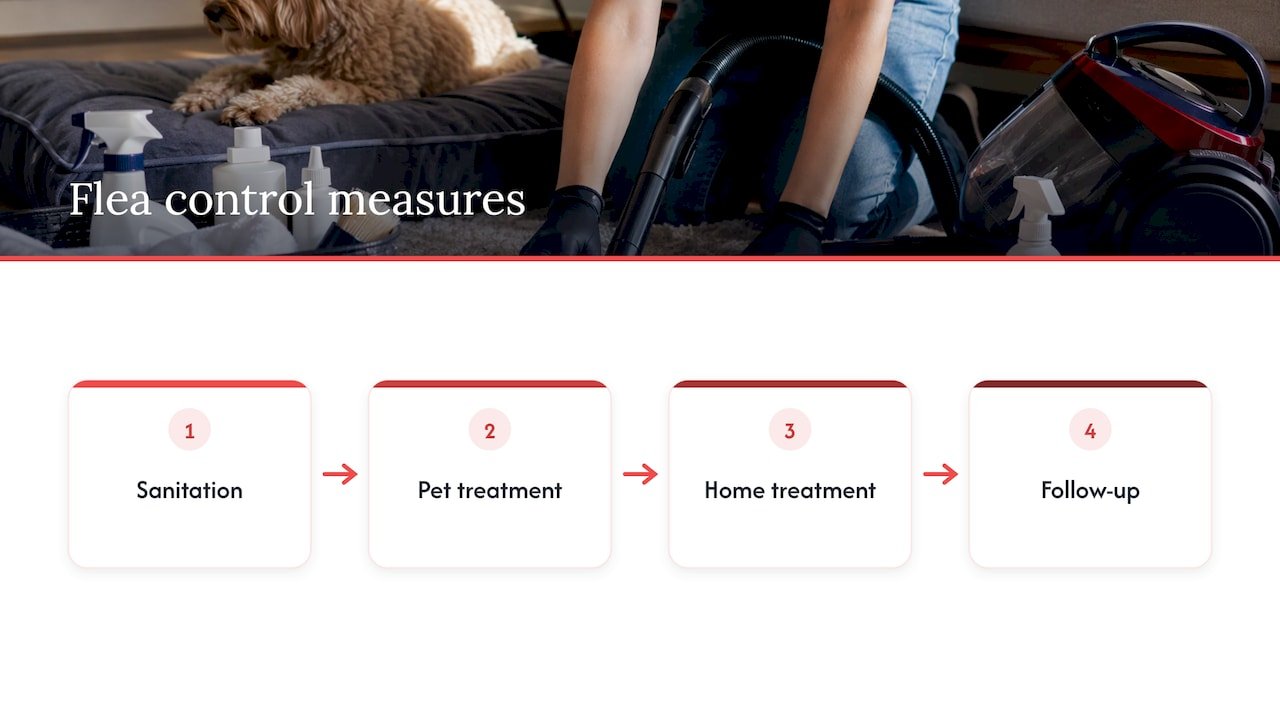
The CDC frames it as a four-step process: sanitation, pet treatment, home treatment and follow-up. Here is how that plays out in an Australian home.
Step 1: Treat every pet
The RSPCA advises treating all pets in the household with a product suitable for each individual animal. It also says supermarket flea preventatives should not be bought without veterinary advice, and that there is no evidence that alternative remedies such as tea leaves or citronella work. Ask your vet which product suits each pet. If you want to read about how dog flea and tick products compare in testing, this review of dog flea and tick treatments is a good place to start before that conversation.
Step 2: Vacuum, then vacuum again
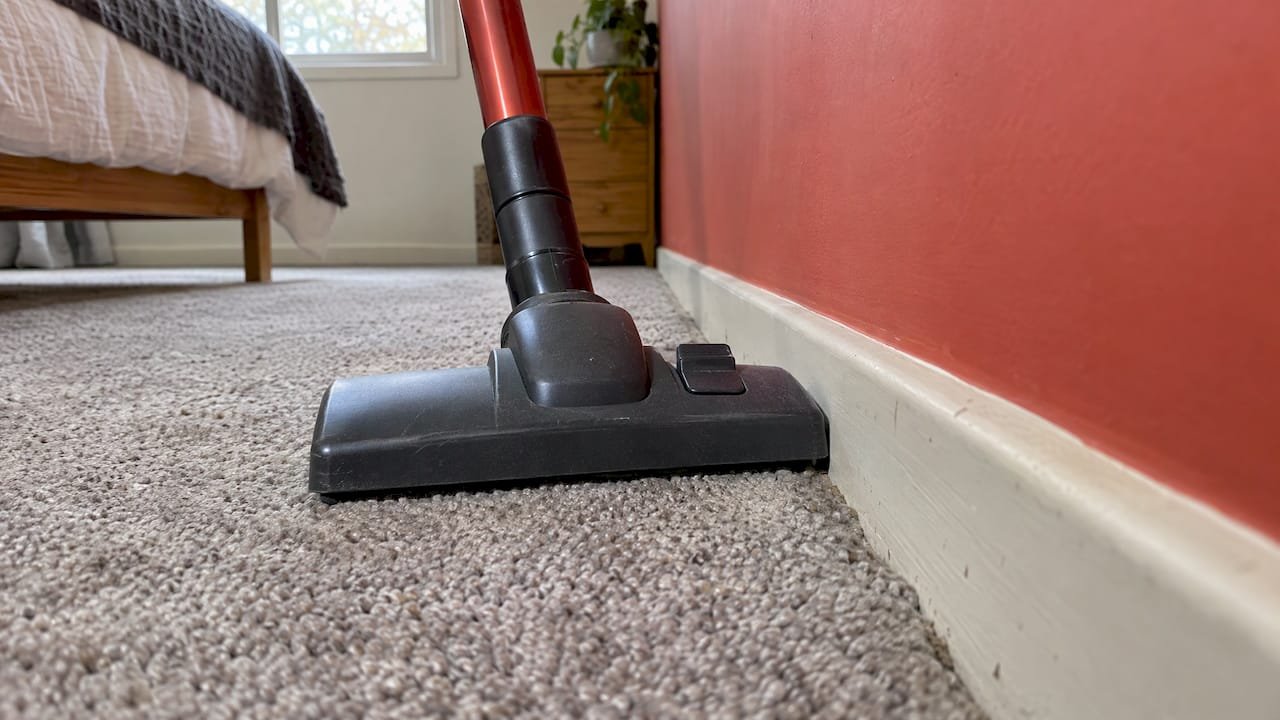
Texas A&M reports that vacuuming removes up to 30 percent of larvae and up to 60 percent of eggs from carpet. A veterinarian writing for Petful adds that the vibration and warmth can coax dormant pupae to hatch early, pulling them out of their cocoons and into reach of treatment.
Vacuum floors, rugs, upholstery and the edges of rooms. DermNet NZ advises sealing and disposing of vacuum bags to avoid re-infestation, and steam cleaning carpets in severe cases.
Step 3: Wash bedding weekly
The RSPCA recommends that every week until the infestation is cleared you wash bedding at a high temperature, vacuum floors and furniture, and spray outdoor kennels, runs or enclosures. Include your pet’s bedding and any blankets they lie on.
Step 4: Treat the home and the harborage areas
AEPMA says control typically combines hygiene and housekeeping, treating pets and bedding, and chemical treatment of infested areas. A professional pest manager treats the areas where fleas are active and the harborages where larvae may be present, including sandy areas around the home and the subfloor.
Step 5: Follow up on schedule
The CDC explains that fleas are resistant to insecticides at some life stages. To catch all of them, it calls for two or more follow-up treatments within 5 to 10 days after the first application, with vacuuming and sanitation continuing throughout. Products containing an insect growth regulator alongside an adult-killing ingredient are recommended by one veterinarian, because resistant pupae keep hatching during the treatment window.
A realistic timeline
| When | What to do |
|---|---|
| Day 1 | Treat all pets with a vet-recommended product, vacuum thoroughly, wash bedding hot, book a home treatment if the problem is established |
| Days 5 to 10 | Follow-up treatment and another full vacuum |
| Weeks 2 to 4 | Keep vacuuming and washing bedding weekly; expect a few fleas to still emerge from cocoons |
| Weeks 4 to 12 | Keep pet prevention going without gaps; watch for new sightings |
This is a general pattern drawn from the sources above, not a guarantee. A heavy, long-running infestation can take longer.
After a professional flea treatment
Cleaning after treatment matters, because it affects how well follow-up works. Our guide on cleaning after pest control covers what to wipe, what to leave and when to vacuum. If you want to prepare before a visit, see our pest control preparation checklist. For a longer walk-through of the process, our article on breaking the flea life cycle in Australian homes goes into more detail.
Our view: why timing beats strength
When we are called out for fleas, the homeowner has usually already treated the pet and sprayed once. The fleas came back because the cycle was only interrupted, not finished. Pupae sit in cocoons through the first treatment, and the carpet and floor cracks are where larvae shelter.
Our approach is built around that. Our licensed technicians treat the areas where fleas are actively living and the harborages where larvae shelter, with a focus on effective and responsible treatments for families, children and pets. We then work to the follow-up window so the next wave is dealt with as it emerges, not weeks later.
We have serviced 5,000+ Canberra homes over 10+ years, and the pattern is consistent: the households that get on top of fleas fastest are the ones that treat pets, clean thoroughly and have the home treated on a schedule. All our treatments are guaranteed for effectiveness.
navin
Get the home treated properly
If you are past the first week and still seeing fleas, bring in a licensed technician. Our general pest control service covers homes across Canberra and surrounding suburbs, with fast response and same-day emergency service available.

If you would rather have regular protection, our subscription plans start with a Bronze General Pest plan at $29.98 per month. Silver Combined is $55.98 per month and Gold Complete is $79.98 per month. See what each plan covers on our maintenance plans page, or contact us to book.
Keeping fleas from coming back
- Keep pet prevention continuous. The RSPCA’s advice is to treat all pets with a suitable product, and gaps in cover let the cycle restart.
- Vacuum high-traffic areas regularly, especially where pets sleep and rest.
- Wash pet bedding often at a high temperature.
- Watch outdoor resting spots. Shaded, sandy or sheltered ground where pets lie can hold eggs and larvae, as can subfloor areas.
- Act early. A handful of fleas in one room is far easier to resolve than a household-wide problem.
Fleas are not the only pest that hides in carpet. If you are seeing small bugs that are not fleas, our guide to carpet beetle removal helps you tell the difference.
FAQ
How long do fleas live in a house?
Adult fleas without a host live only a few days to 2 weeks, but the infestation itself lasts much longer because eggs, larvae and pupae keep producing new adults. PetMD says an infestation can last several weeks to a few months. Pupae can wait in cocoons for months until they sense a host.
Can fleas live in carpet without pets?
Larvae and pupae can live in carpet for weeks to months, and the CDC says adults emerge when they detect movement or body heat. That means a person walking in can trigger a hatch, even in a home with no pets at present. A vacant home that has had fleas can therefore still have a problem.
What kills fleas immediately in the house?
Nothing removes every stage at once. Adult-killing products act quickly, but pupae are not killed by insecticide, freezing or drying, according to Cornell. Vacuuming, hot-washing bedding, treating pets and following up within 5 to 10 days is what breaks the cycle.
Why do fleas come back after treatment?
Usually because pupae were protected in cocoons when the first treatment was applied, and they hatched afterward. The CDC recommends two or more follow-up treatments within 5 to 10 days of the first. Missing a pet, or stopping prevention too early, also lets the cycle restart.
When should I call a pest professional?
Call one if fleas persist beyond a couple of weeks of consistent pet treatment and cleaning, if the problem is in several rooms, or if fleas are in subfloor or outdoor areas. A technician can treat the harborages where larvae shelter.
Sources
- Fleas – pest control, Victorian Department of Health
- Flea Lifecycles, CDC
- Getting Rid of Fleas, CDC
- Fleas, Cornell University College of Veterinary Medicine
- Fleas in Dogs and Cats, Merck Veterinary Manual
- In Focus: Fleas and Flea Treatments, Professional Pest Manager
- AEPMA pest profile: Flea
- Fleas, MU Extension
- Flea bites, DermNet
- How to Get Rid of Fleas, Texas A&M AgriLife Extension
- How do I stop my companion animal from getting fleas? RSPCA Knowledgebase
- How To Get Rid of a Flea Infestation, PetMD
- How Long Do Fleas Live Without a Host? PetMD
- How to Get Rid of Fleas in the House, Petful
- Advantix vs Frontline for dog owners