A food business licence is rarely lost to a rodent. It is lost to a folder. When an inspector walks into your kitchen, the first question is not what you sprayed, it is what you can prove. This post treats your paperwork as the asset it is and gives you an inspection-readiness checklist you can audit against this week.
You will work through four record sets that do the heavy lifting in commercial kitchen pest control: dated service reports, monitoring station maps and device registers, pest sighting and activity logs, and corrective actions with closure evidence. Along the way, the post examines what ACT food businesses must do about pests under the Food Standards Code, including clauses 3.2.2 and 3.2.3, plus the record-keeping system required under Standard 3.2.2A, and what the most commonly written-up gaps actually look like.
You will also learn how to audit records across a full inspection cycle, where a commercial pest control service genuinely helps and where it does not, and how to manage retention, ownership and handover. The final section maps out your next seven days.
Why Your Licence Is Exposed by Records, Not Rodents
An ACT Health inspector is not assessing whether you paid for a treatment. They assess whether you can demonstrate control. An empty folder reads as no system at all.
Clause 3.2.2 of the Food Standards Code requires all practicable measures to prevent pests entering the premises and to eradicate and prevent harbourage, per a secondary summary of clause 3.2.2 that you should check against the Code itself.
A spray visit is an event. Records are the evidence trail connecting that event to what you did about the pest activity around it. Commercial kitchen pest control usually fails at the documentation layer, not the treatment layer: treatments are outsourced, and the records surrounding them are not.
Treat the audit as a test of speed. What can you hand an inspector in under five minutes that shows a cycle of monitoring, not a one-off visit? A documented pest management cycle for Canberra hospitality businesses makes each visit, sighting and fix traceable. Start with the obligations themselves.
What ACT Food Businesses Must Do About Pests
The obligations start nationally, then land locally. Clause 3.2.2 of the Food Standards Code requires all practicable measures to prevent pests entering the premises and to eradicate and prevent harbourage. Verify it against the Code itself. Clause 3.2.3 covers waste storage and removal, which is why bin rooms, grease traps and collection points recur in pest records. Standard 3.2.2A requires a record-keeping system for prescribed activities, with records kept at least three months; it took effect on 8 December 2022, with enforcement by local governments from 2023.
Two related failures surface in the same inspection. A Food Safety Supervisor certificate is current for five years, so a lapsed one sits beside a missing pest report in the officer’s notes. ACT requirements sit in the Food Act 2001 (ACT) and ACT Health guidance, so confirm your obligations with ACT Health rather than interstate law. If a provider will carry the service side, understand what a Canberra commercial pest control contract should contain before signing.
What to Gather Before You Start the Audit
Before you open a single folder, pull these five items together, so the audit runs on evidence rather than memory.
- Licence and registration details, to check the premises description against what actually operates today.
- Every pest control service report from the last 12 months, plus the matching invoices. Undated or missing reports are the easiest gap for an inspector to spot.
- The current monitoring station map or device plan, alongside any site plan showing bin stores, grease traps, delivery doors, dry stores and dishwash areas.
- Your pest sighting log, including staff-reported sightings that never reached a manager or provider.
- The name of the person holding food safety responsibilities on site, and confirmation their Food Safety Supervisor certificate is current.
If item two is thin, the problem may sit with your provider rather than your filing. The questions to ask before hiring a commercial pest control provider in Canberra help you test what records you will receive, and when.
Expected outcome: any duty manager can produce all five within five minutes.
Record 1: Dated Pest Control Service Reports
Start here, with the reports themselves, because they are the spine of the record set.
Each report is provider-issued, dated, and names the technician, the areas treated, the products used and any observations made on site. Gaps look like reports for some months but not others, a report missing the premises address or date, or one annual invoice standing in for twelve visits.
Check two things: that each report names the site rather than just the business, and that its observations line up with your own log for that month. Silence in your log while the report lists activity is itself the finding.
The report proves a commercial pest control service attended; it does not prove your monitoring or corrective actions happened. File each report beside its follow-up, because a report that flags activity with no matching corrective action is half a record, and knowing when to call your pest control company back is how that loop gets closed.
Record 2: Monitoring Station Maps and Device Registers
Once the reports are filed, the next layer is the map showing where those devices actually sit.
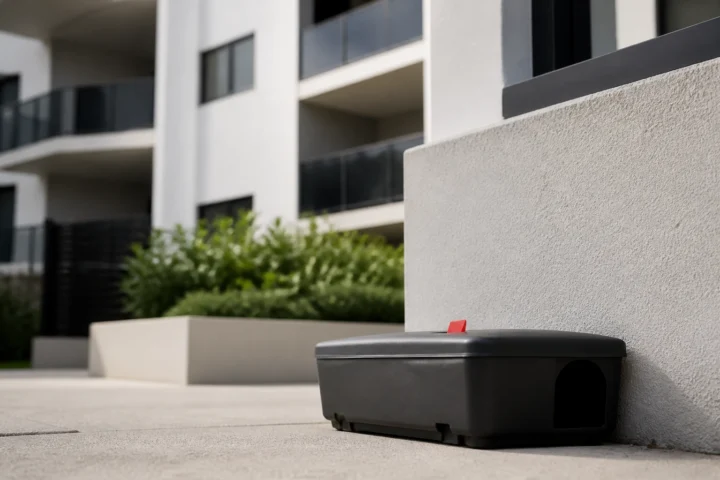
A monitoring station map is a plan of the premises marking every rodent bait station, insect light trap, pheromone monitor and glue board, each with a unique device ID. The device register is the matching list.
Typical gaps: a map with no revision date, devices still listed that no longer exist on site, or a plan never updated after a kitchen refit.
Run three counts against each other: the map, the register and the physical devices on site. Every ID should also appear in the service reports you have filed, which is where what a licensed pest technician actually checks for becomes verifiable.
The map is how an inspector confirms coverage of high-risk zones: dry stores, bin rooms, loading docks and dishwash areas. Re-date it whenever the layout changes, so the revision sequence stays visible to anyone opening the folder.
Record 3: Pest Sighting and Activity Logs
With your device map reconciled, the next record is the one only your team can produce. A pest sighting and activity log is a running record of what was seen, where, when and by whom: droppings, gnaw marks, live insects, flies and sightings reported by staff.
A gap looks like nothing logged for months in a busy commercial kitchen, or entries with no date, no location and no follow-up reference. Check that every entry links to an action, even if that action is simply reported to the provider on service day, with that date recorded.
A blank log is not evidence of absence. It reads as no monitoring between visits. Make logging fast: a laminated sheet at the pass or a phone form keeps the habit alive during service. Apply the same scrutiny you would when learning how to read a termite inspection report, where small omissions change the whole story.
Next: turning those entries into closed corrective actions.
Record 4: Corrective Actions and Closure Evidence
Every sighting log entry needs a matching corrective action. This record states what was found, what was done, who did it, when, and what confirmed the fix worked.
A gap reads as the single word sprayed next to a finding: no date, no responsible person, no follow-up check. It documents an event, not a fix.
Record structural work (door seals, screens, gap sealing, bin lids) separately from chemical treatments. They are different forms of control, and merging them hides whether exclusion work was completed.
Keep one numbered register, cross-referenced to the sighting log and the service report, so an inspector can trace finding to fix in minutes.
Why it matters: corrective actions show you close the loop, which is what the Code’s prevent and eradicate language points at.
Where your provider did the work, attach their report to the corrective action entry rather than filing the two separately. Split records break the chain an inspector follows.
With all four records built, the audit runs across the service cycle.
Auditing Your Records Across the Inspection Cycle
Corrective actions only earn their keep if they sit inside a cycle that keeps running. Audit your records in five stages.
Pre-service: agree the scope with your provider before the visit, listing high-risk zones and any new activity, so the resulting report reflects your actual concerns.
Service day: walk the technician through the site, sign the report, and write verbal observations into your own log the same day.
Between visits: log sightings, confirm device placement has not been disturbed, and action structural issues while they are small and cheap. That is Integrated Pest Management for ACT Commercial Properties in practice.
Inspection day: have the last 12 months of service reports, the current monitoring map, the sighting log and the corrective action register in one folder, physical or digital.
After inspection: record findings and fixes in the same register, so the next inspection sees a continuous cycle, not a clean-up.
The Gaps That Get Written Up Most Often
Run that cycle once and the same five failures tend to surface. Missing or undated service reports break the chain between a visit happening and a visit being provable; if a report lacks a date or premises address, treat it as absent. A monitoring map that was never revised after a refit is equally damaging, because coverage cannot be verified against the premises as it now operates. An empty sighting log, or one full of entries with no action recorded, reads as no active monitoring between provider visits. Corrective actions without closure show a finding was noted but nobody recorded the fix. Finally, records held only by your provider leave you unable to produce your own evidence on the day without chasing documents.
Each gap is administrative, not a treatment failure: commercial kitchen pest control fails less at the spray than at the paper. Your record set is yours; the next section examines what a provider supplies and what remains your responsibility.
Where a Commercial Pest Control Service Fits, and Where It Does Not
That division of labour is the point: a licensed provider supplies the reports, device maps and treatment detail your record set depends on, but never replaces your own logs or corrective actions.
Ask any provider for three things: dated per-visit reports naming the site, a current monitoring station map with unique device IDs, and observations written in plain language a duty manager can act on.
What a provider cannot do is certify your compliance, sign off your monitoring obligations, or absorb responsibility for structural repairs on your premises. Those stay with you.
BugsPatrol is a locally owned Canberra provider based in Throsby, servicing the ACT and surrounding NSW, fully licensed and offering 12-month warranties with rolling cover, monthly payments and no upfront fees. When comparing pest control services commercial venues use, judge the record set left behind as much as the price per visit, an approach set out in our guide to choosing the right pest control company in Canberra.
Retention, Ownership and Handover
Whoever holds the records holds the defence. Standard 3.2.2A sets a minimum three-month retention period for prescribed activity records; keeping a rolling 12 months is recommended good practice, and it lets you read trends: activity rising in one zone, seasonal fly pressure, a station that keeps catching.
Own your copies. A provider portal is convenient, not an archive. Download and file each dated service report, and your own logs, under your own system.
One test applies to storage: can a duty manager produce the set in five minutes without calling you? Inspections are not scheduled around your roster.
On a management or ownership change, hand over the complete record set as part of the food safety program, including the current monitoring map and the corrective action register.
Finally, confirm retention specifics for your category with ACT Health and the Food Act 2001 (ACT); national minimums are a floor, not a ceiling.
That folder is the deliverable: one place, one owner, seven days to build it.
Your Next Seven Days
Put the theory to work. Seven days, one pass each.
- Day one: pull every pest control report from the last 12 months and mark the months with nothing on file. Each gap is a break in the chain an inspector will follow.
- Day two: walk the site holding the current monitoring map. Reconcile every device against it, noting stations that no longer exist and any on site but unlisted.
- Day three: open the sighting log and confirm every entry carries a date, a location and an action taken. Unactioned entries read as no monitoring.
- Days four and five: close out corrective actions still open. If gaps remain in the report chain, book a commercial pest control service now, not during inspection week.
- Days six and seven: build one inspection folder, digital or physical, holding reports, the map, the log and the corrective action register. Name the person who owns it.
Conclusion
Pest control records are the evidence an ACT inspector reads first, and gaps, not pests, are what expose a licence. Four records carry the weight: dated service reports, an accurate monitoring map and device register, a sighting log with actions attached, and closed corrective actions with proof. Together they form an unbroken chain an inspector can follow.
The five-minute test is the standard to build toward: a duty manager should produce the full set without calling you. Confirm retention rules for your category with ACT Health and the Food Act 2001 (ACT), and hand the complete set over on any ownership or management change.
Your next step is simple. Start day one tomorrow: pull twelve months of reports and mark every gap. Build the folder this week, name its owner, and walk into any inspection already prepared.