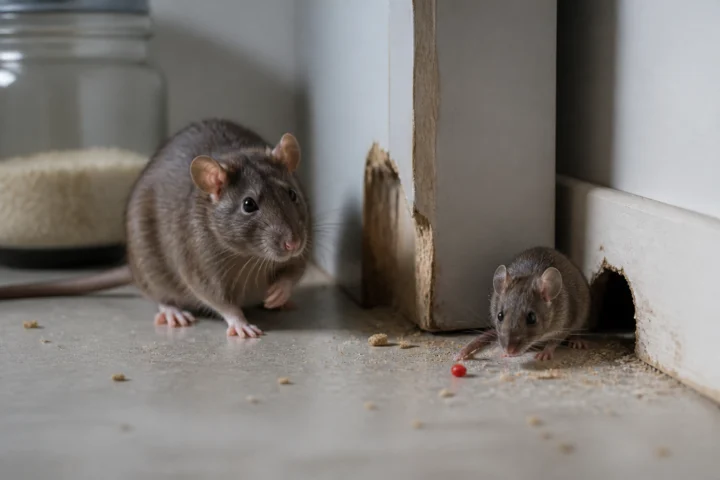
If you have heard scratching at night, found droppings near the pantry, or spotted a blurred shape along a skirting board, the first question is not “How do I get rid of it?” It is “Is this a rat or a mouse?” That single call changes everything. Rats and mice leave different droppings, cause different damage, and use different travel routes through a Canberra home. Treat the wrong species and you may place traps where they will never be triggered, use bait where it is unsafe or ineffective, or seal a gap that is far too small for the animal at hand.
This guide gives you a decisive, beginner-friendly way to tell them apart before you book. You will learn a 60-second side-by-side comparison, how to read droppings, body size and tail, damage and travel routes, and how to check your Canberra home without making the problem worse. We then explain why identification changes baiting, trapping and exclusion, why Norway rats and roof rats are not the same answer, and when to stop DIY and call for professional rodent control canberra. By the end, you will know what you are dealing with and what treatment plan actually fits.
Why the Rat or Mouse Call Comes Before You Book
Most Canberra homeowners book a generic rodent treatment and expect the technician to identify the species. Making the call first means you know what the visit should involve and can ask better questions.
In Australia, “rat” covers two very different species, the Norway rat and the roof rat, plus the house mouse. Each differs in size, habits, entry and habitat (Rodents and pest control). Over 2,200 rodent species exist worldwide, over 40 per cent of mammals; Australia has 60-plus native rodents and three introduced pests.
Rats and mice climb, jump, burrow and gnaw with front incisors (National Park Service, general biology). Guess wrong and you get the wrong device in the wrong place, plus repeat visits. Ahead: a fast side by side identification block, then how the answer changes baiting, trapping and exclusion, and why getting it wrong makes it worse.
The 60 Second Side by Side: Rat vs Mouse at a Glance
Use this to sort the three common culprits in one pass.
| Signal | Norway rat | Roof rat | House mouse |
|---|---|---|---|
| Droppings | Banana or sausage shaped | Smaller than the Norway rat’s | , |
| Body and tail | 20 to 27 cm body; 16 to 20 cm tail; 200 to 500 g | Smaller and slimmer; strong climber | (see species pages) |
| Where you find evidence | Ground level, burrows, subfloor | Roof voids and buildings; built-up areas | Small gaps and cavities |
| Activity timing | Usually nocturnal | , | (see species pages) |
| Damage signature | Digging and burrowing | Gnawing and nesting in roof voids | Similar gnawing on a smaller scale |
| Likely entry route | Under slabs, drains, soil | Roof lines, fascia, overhanging branches | Gaps as small as 1/4 inch (general biology) |
Droppings are a useful first indicator, check size, shape and location alongside body size.
Read the Droppings First: Shape, Size and Location
Dropping size is the fastest tell; any dropping is a sign of a rodent’s presence worth logging. Rat droppings are larger, banana or sausage shaped with tapered ends, and appear along skirting boards, behind appliances, in roof voids and near stored food. Mouse droppings are generally smaller than rat droppings, confirm with body size and location signals.
Freshness and grouping show whether the problem is current. Clusters along a wall mark an active route.
Location is a second signal. Droppings on stored goods or in ceiling spaces point to a climbing species. Ground-level evidence, under slabs, around sheds, in garden beds, fits digging behaviour.
Wear gloves, never sweep dry droppings where dust can be breathed in, and disinfect afterwards. Removing food, water and shelter is effective in its own right, so run it alongside treatment.
Body Size and Tail: The Physical Tells
Droppings give the first clue; the animal confirms it. As shown in the table above, Norway rats are substantially larger than mice. Norway rat tails (16–20 cm) are shorter than the combined head and body, while mice are noticeably smaller overall. Norway rats are stocky with blunt noses and short ears, while roof rats are smaller than Norway rats and are strong climbers.
Scratching high in the ceiling or roof void points to a climbing species, likely a roof rat or mouse, not a ground and burrow oriented Norway rat.
Damage and Travel Routes: How Each Species Uses Your Home
Size and tail narrow the field, but damage rarely settles it alone, as noted in the opening section, both rats and mice gnaw and move through a home. Use damage as a direction, not a verdict.
The Norway rat is the digger. Look for burrows and pushed-out soil under slabs, along shed edges and in garden beds near compost or chook pens. As noted in the comparison table, the roof rat nests in roof voids and buildings, so check roof lines, fascia, vents, cable runs and tree branches touching the house, especially in built-up areas. Mice exploit gaps as small as 1/4 inch, appearing in drawers, appliance cavities, wall cavities and behind kickboards.
Runways are habitual routes, often along walls. Active routes are often found along walls; check both ground level and overhead for signs of travel. In practice, no single damage pattern confirms species; it narrows the likely culprit. Gutter lines and roof edges are common entry highways, as covered in Rodents: Highway to Your Roof.
How to Check Your Canberra Home Without Making It Worse
Damage points to where rodents travel, but the inspection tells you what you are dealing with. Start with a torch and gloves, and never use bare hands. Work the roof void, subfloor, pantry, laundry, garage and behind whitegoods. For a room-by-room route, see Where to Check in Your Canberra Home. Before you look, listen at night for scratching, scurrying or gnawing, and note the direction of travel; in a quiet house this is often the only clue. Photograph smudge marks, gnaw marks on packaging, cabling, timber and pipe insulation, plus droppings, with a coin or ruler for scale. Confirm what you are dealing with before sealing; your technician will advise on sequencing removal and exclusion. Remove food, water and shelter by storing food in sealed containers, clearing pet food overnight, fixing dripping taps and reducing clutter. Keep a simple log of what, where and when; it is the most useful thing to hand a technician.
Why the Answer Changes Baiting, Trapping and Exclusion
That log answers more than what the animal is. A generic rodent visit assumes one approach. Species changes bait choice and placement, trap size and placement, and how the building is sealed. Pest control operators usually use rodenticides (Victoria Department of Health), making placement and safety planning real decisions, not formalities. Identification also drives device count, where devices sit, and how long monitoring runs before the job is finished.
The three subsections below are service informed guidance. Our research found no source comparing methods by species, and specific bait actives should not be assumed.
Baiting follows travel routes. Trapping matches trap size to the animal. Exclusion seals to each species’ gap tolerance. The same species-first logic shapes termite treatment planning, where method follows the pest and the structure.
Baiting: Placement and Safety Change With the Species
Within that plan, bait placement starts with the species, not the droppings. Stations sit where the animal actually travels and forages, because rats and mice use different ranges and cover. Roof rats and mice move above ground, so roof void placements matter, while Norway rats stay ground and burrow oriented, favouring subfloors, sheds and garden edges.
Tamper-resistant stations are a key safety measure. In a home with pets or children, the technician maps active runways first, then secures stations out of reach. Bait consumption and placement location help the technician judge whether the target species is feeding and whether the plan needs adjusting.
Trapping: Why Trap Size and Placement Follow the Identification
With bait take mapped, trap size must match your identification. A rat trap rarely triggers on a mouse.
Set traps along walls and runways, not open floor. Secure each one so it cannot be dragged, and match placement to the species: roof void and subfloor placements differ from kitchen and pantry ones. Pre-bait unset traps for several days before setting, since rodents avoid new objects, then check daily.
Trapping alone rarely clears an established population. Pair it with sanitation and exclusion, and confirm mice are actually in the wall before you commit.
Exclusion: A Mouse Gap Is Not a Rat Entry Point
Exclusion is where a generic rodent visit often fails. Mice squeeze through gaps as small as 1/4 inch (about 6 mm), so mouse exclusion is a fine scale sealing job across the whole building envelope, not a few obvious holes.
Rats need wider openings and are strong gnawers and diggers, so the work involves heavier materials, plus slabs, subfloor areas, drains and burrow proofing. Roof rats add roof line work: fascia, flashing, vents, cable entry points, and any tree branch within reach of the roof.
As noted in the inspection step, removal comes before sealing.
Done well, exclusion quality determines whether the treatment holds, which is exactly why species identification comes first.
Canberra Rodent Control: Why Local Conditions Shape the Plan
Exclusion holds only as well as the environment allows. Canberra’s mix of residential building types and surrounding bushland means rodent access points vary by property, a local assessment matters.
Cold weather generally encourages rodents to seek indoor warmth and food sources, so cooler months often see more activity inside homes, this is general biology rather than local trend data.
ACT-based operators also service surrounding NSW regions under similar conditions. The roof rat, in particular, is associated with built up areas (Victoria Department of Health).
Note on sourcing: no 2026 Canberra rodent activity data exists in this research. Avoid population figures and urgency claims. The ACT Government Rats and mice page is the most locally relevant source and needs full retrieval before publication.
Norway Rat or Roof Rat? Why Rat Is Not One Answer
Local conditions shape the risk; the species shapes the job.
As shown in the comparison table and body size section, the Norway rat and roof rat differ significantly in size, habits and habitat, one is a ground-level digger, the other a climber that nests in roof voids.
Norway rats produce 5 to 6 litters of 8 to 10 pups a year; roof rats, 4 to 5 litters of 6 to 8. Both mature at 3 to 4 months after a 21 day gestation. Populations can rebound quickly, so delay adds to the job.
That answer decides whether it is a subfloor and burrow job or a roof void job, with different devices and sealing.
When to Stop DIY and Book an Inspection
Book an inspection if:
- Scratching continues after you remove food and water.
- Droppings return within days of cleaning.
- Evidence appears in more than one room.
- Gnaw damage reaches wiring.
- Rodent signs appear near food preparation areas.
These signals suggest an established population with a breeding cycle, not a single animal passing through. DIY guesswork at this stage wastes time and can scatter the problem.
BugsPatrol is one practical option: locally owned and operated from Throsby in Canberra, servicing the ACT and surrounding NSW for residential and commercial customers. Rodent control is among its pest management services.
Book an inspection and bring your photos and log. They let the technician plan baiting, trapping and exclusion around the species you are actually dealing with.
Your Action List: Identify, Then Treat
Before booking, turn your findings into a simple plan.
- Make the call: use dropping size and shape, body and tail proportion, and where evidence sits, ground level or overhead.
- Record it: photograph droppings and gnaw marks beside a coin or ruler, and keep a short log of times and locations.
- Remove food, water and shelter: Victorian guidance lists this as an effective control measure alongside any treatment.
- Escalate: if evidence persists or spreads, book a professional inspection. BugsPatrol (details above) can plan treatment around the species in your home.
The identification call you make in ten minutes of checking determines the baiting, trapping and exclusion work that follows, so know the species before you book.
Conclusion
The ten minutes you spend identifying the rodent shape how everything that follows works. Matching treatment to species, rat or mouse, Norway rat or roof rat, is what makes baiting, trapping and exclusion effective rather than approximate. Identify confidently, bring your photos and log, and let that evidence drive the treatment plan.