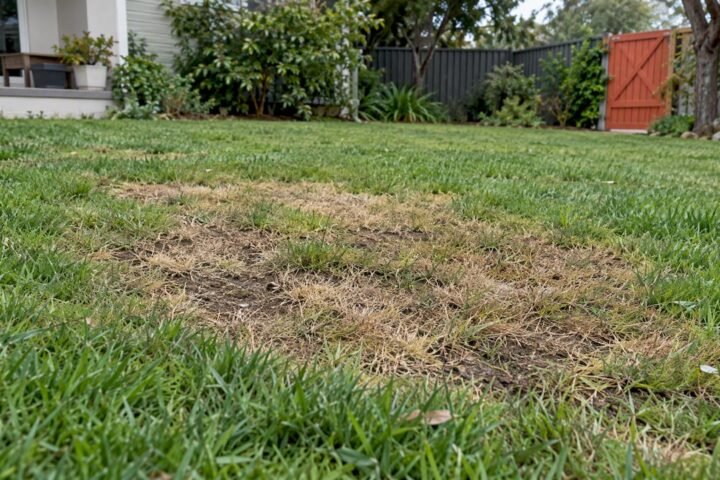
If your Canberra lawn is going yellow or brown in patches over spring and summer, lawn grubs are one possible cause, but not the only one. The reliable approach is to confirm the pest first, then treat only if the numbers and the damage justify it, and to do so in a way that is safe for kids, pets and bees. This guide shows you how to do that step by step, and when it makes sense to call a licensed technician.
TL;DR
- “Lawn grubs” is a catch-all term: beetle larvae that eat roots below ground, and caterpillars such as armyworm that eat leaves above it.
- Brown patches also come from drought, over- or under-watering, fertilizer burn and dog urine, so rule those out before you treat.
- Check your lawn through the warmer months. Adult scarab beetles fly from November to March in New South Wales, and larvae sit just below the surface in spring, summer and autumn.
- Scattered grubs are usually harmless. Treat when you confirm a real infestation, and always follow the product label.
- A healthy, deeper-rooted lawn is your best long-term defense. For a confirmed problem, our licensed team can inspect and treat.
Table of Contents
- What lawn grubs actually are
- Is it really grubs? Rule out the look-alikes first
- How to check your lawn for grubs
- When to check in Canberra
- Your treatment options
- Safe treatment around kids, pets and wildlife
- How to stop grubs coming back
- Our perspective: inspect first, treat precisely
- Get your lawn checked by a local team
- FAQ
- Sources
What lawn grubs actually are
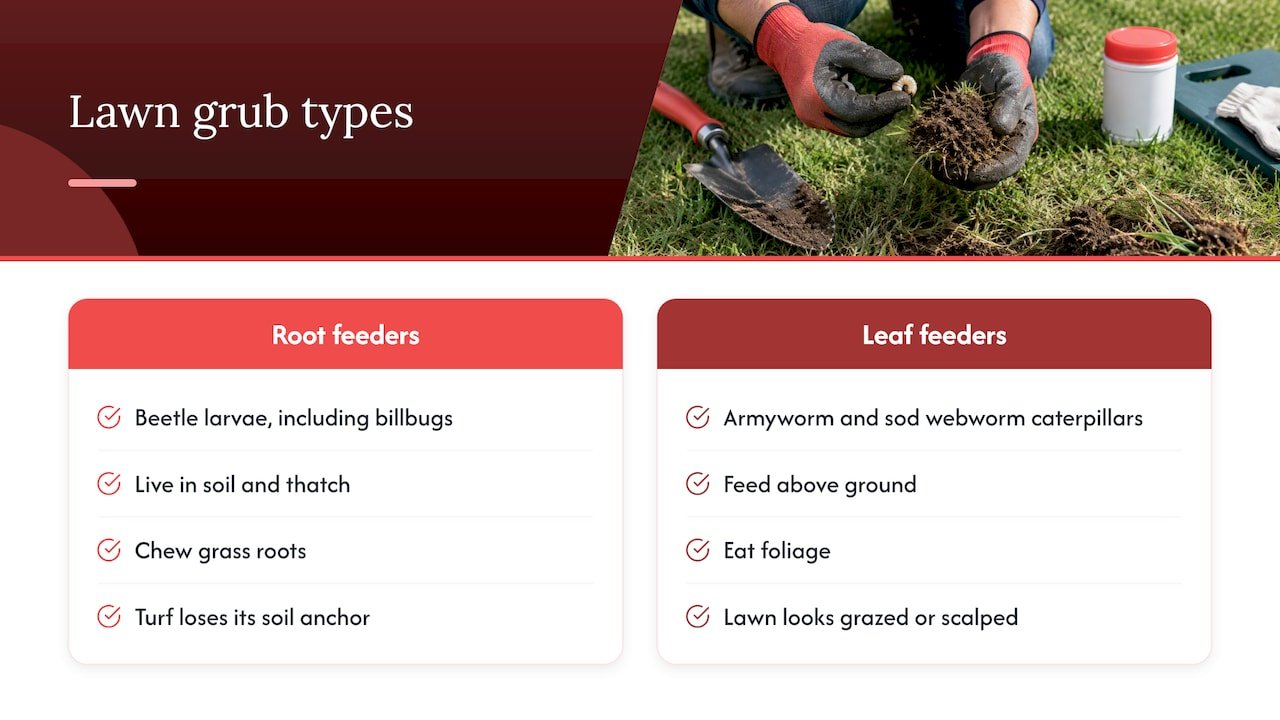
People use “lawn grubs” for two different groups of pests, and the difference matters because they behave differently.
Root feeders. These are the larvae of several beetle species, including the African black beetle, the Argentinian scarab and billbugs. Bunnings and The Lawn Firm describe lawn grubs as larvae that chew grass roots. You will often hear them called curl grubs, because they curl into a C shape when you dig them up. They live in the soil and thatch layer and do not climb the grass blades.
Leaf feeders. Lawn armyworm and sod webworm are caterpillars. They feed on the foliage above ground, so the damage looks more like a lawn that has been grazed or scalped than one that has lost its anchor in the soil.
The practical upshot: a treatment aimed at root-feeding larvae will not necessarily suit a caterpillar problem, and the other way round. Identifying what you have is the first job.
Not every grub is a villain
Some curl grubs are native species. Researchers Tanya Latty and Chris Reid argue that native curl grubs can help soil health by aerating and mixing nutrients, and they suggest using the health of your plants as the main sign that action is needed, rather than killing every larva you find. That is sensible advice for a lawn that looks green and thick. It is also why we start with an inspection, not a spray.
Is it really grubs? Rule out the look-alikes first
Brown lawn in Canberra has plenty of causes. Our dry summers, frosty winters and clay-heavy soils give turf a lot to cope with. Before you assume grubs, review what has happened in the lawn lately.
The University of Maryland’s extension service lists common causes of brown or dead patches: drought, fertilizer or pesticide damage, poor watering practices and dog urine. It advises reviewing the lawn’s history and watering before concluding that pests are responsible. The University of California’s agriculture extension goes further, noting that improper management such as incorrect irrigation is a more common cause of lawn problems than pests. Both are US sources, but the diagnostic logic carries over to any lawn.
A quick checklist:
- Watering. Did the patch appear after a hot spell, or after a sprinkler failed or a run was missed?
- Fertilizer or chemicals. Did you spread fertilizer, weed killer or any spray in the weeks before the damage?
- Pets. Are the patches small, round and found where the dog usually goes?
- Pattern. Grub damage tends to spread unevenly and the turf may lift easily because the roots are gone. Drought stress usually shows on exposed, sunny or compacted sections first.
If none of those explains it, move on to checking for the pest itself.
How to check your lawn for grubs
Two simple tests will tell you most of what you need.
The soapy water test
Better Homes & Gardens Australia describes pouring soapy water over a suspect patch and watching for grubs to come to the surface within about 10 minutes. It works best on caterpillar-type pests that live in the thatch and near the surface. Do it on the edge of a damaged area, where the grubs are still feeding, not in the middle of dead turf.
The dig and tug test
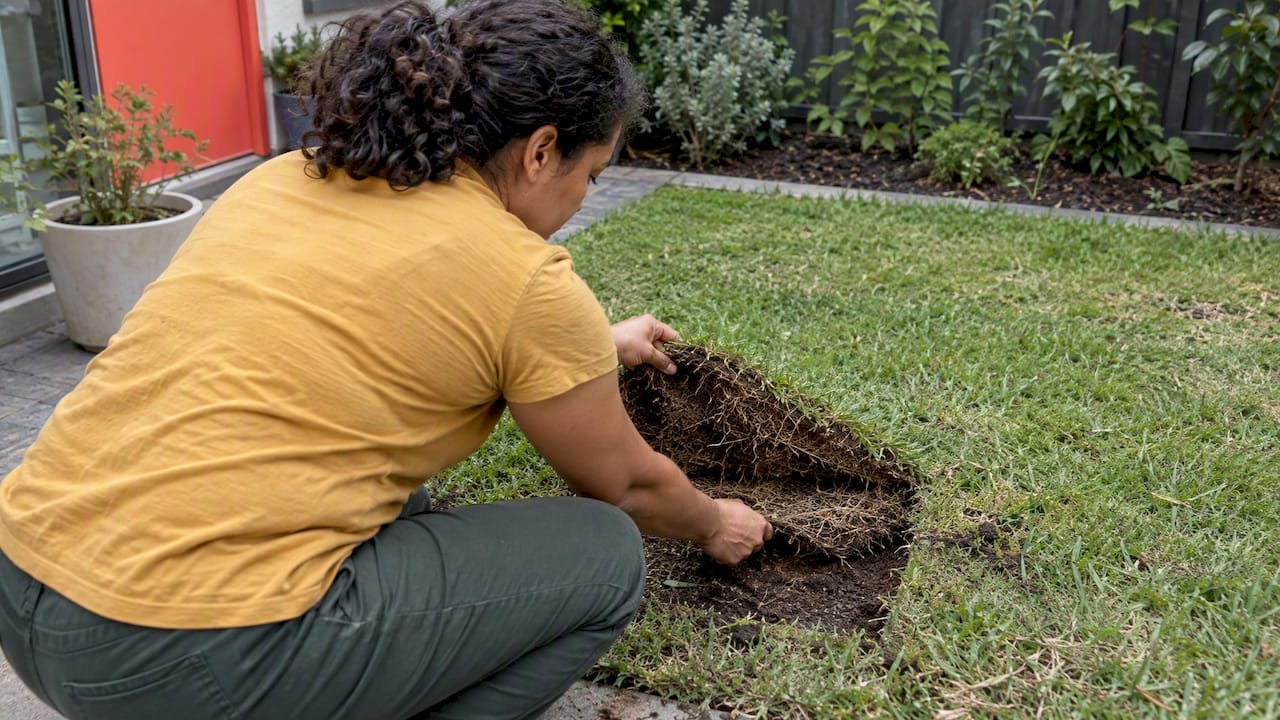
For root feeders, cut three sides of a small square of turf at the edge of a patch, about the size of your hand, and peel it back. Look at the top few centimeters of soil and the thatch. If you find pale, C-shaped larvae, count them. If the turf lifts like a loose mat with almost no roots, that is a strong sign root feeders are at work.
A note for the curious: telling one species from another properly is a specialist job. Envu’s turf team explains that species-level identification generally means examining the raster, the pattern of spines on the underside of the larva’s tip, under a 10x or 20x hand lens. You rarely need that for a home lawn, but it shows why a trained eye helps when the answer affects what you spray.
Other clues
Increased bird activity on the lawn, moths flying up as you walk across it, and yellow or brown patches that keep growing can all point to grubs or caterpillars. Birds digging at turf in the morning is a particularly common sign.
What is a lot of grubs?
A 2026 article syndicated by Phys.org advises treating only when monitoring confirms about 10 or more grubs per square foot, because scattered individuals do no real harm. A square foot is roughly 30 cm by 30 cm, so picture a patch about the size of a dinner plate and a half. This threshold comes from North American turf guidance and Australian species differ, so treat it as a rule of thumb: a handful of grubs in a healthy lawn is not an emergency, while a squirming crowd under a thinning patch is.
When to check in Canberra
Timing is the part most homeowners get wrong. The NSW Department of Primary Industries notes that scarab larvae usually feed in the warmer months and, through spring, summer and autumn, are commonly found 1 to 2 cm below the soil surface. The same page says adult beetles are present from November to March. That document is about pastures on the northern tablelands of NSW, not Canberra lawns, so read it as a guide to the life cycle rather than an exact local calendar.
In practical terms for the ACT:
- Spring: Walk the lawn regularly. Look for early thinning and any increase in bird activity.
- Summer: This is when damage often becomes obvious, because heat stress and root loss combine. Water properly before diagnosing.
- Autumn: Larvae are still feeding near the surface. It is a good time to check patches that have not recovered.
- Winter: Activity slows, and Canberra frosts are not the time to look for surface-feeding grubs.
We cover the local pattern in more detail in our post on lawn grub season in Canberra.
Your treatment options
Once you have confirmed a real problem, you have several routes. Which is right depends on the pest, the size of the infestation and who uses the lawn.
Improve the lawn and tolerate light numbers
If you find only a few grubs, the best response is often to water deeply and less frequently, feed the lawn appropriately and recheck in a couple of weeks. A strong lawn can outgrow modest root pruning.
Hand removal for small outbreaks
For surface-feeding caterpillars, a well-known low-tech method is to lay a wet hessian bag on the lawn overnight. The grubs gather under it and you collect and dispose of them in the morning. It will not solve a lawn-wide infestation, but it helps you confirm what you have.
Biological controls
Beneficial nematodes are microscopic worms that attack grubs in the soil. Rutgers University’s extension service says products containing Heterorhabditis bacteriophora nematodes can give good control of Japanese beetle grubs but are less effective against some other grub species. Japanese beetle is a North American pest, so check that any product you buy is labelled for the grub you actually have in Australia. Nematodes are living organisms: they need moist soil and correct storage, and timing matters.
Chemical treatment
When the infestation is confirmed and plants are suffering, a registered insecticide is the fastest option. In Australia, registration is recorded on the regulator’s public database. For example, the APVMA listing shows a turf insecticide registered on 1 July 2025 with turf uses that include African black beetle larvae and Argentinian scarab. The general rule is simple: the product must be registered for the pest and the site, and you follow the label exactly, including rates, watering-in and re-entry instructions.
What a professional adds
A licensed technician identifies the pest, sizes up the infestation, picks the right product and rate, and applies it evenly at the right time of day and season. Timing and even coverage are where do-it-yourself treatments most often fall short.
Safe treatment around kids, pets and wildlife
A lawn is a living space, so safety is not optional.
Follow the label. Access Canberra’s guidance for the ACT is that agvet chemical products must be used safely and according to the approved label to protect human health and the environment.
Use a licensed operator if you pay someone. The same page explains that commercial pest and weed control operators in the ACT are required to hold an Environmental Authorisation under the Environment Protection Act 1997 because of the potential risks of these chemicals. Ask any provider to confirm theirs.
Protect bees and waterways. Insecticides can harm bees, fish and other aquatic life. Product guidance from the Australian garden brand Yates advises avoiding spraying while bees are foraging and preventing runoff into drains or ponds, and the Phys.org article makes the same point about pollinators and biodiversity. Practically, that means no spraying in flower beds in bloom or at midday when bees are active, and no hosing product down the driveway.
Keep kids and pets off. Keep children and animals off the treated area for as long as the product label says. If you are unsure, ask your technician for the exact re-entry time in writing.
If anyone in your household has been exposed and feels unwell, call the Poisons Information Centre on 13 11 26 and keep the product label handy.
How to stop grubs coming back
Prevention is mostly good lawn care, and it pays off for every lawn problem, not only grubs.
- Mow correctly. Never remove more than one-third of the leaf blade in a single mow, and avoid scalping. Stressed, closely cropped turf is less resilient.
- Manage thatch. A thick thatch layer gives caterpillars somewhere to hide, so dethatch when it builds up.
- Build deep roots. Water deeply and less often, and fertilize appropriately for your grass type. A deep-rooted lawn tolerates root feeding far better.
- Monitor regularly. Do a quick walk-over and a bird-activity check every couple of weeks through the warm months, and act early on small patches.
- Fix the basics first. Repair uneven irrigation, aerate compacted areas and keep an eye on shade and drainage problems.
The Australian turf industry makes the same point: maintaining a healthy, deep-rooted lawn through appropriate fertilizing can reduce the impact of a scarab infestation, and monitoring helps you catch trouble early.
Our perspective: inspect first, treat precisely
We see the same pattern across Canberra yards. A homeowner notices brown patches in January, assumes grubs, and sprays. Sometimes that is right. Often the real story is a dry spot, a blocked sprinkler or a dog, and sometimes it is both grubs and stress at once.
That is why our approach starts with an inspection. Our licensed, insured technicians identify what is actually in the turf, tell you honestly whether it justifies treatment, and choose a method that suits a family yard: children playing, pets running, bees in the garden. We have serviced more than 5,000 Canberra homes over more than 10 years, and we treat responsible, effective control as the standard, not a bonus.
If treatment is needed, we apply it properly and stand behind it: our treatments are guaranteed for effectiveness. If it is not needed yet, we will say so and tell you what to watch for. A lawn that is healthy, mown right and watered deeply is the best protection you have, and our job is to back that up when pests get ahead of it.
navin
Get your lawn checked by a local team
If you have confirmed grubs, or you cannot work out why your lawn is failing, our team can inspect it, identify the pest and treat it. You can read how it works on our lawn grubs service page, and see the rest of what we cover on our all services page. We do not publish a set price for lawn grub treatment, because it depends on lawn size and the pest involved, so contact us for a quote.

If you also want year-round protection for the house, our monthly plans start at $29.98 per month for Bronze General Pest or Bronze Termite, with Silver Combined at $55.98 per month and Gold Complete at $79.98 per month. Compare them on our subscriptions page. Check the page for what each plan includes before you choose.
FAQ
What do lawn grubs look like?
Root-feeding larvae are typically pale, plump and curled into a C shape, found in the soil or thatch just under the surface. Caterpillar pests such as armyworm are longer and more worm-like and feed on the leaves. If you are not sure what you have, a photo and an inspection from a technician will settle it.
When are lawn grubs most active in Canberra?
They are generally a warm-season problem. NSW DPI notes that scarab larvae feed in the warmer months and are commonly found just below the surface in spring, summer and autumn, with adult beetles around from November to March. Check your lawn regularly through that period.
Do I need to treat every time I see a grub?
No. A few scattered grubs usually do no real damage, and some curl grubs are native insects that help the soil. Treat when you confirm a real infestation and the lawn is visibly declining, after ruling out watering and fertilizer problems.
Is lawn grub treatment safe for kids and pets?
It can be when the product is registered for the use, applied exactly as the label directs and the area is kept clear for the stated time. In the ACT, commercial operators must hold an Environmental Authorisation. Ask your technician for the product name and re-entry time before they start.
Can I stop grubs without chemicals?
Often you can reduce the problem by improving lawn health: mow higher, water deeply, remove excess thatch and fertilize sensibly. Hand collection and biological products such as nematodes are options for lighter infestations, as long as the product suits the grub species you actually have.
Sources
- How to get rid of lawn grubs (Bunnings)
- Lawn grub solutions: how to get rid of curl grubs (Better Homes & Gardens)
- White grubs in turf overview (Envu Australia)
- Don’t kill the curl grubs in your garden (The Conversation)
- Diagnose home lawn problems (University of Maryland Extension)
- Diagnosing lawn disorders (University of California ANR)
- How to test your lawn for grubs (Phys.org)
- Scarab grubs in northern tableland pastures (NSW DPI)
- An integrated approach to insect management in turfgrass (Rutgers)
- APVMA public chemical registration information
- Pest and weed control operators (Access Canberra)
Recommended
- Lawn Grubs Control: Effective Methods for Success
- Lawn Grubs Control: Effective Methods for Success
- Lawn Grubs Control: Effective Methods for Success