If wasps are building under your eaves, stay away from the nest, keep children and pets clear, and have a licensed pest controller remove it. Most eave nests in Canberra belong to paper wasps, but European wasps can also nest in sheltered parts of a house. The two are treated differently, so identifying them correctly matters.
TL;DR
- Paper wasps commonly nest in sheltered spots such as under eaves. European wasps usually nest in the ground, but some nests end up inside or around buildings.
- Wasps can sting repeatedly, and disturbing a nest raises the risk of being stung.
- Call Triple Zero (000) if someone shows signs of anaphylaxis after a sting.
- Do not knock the nest down or spray it at midday. Treatment works best when the wasps are in the nest, usually late in the evening.
- Fix the cause afterward: seal gaps, remove food sources and check the eaves weekly in spring and summer.
Table of Contents
- Which wasps build under eaves in Canberra
- How to tell what you are looking at
- Why a nest under the eaves is a problem
- What to do when you find a nest
- Why DIY removal goes wrong
- How professional removal works
- What does wasp nest removal cost in Canberra?
- Stopping wasps from coming back
- Our perspective
- Get the nest checked by a Canberra team
- FAQ
- Sources
Which wasps build under eaves in Canberra
Eaves are attractive to wasps for simple reasons. They are dry, shaded, sheltered from wind and rarely disturbed. A small gap or a flat ledge is enough for a queen to start a colony in spring.
Paper wasps: the usual suspects
The nest you see hanging from the underside of an eave is most often a paper wasp nest. It is an open, umbrella-shaped comb of hexagonal cells, usually grey or tan, with the cells visible from below. It hangs from a short stalk. Agriculture Victoria notes that European paper wasps nest in protected places such as under eaves, and that attacks are common when unsuspecting homeowners get close.
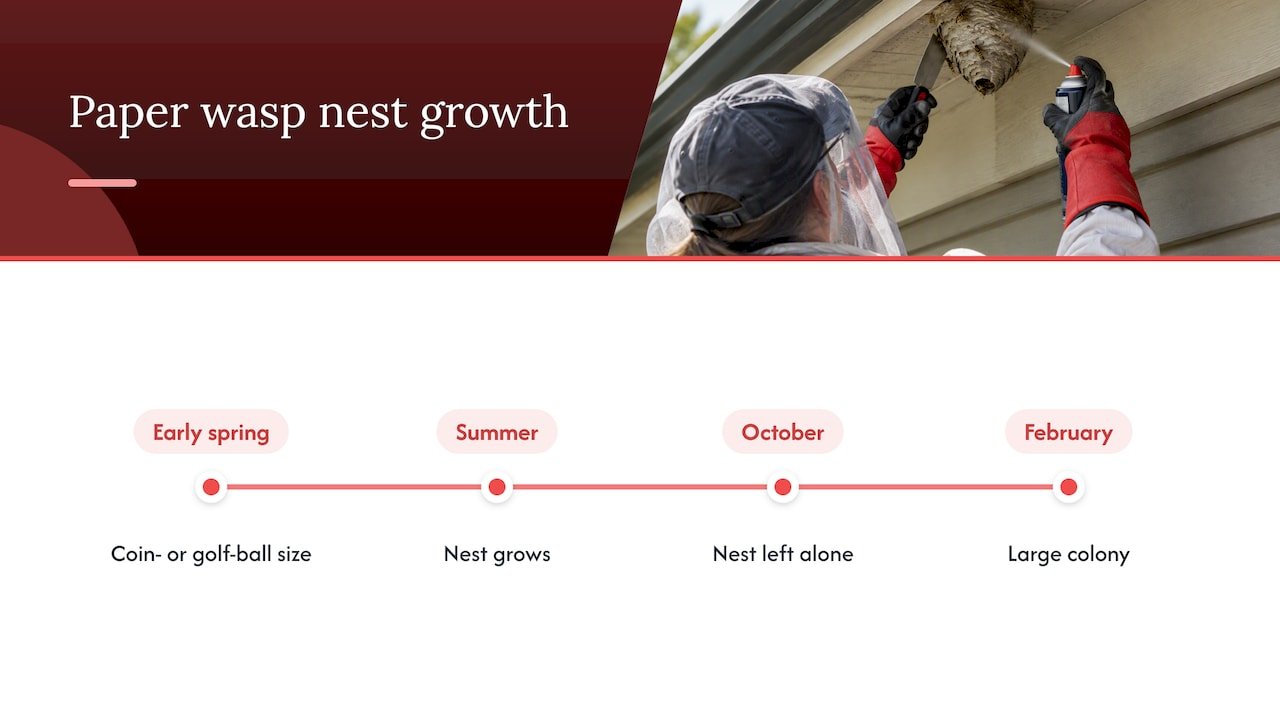
Paper wasps are slimmer than bees, with long legs that dangle in flight. Their nests start small, often the size of a coin or a golf ball in early spring, and grow through summer. A nest you ignored in October can be a large colony by February.
We cover these species in more detail in our guide to night treatment for paper wasp nests.
European wasps: less common under eaves, more serious
European wasps are a declared priority pest in parts of Australia. Agriculture Victoria says their nests are usually in ground holes or near the ground, and that about 20% are inside buildings or sheltered areas around them. So a European wasp nest in a wall cavity, roof void or behind eave lining is uncommon but real.
The clue is often not the nest itself. If you see a steady stream of wasps flying in and out of a small hole or gap, with no visible paper comb, the nest may be hidden inside the structure. Do not block that hole. Trapped wasps can chew through plaster or find their way into the house.
Our page on spotting European wasp nests in Canberra explains how to report sightings and what to expect.
Mud nesters and other look-alikes
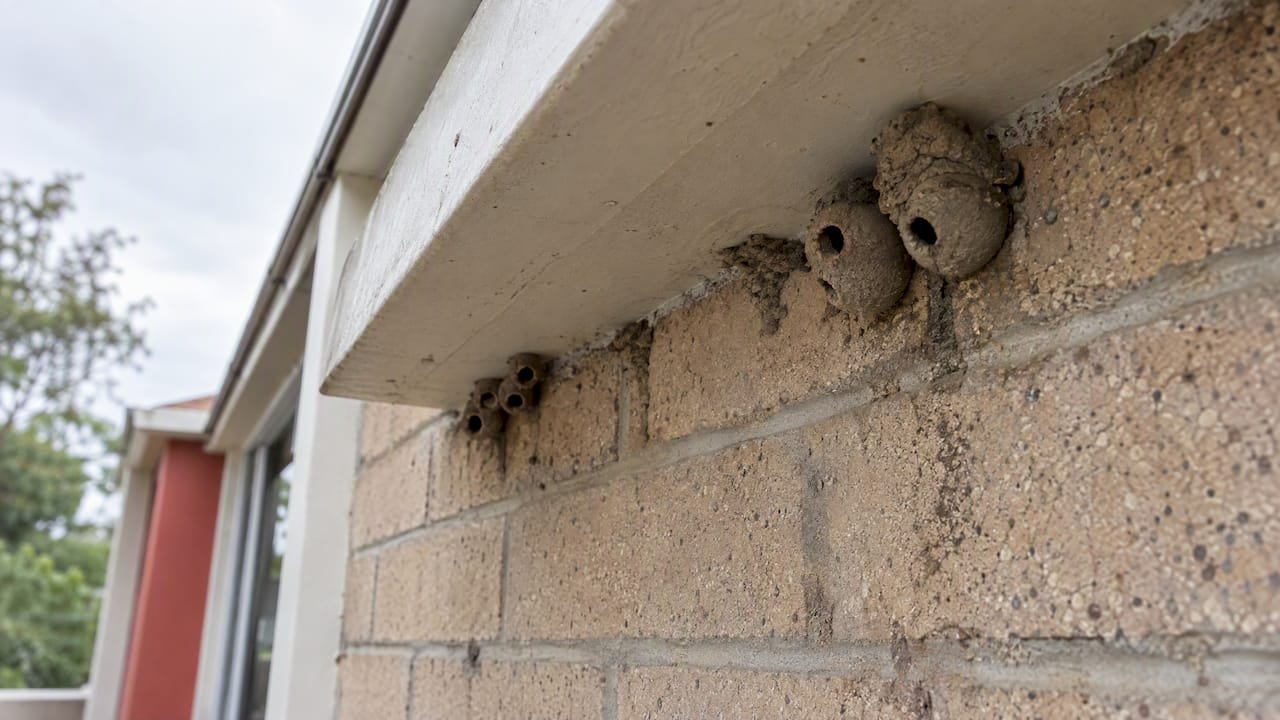
Not every insect under an eave is a threat. Mud dauber and potter wasps build small tubes or pots of mud, often on walls and under ledges. They are solitary and rarely defend the nest. A colony with dozens of wasps coming and going and a papery comb is a different matter.
How to tell what you are looking at
Keep a safe distance. Use binoculars or take a zoomed photo from several meters away. Never stand on a ladder next to a nest to get a better look.
| What you see | Likely culprit | What it means |
|---|---|---|
| Open grey comb, hexagonal cells visible from below, hanging on a stalk | Paper wasp | Common eave nest. Needs professional removal if it is near a door, window or walkway |
| Small mud tubes or pots on a wall or ledge | Mud dauber or potter wasp | Usually solitary and calm. Check that it is not a larger colony |
| Wasps entering a small hole, no visible nest | Possibly European wasp or another species nesting in a void | Do not block the hole. Get it inspected |
| Wasps streaming from a hole in the ground nearby | European wasp | Ground nest. Report it and call a professional |
| Fully enclosed round or football-shaped paper nest | Social wasp species | Treat as a large colony. Keep well clear |
If you cannot tell, treat the nest as dangerous. Our guide on how to identify and report wasp nests safely walks through the same checks with photos in mind.
Why a nest under the eaves is a problem
A nest above a front door, a window you open or a patio where children play puts wasps right on your daily routes. The risk is not that wasps are out to get you. It is that their defense of the nest is automatic and fast.
Stings can repeat
Healthdirect Australia explains that wasps can sting repeatedly and do not die after stinging, unlike bees, and that European wasps are more aggressive than bees and attack when their nests are disturbed. Agriculture Victoria also says European wasps can sting more than once, especially if the nest is disturbed.
Allergic reactions are an emergency
For some people a sting is more than painful. Healthdirect says to use an adrenaline autoinjector straight away and call Triple Zero (000) if anaphylaxis is suspected. Warning signs include noisy breathing, a swollen tongue or throat, wheeze, a persistent cough, a change in voice, dizziness or collapse. If anyone in your household has a known allergy, an active nest above your entry is a reason to book removal quickly.
Pets and children
Curious dogs and young children are the most likely to wander too close. Agriculture Victoria advises that animals stung by wasps may become agitated, and that if they are distressed you should seek veterinary treatment as soon as possible.
What to do when you find a nest
The safest steps are boring ones, and they work.
- Keep your distance. Stay several meters away and avoid vibration near the nest, including lawn mowing, hammering and slamming a door right below it.
- Keep people and pets away. Close the door or window nearest the nest if you can do so without approaching it. Move children’s play and the dog’s usual spots elsewhere.
- Note the details. Photograph the nest from a distance, and note the height, the size and how many wasps you see in flight. This helps a technician plan the visit.
- Do not block, spray or knock it down. An agitated colony will defend itself. Spraying the wrong product at the wrong time just sends angry wasps in all directions.
- Book a licensed professional. Healthdirect’s advice is that a professional should remove the nest, because disturbing it yourself can increase the chance of being stung. The City of Monash likewise recommends a licensed pest controller for private-property nests, and says people who think they are allergic should not destroy nests themselves.
If the nest is a European wasp nest, also report it through the relevant reporting channel. Our European wasp page explains the process for Canberra residents.
Why DIY removal goes wrong
Plenty of articles describe how to do it yourself: suit up, spray at night, knock down the nest. We understand the temptation. A few things make eave nests harder than they look.
- Height. Most eave nests need a ladder. Standing on a ladder with one hand holding a spray can and wasps flying at your face is how falls happen.
- Wrong species. If it turns out to be a European wasp nest in a cavity, a can of surface spray will not reach the colony, and survivors can relocate.
- Returning foragers. Wasps out foraging come back to a nest that is no longer there. They hover and sting around the spot for days.
- Hidden damage. A nest in a void can be bigger than the opening suggests.
If you do choose to treat a small, accessible paper wasp nest yourself, the usual advice from those who deal with it is to work at night when wasps are in the nest and less active, and to cover up with thick long sleeves, trousers, sealed shoes and gloves. Agriculture Victoria notes that Asian paper wasps are best treated late in the evening, when they are in the nest. We would still rather you did not. Our page on avoiding DIY wasp treatment explains why.
Not sure whether a nest is worth removing at all? Our quick guide on when to remove a wasp nest covers the decision.
How professional removal works
Here is what a typical visit from our team looks like, so you know what to expect.
- Inspection. A licensed technician identifies the species, finds every nest (there is often more than one) and checks access. For nests inside voids, this may involve checking entry points and the wall or roof space.
- Treatment plan. The product and method depend on the species, the location and who is around: children, pets, neighbors, a vegetable garden. We focus on treatments that are effective and responsible for families and pets.
- Timing. Wasp treatment is often done late in the day or at night, when most of the colony is home.
- Nest removal. Once the wasps are dead, the nest can be taken down and disposed of. Leaving old nests up is not recommended, because they can attract other insects and some wasps will try to rebuild nearby.
- Follow-up advice. We point out the gaps, ledges and food sources that attracted the colony.
We offer wasp control with free inspections, same-day emergency service where an urgent job needs it, and all our treatments are guaranteed for effectiveness.
What does wasp nest removal cost in Canberra?
We do not publish a fixed price for wasp removal, because the job varies too much for a single number to be honest. What moves the price:
- Species. A small paper wasp nest on a low ledge is a different job from a European wasp nest in a wall void.
- Height and access. Second-storey eaves, steep roofs and tight roof voids need more equipment and time.
- Number of nests. One nest found often means more elsewhere on the property.
- Urgency. Same-day emergency attendance is a different call-out from a booked visit.
- Repairs. Sealing gaps or removing a nest from a cavity adds work.
The quickest way to a real figure is a quote based on a photo and a short description. You can request a free quote for wasp control and we will tell you what the job involves before we start.
Stopping wasps from coming back
Removal deals with this year’s colony. Prevention is about making your house a less attractive place to start the next one. Queens look for shelter in late winter and spring, so the work is best done before then.
- Seal gaps. Close holes around eaves, windows and doorways before spring to reduce the risk of nests in wall cavities, as the eWasp guidance suggests. A technician can point out the gaps worth fixing.
- Remove food. Pick up fallen fruit and food scraps, cover compost, keep bin lids shut and cover food and drinks when eating outdoors.
- Feed pets inside, or after dark if you have to feed them outside, and clean up their bowls.
- Inspect weekly from spring through autumn. A nest the size of a golf ball is far easier and cheaper to deal with than a large one.
- Consider a regular service. A scheduled inspection catches nests early. Our subscription plans include general pest and termite options, so ask us which suits your property.
Do dryer sheets keep wasps away?
You will see this tip often, usually for mailboxes and porches. Snopes says there is anecdotal evidence that dryer sheets repel wasps, but that the claim has not been scientifically tested. Do not rely on them to protect a nesting site above a door. Sealing the gap and removing food sources does more.
Our perspective
We attend wasp jobs in Canberra throughout the warmer months, and the pattern is familiar. A small nest is spotted in spring and left alone, then by summer it is above the front door and nobody wants to use it.
Our view is simple: the best time to deal with a nest is as soon as you see it, and the best person to do it is a licensed technician. We use modern detection methods, we focus on treatments that are safe for families and pets, and we back our work with a guarantee on effectiveness. We also check what attracted the wasps, because removing a nest without fixing the entry point or food source just invites the next queen.
If you are unsure what you are looking at, send us a photo. A free inspection costs you nothing and often settles the question in minutes.
navin
Get the nest checked by a Canberra team
BugsPatrol Pest Management has serviced 5,000+ Canberra homes, with 10+ years of industry experience, licensed and insured technicians, and rapid response for urgent jobs. If wasps are under your eaves, we can identify the species, remove the nest and show you how to stop a repeat.

See our wasp control service or contact us through our main site to book an inspection.
FAQ
Should I knock down a wasp nest under my eaves myself?
No. Disturbing a nest makes wasps defend it, and they can sting repeatedly. Healthdirect advises having a professional remove the nest. If you are allergic or unsure, keep well away and call a licensed pest controller.
How can I identify a wasp nest?
Look from a distance. A grey, open comb with visible hexagonal cells hanging on a stalk is typically a paper wasp nest. A stream of wasps entering a hole with no visible comb may mean a hidden nest in a cavity, which can include European wasps. Photograph it and ask a professional if you are unsure.
What should I do if someone is stung and feels unwell?
If you suspect anaphylaxis, use an adrenaline autoinjector immediately if one is available and call Triple Zero (000). Signs include noisy breathing, a swollen tongue or throat, wheezing, a persistent cough, a changed voice, dizziness or collapse. For stung pets that seem distressed, see a vet as soon as possible.
How much does it cost to remove a wasp nest in Canberra?
It depends on the species, the height and access, the number of nests and how urgent the job is. We provide a free quote once we know the details, and a photo of the nest speeds that up.
Sources
- European wasp, Agriculture Victoria
- Bee and wasp stings, treatment, healthdirect
- European Wasps, City of Monash
- Do Dryer Sheets Repel Wasps From Mailboxes?, Snopes
Recommended
- Homeowners: Tell a Wasp Nest From a Bee Hive Without Getting Close
- Identify and Report Wasp Nests Safely in Australian Yards
- 30 Seconds to Decide When to Remove a Wasp Nest in Australia
- Polistes & Ropalidia: Night Treatment for Paper Wasp Nests in Australia