A pest inspection report is a written record of what an inspector could see, and could not see, when they checked a property for timber pests. In Australia that mostly means termites, borers and decay. Read it section by section, treat the summary as a starting point, and pay as much attention to the limitations as to the findings. If you are buying, selling or managing a Canberra property and something in the report is unclear, our licensed technicians can walk you through it and act on it.
TL;DR
- A timber pest report covers subterranean termites, rot or fungal decay, borers of seasoned timber and the conditions that invite them. It does not cover other pests.
- The summary comes first, but the industry code of practice says purchasers should read and understand the full report.
- “Active”, “previous activity”, “damage” and “conducive conditions” are four different findings, and each calls for a different response.
- The limitations and “areas not inspected” sections tell you where the inspector could not look. That is where surprises hide.
- A report is not a guarantee that a property is free of timber pests.
Table of Contents
- What a pest inspection report is for
- What the report covers, and what it leaves out
- The anatomy of a report, section by section
- How to read the findings
- The limitations section: where to look hardest
- Reading a sample report
- What to do after you read it
- Our view: a report is where the work starts
- Ongoing protection after the report
- FAQ
- Sources
What a pest inspection report is for
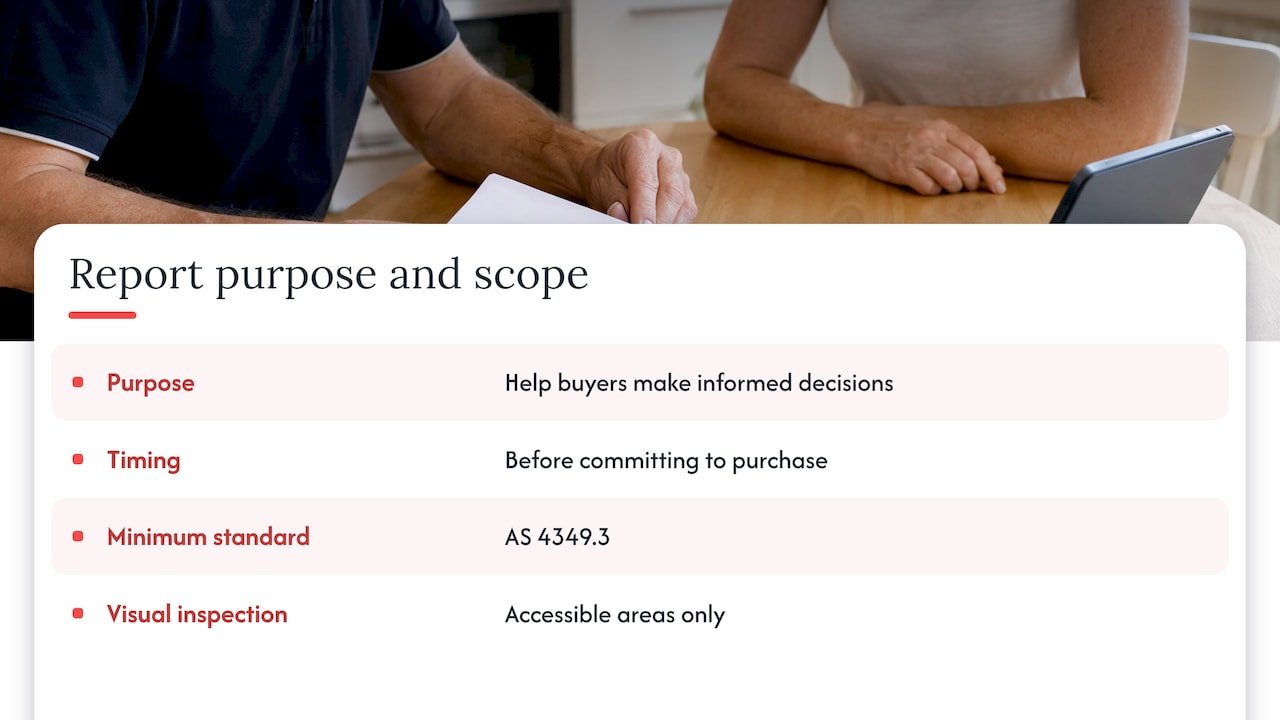
The Australian Environmental Pest Managers Association (AEPMA) publishes a code of practice for prior-to-purchase timber inspections. It says the report is meant to help a prospective buyer make an informed decision, and that it should be obtained before you commit to the purchase. So the report is a decision tool, not a certificate.
The same code describes AS 4349.3 as the minimum standard for visual timber pest inspections. “Visual” matters. The inspector looks at what is accessible and reports what they find. Where something is behind a wall, under a floor they cannot enter or covered by stored goods, the report should say so rather than guess.
This guide is for the people who most often hold one of these documents: homeowners wanting to understand a report on their own place, buyers weighing a purchase, agents and property managers who need to explain a report to a client, and business owners responsible for a commercial building.
What the report covers, and what it leaves out
According to AEPMA’s code, a timber pest report covers:
- subterranean termites
- rot or fungal decay
- borers of seasoned timber
- conducive conditions, meaning conditions that make an attack more likely
- potential concealed termite entry points
- recommendations for reducing risk and managing timber pests
It does not cover other pests, and it does not guarantee that a property is free of timber pests. If you are worried about rodents, cockroaches, ants or bed bugs, a timber pest report will not answer that. Those need their own inspection, and our general pest control and rodent removal services are set up for that work.
A building report is a different document again. A standard building report looks at structure and defects. It may mention visible damage that looks like termite work, but it is not designed to tell you whether pests are still active. That is why buyers commonly order a building inspection and a pest inspection together. Our pre-purchase pest inspection guide for Canberra covers how that works locally.
The anatomy of a report, section by section
Layouts differ between inspectors, but AEPMA’s code lists the sections a report should contain. Here is what each one tells you.
Identifiers and property details
The top of the report records the date and time of the inspection, the agreement or report number, who the report was prepared for and a description of the property inspected. Check these first. A report for the wrong address, or one that is months old, is not much use in a contract.
Summary
The report normally opens with a summary, usually a short paragraph or a list of the main findings. It is the quickest way to see whether the inspector found activity, damage or high-risk conditions. The code is clear, though, that purchasers should read the full report and not rely on the summary alone. Details that shape your decision, such as which rooms were blocked or which timbers were affected, often sit further in.
Findings
This is the body of the report. It should describe any timber pest activity or damage, its general location and its possible extent. Findings are usually grouped by area: the interior, the roof void, the subfloor, the exterior and the surrounding grounds.
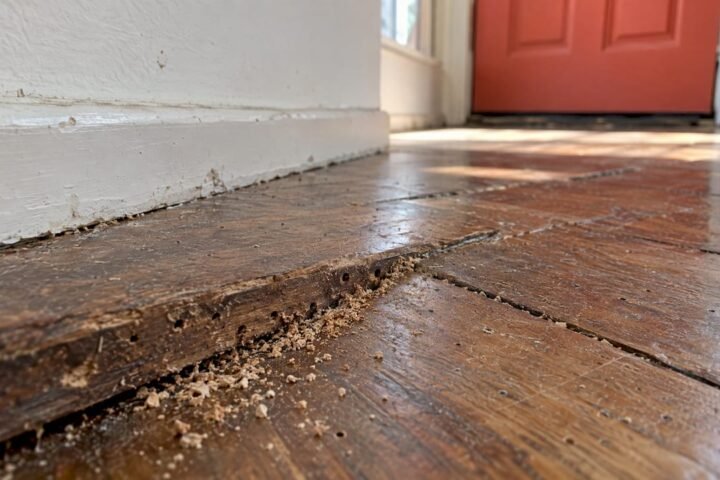
Good findings are specific. “Evidence of termite workings to the skirting in the second bedroom” tells you where to look and what to ask about. “Termites noted” does not.
Risk assessment
The code lists a risk assessment among the report sections. It is the inspector’s view of how likely a problem is, given what they saw and the conditions around the building. Treat it as informed judgment rather than prediction. Two houses with clean findings can carry different levels of risk.
Limitations
The limitations section sets out what the inspection could not do. The scope of a visual inspection is restricted to what the inspector can reach and see safely, and the report records that. We come back to this below, because it is the section most readers skip.
Access and areas not inspected
These sections list where the inspector could and could not get in. A locked room, a roof void with no safe access or a subfloor that is too low to enter all appear here. Each area on this list is an area where the report cannot say either way.
Recommendations
The final section gives recommendations for reducing risk and managing timber pests, and may recommend additional inspection. Recommendations are where the report turns into a to-do list.
How to read the findings
The words in the findings section are precise. The same house can produce several of them in a single report, and they do not mean the same thing.
| Term in the report | What it usually means | Typical next question |
|---|---|---|
| Active termites or live activity | Pests were found in the timber at the time of inspection | Where is the nest or entry point, and how do we treat it? |
| Previous or inactive activity | Signs of an earlier attack, with no live pests found on the day | Was it ever treated, and is any damage still present? |
| Timber damage | Timber has been affected by termites, borers or decay | How extensive is it, and does it affect structure? |
| Conducive conditions | Features that make an attack more likely | What can be changed to lower the risk? |
| Concealed entry points | Spots where termites could enter without being seen | Can these be inspected or protected? |
Separate activity from damage
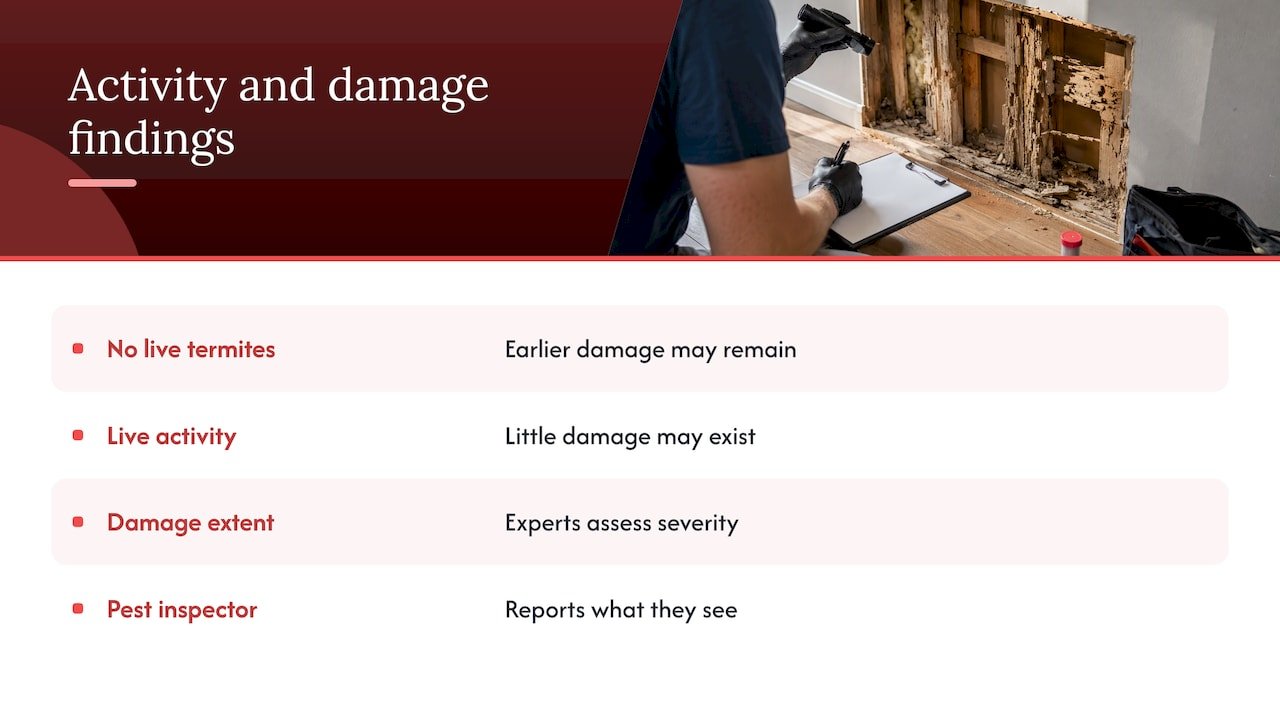
One trap is to read “damage” as “active termites”, or “no activity” as “no damage”. They are separate questions. A report can find no live termites and still record damage from an earlier attack. It can also find live activity with little damage yet. AEPMA says a report should describe the damage, its general location and its possible extent. It also says qualified building experts or engineers are needed to determine how extensive or severe damage is. A pest inspector reports what they see. A structural verdict is a different job.
Previous activity is not the same as protection
If a report notes old activity and a past treatment, do not assume the problem is closed. Ask for the treatment records, and ask what was treated and when. A past treatment tells you something happened. It does not tell you the building is protected now.
Conducive conditions are about risk, not a current problem
A conducive-conditions finding means the building or its surroundings make an attack more likely. It is not evidence that an attack has happened. It is still worth acting on, because it is usually the part of the report you can change. Our termite inspection checklist lists the features that inspectors look at around a home.
Borers and termites are different findings
Borers and termites both leave marks in timber, but they behave differently and are treated differently. If your report mentions either and you are not sure which, our guide on telling borer and termite damage apart shows the signs.
The limitations section: where to look hardest
The limitations, access and “areas not inspected” sections are not boilerplate. They define the edges of what the report can tell you.
When you read them, ask three things:
- Which areas were not inspected? Note each one. A roof void or subfloor that could not be entered is an unknown, not a clear result.
- Why were they not inspected? Stored goods, locked doors, low clearance and unsafe access have different fixes. Some can be solved by clearing the space and booking a return visit.
- Did the inspector recommend further inspection? AEPMA says further access or specialist tests may be recommended after the initial inspection. If the report says so, that is a direct instruction to follow up, not a courtesy line.
A report with a long list of uninspected areas is not necessarily a bad report. It may be an honest one. But it tells you the clean findings apply only to the parts that were seen.
Reading a sample report
If you are reading a sample before ordering your own, use it to check the structure rather than the content. A sample should show you:
- the identifiers and the date and time of inspection
- a summary up front
- findings grouped by area of the property
- a risk assessment
- limitations, access and areas not inspected
- recommendations, including any additional inspection
If a sample is missing the limitations or the areas-not-inspected sections, it is hard to know what its findings cover. Those two sections are what separate a useful report from a reassuring one.
What to do after you read it
If the report finds active termites
Do not disturb the area. Probing or breaking open timber can scatter the colony and make treatment harder. Photograph the location from a distance, note where it is and get a treatment assessment. Our guide to why you should not disturb a termite nest explains the reasoning. Our termite control service handles treatment, and our technicians use thermal imaging in termite inspections.
If it records old activity or damage
Ask what was treated and when, and whether any records exist. If the extent of damage is unclear, AEPMA says a qualified building expert or engineer is the right person to judge severity. Share the pest report with them so they know where to look.
If it recommends further investigation
Book it, and do it before any deadline in your contract. Buyers in particular should line up follow-up work with the contract timeline, since a report that raises a question is only useful if the question is answered in time.
If it flags conducive conditions
Work through them as a maintenance list. Many are cheap to fix compared with a treatment or repair. Fixing them is also what makes the next inspection cleaner.
If the report is clean
A clean report is good news for the day it was done. Termites do not wait for your next sale, so regular inspection matters. Our article on how often to inspect for termites sets out the schedule for Australian homes, and termite season explains when activity tends to rise.
Our view: a report is where the work starts
We have serviced more than 5,000 Canberra homes over 10+ years, and the pattern in how people use reports is simple: the document gets read once, filed and forgotten. We think that wastes most of its value.
A report is a map of what the inspector could see on one day. The useful parts are the ones that point forward: the conducive conditions you can fix, the areas that need a second look and the recommendations that turn into a maintenance routine. Reading the findings is half the job. Acting on them is the other half.
That is why we pair inspection with ongoing protection. Our licensed technicians use thermal imaging in termite inspections, and our treatments are designed to be effective and responsible for families, children and pets. We stand behind our treatments with a guarantee for effectiveness.
If you hold a report and are not sure what it means for your property, bring it to us. We will explain it in plain terms and tell you what, if anything, needs doing first.
navin
Ongoing protection after the report
A report is a snapshot. If you want the findings followed through, our plans spread the cost across the year: Bronze Termite and Bronze General Pest are each A$29.98 per month, Silver Combined is A$55.98 per month and Gold Complete is A$79.98 per month. You can compare them on our protection plans page.
If your report calls for treatment now, our team offers fast pest removal and same-day emergency service across Canberra. Start at bugspatrol.com.au and tell us what the report found. For buyers, our pest inspection checklist for Australian buyers is a good companion to read alongside the report.
FAQ
What does a pest inspection report check?
A timber pest report checks for subterranean termites, rot or fungal decay and borers of seasoned timber. It also records conducive conditions and potential concealed termite entry points. It does not cover other pests such as rodents or cockroaches.
Does a clean report mean the property is free of termites?
No. The report records what the inspector could see and access on the day. AEPMA’s code states that it does not guarantee a property is free of timber pests, which is why the areas not inspected matter as much as the findings.
Should I just read the summary?
The summary is a good first read, but not the last. The industry code says purchasers should read and understand the full report. Limitations, access issues and recommendations often sit outside the summary and can change your decision.
Who decides how serious the damage is?
A pest inspector reports where damage is and its likely extent. To determine how extensive or severe it is, AEPMA says qualified building experts or engineers are needed. Share your pest report with them before they assess.
What should I do if the report recommends further investigation?
Arrange it promptly. Further access or specialist tests may be recommended after the first inspection, and buyers should fit this work inside their contract timeline. Our team can help with the pest side of that follow-up.
Sources
Recommended
- Pest Inspection Checklist for Australian Buyers (AS 4349.3/AS 3660.2)
- How to Read a Termite Inspection Report: A Canberra Homeowner’s Field Guide
- Pest Control Records: What ACT Inspectors Ask to See
- Termite Inspection Checklist for Homeowners and Buyers