Yes, birds can damage solar panels, and most of the harm happens where you cannot see it. Droppings shade cells and cut output, while pigeons and other birds that nest in the gap beneath the array leave debris that traps water, and they can disturb wiring. The lasting fix is to stop birds getting under the panels in the first place, which is what our Canberra technicians do through solar panel bird proofing.
TL;DR
- Droppings on the glass cause concentrated shading, and the dirt can stay put after rain, so output can fall well beyond what the mess looks like.
- The bigger long-term risk is nesting under the array: debris, trapped water, roof corrosion and disturbed wiring.
- Warning signs are visible dirt or discoloured patches, a pile of twigs at the edges, and output below what your inverter data suggests it should be.
- Do not climb onto the roof to clean or clear panels. Use a qualified person, and have the nesting problem fixed at the same visit.
- A barrier around the whole perimeter of the array is what stops birds returning. Spikes alone stop perching, not entry.
Table of Contents
- What birds actually do to a solar system
- How much do bird droppings cut your output?
- Why nesting under the panels is the bigger problem
- Warning signs to check from the ground
- Cleaning droppings safely
- Keeping birds out for good
- What this means for different readers
- How we handle solar panel bird proofing
- Our view on bird proofing
- FAQ
- Sources
What birds actually do to a solar system
Bird trouble on a roof comes in two layers: what lands on top of the panels, and what happens underneath them.
On top, it is droppings. Queensland’s Electrical Safety Office says in its inspection and maintenance checklist for solar systems that bird droppings on modules may affect performance. CHOICE’s solar health check guide adds that droppings, dust, grime and tree sap can reduce output and may cause damage over a long period.
Underneath, it is nesting. The gap between panels and roof is warm, dry and sheltered, which is exactly what a pigeon, myna or sparrow wants. The same Queensland checklist notes that debris building up around or under an array may cause roof corrosion because water backs up behind it. A US Department of Energy owner’s guide, written for American conditions rather than Australian rules, lists animals nesting under modules and chewing or damaging wires as a known vulnerability of PV systems, and recommends removing and preventing nesting. You can read it in the PV system owner’s guide to weather and wildlife vulnerabilities.
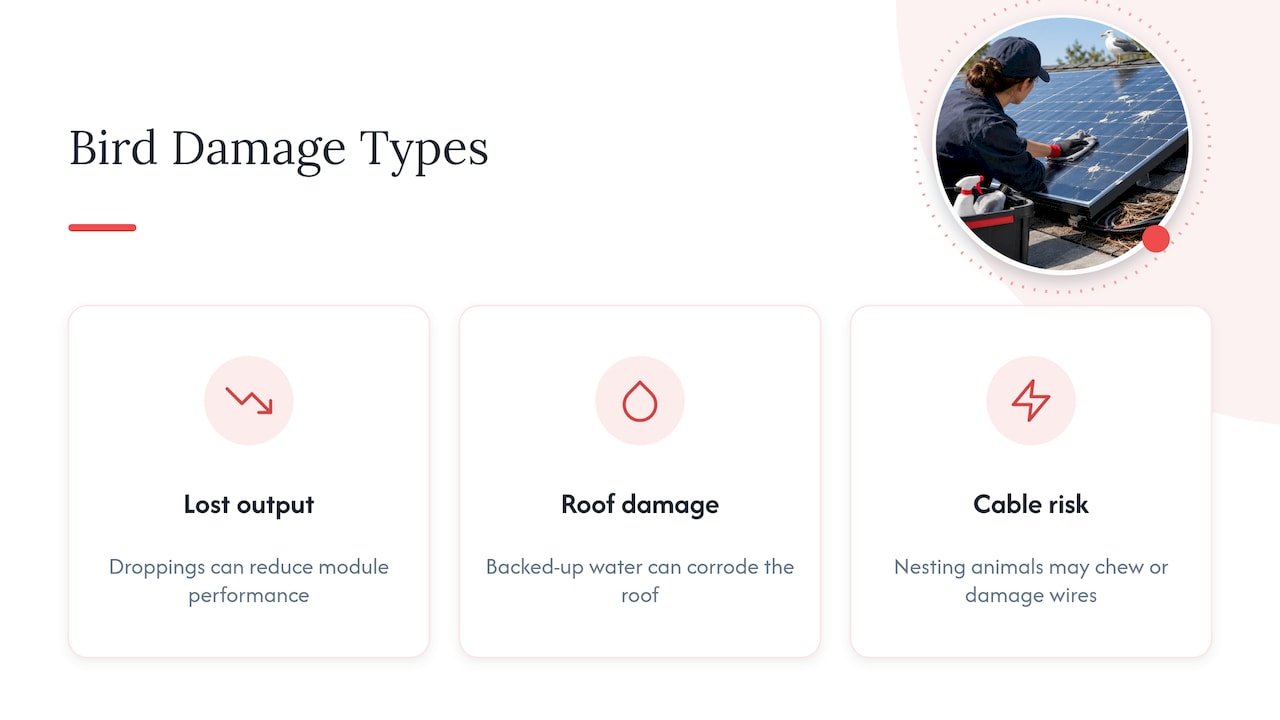
So the answer to “can birds damage solar panels” has three parts: lost generation, physical debris and moisture, and risk to cabling. The first is a performance problem. The other two are property problems, and they are the ones that cost real money.
How much do bird droppings cut your output?
The honest answer is that it depends on how much lands, where, and how your panels are tilted. The research gives a wide range, which is itself useful: a light scatter is minor, a concentrated patch is not.
Why droppings are worse than dust. Dust spreads evenly and rain clears much of it. Droppings sit in one spot. Solar Choice’s 2026 guide explains that droppings create concentrated shading on cells, can disproportionately affect output, may contribute to hotspot stress over time and may not be fully washed off by rain. The technical documentation for the PVsyst simulation software makes the same point: it describes droppings as a serious soiling concern because rain usually does not remove them, while noting that the overall effect across a system is reported as relatively small, under 2% in the context it cites.
What experiments have measured. Two studies show how severe a concentrated deposit can be in controlled tests:
- A 2024 peer-reviewed experiment found that guano produced hotspots on the panel surface and raised working temperature by 5% compared with a clean module. Four drops reduced module current by 36 to 38%, and in that setup output power was 26% lower and efficiency 43% lower than the clean module.
- A 2023 experimental study reported efficiency losses from bird droppings of 31.25% to 86.53% with the panel laid flat at 0 degrees.
These are test results, not a forecast for your roof. Most Australian panels are tilted, and tilt helps. The Australian Government’s guidance on looking after your solar system says dirt or debris buildup can reduce generation, and that panels on a slope of at least 10 degrees should usually self-clean in rain, although dusty locations may need cleaning.
A worked example
Say your system normally produces a steady amount on a clear day, and one string of panels sits under a favorite pigeon perch. Because panels in a string are wired together, shading a few cells on one panel can pull down more than the shaded area suggests. That is why a few drops can matter more than a thin film of dust. It also explains why the effect shows up in your inverter data as a gap against the other days, not as an obvious dirty roof from the ground.
Why nesting under the panels is the bigger problem
Droppings cost you generation. Nests cost you repairs. Birds that get under the array bring twigs, feathers and food scraps, and they keep coming back to the same sheltered spot.
Three things follow:
- Debris and water. Material packed against the roof surface can hold water and block its flow. The Queensland checklist links buildup under an array to roof corrosion from backed-up water.
- Moisture in the panels. The same checklist identifies cracks or glass damage as a route for moisture to enter, and says internal moisture can result in panel failure. Twigs and debris can also scratch the surface, as several industry pages note.
- Wiring. Birds nesting beside cabling can pull at it or chew it. Damaged cabling is a job for a licensed electrician, not a pest controller, so the point is to stop the birds before it gets that far.
Nesting is also a hygiene issue. Droppings, mites and nesting material collect directly above your roof space, and where a roof cavity is already open to birds the problem can spread beyond the panels. If you are hearing scratching in the ceiling, our guide to birds in the roof explains what is happening and what to do.
Warning signs to check from the ground
You can spot most problems without a ladder. CHOICE and Solar Choice both point to the same checks:
- Visible dirt or droppings on the glass, particularly white or streaked patches near the lower edge where they gather.
- Discoloured areas on a panel that look different from the ones around it.
- Output lower than expected. Compare your inverter or app data with the same time of year, allowing for cloud and sunlight. Solar Choice suggests lower-than-expected monitored production is a reason to consider professional service.
- Birds going in and out at the same panel edge, or twigs and feathers hanging from the gap, which are signs of nesting.
- Droppings on the wall, gutter or ground directly below the array.
The Queensland checklist offers a useful split. Surface soiling can impair performance, but glass damage, moisture inside the panel, discolouration and corrosion may point to a more serious equipment fault. If you see the second group, book a qualified solar installer or electrician. The Australian Government also advises monitoring your system’s generation and having an accredited installer or qualified electrician service it.
Cleaning droppings safely
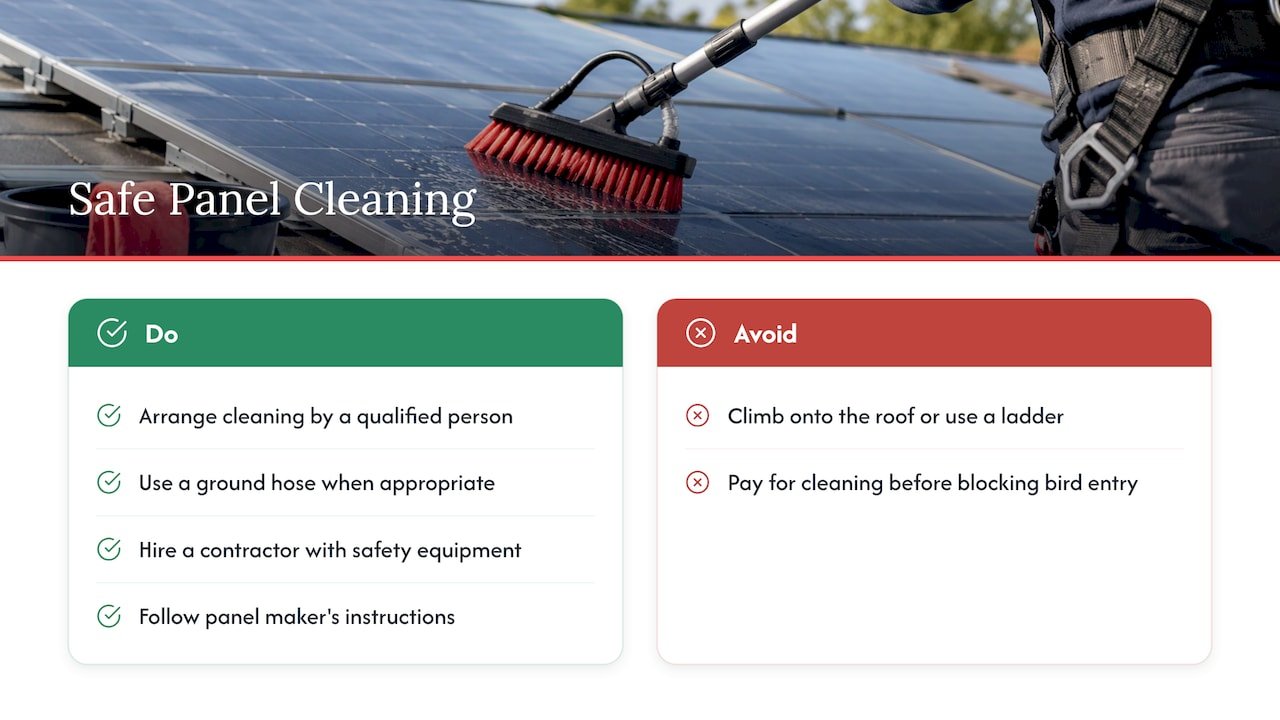
It is tempting to grab a ladder and a bucket on a weekend. Do not. The Australian Government’s guidance says only a qualified person should clean solar panels, because the job can be dangerous, and that servicing by an accredited installer or qualified electrician should include panel cleaning, clearing around and under the panels, and electrical checks.
CHOICE recommends not climbing onto the roof or using a ladder to clean panels. It suggests using a hose from the ground only where that is appropriate, and hiring a contractor with the right safety equipment if the dirt will not budge. Solar Choice says to follow the panel manufacturer’s cleaning instructions and favors professional cleaning where getting to the roof is a safety risk.
For the reasons panels need regular cleaning more broadly, this explanation of why solar panels need cleaning is a helpful companion read.
There is one point worth planning around: cleaning is only worth paying for if the birds are not coming straight back. If a pigeon colony has taken to your array, a clean panel will be fouled again within days. Sort out the entry points first, or at the same visit.
Keeping birds out for good
The approach that works is a physical barrier. 1KOMMA5° Australia’s guidance recommends mesh or guards around solar panels to prevent nesting underneath, with the caution that the barrier must not shade or block the panels.
That sets the standard for any job:
- The barrier has to close the gap along the full perimeter. A single open corner is all a pigeon needs.
- It must not cast shade or restrict airflow in a way that hurts the panels. Placement matters as much as material.
- It must be fitted without damaging the panels, frame or roof. Poor fixings can create the very leaks you were trying to avoid.
- Nests and mess should be cleared before the barrier goes on. Sealing birds or old nesting material in is the most common way a good barrier fails.
Deterrents that sit on top, such as spikes, are designed to stop birds perching, not to close the entrance beneath the array. Our article on mesh versus spikes explains where each belongs, and our Canberra guide to bird proofing solar panels covers the local details. For what to do if birds are already nesting, see birds under solar panels.
Native birds and the rules
Many of the birds you will find on Canberra roofs are native, and native birds are protected in Australia. In Queensland, the Department of the Environment states that all native birds are protected and that nuisance wildlife is removed under a permit scheme that requires knowledge of wildlife biology and safe handling. Queensland’s rules do not apply in the ACT, but the principle is the same: do not trap, poison or harm birds yourself. Removal and exclusion should be humane, and the sensible order is to check for active nests and eggs before anything is sealed. Our technicians work to that approach, with a focus on effective and responsible treatments for families, children and pets.
What this means for different readers
Homeowners. A small repair bill and a drop in generation can both trace back to one nesting spot. Early action is a smaller job than a clean-out after a season of nesting.
Business owners. Warehouses, retail roofs and industrial sites often have large arrays and a steady supply of birds. Our guide to bird control for Canberra retail and industrial sites covers docks and rooftops.
Real estate agents and property managers. Nesting debris, droppings and a damaged roof surface can all come up at inspection or handover. Dealing with them before listing avoids surprises.
Families and pet owners. Bird droppings and nesting material are unpleasant to have above the home, and the clean-up should be done by people who work safely and avoid harsh treatments around children and pets.
How we handle solar panel bird proofing
Solar Panel Bird Proofing is one of our services, alongside bird spikes and deterrents, and it sits on our bird control page. Our licensed and insured technicians have serviced more than 5,000 Canberra homes over 10 years, and our treatments are guaranteed for effectiveness. If birds are already causing a problem, we offer same-day emergency service.

If you also have gutters filling with nesting material or leaves, our gutter guard installation is worth asking about at the same visit. Ongoing protection for the rest of the property, including general pests, is available through our monthly plans: Bronze General Pest is $29.98 per month, Silver Combined is $55.98 per month and Gold Complete is $79.98 per month.
Our view on bird proofing
Most of the solar jobs we are called to follow the same pattern. The owner noticed a few droppings, cleaned them or paid for a clean, and weeks later the birds were back. The real problem was never the glass. It was the open gap under the array.
We think the right order is simple: check for nests, clear what is there, close the perimeter, then keep the panels clean. Done in that order, you stop paying for the same job twice, and you protect the roof, the cabling and your generation together.
That is why we treat solar panel bird proofing as a core part of what we do for Canberra homes and businesses. We want families and pets safe, the birds treated responsibly, and the system left working the way it was installed to.
navin
FAQ
Can birds damage solar panels?
Yes. Droppings shade cells and can reduce output, and birds that nest beneath the array leave debris that may trap water and cause roof corrosion. Nesting birds can also disturb wiring. The most effective response is to stop them reaching the space under the panels.
Do bird droppings on solar panels reduce power?
They can. Droppings create concentrated shading, and they may not wash off in rain. Laboratory tests have reported large losses from small deposits, though a real roof with tilted panels will usually see less. Your inverter data will show whether your system is affected.
Can I clean bird droppings off my panels myself?
The Australian Government advises that only a qualified person should clean panels because the work can be dangerous. CHOICE says not to climb onto the roof or use a ladder. A hose from the ground may suit some systems, but check your manufacturer’s instructions first.
How do I stop birds nesting under my solar panels?
Fit a barrier around the full perimeter so birds cannot get into the gap, making sure it does not shade the panels. Clear any existing nests first. Our technicians can do this as part of solar panel bird proofing.
Are birds on a solar roof protected?
Native birds are protected in Australia, so you should not harm them or their nests. In the ACT, check the local rules before removing an active nest. Humane exclusion, done when the nest is empty, is the safest approach.
Sources
- Inspection and maintenance checklist, solar energy systems (Queensland Electrical Safety Office)
- PV system owner’s guide to weather vulnerabilities (US Department of Energy)
- Look after your solar system (energy.gov.au)
- Soiling loss (PVsyst documentation)
- Performance evaluation of solar photovoltaic panels under guano deposition (2024)
- Experimental analysis on the impacts of soil deposition (2023)
- How can you tell if your solar panels are working? (CHOICE)
- Solar panel cleaning guide (Solar Choice)
- How to ensure pests and birds don’t impact your solar (1KOMMA5°)
- Plants and animals (Queensland Department of the Environment)
- Why solar panels need cleaning
Recommended
- Birds Under Solar Panels: What to Do and How to Stop It
- Birds in Roof: Safe Removal and Prevention for Homeowners
- Pigeons on Roof? Humane Fixes You Can Start Today
- Australian Homeowners: Stop Bird Mites Without Spraying Yourself