Redback spiders live around Canberra homes, sheds and workplaces, and they are most abundant in the warmer months. A female redback is easy to recognise once you know what to look for. The safest approach for a household with children, pets or staff is to have the webs and egg sacs found and cleared properly, and to know the first-aid steps before you ever need them. Our spider control service in Canberra is built for exactly that job. This guide covers identification, hiding spots, bite risk, first aid and when to call us.
TL;DR
- Only the female redback is dangerous: a glossy black, pea-sized spider with a red stripe on her back, found in untidy webs in sheltered, cluttered spots.
- Bites are uncommon but real: the Australian Museum reports more than 250 antivenom cases a year across Australia, and no deaths since antivenom arrived.
- After a bite, wash it, apply a cold pack and get medical advice. Ring the Poisons Information Centre on 13 11 26 or go to an emergency department if pain is severe.
- Redbacks hide in stacked junk, under windowsills and in brickwork crevices, so these are the places to check, and the places a technician inspects.
- Book a professional when you find repeated webs, egg sacs near children’s play areas, or a redback inside the house.
Table of Contents
- How to recognise a redback spider
- Redback look-alikes in Canberra
- Where redbacks hide around Canberra homes
- How dangerous is a redback bite?
- What to do if someone is bitten
- When to call a pest professional
- Spider control with Bugs Patrol
- Our view on redbacks in Canberra
- Frequently asked questions
- Sources
How to recognise a redback spider
The female is the one that matters. According to ACT City Services, she is spherical and black, about 12 mm in body length, with long thin legs and a distinctive red stripe on the back of the abdomen. The Queensland Museum adds that her abdomen is about pea-sized and that she carries a red hourglass mark on the underside. You will rarely see that underside unless the spider is hanging in her web or has been disturbed, so the dorsal stripe is the practical clue.
The male looks nothing like her. He is small, around 3 to 4 mm, and brown, and he is harmless. The Australian Museum states that only the female bite is dangerous. A small brown spider in a web is not a redback problem. A glossy black one with a red mark is.
The web is the second giveaway. The Queensland Museum describes it as an irregular tangle of strong silk that can reach 50 cm or more, with a funnel-like retreat in the upper part where the spider sits. If you pull a thread and it feels tough rather than wispy, you are likely looking at a redback web. Egg sacs hang in the same tangle and are round and papery.
Redback look-alikes in Canberra
Many calls we get about redbacks turn out to be other spiders. Two are worth knowing.
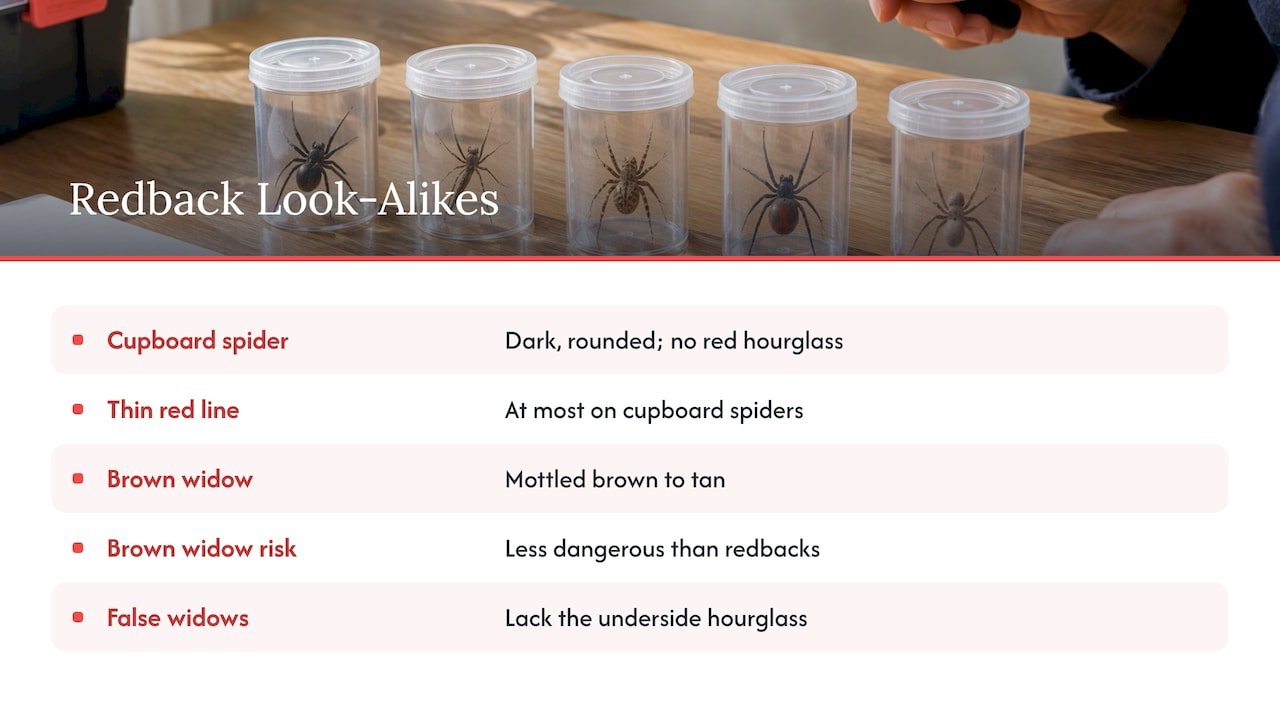
Cupboard spiders (Steatoda). The Australian Museum explains that these can be mistaken for redbacks but never have the orange or red hourglass spot underneath, and show only a thin red line at most. They are dark and rounded, so the confusion is understandable. The same page notes that in two recent identified Steatoda bite cases, redback antivenom was used to treat the more serious symptoms, which is a good reason to treat any painful bite from a spider of this shape seriously.
Brown widows. The CSIRO’s booklet on spiders found in the ACT says redbacks in Canberra are currently being replaced by the less dangerous brown widow (Latrodectus geometricus). Brown widows are mottled brown to tan rather than black, and they are in the same family as the redback. If you have a spider in a tangled web that does not match the black-and-red description, a photo is enough for us to identify it.
The Queensland Museum notes that the widow genus, Latrodectus, is identified by that hourglass mark on the underside, which false widows lack. When in doubt, do not lift the spider or its web to look underneath.
Where redbacks hide around Canberra homes
The CSIRO booklet says redbacks are common around ACT houses and abundant during warmer months. They like shade and shelter, with a hidden spot to retreat into. In practice that means:
- Stacks of junk, timber, pots, bricks and building rubbish in yards and side passages.
- Under windowsills, in crevices in brickwork and behind meter boxes.
- Sheds, garages, letterboxes, outdoor furniture, barbecue covers and the undersides of play equipment.
- Water meter and irrigation boxes, and the gaps beneath garden seats and bins.
The ACT City Services page lists stacked junk and rubbish, yards, windowsills and brickwork crevices as typical web sites. Clutter is the common thread. Every pile of stored material is a ready-made retreat, so clearing it is the first step in prevention. If you need a large clear-out, rubbish clearing and pest prevention goes hand in hand with spider control.
Timing matters too. Redbacks breed year-round, with peak activity across the warmer months, which in Canberra means spring through to autumn. Hot, dry weather in late spring and summer is when most households start noticing webs on outdoor furniture and around doorways. Our own guide to spider season in Canberra goes into the seasonal pattern.
Redbacks in businesses and rental inspections
For business owners, body corporates and agents, the same hiding spots apply to loading docks, bin enclosures, car parks, storerooms and landscaping. A redback in a staff or customer area is a safety concern as well as a nuisance. Real estate agents preparing a property for sale or lease often want a pest inspection report that records spider activity as well as termites, and spiders around entries and outdoor areas are a common finding.
How dangerous is a redback bite?
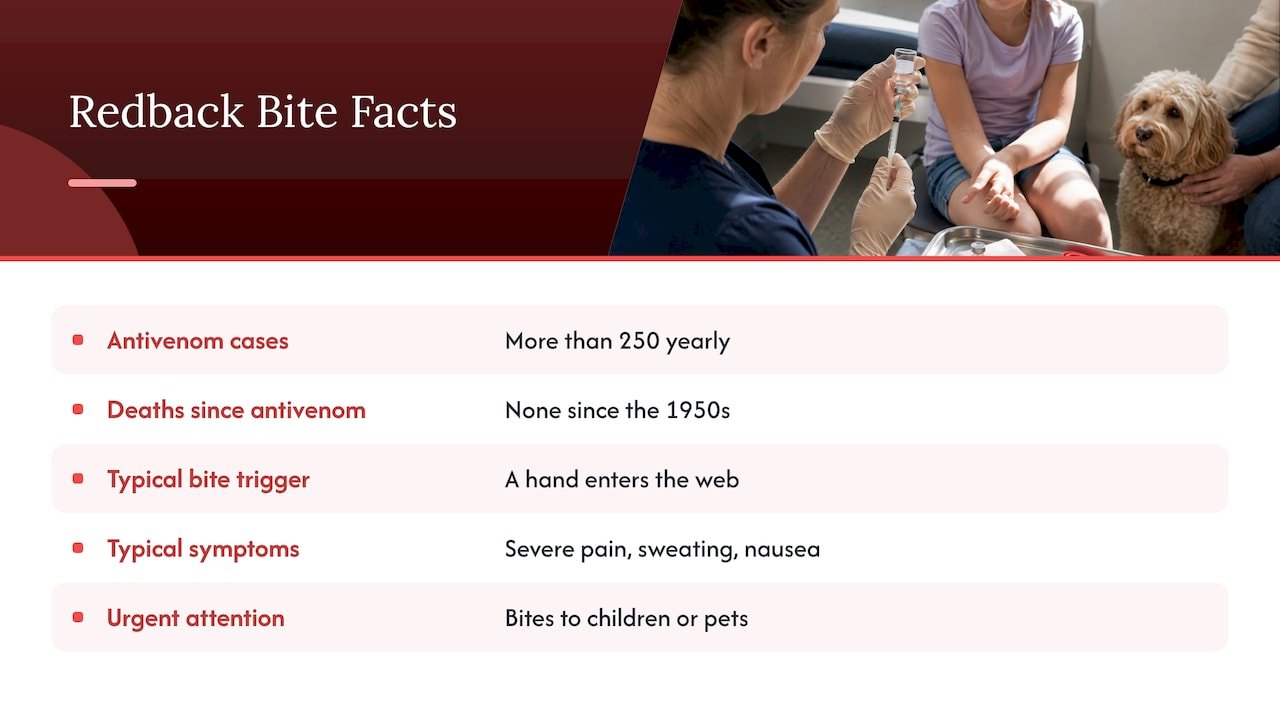
The numbers are reassuring but not trivial. The Australian Museum says redback bites occur frequently, particularly over summer, with more than 250 cases a year receiving antivenom and several milder envenomations probably unreported. It also says no deaths have occurred since antivenom was introduced, and the Queensland Museum dates that to the 1950s.
Redbacks are not aggressive. The CSIRO says they usually bite only when handled. The Australian Museum explains that they rarely leave the web, so people are usually bitten when a hand or other body part goes directly into it. That is why the typical redback bite happens when someone reaches into a letterbox, a garden glove, a shoe left outside, or a pile of stored items.
The venom is a different matter. It acts on nerves, and the typical picture is severe pain at the bite site that can spread, together with sweating and nausea. Arachne, the Australian Arachnology Society’s database, lists extreme pain, severe sweating and feeling sick as the symptoms and says to see a doctor immediately if a bite is suspected.
Children and pets are the groups we think about most, because they poke into sheds, toys and garden corners. ACT City Services states that although redbacks are not aggressive, they can give a very serious bite, and antivenom is available. Any bite to a small child or a pet needs prompt medical or veterinary attention.
What to do if someone is bitten
The first steps below follow Healthdirect’s spider bite guidance:
- Wash the bite with soap and water.
- Apply a cold pack for 15 minutes.
- See a doctor if symptoms are bad, and go to a hospital emergency department if the pain is very bad.
The Sydney Children’s Hospitals Network factsheet adds that pain relief such as paracetamol or ibuprofen can be used if needed, that the person should be watched for worsening symptoms or infection, and that you can call the Poisons Information Centre on 13 11 26 if pain and symptoms get worse. ACT City Services directs residents to the same number, and says spider bites need treating as soon as they occur.
One point matters for safety: the Australian Prescriber review of spider bite management says that pressure bandaging is contraindicated in redback bites. That is different from funnel-web or snake first aid, so do not apply a tight bandage. The same review says antivenom is recommended for systemic envenoming or severe local or radiating pain, and it is a doctor’s decision. A prospective study it cites found that many untreated patients had persistent pain and could not sleep, which is why medical review is worth it even when the bite does not look dramatic.
If you can do so safely, note what the spider looked like or take a photo. Do not handle it. For a severe reaction, difficulty breathing or a collapsed child, call 000.
When to call a pest professional
A single redback on a fence post is a nuisance. These situations are different, and they are the ones where our technicians are the right call:
- Repeated webs. If you clear a web and another appears within days or weeks, there is a hiding place or breeding site you have not found.
- Egg sacs. Each sac holds many spiderlings. Missed sacs are the reason numbers rebound.
- Children’s areas. Play equipment, sandpits, cubby houses, sheds and garages that children use.
- Inside the house. A redback indoors, in a laundry, garage entry or behind furniture, needs a proper inspection.
- Businesses and shared properties. Staff, customers or tenants are exposed, and you may need a record of the inspection and treatment.
- Pre-sale and lease inspections. Agents and landlords who want spiders and other pests documented before handover.
Our licensed and insured technicians treat the whole property, including the sheltered corners where redbacks settle, with a focus on effective and responsible treatments for families, children and pets. We also offer same-day emergency service, and our treatments are guaranteed for effectiveness. Our article on which Canberra spiders warrant a professional call sets out the species and situations in more detail, and Check Before Reaching In covers the habit that prevents most bites.
Habits that cut bite risk between visits
Wear gloves when working in sheds, garden beds or around stored items. Shake out shoes and gloves left outside. Look before reaching into letterboxes, meter boxes and the undersides of furniture. Keep stored items off the ground and away from walls, and keep the perimeter of the house free of rubbish. Children should be taught not to put their hands into dark gaps.
Spider control with Bugs Patrol
We handle spider control for homes and businesses across Canberra, from a single call-out to ongoing protection. For households that want year-round cover, our plans start with Bronze General Pest at $29.98 per month, with Silver Combined at $55.98 per month and Gold Complete at $79.98 per month. You can see what each plan covers on our subscriptions page. If you need someone urgently, book fast pest removal and describe what you have found.
Our view on redbacks in Canberra
Most redback bites we hear about happen in ordinary moments: reaching into a shed, lifting a pot, pulling a glove on. The spider was not hunting anyone. It was sitting in a web in a spot that nobody had looked at for months.
That is why we treat redbacks as a property problem rather than a single-spider problem. A web in the open is the easy part. The egg sacs, the stacked materials, the brickwork gaps and the corners behind the meter box are where the next generation comes from, and they are where an experienced technician looks first. Over 10 years and more than 5,000 Canberra homes serviced, that systematic inspection has been the heart of our work.
We also think families should not have to choose between safety and responsibility. Our treatments focus on being effective and responsible around children and pets, and we guarantee them for effectiveness. For households and businesses that want to stay ahead of spider season rather than react to it, a maintenance plan keeps the property checked through the warmer months.
navin
Frequently asked questions
Are redback spiders aggressive?
No. The CSIRO says redbacks are not aggressive and usually bite only when handled. Most bites happen when a hand is put into or against a web, so checking before reaching into sheltered spaces is the best protection.
Is the redback spider found only in Australia?
No. Animal Diversity Web records redbacks in New Zealand, where they arrived through imported grapes, and across much of Southeast Asia to India and south central Japan. In Canberra they are a familiar household spider.
Can I tell a redback from a false widow at a glance?
Look for the red stripe on the back of the abdomen and, if you can see it safely, the hourglass underneath. False widows (Steatoda) never have the hourglass and show a thin red line at most. If you are unsure, send us a photo and we will identify it.
Do redbacks only appear in summer?
They are most active in the warmer months, but they breed year-round. That means webs and egg sacs can persist in sheltered spots over winter, and a check outside the summer peak is still worthwhile.
Sources
- Spiders – ACT City Services
- Redback Spider – Queensland Museum
- Redback Spider – The Australian Museum
- Cupboard Spiders – The Australian Museum
- Spiders found in the ACT – CSIRO
- Spider bites – Healthdirect
- Spider bites factsheet – Sydney Children’s Hospitals Network
- Spider bite: a current approach to management – Australian Prescriber
- Latrodectus hasselti – Arachne
- Latrodectus hasselti – Animal Diversity Web
Recommended
- Check Before Reaching In: Redback Spiders in Australian Homes
- Spider Control in Canberra: Which Species Actually Warrant a Call to a Professional?
- Keep Spiders Out Safely in Australian Homes and When to Call a Pro