You’ve been here before. You wipe the kitchen bench, spray the skirting board, and by morning there’s another neat line of ants heading for the bin or the kettle. It’s frustrating, but it isn’t a sign you need a stronger surface spray. It usually means you’re treating the symptom, not the source. Kitchen ants are often workers trailing in from a nest outside. Wiping and spraying the visible line kills those workers and removes the scent trail for a while, but the colony can keep sending more.
In this post, we’ll look at why the ant trail comes back the next morning, what worker ants are actually doing when they follow a trail, and why surface spray kills the ants you can see and not the colony. Then we’ll move outside the kitchen to where the nest usually is, what a perimeter and nest-focused treatment does differently, and the questions worth asking before you book a treatment. We’ll also cover prevention that matches the problem and when to bring in a licensed technician in Canberra. By the end, you’ll know why the spray didn’t work and what to focus on instead.
Why the Ant Trail Comes Back the Next Morning
You wiped the bench, sprayed the skirting, cleared the crumbs away, and by the next morning the same line of ants is marching back across the tiles. The workers you see are a small fraction of a colony still active elsewhere, which is why the trail rebuilds along the same route. This is also why what homeowners get wrong about ant signs is usually a misread of the symptom rather than the cause.
The rest of this guide works through it in order: how trail behaviour really functions, why indoor spraying keeps missing the point, and then what a nest-focused perimeter treatment does differently, plus how to keep the kitchen clear afterwards.
What Worker Ants Are Actually Doing: How Trails Work
So what are those ants on your bench actually doing? They’re following a trail pheromone, a chemical scent laid down by worker ants that other ants in the same colony can follow.
The trail builds itself. A forager finds food, then marks the route home on its way back to the nest, laying a fairly uniform scent line. Nestmates pick it up, follow it, and add their own pheromone as they go, so the route grows stronger with every trip. The result is a reliable highway between the colony and your kitchen.
Wiping the trail removes the signal, not the source, which is why it keeps reforming. The scent also fades on its own when food runs out, so a trail is a temporary message, not a permanent stain.
For treatment, that changes the trail from an enemy into a clue. The line of ants is the best pointer you have to where the nest actually is, which makes following it far more useful than destroying it.
If you want to slow activity while you work out where the trail leads, short-term steps to stop ants indoors right now can help, but the trail itself is the information you need.
Why Surface Spray Kills the Ants You Can See and Not the Colony
A surface spray leaves a film of insecticide on whatever you treat, and it kills ants that walk across that film while the residue stays active. That part works. The problem is placement.
Think about what you are actually covering. You spray the benchtop edge, the skirting, the line of ants. The nest sits somewhere else, often outside the building entirely, and most of the colony is back there with it. So the product goes where ants are visible, not where the population lives. The ants killed on the treated surface are a working fraction of a much larger group.
The result is a repetition trap: the bench looks clear, then a new line forms, because nothing that produces the trail has changed.
Extension IPM guidance makes the same point: identifying the source and reducing what attracts ants is preferred over repeated spraying, according to Pests in the Home.
Worth saying plainly: this is mechanism and proportion, not a guaranteed outcome. Indoor spraying is not aimed at the colony. It is also part of a wider pattern, why most ant advice online gets the order backward.
Where the Nest Usually Is: Outside the Kitchen, Not Inside It
Now the trail itself is only half the story. The other half is where it starts.
Some ants live alongside us
Some species, often called tramp ants, live closely alongside people, travel with them, and thrive where moisture is introduced into the environment. These are the ones most likely to show up indoors.
Look outside the kitchen first
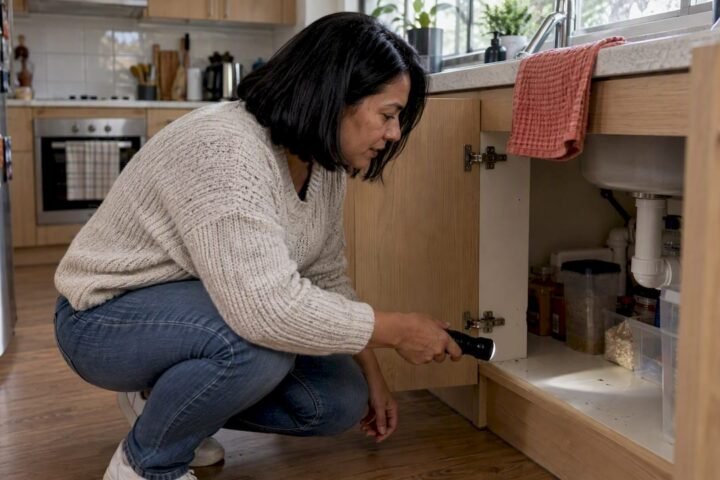
In many common cases, the activity on your benchtop often points somewhere else: a nest outside the building, with workers entering through gaps and following a trail to whatever they have found (how ants get inside). The zones worth checking as a general pattern include:
- Gaps under skirting and inside wall voids
- Door and window frames
- Plumbing and utility penetrations
- Potted plants, paving edges, and garden beds or mulch sitting against the wall
Moisture ties it together. Leaking taps, drip trays, condensation and wet sink areas create the conditions ants favour, which is why the moisture already available indoors matters more than the crumbs.
Following a trail to its entry point tells you far more than spraying it does. If you want to see how the whole picture fits together, start with why ants are in my kitchen in the first place.
What a Perimeter and Nest-Focused Treatment Does Differently
If the nest is outside, the fix has to start there too. A perimeter and nest-focused treatment works on a simple principle: it targets the colony at or near its source and puts a treated zone between the nest and the building.
Two halves. Perimeter means a treated band around entry routes and the building edge. Nest-focused means finding the colony itself and treating that, not the workers on your bench.
No research source describes exactly what such a treatment involves, so here’s the principle only. No methods, chemicals, dosages or product names.
A technician assesses where the trail leads, moisture sources, entry points, and which spots are realistic nest candidates. Treatment products are registered by the APVMA and applied according to label directions, a process a licensed technician manages.
This is a licensed technician’s job. We deliberately give no DIY application steps, partly because Canberra’s newer suburbs can throw up different nesting patterns, as we’ve covered in ant control in Canberra’s new suburbs.
If you decide to book, a few questions are worth asking first.
Questions Worth Asking Before You Book a Treatment
Before you book, a few questions separate a targeted treatment from another spray along the skirting.
- Where do you expect the nest to be, and how will you find it? A good answer describes following the trail outward and inspecting entry points, not just treating the bench.
- What gets treated, and where? Ask whether the work covers indoors, outdoors or both, and what happens along the perimeter. You want a treated zone between the nest and your walls.
- What preparation does the kitchen need? Ask about covering or clearing food, keeping pets and children away from treated areas, and any re-entry time before the kitchen is back in use.
- What if activity returns? Confirm re-treatment terms and the warranty period before work starts, and get them in writing.
BugsPatrol offers year-round protection plans and rolling cover. For the wider picture, see pest control in Canberra.
Vague answers here usually mean the treatment is aimed at the ants you can see, not the nest.
Keeping the Kitchen Clear: Prevention That Matches the Problem
Once you know what to ask, the next job is making your kitchen a less inviting place to trail through. IPM (integrated pest management) is simple in principle: cut what attracts ants and remove the conditions that let a trail rebuild, rather than reaching for the spray again.
In the kitchen
Wipe spills from benches, tables, floors and the outside of containers. Store snacks, sugar, syrup, honey and pet food in closed containers. Take the bin out at the end of each day. Fix dripping taps, leaking pipes and any standing water, since moisture often plays a part in where ants settle.
Around the edges
Follow a trail to where it enters, then seal cracks and openings, especially around foundations and where pipes and wires come through. Keep plants and mulch well back from the wall, and check potted plants for activity.
Watch, don’t spray
If a trail reappears, follow it before reaching for the can. Where it leads is a clue about the nest, not proof the earlier work failed. If it keeps leading you in circles, that is your cue to call someone in.
When to Bring in a Licensed Technician in Canberra
If you’ve sealed the gaps, dried the kitchen and still find ants by morning, that’s your cue.
Practical triggers
Bring in a professional when:
- Activity returns after cleaning and sealing
- Trails appear in more than one room
- A trail survives a treatment attempt
- You cannot locate the nest
Source identification and nest-focused treatment sit outside what a supermarket surface spray is designed to do. The label is written for exposed surfaces, not for finding and treating a colony.
BugsPatrol services the ACT and surrounding NSW regions for both residential and commercial customers, and offers year-round protection plans. If termites are also a concern, that is a separate service with its own method.
What to Take Away
So if you take one thing from all of this, make it the mechanism: the trail is a signal, the colony is the source, and indoor surface spray only ever addresses the signal.
Three actions are worth trying first:
- Clean and dry the kitchen, since moisture and food are what keep workers coming back.
- Seal the obvious entry gaps around skirting, pipework and frames.
- Follow the trail instead of spraying it again, and note where it leads.
If activity returns after that, the nest is almost certainly outside the kitchen. At that point, a nest-focused perimeter treatment is the logical next step, and it is a licensed job rather than a supermarket aisle one.
Conclusion
For homes across Canberra, the ACT and surrounding NSW, BugsPatrol can assess the trail, target the source and back year-round protection plans. If you are ready to stop treating the signal and start solving the source, book an assessment and take the next step with a plan built around your property.