Stainless steel mesh is the stronger long-term choice for most Australian roofs. It is non-combustible, it handles UV and heat, and it holds its shape for years. Plastic mesh costs less up front and suits a sheltered, low-risk home, but it is the weaker performer once sun, heat and bushfire rules come into play. This guide compares the two on the things that decide the outcome: durability, water flow, debris and pest exclusion, fire safety and upkeep.
TL;DR
- Stainless steel mesh is non-combustible and suits bushfire-prone areas. Plastic is not a metal option and does not meet non-combustible requirements.
- Plastic mesh is cheaper to buy, but UV and heat wear it down faster across Australian summers.
- A fine aperture matters more than the material alone. Around 2 mm is the ceiling for bushfire mesh, and finer micro-mesh keeps out more small debris.
- No guard removes maintenance. Silt and fine debris still collect, so plan a periodic check.
- If your property has a BAL rating, check it before you buy anything.
Table of Contents
- The short comparison
- How each material performs in Australian conditions
- Bushfire rules: where the choice is often made for you
- Keeping out leaves, debris and pests
- Lifespan and cost: how to think about it
- Maintenance: what each needs
- Rainwater tanks: a separate rule
- Perspective: why we lean towards metal micro-mesh
- How to choose for your own roof
- Gutter guards and pest control together
- Get a gutter guard fitted in Canberra
- FAQ
- Sources
The short comparison
Here is how the two materials stack up in everyday terms. The differences are about behaviour on the roof, not brochure claims.
| Factor | Stainless steel mesh | Plastic mesh |
|---|---|---|
| Upfront cost | Higher | Lower |
| UV and heat | Handles prolonged sun well | Can become brittle, warp or fade over time |
| Fire behaviour | Non-combustible | Combustible, can melt |
| Bushfire-prone areas | Suitable when the aperture meets the standard | Not suitable where non-combustible guards are required |
| Rust | Corrosion-resistant grades resist rust | Does not rust |
| Fine debris | Micro-mesh options keep out small material | Hole size varies, often coarser |
| Typical fit | Long-term installs, tree-heavy and fire-exposed homes | Short-term or budget fixes on low-risk roofs |
The rest of this article explains why each row looks the way it does, so you can match it to your own roof.
How each material performs in Australian conditions
Australian roofs take a harder beating than most. Heavy downpours deliver a lot of water in a short time, native trees drop broad leaves, bark and fine fibrous material, and summers deliver sustained UV and heat. Coastal homes add salt, and bushfire-prone regions add embers. A guide to Australian gutter systems from a gutter supplier describes these same pressures, and they are the reason material choice matters more here than it would in a mild climate.
UV and heat
Plastic is the material most affected by long sun exposure. Ultraviolet light breaks down the polymer, and the result is usually a guard that becomes brittle, discolours, sags between clips or cracks. Quality and UV stabilisation vary between products, so some plastics last better than others. But there is a ceiling on what plastic can do on a dark roof in January.
Stainless steel does not degrade under UV. It expands and contracts a little with temperature, as any metal does, and a properly fixed mesh handles that without trouble. Over a decade or more, this is where steel earns back its higher price.
Storms and heavy rain
A gutter guard has two jobs in a storm: let water in quickly and keep debris out. A rigid metal mesh holds its shape under a load of wet leaves and hail. A flexible plastic mesh can sag under weight, and a sagging section collects debris and slows flow into the gutter.
Water flow is also affected by aperture. Very fine mesh blocks more debris but can shed water over the front edge in the heaviest bursts if it is not fitted well, which is why installation quality and gutter pitch matter as much as the product. This applies to both materials.
Salt and coastal air
Canberra is inland, so salt is rarely the problem, but if you own a coastal investment property it is worth knowing that metal choice matters near the sea. Marine-grade stainless and coated aluminium are the usual answers there. Plastic does not corrode, which is a real strength, but it still faces the UV problem.
Bushfire rules: where the choice is often made for you
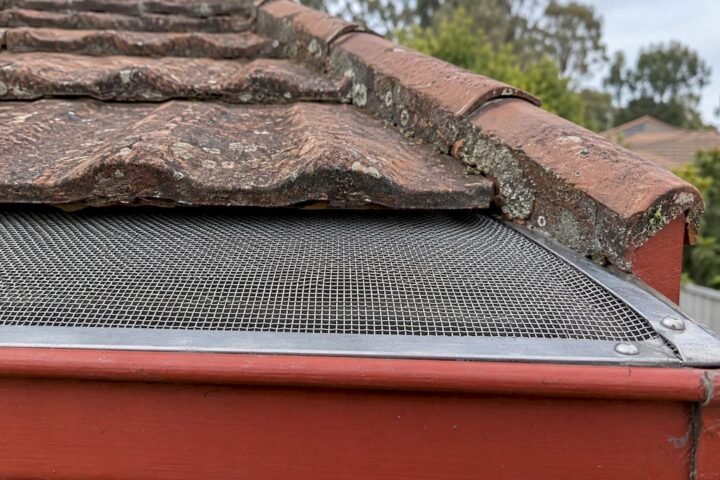
For homes in a bushfire-prone area, the decision is frequently about compliance, not preference. Australian Standard AS 3959, Construction of Buildings in Bushfire-Prone Areas, sets requirements by Bushfire Attack Level (BAL). Where it applies, gutter guards and similar ember barriers need to be non-combustible, and mesh used for ember protection is limited to a maximum aperture of 2 mm for stainless steel woven wire mesh.
That is the practical line between the two materials. Plastic can melt and can hold or feed embers in a gutter full of dry leaf litter. A stainless or other non-combustible metal mesh with a small aperture is designed to stop embers reaching the leaf litter and the roof space.
What to do about it:
- Find out whether your block is in a bushfire-prone area and what BAL applies. Your council, a certifier or your building file can tell you.
- If a BAL applies, ask for a guard that is non-combustible and has an aperture within the standard.
- Confirm the guard works with your roof type and gutter profile before it is fitted.
If you are not sure whether your property is affected, ask a licensed installer before buying a roll of mesh from a hardware aisle. It is a short conversation and it prevents a costly redo.
Keeping out leaves, debris and pests
This is where hole size and design count more than the label “stainless” or “plastic”.
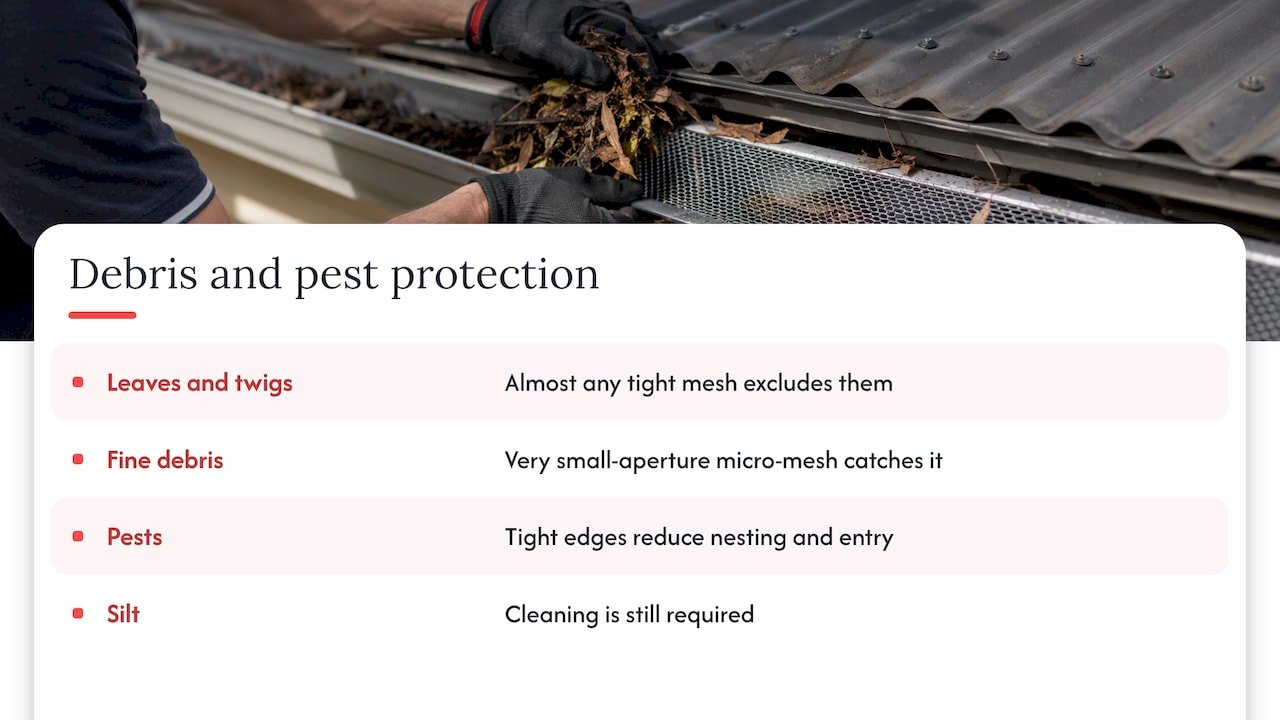
Leaves and twigs. Almost any mesh keeps these out. Both materials do the basic job when they are fitted tightly.
Fine debris. Gum blossom, seeds, pine needles and roof grit pass through wider holes. Micro-mesh, with very small apertures, is the style built for this. Metal micro-mesh is a common pick among installers because the fine weave stays stable, whereas a very fine plastic mesh tends to be less rigid.
Pests. A tight guard with no gaps at the edges also reduces the chance of birds, rodents and wasps using the gutter line to nest or enter the roof space. Gaps at the ends, corners and roof edge matter as much as the mesh itself. That is why fitting quality is part of pest protection, not just a roofing detail. Standing water and decaying leaves also attract mosquitoes and other insects, so a gutter that drains and stays clear is a small part of keeping pests away from the house.
Silt. Every guard lets some fine silt through. A gutter cleaning company notes that silt still gets through a guard, so gutter cleaning is still required. Treat a guard as a way to make cleaning rarer and easier, not to eliminate it.
Lifespan and cost: how to think about it
Plastic is the cheaper product on day one. Metal costs more on day one, and it is usually the one you only pay for once. Published per-metre figures for Australian gutter guards vary widely between suppliers and regions, and they change, so ask for a written, itemised quote for your own roof rather than relying on a number from a website.
A useful way to compare is cost per year of service:
- Add the supply and fitting cost of the guard.
- Divide by the number of years it realistically stays functional on your roof.
- Add the cost of any early replacement, including the labour of removing the old guard.
On a short horizon, such as a home you plan to sell soon, a cheaper product may be reasonable. On a home you will keep, a guard that avoids a replacement usually works out better. Labour is a large share of the total, which is why fitting a short-lived guard twice is the expensive route.
Maintenance: what each needs
Stainless steel mesh and plastic mesh need the same basic routine:
- Check after major storms and at the end of the leaf-drop season.
- Brush the surface lightly to clear leaves that sit on top. Metal handles a stiff brush better than most plastic.
- Look at downpipe outlets, where fine debris collects first.
- Check the edges and fixings for lifted sections.
A Brisbane plumbing company suggests that gutters with mesh be cleaned every 6 to 12 months after major storms on tree-heavy properties. Canberra’s deciduous trees mean the heaviest load arrives in autumn, so a check in late autumn and another after spring storms is a sensible rhythm.
Safety note: roofs and ladders cause serious injuries every year. If your gutters are high, your roof is steep or wet, or you are not confident, have a licensed tradesperson do the work.
Rainwater tanks: a separate rule
If your downpipes feed a rainwater tank used for drinking, the downpipe materials have their own rules. In Victoria, the Victorian Building Authority’s plumbing practice note on downpipes states that downpipes collecting roof water for a drinking-water tank must be AS/NZS 4020 compliant. That is a Victorian document, so check the equivalent requirement with the authority that applies to your state or territory. In the ACT, ask your installer or plumber before fitting anything on a roof that feeds a tank.
Perspective: why we lean towards metal micro-mesh
We have serviced more than 5,000 Canberra homes over 10+ years, and gutters come up on a lot of those jobs. Blocked gutters hold water, attract birds, give wasps and rodents a way into the roof line, and leave dry leaf litter against the house.
From that experience, our view is simple. A guard is only worth fitting if it keeps working for years without fuss. That is why we steer homeowners toward metal micro-mesh, and why we install it as part of our gutter guard installation service. A rigid metal mesh holds its shape, does not fade or crack in the sun and is non-combustible.
We also treat the gutter line as part of pest protection. A well-fitted guard closes gaps that birds and pests use, and it keeps the gutter draining so water does not pool near the house. Our technicians are licensed and insured, and we stand behind our treatments and workmanship with a guarantee on effectiveness.
Plastic has its place on a tight budget, but if you plan to stay in your home, we would rather fit something once and fit it well.
navin
How to choose for your own roof
Use these questions in order. They narrow the choice fast.
- Is the property bushfire-prone or does it have a BAL rating? If yes, choose a non-combustible metal mesh within the aperture limit. Plastic is out.
- How many trees overhang the roof? Heavy leaf, blossom or needle fall points to a fine metal micro-mesh. A light fall can be managed with a simpler guard.
- How long will you own the property? Long-term owners benefit most from a guard that does not need replacing.
- What is your roof and gutter profile? Not every guard fits every gutter, so a site check by a licensed installer saves problems.
- Who will do the fitting? Gaps, loose clips and poor edge sealing are what let debris and pests in. Fitting quality matters as much as material.
If you want to see how different types work on Canberra roofs, our guides on gutter guard types in Canberra and the benefits of gutter guards in Canberra go into more detail, and do gutter guards work in Australia covers the installers’ view on metal micro-mesh.
Gutter guards and pest control together
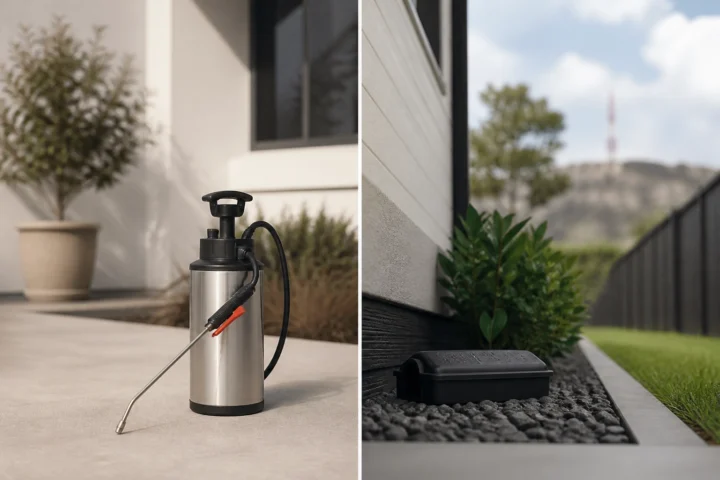
Gutters are an overlooked entry point. Birds nest in them, rodents use overhanging gutters to reach the roof, wasps build along the eaves and damp, leaf-filled gutters can contribute to moisture problems around the roof line. Because we handle both pest control and gutter guards, we can look at the whole picture on one visit instead of sending you to separate trades.
If you already have a pest issue in the roof or eaves, our rodent removal and bird control services deal with the cause, and a properly fitted guard helps keep the problem from returning.
Get a gutter guard fitted in Canberra
We install metal gutter guards across Canberra and surrounding suburbs, and our technicians can look at your roof, gutter profile and tree cover before recommending a guard. Request a quote through our gutter guard installation page, and we will tell you what suits your property.

If you would also like regular protection against ants, spiders, cockroaches and termites, our maintenance plans start at 29.98 AUD per month for Bronze General Pest or Bronze Termite, with Silver Combined at 55.98 AUD per month and Gold Complete at 79.98 AUD per month.
FAQ
Is stainless steel mesh better than plastic for gutter guards?
For most Australian homes, yes. Stainless steel is non-combustible, handles UV and heat and holds its shape under wet leaf loads. Plastic costs less up front, but it is more affected by sun exposure and is not suitable where non-combustible guards are required.
Can I use plastic gutter guards in a bushfire-prone area?
Not where a BAL rating requires non-combustible guards. AS 3959 calls for non-combustible materials and a small mesh aperture in those areas. Check your BAL with your council or a certifier, and ask your installer to confirm the product complies.
Do gutter guards mean I never have to clean my gutters?
No. Guards keep out leaves and twigs, but silt and fine debris still build up, and the guard surface needs an occasional brush. A check after major storms and at the end of autumn keeps water flowing.
What mesh size should I look for?
For bushfire protection, the standard sets a maximum aperture of 2 mm for stainless steel woven mesh. For fine debris such as needles and blossom, a finer micro-mesh is the usual choice. A licensed installer can match the aperture to your trees and roof.
Sources
- Stainless Steel Bushfire Mesh for Home Protection
- Gutter Guards Explained: Choosing the Right System
- Common Gutter Problems and How Gutter Cleaning Can Help
- How to Stop Leaves Blocking Outdoor Drains and Gutters
- Plumbing RP 04 – Downpipes, Victorian Building Authority