The right borer treatment depends on three things: the type of borer, whether it is still active, and how deep it has gone into structural timber. Small seasoned items can be frozen or replaced. Surface sprays reach only the outer layer of timber. Bearers, joists and roof timbers usually need a licensed technician to inspect, identify the borer and treat it. If you have fresh holes and dust in timber that holds up your house, we recommend getting it looked at before you buy a spray. Borer treatment is one of the services our licensed Canberra technicians provide.
TL;DR
- Not every borer needs treatment. Some attack only the sapwood of certain hardwoods and rarely need further action once they are positively identified.
- Active borers in structural timber are treated by spraying, coating, injection or, in severe cases, fumigation, and these jobs need specialist skills.
- Fresh, loose dust (frass) under small holes is the main sign that borers are active now.
- Over-the-counter surface products penetrate only a few millimetres, so they do not solve an infestation in bearers or roof joists.
- Keeping timber dry and inspecting it every six months prevents most repeat problems.
Table of Contents
- What borers are and why the type matters
- How to tell if the borers are still active
- The main borer treatment options compared
- When treating in place is not enough
- Borer treatment cost in Canberra
- Safety: children, pets and treated timber
- Preventing borers coming back
- Buying or selling a property with borer
- What we think about borer treatment
- Book a borer inspection in Canberra
- FAQ
- Sources
What borers are and why the type matters
Wood borers are beetles. Each goes through four stages: egg, larva (a grub), pupa and adult. The larvae do the damage, tunnelling through timber and leaving galleries that can weaken it. What you see is usually the adult’s exit hole, often with fine dust called frass beneath it. This comes from the WA Government’s wood preservation guide.
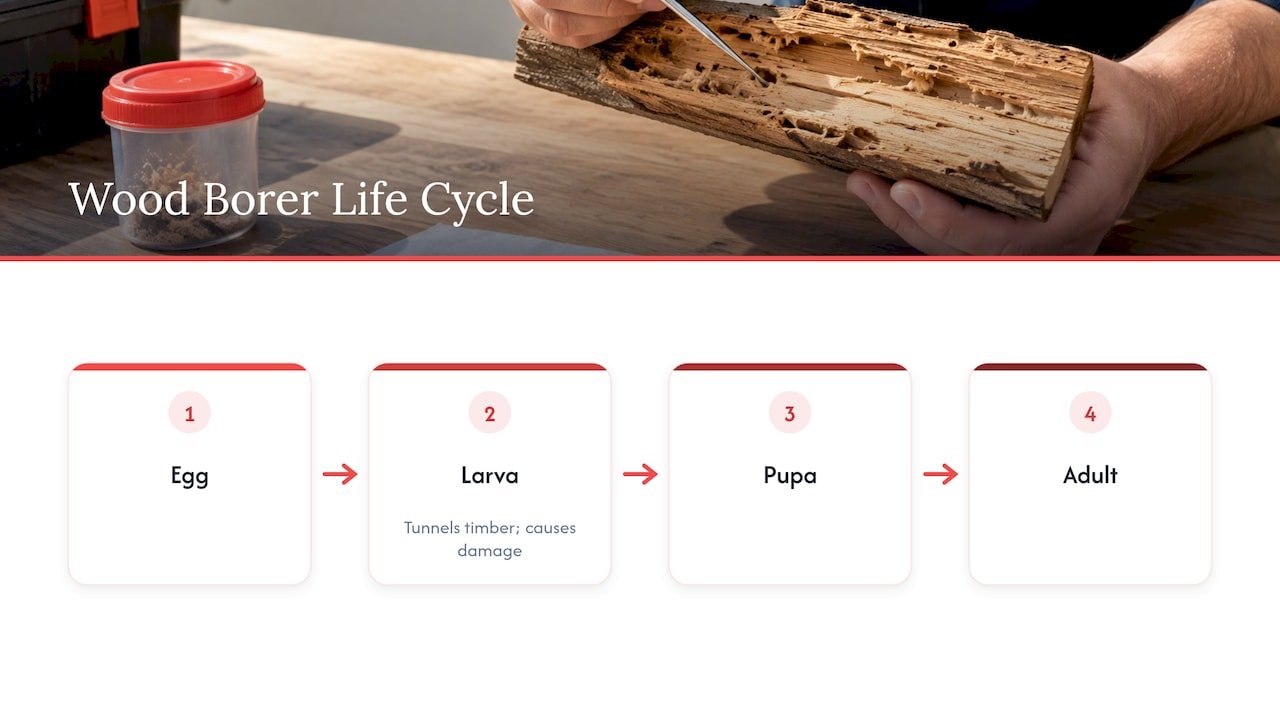
The same guide explains that frass tells you something. Furniture beetle frass is loose and gritty, while powderpost beetle frass is fine and powdery. Active furniture beetle infestations in old buildings must be treated.
Powderpost beetles (lyctids) are a different case. They attack only the sapwood of some hardwoods and usually strike susceptible timber in its first years of service. Because sapwood content is limited by law in NSW and Queensland, lyctid damage rarely causes structural problems and, once positively identified, rarely requires further action (WA Government guide). That is why identification comes before treatment. Paying to treat a harmless borer is as wasteful as ignoring a harmful one.
If you are unsure whether the damage is borer or termite, our guide on telling borer and termite damage apart shows the differences. Termites can destroy timber far faster, so a wrong guess is costly.
How to tell if the borers are still active
A hole by itself proves nothing. It may be decades old. Look for:
- Fresh, clean-edged holes rather than dark, weathered ones.
- Loose dust below the hole or on nearby surfaces that returns after you wipe it away.
- Gritty or powdery frass, which helps indicate the borer type.
- Timber that sounds hollow when tapped, or crumbles at the surface.
A practical tip from Radial Timber Sales’ treatment guide is to photograph the affected area. Come back in a few weeks and compare. New holes or fresh dust mean activity. Our five-step wood borer diagnostic walks through this process in more detail, and for items such as a table or cabinet, see borer holes in furniture.
The main borer treatment options compared
The options run from doing nothing to treating a whole building. Professional Pest Manager’s timber borer guide sets out the range, and the table below summarises it.
| Option | Best for | What to know |
|---|---|---|
| No treatment | Borers of green or unseasoned timber | The damage is already done and the borer will not reinfest seasoned wood |
| Freezing or localised heat | Small seasoned items | Items are frozen for days, or heated in the affected spot |
| Replacement | Small or badly damaged pieces | Removes the problem entirely |
| Insecticide treatment | Active infestations in structural timber | Kills emerging adults and breaks the breeding cycle |
| Fumigation | Severe infestations | Reserved for the worst cases, sometimes whole buildings |
The same guide notes that insecticide is unlikely to penetrate deep enough to stop larvae already deep in the wood. The aim is to stop the cycle: kill the adults as they emerge and prevent new eggs being laid.
Spraying and coating
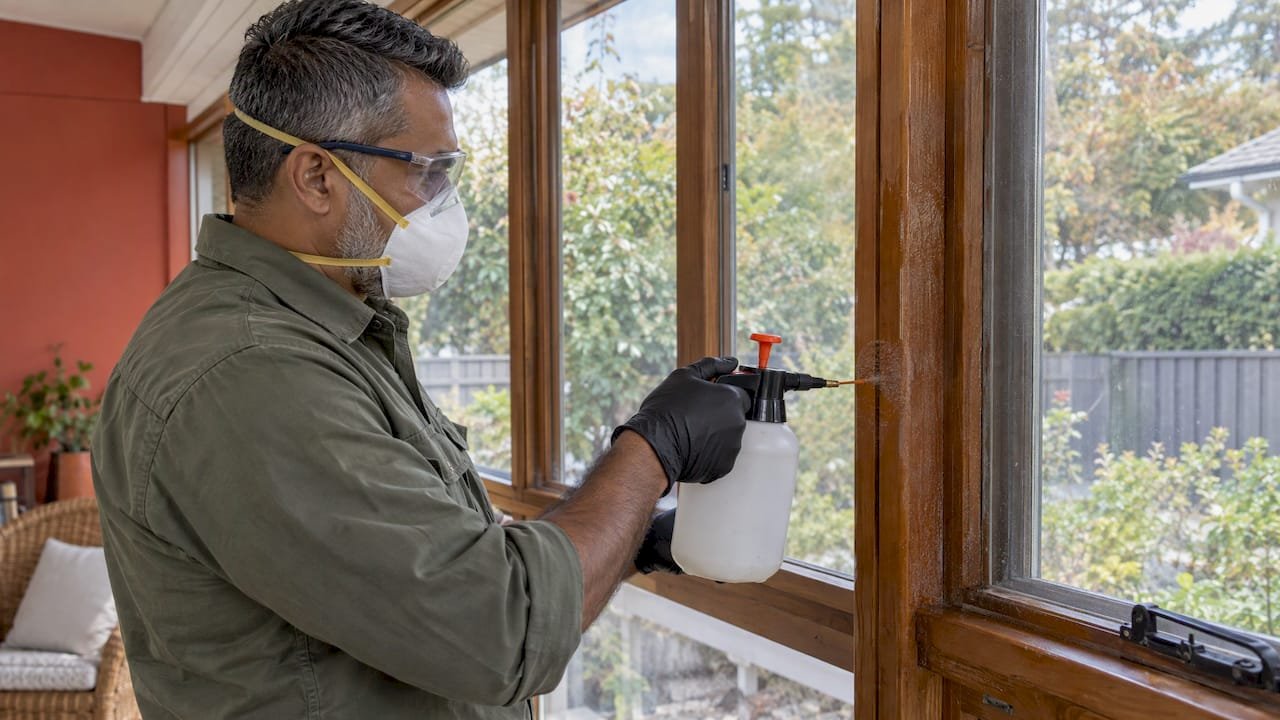
Surface treatment puts a residual insecticide on exposed timber so that emerging adults and newly hatched larvae contact it. It suits accessible timber such as exposed subfloor bearers, roof timbers and joinery. The WA Government guide lists spraying and coating among the standard control measures for active infestations, and says handling and applying the chemicals involved needs specialist skills.
Injection into drilled holes
For deeper timber, product is injected into drilled holes so that it travels beyond the surface. Manufacturer instructions show how exact this is. Preschem’s clear wood preservative documentation says to drill damaged areas, inject the product and treat every area where frass shows, and that in severe cases timber replacement or a professional pest controller is the better option. A surface application needs absorption at 0.25 litres per square metre. Getting that rate right across joists and bearers you can barely reach is hard to do well.
A borate-based product, for example, is applied by brush or injection at a remedial rate of 10 mL per 1,000 cubic centimetres, double the preventative rate, with coats a few hours apart (Koppers’ application guidance). Rates, timing and drying conditions differ by product, which is why the job is best handled by someone who works with them daily.
Fumigation
Fumigation uses toxic gases and is reserved for severe infestations. It is sometimes done on complete buildings (WA Government guide). Most homes never reach this stage when the problem is caught early.
When treating in place is not enough
The key limit is depth. Over-the-counter surface products penetrate only the outermost layer of timber, a few millimetres. In subfloor bearers, roof joists or any timber where the affected depth goes beyond that, professional treatment is required (Radial Timber Sales, summarising Protech’s guidance).
It also helps to know that products behave differently. A solvent-based preservative soaks in only 3 to 4 millimetres. A water-based boron gel can reach 10 to 15 millimetres in hardwood but is easily flushed away by rain. Only the right product, in the right place, at the right depth does the job. Each product also has finish compatibility rules: some will not work over painted or sealed timber.
Replace timber rather than treat it when:
- The piece is structural and the galleries have already weakened it.
- Large areas of the cross-section are tunnelled.
- The item is small enough that replacement is cheaper than any treatment.
A structural engineer or builder should assess load-bearing timber that looks badly compromised. A pest technician stops the borers. They do not certify the strength of the beam.
Borer treatment cost in Canberra
We do not publish a fixed price for borer treatment, because there is no meaningful flat rate. The cost depends on what the inspection finds:
- Type of borer and whether it is active. An inactive infestation may need no treatment at all.
- How much timber is affected. A single bearer is a different job from a whole subfloor or roof frame.
- Access. Tight subfloors and roof spaces take longer to work in.
- Method. Spraying, injection and fumigation sit at very different points on the cost scale.
- Repairs. Replacing damaged timber is a separate cost from killing the borers.
Be wary of any quote given without an inspection. A price that ignores the borer type, depth and extent is a guess. A proper inspection is what lets you compare like with like.
Safety: children, pets and treated timber
Families reasonably ask what is going into the house. Some points worth knowing:
- Timber treatment products are insecticides and preservatives. Wearing gloves, goggles and a P1 or P2 dust mask is standard when cutting or drilling treated timber, and sawdust is best cleaned with a HEPA-filter vacuum (NSW EPA guidance). Work outside where possible.
- Where children play, the same guidance advises choosing the least toxic suitable preservative.
- Some solvent-based products leave a strong smell for two to three days (Radial Timber Sales).
- In NSW, a code of practice for safe handling of timber preservatives commenced on 27 March 2026. It sets out duties such as safety data sheets, labelling and ventilation for people who handle these products at work. It is a NSW rule, but it shows the standard that careful operators work to.
Our approach focuses on effective and responsible treatments for families, children and pets. Tell your technician if anyone in the home is pregnant, has asthma or other breathing conditions, or if pets are kept in the subfloor or roof space. For medical concerns about exposure, speak to your doctor.
Preventing borers coming back
Borers want moist, susceptible timber. The WA Government guide’s prevention advice is simple:
- Keep wood dry: make sure roof drainage, guttering and stormwater systems work.
- Fix plumbing leaks promptly.
- Drain surface water away from walls.
- Keep underfloor spaces well ventilated.
- Inspect wooden items every six months, checking subfloors for rot and termites and roof spaces for leaks.
Guttering matters more than people think, and gutter guard installation is one of our services. After any treatment, photograph the area as a record, then check for new holes or dust over the following months and re-treat as needed (Radial Timber Sales). Sealing old exit holes in non-structural timber also removes places where adults lay eggs.
Because termites love the same damp conditions, a regular termite check goes hand in hand. See why yearly termite inspections are worth keeping up.
Buying or selling a property with borer
For real estate agents and buyers, borer often shows up in a pre-purchase report. Reports follow Australian standards for timber pest inspections, and our pest inspection checklist for buyers explains what the AS 4349.3 and AS 3660.2 references mean. A report that says borer was found should state the type and whether it appears active. That tells you whether you are looking at a cosmetic issue or a treatment and repair job to negotiate.
What we think about borer treatment
Most of the borer calls we get start the same way: someone has found holes, bought a can of spray and is still finding dust a month later. The spray is not always wrong. The problem is that nobody confirmed the borer type, whether it was active, or how deep it had gone.
That is why we put inspection first. A licensed technician can identify what is in the timber, decide whether it needs treatment at all, and match the method to the job, instead of leaving you to guess between a surface coating and a deeper treatment. For a family home, that also means choosing a treatment with children and pets in mind.
With more than 10 years in the industry and over 5,000 Canberra homes serviced, we would rather give you a clear answer on the first visit than a second round of spraying. Our treatments are guaranteed for effectiveness, and for urgent problems we offer same-day emergency service.
navin
Book a borer inspection in Canberra
If you have found fresh holes or dust, our licensed technicians can identify the borer, check whether it is active and treat it. Borer treatment is among the services for homes and businesses across Canberra and surrounding suburbs. Start from our professional pest control services page to request an inspection.
If you also suspect termites, our termite control service uses thermal imaging as part of inspections. For broader treatment choices, see termite treatment options for Canberra homeowners.
FAQ
What is the best treatment for wood borer?
The best treatment depends on the borer and the timber. Small seasoned items can be frozen or replaced, while active infestations in structural timber are usually treated by spraying, coating or injecting insecticide, with fumigation kept for severe cases. A licensed technician can identify the borer first so the method fits the problem.
Are wood borers as bad as termites?
Usually not, but it depends on the species. Powderpost beetles attack only the sapwood of some hardwoods and rarely cause structural problems, while furniture beetle in old buildings must be treated. Termites can do far more damage far faster, so it is worth confirming which one you have.
How do I know if borer is still active?
Look for fresh, clean-edged holes and loose dust that reappears after you clean it. Photograph the spot and check again over a few weeks. If new holes or frass appear, the borers are active.
Can I treat borer myself with a spray?
Surface products penetrate only the outer few millimetres of timber, so they do not resolve an infestation in bearers or roof joists. For structural timber, professional treatment is required. A licensed technician can confirm the depth of the problem before anything is applied.
How much does borer treatment cost in Canberra?
It depends on the borer type, how much timber is affected, access and the method used, so the price is set after an inspection. Treating the borers and repairing damaged timber are separate costs. Contact us for an inspection and quote.
Sources
- WA Government: Maintenance series, wood preservation
- Professional Pest Manager: timber borers and treatment options
- Preschem: TWA Clear Wood Preservative
- Koppers: Boracol 400RH application guidance
- Radial Timber Sales: timber borer treatment
- NSW EPA: working with and handling treated timber safely
- SafeWork NSW: safe handling of timber preservatives
Recommended
- Termite Treatment Options: What Canberra Homeowners Need to Know
- Australian Homeowners: 5 Step Wood Borer Diagnostic Before You Spray
- Borer vs Termite: How to Tell the Damage Apart
- Borer Holes in Furniture? Check Fresh Frass Before Treating