
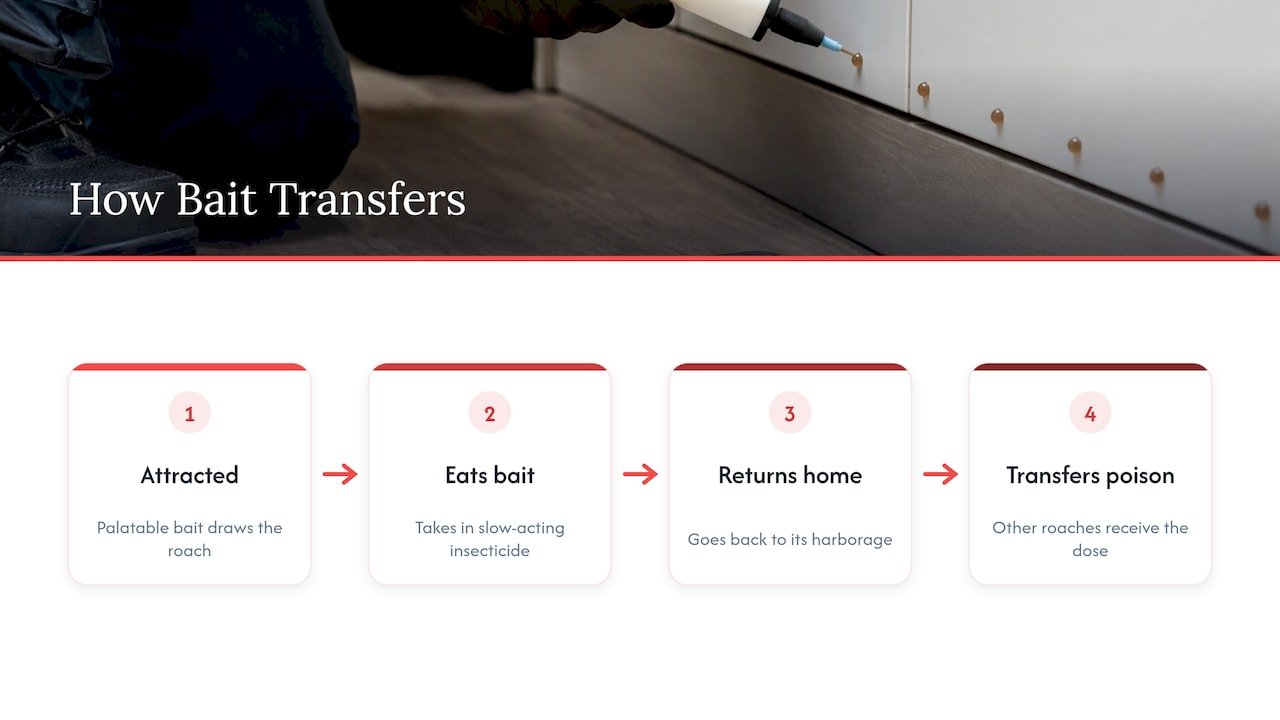
A cockroach bait is a food the insects want to eat, mixed with an insecticide that works slowly. A roach eats it, walks back to its hiding place, and dies there hours later. Other roaches then pick up the poison from its droppings, vomit or body. That delay is the whole design, and it is why a bait that looks like it is doing nothing on day one is often the one that clears the infestation. When the timing, placement and product are right, baiting can take a heavy infestation down by more than 95 percent. If you want it done properly in Canberra, our licensed technicians treat cockroaches at your home or business, with treatments guaranteed for effectiveness.
TL;DR
- Bait is an attractive food plus a slow-acting insecticide, so roaches carry it back to the nest before they die.
- Dying roaches spread the active ingredient through their droppings, vomit and bodies, which is how young roaches you never see get reached.
- Expect the first effect within a day or so and real control in roughly a week, longer in heavy infestations.
- Sprays, dried-out gel, sunlight and competing food are the usual reasons a bait seems to fail.
- Gel goes in many tiny dots in cracks and crevices, kept away from children and pets, never in one big blob.
Table of Contents
- What is actually in a cockroach bait
- The domino effect: how one roach can kill many
- How long gel bait takes to work
- Do cockroach baits really work?
- Why a bait can look like it is failing
- Where the gel goes, and how much
- Bait safety around children, pets and the environment
- What to do alongside the bait
- Getting baiting done properly in Canberra
- Our view on baiting
- FAQ
- Sources
What is actually in a cockroach bait
Two things: something cockroaches find tasty, and something that kills them. The food part is a gel or paste matrix, often with sugars, proteins and fats, so that a roach on the hunt for a meal chooses it. The killing part is an insecticide chosen because it does not act immediately. Research from Rutgers University credits the high success of gel baits to palatable matrices, active ingredients that do not repel the insects, and to some degree the transfer of the active ingredient between individuals.
That last point separates a bait from a spray. A contact spray kills the roach it touches and tends to push the rest away. A bait is the opposite: it needs roaches to come to it, eat, leave and take the poison home. If a roach drops dead on the spot, the other roaches never get the dose, so the slow action is a feature, not a flaw.
Gel is the most common format for homes because a small dot can sit in a crack for weeks. Bait stations (small plastic boxes) and granules work on the same principle, but a technician’s choice of format depends on where the roaches travel and where children and pets can reach.
The domino effect: how one roach can kill many
The part that surprises most homeowners is that a roach does not have to eat the bait to die from it. A 2021 industry paper from the Federation of Asian and Pacific Pest Management Associations describes horizontal transfer: the slow-acting insecticide is still present in the bait formulation, in the feces or oral secretions of affected cockroaches, or in the bodies of the dead ones, and other cockroaches pick it up.
Trade research on indoxacarb-based gels names three routes by which the poison moves through a colony:
- Coprophagy: eating feces.
- Necrophagy: eating dead cockroaches.
- Emetophagy: eating the vomit of dying cockroaches.
This matters because the cockroaches you see are a small share of the population. Nymphs (young roaches) hide deep in wall voids and behind appliances, and they feed on exactly these droppings and carcasses. The same research describes a lethal dose eaten by one adult being able to kill many nymphs, and those nymphs then pass it on again. That chain is called secondary and tertiary kill, and it is how bait can reach a nest you cannot get at.
It also explains why professionals avoid killing roaches in a hurry near the bait. A roach that dies slowly, back at the harborage, is worth far more than one that dies on the kitchen bench.
How long gel bait takes to work
Plan on days, not hours. In the field, noticeable results often start within the first day or two, and most homes see the population drop sharply over the first week. Washington State University’s pest guidance notes that baits are most effective when no other food is available and may need 7 days or more before control is noticed.
The speed depends on three things:
- Species and life stage. In the FAO PMA paper, mortality was faster for adults (3 days or more) than for nymphs (7 days or more). Nymphs are the slower part of the cleanup.
- Size of the infestation. A 30 g tube of gel bait was calculated to kill anywhere from 394 to 6,966 adult cockroaches depending on the species, which tells you a large colony can need more than one round.
- Competition from other food. Roaches choose the easiest meal. Crumbs, pet food and greasy surfaces compete with the bait.
One sign it is working: you may see more roaches for a day or two as affected insects leave cover to die. Then activity drops. Nymphs in the open and a falling count on a sticky monitor are the signs a technician looks for when checking back.
Do cockroach baits really work?
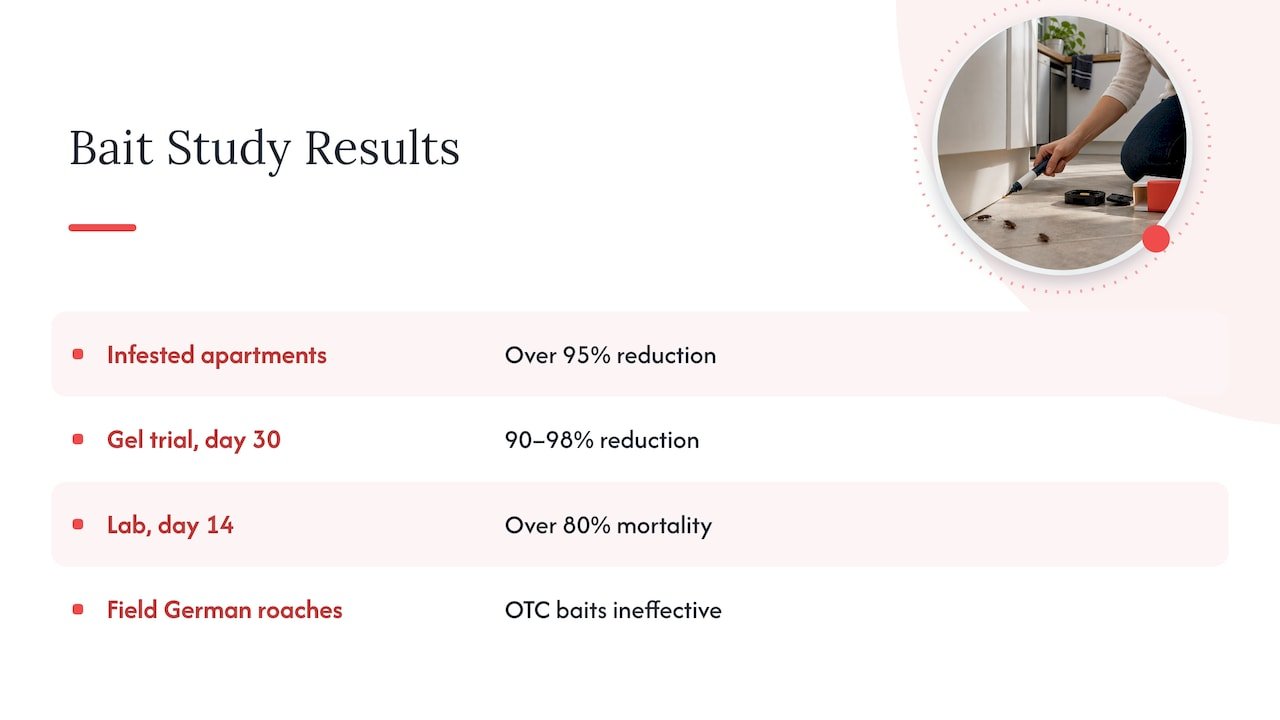
Yes, when the product, placement and conditions are right. The evidence is strong in controlled settings. Rutgers entomologist Changlu Wang reported that baiting alone reduced cockroaches by more than 95 percent in heavily infested apartments. A trade report on a similar trial found 90 to 98 percent reductions by day 30 with gel alone, and in that trial residents were not asked to clean up first.
The results in ordinary homes are more variable, and that is where product choice and technique matter. A 2025 study in the journal PLOS and PubMed Central archive found that all baits, consumer and professional grade, caused over 80 percent mortality within 14 days in the laboratory. In real homes, though, the consumer-grade baits were inconsistent, and some never produced a drop in trap catch. A separate 2025 Journal of Economic Entomology study found over-the-counter baits ineffective against field-collected German cockroaches, with insecticide resistance and bait avoidance as possible contributors.
The lesson for a homeowner is practical: the bait chemistry matters, and so does knowing which species you have, where they travel and how to rotate products. This is the work a licensed technician does every day.
Why a bait can look like it is failing
When a bait “doesn’t work”, the cause is usually one of these:
Sprays near the bait
Sprays repel roaches. Washington State University advises that residual insecticides reduce the attractiveness and efficacy of baits and should not be used in the same vicinity. A common mistake is to bomb or spray the kitchen on the day the gel goes down, which sends the roaches away from the one thing meant to kill them. Where both are used, the sensible split is bait in and around cupboards and any spray on the room perimeter, applied by someone who knows the product interactions.
Cleaning up first
It feels logical to scrub the kitchen before baiting. The trade report on the apartment trials advises against disturbing the roaches and then trying to feed them: don’t do a big cleanup or spray beforehand, because placing bait near hot spots and current feeding sites gets the fastest uptake. Cleaning matters a great deal afterwards, as covered below.
Dried-out or sun-damaged gel
Bait is food, and food ages. Washington State University notes that gel baits lose efficacy when dry and may need to be replaced regularly. Gel also does not tolerate heat: the product label for a widely used professional gel says not to place it on surfaces above 50°C, which rules out spots near ovens, hot water pipes or sunny windowsills.
Resistance and bait aversion
Roaches that survive repeated use of the same active ingredient can pass on tolerance. One Australian gel label warns that repeated use may allow resistant individuals to dominate the population. The trial reported in the trade press handled this by rotating bait products every 90 days. It is one reason a repeat treatment is not simply the same gel again.
The wrong place
A bait three meters from the roaches’ route is a bait nobody visits. The next section covers where gel belongs.
Where the gel goes, and how much
Placement is where professional baiting differs most from a squirt along the skirting board. The label for a professional gel used in Australia (APVMA approval 60126/134450) sets out the approach:
- Small spots, many of them. Apply about 0.1 g, roughly 5 mm across, the size of a small pea. Several small applications spread across an area are more effective than one or two large ones.
- Where roaches travel and hide. Cracks and crevices along walls and floors, behind or under equipment, under tables, around sinks, inside cabinet joins and near garbage areas.
- Not on washed or food-prep surfaces, and not in areas that children or pets can reach.
The label also gives a sense of scale. A typical infestation may need as little as half a tube (15 g), while heavy infestations in large buildings can take several tubes. Where maintenance visits are part of the service, the label recommends checking activity about a month after the first treatment.
Finding the right spots depends on knowing where roaches rest. Our guide to cockroach hiding places shows the usual ones, and if you are seeing small roaches, baby cockroaches explains what to photograph before treatment so the species can be identified.
Bait safety around children, pets and the environment
Baits use very small amounts of active ingredient, placed in discrete dots, and the central rule is simple: keep them where children and pets cannot get at them. WA Health advises not leaving pesticide baits where children and pets can reach them, storing products in their original containers somewhere dry, ventilated and out of reach, and choosing products that are least toxic to people and the environment where practicable. The Australian label for one gel also says it must not be applied where children or animals can easily access it and must not contaminate streams, rivers or waterways.
For families, that means placement decisions are safety decisions: tucked into the back of a cabinet hinge or behind an appliance, not on a countertop edge or a low skirting board in a play area. Our guide on pest control that is safe for pets and children goes through what to move, cover or keep out of a room before a visit.
Cleanup is also part of safety. Roach droppings and shed skins are worth removing with gloves and care, and the steps are much like those in this guide to safe droppings cleanup steps. Wait until the treatment has done its work before heavy cleaning near bait spots.
If anyone in your household has a medical condition or has swallowed or touched bait, call the Poisons Information Centre on 13 11 26 or a doctor, and take the product label with you.
What to do alongside the bait
Bait removes the population. Hygiene stops it coming back. The WA Department of Agriculture’s Gardennote on cockroaches states that hygiene is the single most important factor in managing cockroach problems, and that making food and water hard to reach holds back their normally high population growth. Fixing leaking equipment and sealing access points are named as very important steps.
In practice, once the bait is down:
- Fix dripping taps and pipes, since roaches need water more than food.
- Store pet food and pantry items in sealed containers and take rubbish out nightly.
- Seal gaps around pipes, skirting and door frames.
- Keep clutter and cardboard away from kitchens and laundries.
Our guide to what attracts cockroaches covers crumbs, leaks and clutter in detail, and German cockroach control explains the species most likely to be behind a kitchen infestation. In the colder Canberra months, roaches often move indoors to warm, damp spaces, so prevention is worth a look in autumn. Our Canberra cockroach prevention guide has the local detail.
Getting baiting done properly in Canberra
If you have cockroaches in a kitchen, a rental you manage, a restaurant or a body corporate building, the faster route is a treatment planned around the species and the property. Our licensed and insured technicians treat homes and businesses across Canberra, and every treatment is guaranteed for effectiveness. We have more than 10 years of industry experience and have serviced 5,000+ Canberra homes. See our general pest control service, or call for fast pest removal when you need a same-day emergency visit.
For ongoing protection, our annual plans start with Bronze General Pest at $29.98 per month. Silver Combined is $55.98 per month and Gold Complete is $79.98 per month. You can compare them on our maintenance plans page.

If you want to see the process before you book, our guide to getting rid of cockroaches in Canberra walks through what a visit looks like.
Our view on baiting
Most cockroach calls we get start the same way: a householder has sprayed everything in sight, the roaches have vanished for a week, and then they are back in greater numbers. Spraying treats the roaches you can see. Baiting treats the colony.
That is why we think about a cockroach job as a plan, not a product. Where do the roaches travel? Which species are they? What else are they eating? Where can a gel dot sit without a child or a pet getting near it? Those answers decide the result far more than the brand on the tube.
We built our approach around licensed technicians, safe treatments for families and pets, and fast response, including same-day emergency visits. A guaranteed treatment matters to a family with a kitchen full of roaches at 9 pm, and to a business owner whose reputation is on the line.
If you are going to put a poison in your home, put it in the right place, in the right amount, with someone who can come back and check it worked.
navin
FAQ
Do cockroach baits work?
Yes, when the right product is placed in the right spots without competing sprays. A Rutgers trial recorded more than 95 percent fewer cockroaches in heavily infested apartments using baiting alone. Results in real homes vary with species, food competition and bait quality, which is why professional placement matters.
How does cockroach gel work?
The gel is a tasty food laced with a slow-acting insecticide. A roach eats it, returns to its hiding place and dies hours later. Other roaches, including nymphs, are then exposed through its droppings, vomit and body, so the colony is reached without you seeing it.
How long does cockroach gel take to work?
You may see an effect within a day or so, and control of the population typically takes about a week or more. Heavy infestations and nymphs take longer. Washington State University notes that 7 days or more may pass before control is noticed.
Is cockroach bait safe around pets and children?
It is used in tiny amounts, but it must be placed where children and pets cannot reach it. Official guidance says not to leave baits within their reach and to store products in original containers out of reach. If a child or pet eats bait, call the Poisons Information Centre on 13 11 26.
Can I use bait and spray together?
Not in the same place. Residual sprays repel roaches and lower the bait’s appeal. A technician will plan which areas get bait and which, if any, get a perimeter treatment.
Sources
- Baiting for Success, Rutgers University
- Insect Baits and Baiting, FAO PMA 2021
- Gel baits and secondary kill in cockroach populations
- Cockroaches, Pestsense, Washington State University
- Laboratory and in-home evaluations of consumer- and professional-grade cockroach baits, 2025
- Ineffectiveness of over-the-counter bait and aerosol products, Journal of Economic Entomology 2025
- Assessment-Based Pest Management and cockroach bait myths, Professional Pest Manager
- Cockroach gel product label, 2023
- Gel insecticide product label, 2023
- Protecting the public when using pesticides, WA Health
- Gardennote 39: Cockroaches and their control, WA Agriculture
Recommended
- 24–72 Hour German Cockroach Control for Australian Homeowners
- Inspect Cockroach Hiding Places for Homeowners and When to Call a Pro
- American Cockroaches in Australia: Identify, Treat, Prevent
- Spot 5–13 mm Cockroach Eggs and Remove Them Safely for Homeowners