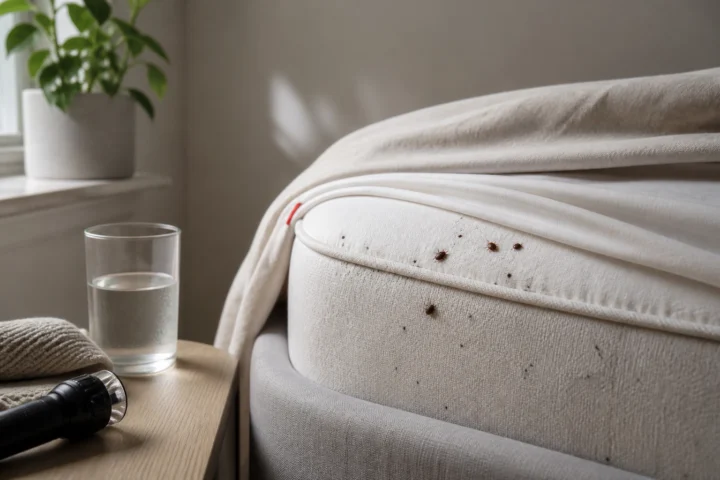
Termite barriers fall into two main families. Physical barriers, such as stainless steel mesh and graded stone, block or expose termites. Chemical barriers use a termiticide in the soil around and under a building. Many homes use both together. Which one suits your property depends on the construction, the slab, the soil and the age of the building, and a licensed inspector should assess all of that on site. At Bugspatrol we install and inspect termite barriers across Canberra, and the guide below sets out how each type works, where it goes and what to ask before you choose.
TL;DR
- Physical barriers (stainless steel mesh, graded stone, metal caps and collars) are materials that termites cannot get through or must build visible tubes over.
- Chemical barriers treat the soil with a termiticide, either as a perimeter trench or with a reticulation system under the slab.
- Combined systems pair a physical layer at slab edges and pipes with a treated zone. They are common on modern builds.
- Lifespan differs: physical materials are generally life-of-building, while soil chemicals need re-treatment over time.
- Every barrier needs inspections. No barrier stops termites living on a site, so regular checks matter.
Table of Contents
- The three families of termite barrier
- Physical termite barriers
- Chemical termite barriers
- Combined systems
- Barriers versus baiting
- How long does a termite barrier last?
- What the standards require for new buildings
- How to choose the right barrier for your property
- Promo: termite barriers and inspections in Canberra
- Our perspective
- FAQ
- Sources
The three families of termite barrier
Australian termite management systems are usually grouped as physical, chemical and combined. The AEPMA Code of Best Practice says the choice between physical, pesticidal and pesticide-impregnated systems generally comes down to cost, personal preference, availability and the dictates of design.
The goal is the same across all of them. The National Construction Code describes the aim as a system that deters termites from reaching a building by a concealed route. The same text notes that a system will not stop termite activity on the site itself. That is why barrier choice and ongoing inspection go together.
Here is a quick comparison before the detail.
| Type | How it works | Typical forms | Usual lifespan |
|---|---|---|---|
| Physical | Blocks entry or forces visible shelter tubes | Stainless steel mesh, graded stone, ant caps, collars, metal strips | Generally life-of-building |
| Chemical | Termiticide in soil deters or kills termites | Perimeter trench treatment, reticulation under slab | Re-treatment needed over time |
| Combined | Physical layer at weak points plus treated soil zone | Mesh at penetrations plus chemical perimeter | Depends on each component |
Physical termite barriers
Physical barriers stop termites getting through, or force them to build shelter tubes where an inspector can see them. CSIRO’s guide lists the common forms: ant caps for stumps, metal strip sheeting for masonry walls, rigid PVC or metal collars for pipes through slabs, fine stainless steel mesh, and graded crushed rock as a perimeter barrier.
Stainless steel mesh
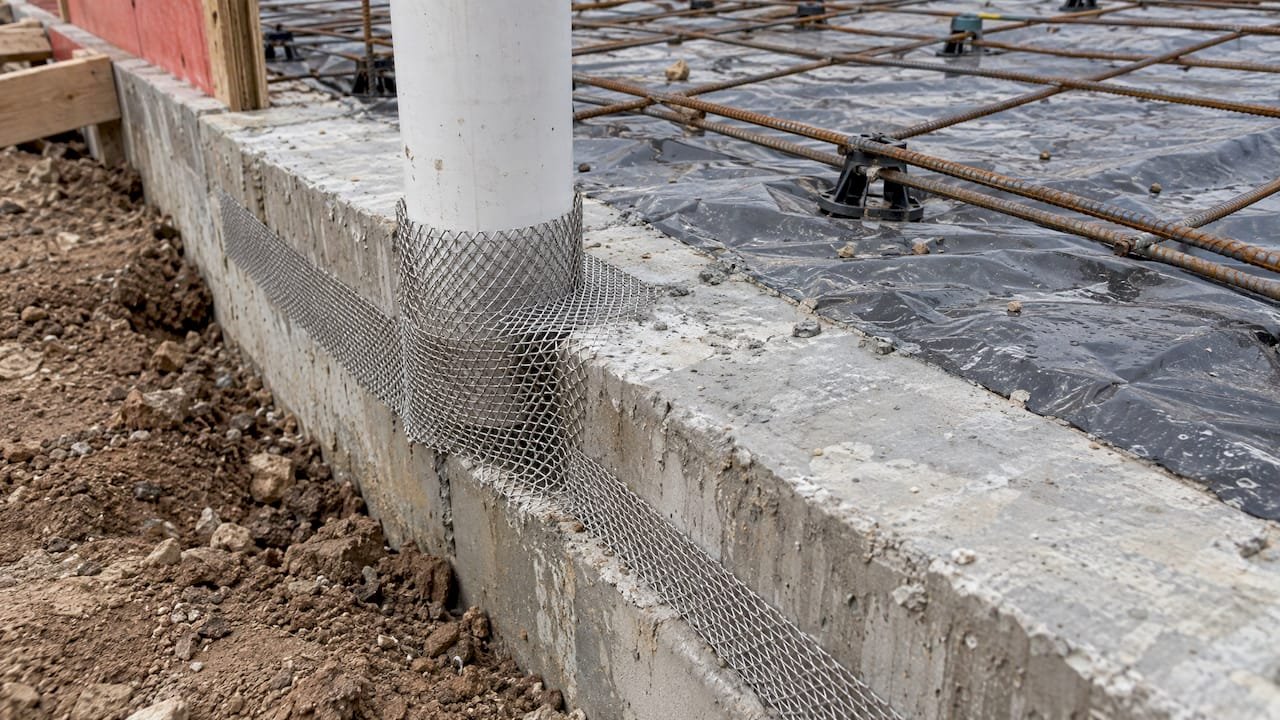
Finely woven, high-grade stainless steel mesh can go under the whole slab, around the building perimeter as a partial barrier, or around individual penetrations. The Queensland Building and Construction Commission notes that, being stainless steel, it is unlikely to be affected by corrosive concrete and ground conditions. The Western Australian government adds that continuous mesh sheets can be installed under slabs and in external walls during construction, and that mesh can also protect penetrations in floors and walls.
Graded stone
Graded stone (crushed rock or granite chip) works because the particles are too tightly packed for termites to move between and too heavy to shift. It can be installed around or under slabs, or under a suspended floor. The same WA fact sheet says it is not suitable for tropical northern areas, where large termites (Mastotermes darwiniensis) can get through a standard granite chip barrier. That species is not a concern for Canberra, but it is a good reminder that barrier choice depends on the region.
Slabs, caps and collars
A concrete slab can itself act as a barrier. Timber Queensland’s data sheet states that a good quality monolithic slab with no cracks or construction joints, built to AS 2870, provides a physical barrier. Where there are construction joints or service penetrations, other forms of protection are required. Pipes, plumbing stacks and slab edges are the usual weak points, which is why collars and mesh collars exist.
Where physical barriers go wrong
A physical barrier protects the pathway it covers and nothing else. If it is damaged during later works, such as a new patio, a plumbing change or digging for a garden bed, the protection at that point is gone. Landscaping that piles soil or mulch against a slab edge can also cover the visible inspection zone. If you plan renovations, tell your inspector before the work starts.
Chemical termite barriers
Chemical barriers use a termiticide to create a treated zone in the soil. CSIRO’s guide explains that these insecticides treat the soil before and after construction, and the main active ingredients are bifenthrin, imidacloprid, fipronil and chlorantraniliprole. The guide says most insecticides provide at least 3 to 5 years of protection.
Perimeter trench treatment
For existing homes, a chemical perimeter is the usual approach. The QBCC describes the process for chemical perimeter systems: excavate trenches, treat the exposed trench, backfill with suitable material, then treat the backfill. On completion, a 300 mm wide by 50 mm deep concrete protection layer (a mowing strip) must be installed in Queensland. The principle is a continuous treated zone with no gaps, so careful coverage around steps, pavers and pipes matters more than any single product choice.
Reticulation under the slab
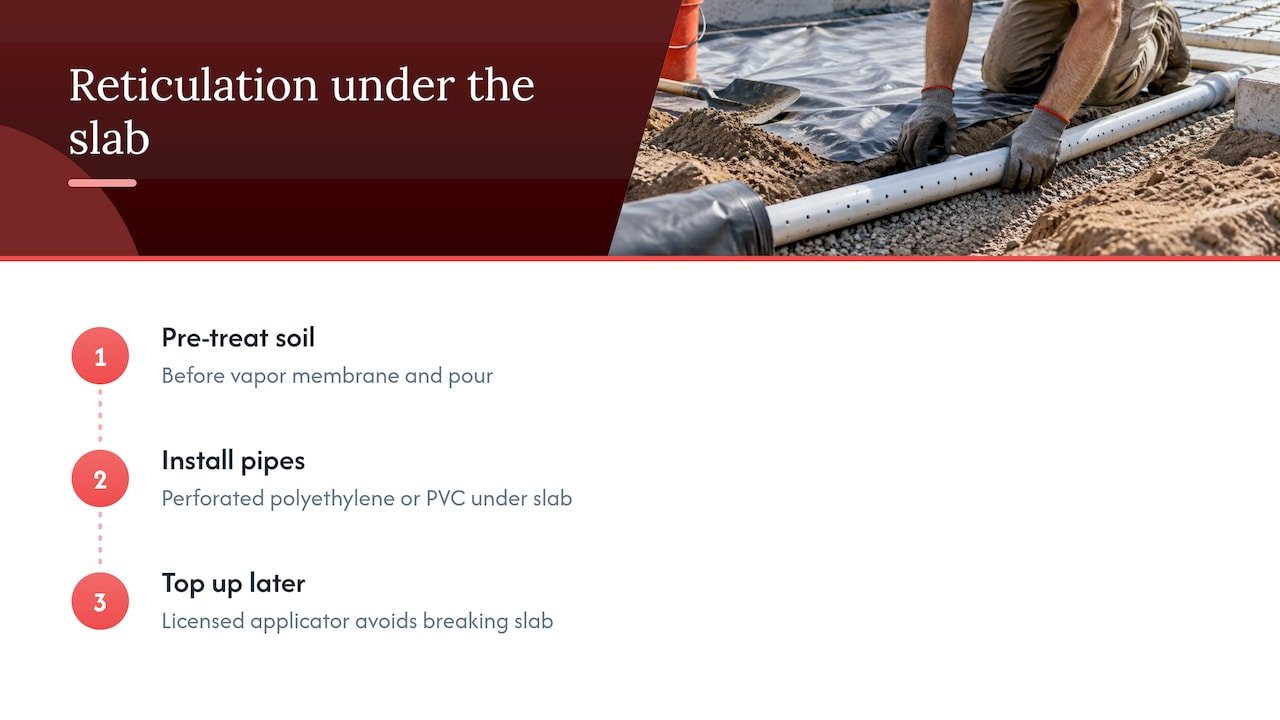
On new slab-on-ground builds, pre-treating soil before the vapor membrane and pour is not enough on its own. CSIRO explains that the NCC’s requirements also call for a reticulation system under the slab using perforated polyethylene or PVC piping. The pipes let a licensed applicator top up the chemical later without breaking the slab.
The QBCC adds that for non-temporary Class 1 buildings in Queensland, chemicals cannot simply be hand-sprayed unless a 50-year life can be proven, which is why reticulation is often used. These are Queensland rules, but they show the direction of the standards.
Repellent and non-repellent products
Chemical products are often described as repellent, which create a zone termites avoid, or non-repellent, which termites cannot detect and which affect them as they pass through. Both aim at the same result: a treated zone termites cannot cross without exposure. Your licensed technician can explain which product class suits your soil, slab and budget.
Licensing
Timber Queensland’s data sheet states that chemical soil barriers must be installed by licensed pest control operators. Our technicians are licensed and insured, and termite barriers are part of what we do for Canberra homes.
Combined systems
Most modern homes layer defenses. Mesh or stone collars go around pipes and penetrations. A chemically treated zone covers the perimeter. Some properties add in-ground monitoring stations. The idea is that no single component is the only thing between termites and your timber. If one layer is disturbed, another is still doing its job.
If you are building, the cheapest time to put in a barrier is before the slab goes down. Our guide for Canberra builders on compliant termite protection before the slab pour covers that timing, and our page on termite prevention for a new home in Canberra covers what to expect after handover.
Barriers versus baiting
A barrier is about keeping termites out. Baiting is about finding and eliminating a colony. The two are often used together. The AEPMA notes on AS 3660.2:2017 state that where monitoring systems are installed, the time between monitor inspections must not exceed 3 months. If you want the full comparison, read our article on termite bait versus barrier for Australian homes.
How long does a termite barrier last?
The answer depends on the type.
- Physical materials are generally described as life-of-building solutions, according to the AEPMA Code of Best Practice.
- Soil chemicals break down over time and need re-applying. CSIRO says at least 3 to 5 years, and the Australian Pest Control Association says each chemical may need replenishing every 5 to 10 years depending on weather and soil conditions.
- Pesticide-impregnated systems, where the pesticide sits in a flexible membrane, allow providers to claim a service life of not less than 50 years, according to the same AEPMA Code.
The NCC also requires a durable notice fixed in a prominent place, such as the meter box, showing the system used, the installation date, and the recommended scope and frequency of future inspections. Find yours, and diarize the dates it gives. Our page on whether termite barriers expire in Canberra explains what to do when the date is close.
What the standards require for new buildings
AS 3660.1:2014 sets out requirements for the design and construction of subterranean termite management systems for new buildings and new building work, and it is part of the NCC reference set. AS 3660.3:2014 sets out the procedures for assessing how well a system and its components manage termite activity.
The NCC also lists building elements considered not subject to termite attack, including steel, aluminum, concrete, masonry, fiber-reinforced cement, and timber that is naturally termite resistant or preservative treated in line with AS 3660.1 (NCC 2019 Part 3.1.4). Even so, CSIRO notes that termites can still damage timber flooring, linings, architraves, books, furniture and even the paper backing on plasterboard when the main structure is protected. A barrier is one part of protecting a home, and inspections are the other.
How to choose the right barrier for your property
Work through these questions with your inspector.
- Is the building new or existing? New slabs can take mesh, stone, or a reticulation system before the pour. Existing homes usually get a treated perimeter and protection at penetrations.
- What is the foundation? Slab-on-ground, suspended floor and stumps each call for different forms. Stump caps suit piers, and mesh or stone suit slabs and subfloors.
- Where are the weak points? Pipes, joins, slab edges and garden beds all need a plan.
- What is the maintenance plan? Chemical zones need inspection and re-treatment on a schedule. Physical barriers need inspection to confirm they are intact.
- Who will install it? Chemical systems need a licensed operator, and an installer who handles the full inspection schedule keeps the paperwork and dates in one place.
The cost, preference, availability and design factors from the AEPMA Code sit behind all five. A quote that names the system, the product, the areas covered and the re-inspection interval is the one you can compare properly.
Promo: termite barriers and inspections in Canberra
We install and inspect termite barriers for homes across Canberra. Our licensed technicians use thermal imaging for termite inspections, and we have serviced more than 5,000 Canberra homes over 10+ years. If you want ongoing cover, our Bronze Termite plan is $29.98 per month, and our Silver Combined and Gold Complete plans also include termite protection alongside general pest control. See our termite control service or the maintenance plans.

Our perspective
Most barrier problems we hear about are not really about the product. They come from gaps: a pipe nobody collared, a garden bed built over the edge of the slab, a treatment date nobody wrote down.
That is why we think of a termite barrier as a system with a schedule, not a one-off purchase. A licensed technician puts the barrier in. Regular inspections, including thermal imaging, tell you whether it is still doing its job.
If you are building, put protection in before the slab is poured. If you already own the home, start with an inspection and a plan that covers every entry point. For many Canberra households that plan is simply an annual inspection built into a monthly subscription, so it does not get forgotten.
Our treatments are designed with families, children and pets in mind, and we guarantee them for effectiveness.
navin
FAQ
What are the main types of termite barriers?
The main types are physical barriers, such as stainless steel mesh, graded stone, caps and collars, and chemical barriers, which use a termiticide in the soil. Combined systems use both. Your inspector will recommend one based on the foundation and the age of the building.
How long does a termite barrier last?
Physical materials are generally life-of-building, according to the AEPMA Code. Soil chemicals need re-treatment, with CSIRO citing at least 3 to 5 years and the Australian Pest Control Association citing 5 to 10 years depending on conditions. The durable notice on your building shows the installer’s recommended inspection schedule.
Does a termite barrier stop termites completely?
A barrier deters concealed entry into the building, but the NCC states it does not stop termite activity on the site. That is why regular inspections are recommended, and why timber items such as furniture and linings still benefit from checks.
Do I need a licensed professional for a chemical barrier?
Yes. Timber Queensland states that chemical soil barriers must be installed by licensed pest control operators. Our technicians are licensed, and we can assess your property and explain the options for your Canberra home.
Sources
- AEPMA Code of Best Practice for Termite Management During Construction
- NCC 2019 Part 3.1.4 Termite risk management
- NCC 2016 Part 3.1.3 Termite Risk Management
- CSIRO, Managing Termites
- QBCC, Termite Management Systems
- Western Australian Government, Termites and your home
- Timber Queensland, Termite Management data sheet
- Australian Pest Control Association, Protecting Buildings from Subterranean Termites
- AEPMA notes on updates to AS 3660.2 2017
- AS 3660.1:2014, Standards Australia
- AS 3660.3:2014, Standards Australia
Recommended
- Termite Bait vs Barrier: Which Suits Your Australian Home?
- Termite Treatment Options: What Canberra Homeowners Need to Know
- Canberra Builders: Book Compliant Termite Protection Before Slab Pour
- Termite Reticulation Systems for Canberra Homes: What They Are and When to Choose One