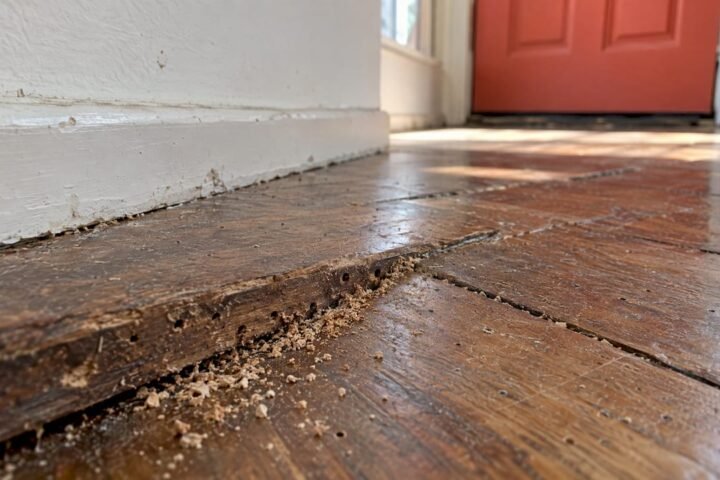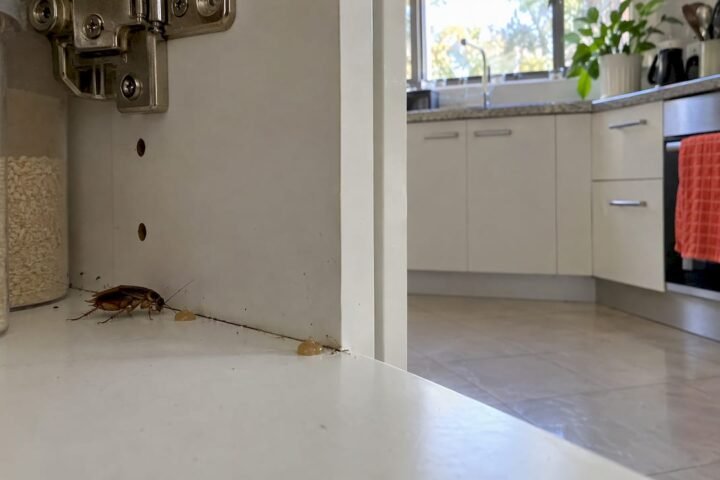
Termite baits work by turning the termites’ own behavior against the colony. Workers find a bait station while foraging, feed on a slow-acting ingredient, and carry it back to share with nestmates. Because the ingredient does not act immediately, enough of the colony is exposed before anyone notices. Done properly, that can eliminate the colony over a period of months rather than days. The catch is that a bait only works as well as the inspection, placement and monitoring behind it, which is why we treat it as a job for a licensed technician rather than a weekend project.
TL;DR
- Termites do not get lured in. They bump into stations during normal foraging, feed, and share a slow-acting active ingredient with the rest of the colony.
- Most baits use a chitin synthesis inhibitor, which stops termites from molting properly. Colony elimination typically takes about 3 to 6 months of bait consumption.
- Stations need regular checking. Without inspection, nobody knows whether termites have found the bait or whether it needs topping up.
- Baits are one tool in an integrated plan alongside inspections, moisture control and, where suitable, barriers.
- If you suspect termites in your Canberra home, a licensed inspection comes first, and that is where we start.
Table of Contents
- What a termite bait station actually is
- How termites find the bait
- How the active ingredient travels through the colony
- Do termite baits work?
- Monitoring: what keeps bait working
- Baits, barriers and the wider plan
- Why a licensed inspection comes before any bait
- Our view
- Protecting your home with BugsPatrol
- FAQ
- Sources
What a termite bait station actually is
A bait station is a small plastic housing, usually a tube or cartridge holder, set into the soil around your house (in-ground) or fixed on or near an active mud tube or infested timber (above-ground). Inside sits a piece of timber or cellulose material, either a monitoring timber or a bait matrix laced with an active ingredient.
Queensland’s Department of Agriculture and Fisheries (DAFF) describes the principle simply: a susceptible substance is placed in a station, termites aggregate and keep feeding after they find it. Several manufacturers have bait toxicants registered with the Australian Pesticides and Veterinary Medicines Authority (APVMA), the national regulator for these chemicals.
The stations are only the visible part. What matters is where they go, how often someone checks them, and what happens once termites are found inside.
How termites find the bait
A common belief is that baits attract termites like a lure. They mostly do not. NC State Extension explains that workers find stations during normal foraging, just as they would find any underground food source. DAFF likewise says termites are not strictly attracted to most baits, and that directed placement in areas conducive to termite activity improves the chance of contact.
That has practical consequences for your home:
- Placement matters. NC State describes stations inserted in soil roughly 2 to 4 feet (about 0.6 to 1.2 meters) from the foundation and no more than 20 feet (about 6 meters) apart. Australian technicians adapt spacing to the site, the species and the layout of the property.
- Hot spots come first. Damp soil, garden beds against walls, leaking taps, stumps and old timber are where foraging termites concentrate. A station in the right spot gets found much sooner than one placed at random.
- Weather plays a part. Cold temperatures and drought can reduce foraging and delay contact with stations. In Canberra, with its frosty winters, activity at stations is usually slower in the cold months, so patience and regular checks are part of the process.
Once termites discover a station, DAFF notes they can quickly recruit large numbers to a new food source and regulate how many foragers come according to the amount of timber available. A good bait gives them plenty to feed on.
How the active ingredient travels through the colony
This is the clever part. For a bait to work, the active ingredient has to meet two requirements. A paper on bait technology from an Australian perspective puts it as non-repellent and slow acting, so foraging termites carry it to the nest and distribute it through contact with nestmates. If termites tasted something harmful or dropped dead beside the station, the rest would simply avoid it.
Chitin synthesis inhibitors
The most widely used modern baits rely on chitin synthesis inhibitors (CSIs), with active ingredients such as hexaflumuron, noviflumuron, novaluron and bistrifluron. Chitin is the material termites use to build their hard outer shell. As termites grow they have to molt, shedding that shell and forming a new one. A CSI blocks the new shell from forming properly.
A 2024 peer-reviewed review by Thomas Chouvenc explains what happens next. Foragers feed on the bait with no immediate effect, then move through the colony and share it with nestmates through trophallaxis, the mouth-to-mouth food exchange termites use constantly. Within a few days, with fewer than 5% of the foraging population feeding on the bait, the colony can acquire a colony-wide lethal dose. Dying workers are also eaten by others, which spreads the ingredient to the brood and queen.
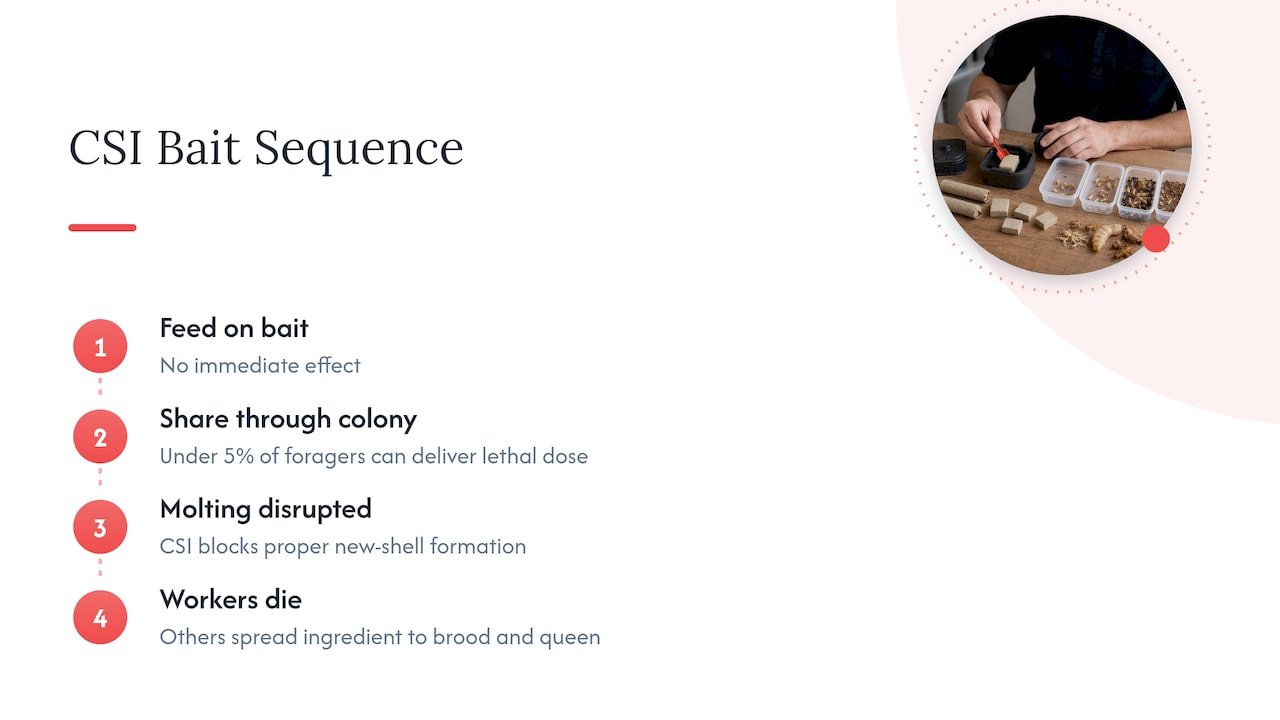
That is a very small share of foragers doing the work. The same review reports that as little as 77 mg of noviflumuron per million Coptotermes workers is enough for elimination, which is why baiting uses only a small amount of active ingredient.
Why the delay is the point
Because termites molt at different times, the effect rolls through the colony gradually. Entomology Today describes it this way: when a worker molts, the CSI interferes with its new cuticle, and as workers progressively die, the soldiers, queen and king starve, leading to colony elimination within about three months in the example it covers. A worker that has fed on bait is not suddenly dead. It keeps walking, feeding others and carrying the ingredient to where it counts.
Metabolic inhibitors and other types
The Australian bait paper also notes that the greatest successes have come from metabolic inhibitors such as sulfluramid and borates, as well as CSIs like hexaflumuron and triflumuron. The common thread is always the same: slow, non-repellent and shared. The same paper reports that Australian researchers eliminated field colonies of the mound-building species Coptotermes lacteus within two months using a juvenile hormone mimic in feeding stations.
Do termite baits work?
Yes, when installed, monitored and maintained properly. A 2021 study of area-wide colony elimination by Shults and colleagues reports that elimination occurs on average after 3 to 6 months of bait consumption, with a 90 to 100% efficacy rate. DAFF notes that baiting reduces further potential damage to timbers, and that because only a small amount of toxin is used and it affects a single colony, it leaves other colonies in the foraging range alone.
The words “properly installed and maintained” carry real weight. Mississippi State Extension says that when stations are properly installed and maintained, they can control termites indefinitely with protection similar to soil-applied treatments. Results depend on a few things you can influence:
- Finding the activity. A thorough inspection before any station goes in tells the technician where termites are working.
- Station placement. Stations near moisture, timber contact and known activity are found faster.
- Regular monitoring. Termites cannot be eliminated by a station nobody opens.
- Removing competing food. Stumps, buried timber, wood mulch against walls and leaking pipes all give termites alternatives and moisture, so tidying them up helps the bait do its job.
If you are wondering about timing, here is a realistic picture:
| Stage | What happens | Typical timing |
|---|---|---|
| Inspection | Licensed check for activity, conducive conditions and entry points | Before any treatment |
| Station placement | Stations installed around the property or at active sites | Same visit or shortly after |
| Discovery | Foraging termites find a station and begin feeding | Days to months, depending on season and activity |
| Bait feeding | Workers consume bait and share it through the colony | Roughly 3 to 6 months on average |
| Colony elimination | Activity stops at the stations | Confirmed by checks |
| Ongoing monitoring | Stations stay in place and are inspected | At least annually |
Monitoring: what keeps bait working
Baits are not a set-and-forget product. Mississippi State Extension states that bait stations must be inspected and maintained at least annually, unlike soil-applied termiticides, which remain in the soil for years. It recommends hiring a professional to install and maintain stations and keeping the termite contract in force.
In practice, monitoring covers:
- opening stations to see whether termites are present;
- replacing or topping up the bait when termites are feeding on it;
- recording what is found so patterns are clear over time;
- keeping the surrounding soil and landscaping from burying, blocking or damaging stations.
The Australian termite code of practice from the Australian Environmental Pest Managers Association (AEPMA) adds that baiting systems must use APVMA-registered products, which you can check at apvma.gov.au, and that such systems may be replenished per the installer’s advice, normally every three to five years. Your installer should be able to tell you the schedule for your property in writing.
Baits, barriers and the wider plan
Baits are one part of a bigger approach. DAFF says baiting is most beneficial within an integrated strategy, followed by hazard reduction and regular inspection. Australian Standard AS 3660, the national standard for termite management, describes integrated management as a combination of building design, wood preservative treatments, physical barriers and dust toxicants, and procedures from two or more options can be combined for higher protection.
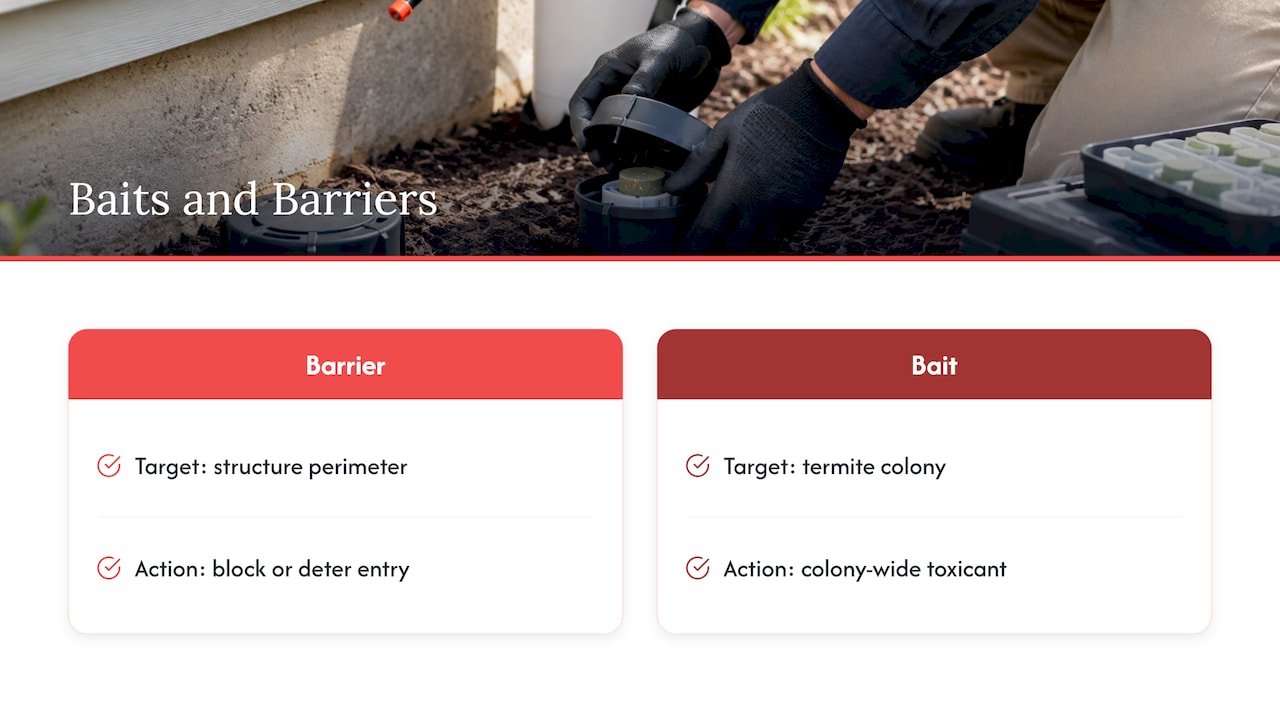
The difference in approach is easy to picture. A barrier, whether chemical or physical, is built around the structure to block or deter termites at the point of entry. A bait system targets the colony itself. DAFF notes that the termiticides still registered for soil barriers (chlorpyrifos, bifenthrin, imidacloprid and fipronil) are far less persistent than the old cyclodienes withdrawn in 1995, so they need more regular re-treatment. Which mix suits your home depends on the slab or subfloor, the site, the species and where activity has been found. Our guide to termite bait versus barrier walks through that choice for Australian homes, and our overview of termite treatment options in Canberra covers the rest.
It also helps to look at the whole property. Pests around the roofline, such as birds nesting under solar panels, are a separate issue from termites, but they are part of keeping the building in good order. If that is on your list, this guide to bird proofing solar panels explains the options for Australian homeowners.
Why a licensed inspection comes before any bait
The bait itself is a small part of the result. What decides it is knowing where termites are, which species you are dealing with and what is feeding them. Species matter: the Australian bait paper by Kirkham points out that bait systems are often designed around one or two locally important species, so understanding termite biology is critical to a system’s efficacy in different situations.
That is why inspection is the first step in any plan. We use thermal imaging in our termite inspections, which helps our licensed technicians spot temperature differences in walls that may indicate activity. Thermal imaging is a screening aid, and it works best alongside moisture readings, tapping and a visual check. Our article on how thermal imaging fits within AS 4349.3 inspections explains how we use it. For how often to book, see termite inspection frequency for Australian homes, where the minimum is every 12 months.
For real estate agents and property managers, the same logic applies. A written inspection report records what was found and where, which is exactly what a buyer, a tenant or a body corporate wants to see.
Can you refill stations yourself?
Some stations are sold to homeowners, and installing one can take an afternoon. But Mississippi State Extension says DIY termite control is not a good idea and recommends a professional for installation, maintenance and an annual building inspection. The reasons are the ones above: placement, species knowledge, correct timing for replenishment and the ability to read what is happening in a station. We compare the two paths in DIY termite baiting versus a professional service.
Our view
Most Canberra homeowners who call us about termites want two things: to know whether they have a problem, and to be sure it stays solved. Baits are an elegant answer to the second part because they go after the colony, not just the termites you can see.
What we have learned from servicing more than 5,000 Canberra homes over 10+ years is that the product is only as good as the plan around it. Our licensed technicians start with a proper inspection, use thermal imaging to help locate activity, and treat with families, children and pets in mind. A termite treatment should never be a guess.
That is also why we like ongoing protection over one-off fixes. Termites do not take seasons off just because the garden looks tidy, and a regular schedule of checks catches activity early, when it costs least to deal with. Our treatments are guaranteed for effectiveness, and our response times are built around the fact that termite and pest problems do not wait.
navin
Protecting your home with BugsPatrol
If you suspect termite activity, or you simply want to know where your home stands, our termite control service starts with an inspection by a licensed technician. We also offer termite barriers and ongoing protection plans for Canberra homes and businesses.
For regular cover, our Bronze Termite plan is $29.98 per month, and our Silver Combined plan is $55.98 per month. Our Gold Complete plan is $79.98 per month. You can see the details on our subscription plans page.
For a quick question or an urgent callout, you can reach us through bugspatrol.com.au, where same-day emergency service is available.
FAQ
Do termite baits work?
Yes, when they are installed in the right places and monitored regularly. A 2021 study reports that colony elimination occurs on average after 3 to 6 months of bait consumption, with a 90 to 100% efficacy rate. Results depend on inspection, placement and follow-up checks.
How long do termite baits take to work?
The timeline has two parts: the time termites take to find the station, and the time the colony takes to collapse once feeding starts. Discovery varies with season and activity, and cold or drought can slow foraging. After feeding begins, elimination typically takes a few months.
Do termite baits attract termites to my house?
No. Termites are not lured in by most baits, and workers find stations while foraging as they would any food source underground. Stations are placed where termites are likely to pass, so the bait intercepts them rather than drawing them toward your home.
Are termite baits safe around children and pets?
Bait products are APVMA-registered, and the active ingredient is sealed inside a station, with only a small amount used for a single colony. Stations should stay closed and undisturbed, and the garden should be kept clear of them. We design our treatments with families, children and pets in mind, and our technicians can explain exactly what goes where on your property.
How often do bait stations need to be checked?
At least once a year, according to Mississippi State Extension. Stations with termite activity are checked more often while the colony is being eliminated. The installer should give you the schedule in writing.
Sources
- Queensland DAFF: Subterranean termite baiting systems (2013)
- Queensland DAFF: Subterranean termite infestation in buildings (2013)
- NC State Extension: Termites, Baiting Systems
- Chouvenc (2024): How do termite baits work?
- Termite Bait Technology: Perspectives from Australia (ICUP)
- Entomology Today: Killing It In The Egg, A Termite Bait Story
- Shults et al. (2021): Area-Wide Elimination of Subterranean Termite Colonies
- Mississippi State Extension: Termite Bait Stations
- AEPMA Code of Best Practice for Termite Management During Construction
- Bird Proofing Solar Panels: The Australian Homeowner’s Guide
Recommended
- DIY Termite Baiting vs Professional Service: Why the Bunnings Aisle Falls Short
- Termite Bait vs Barrier: Which Suits Your Australian Home?
- Termite Season in Australia: When It Starts and What to Do
- Homeowners: Don’t Disturb the Nest. Thermal Imaging for Termite Removal