The best time to treat lawn grubs is before or at peak egg hatch, when the larvae are small and feeding near the surface. In most of Australia that means spring for African black beetle and early to mid summer for Argentinian scarab. By the time a lawn is visibly brown, much of the root damage is done. A licensed technician can confirm which grub you have, time the treatment to its life cycle and re-check the lawn afterwards. That is why we treat on the grub’s calendar, not the lawn’s appearance.
TL;DR
- Treat young grubs before or at peak egg hatch. The registered label for a common lawn grub product puts this at around mid-September for African black beetle and mid-December for Argentinian scarab.
- Brown patches that do not green up after watering, spongy turf and birds pecking at one spot point to active grubs. Heat stress and pet urine can look similar, so confirm first.
- Small larvae are far easier to control than large ones. Waiting until autumn means treating the hardest stage and paying for damage already done.
- Check again two to three weeks after treatment, because eggs from one laying period do not all hatch at once.
- Treating the damage and repairing the lawn are two separate jobs. Stop the grubs first, then rebuild.
Table of Contents
- Why timing matters more than the product
- The seasonal calendar for Australian lawns
- How to tell if grubs are active now
- What to do once you confirm grubs
- When to treat again
- Safer treatment for families and pets
- Recovering the lawn after treatment
- Why use a pest controller rather than guess the timing
- Perspective
- Book a lawn grub inspection and treatment
- FAQ
- Sources
Why timing matters more than the product
Lawn grubs are the larvae of beetles and moths. The adults lay eggs in the turf, the eggs hatch, and the young larvae feed on grass roots or leaves. Larvae grow through stages called instars. The earliest stages are small and feed near the surface. Later stages are bigger, eat far more and are harder to kill.
That is the whole logic of timing. Turf research summarized for Australian growers makes the same point: young larvae are easier to manage than mature populations, so acting early beats reacting late. A treatment applied when the lawn is already collapsing is working against the clock.
There is a second reason timing matters. Some pests feed on the roots and some feed on the leaf blades at night. Those two groups need different treatments, applied and watered in differently. Treating on a hunch, in the wrong month, for the wrong insect, is the most common reason a lawn keeps dying after “treatment”.
The seasonal calendar for Australian lawns
There is no single grub season. Different pests have different life cycles, and the weather in a given year shifts them. The calendar below gives the typical windows. Treat it as a guide to when to start looking, not a date to act on without checking.
| Period | What is usually happening | What it means for you |
|---|---|---|
| Late winter to early spring (August to September) | Beetles begin to stir as the soil warms | Start watching the lawn. Moths over the grass at dusk are a warning sign |
| Mid-September | Typical peak egg hatch for African black beetle, per the product label | The classic window for preventative treatment |
| Spring to early summer (October to December) | Eggs laid earlier hatch into small larvae. Armyworm moths are active | Best time to treat confirmed young grubs |
| Mid-December | Typical peak egg hatch for Argentinian scarab, per the same label | Second key window for curl grubs |
| Mid summer to early autumn (January to March) | Larger larvae do the most feeding. Damage shows quickly | Treat as soon as grubs are confirmed. Control is harder at this stage |
| Autumn to winter | Larvae move deeper. Old damage stays brown while the lawn grows slowly | Repair rather than treat, unless a check shows live grubs |
The two mid-month dates come from a registered label, so they are the firmest figures available. Regional guidance varies. A Victorian turf supplier notes that black beetle larval damage is watched from late spring into summer, while other cockchafers can be active through autumn and winter after rain. That is why identifying the actual insect matters more than following a calendar.
Preventative versus curative timing
Preventative treatment goes on before or at egg hatch, usually spring for black beetle. The label for one widely registered grub product describes a higher rate for early-spring applications that need long protection, and for later applications when mid-sized grubs are present or pressure is high. It claims up to six months of protection at the higher rates.
Curative treatment is for grubs you have confirmed. It works best while larvae are small. If you find them in January, treat in January. Do not wait for a “better” season, because the grubs will keep eating.
A lawn with a history of heavy grubs deserves earlier attention. Turf breeders note that after two dry spring and summer periods in a row, black beetle numbers can reach plague levels in the second year.
How to tell if grubs are active now
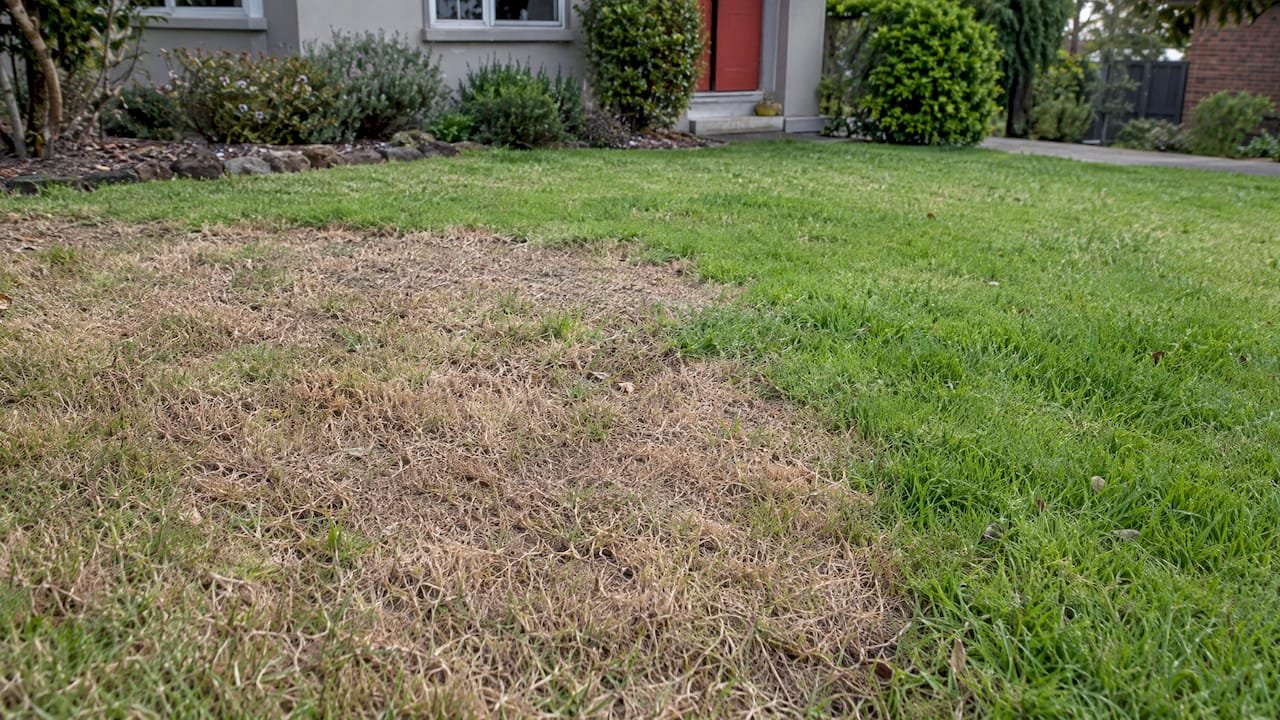
Brown lawn is not proof of grubs. Heat, poor watering, disease, pet urine and scalping can all produce brown patches, and treating the wrong problem wastes time and money. Look for the pattern that grubs make.
Signs that point to active grubs:
- Brown or yellowing patches that spread outwards and do not improve with watering or fertilising.
- Spongy turf underfoot, or grass that wilts even when well watered, because the roots are damaged and cannot take up water. Better Homes and Gardens describes these same signs.
- Turf that lifts or rolls back like loose carpet.
- Birds pecking repeatedly at the same spots.
- Moths flying low over the lawn at dusk, which can mean eggs are being laid.
Signs that point to something else:
- Patches that green up after a deep soak are drought stress.
- Tight round burn marks with a dark green ring and firm turf are usually from dog urine.
- Rings or spots on the leaves with the grass still rooted suggest fungal disease.
- Firm ground with anchored turf after a low mow is scalping.
A turf supplier recommends confirming with an inspection flap, a soap flush or a hessian sack check before treating. For a quick look yourself, cut a flap of turf at the edge of a patch, peel it back and look in the top few centimeters of soil and thatch. A couple of curl grubs in a garden bed or compost heap is normal. Several in the root zone of a dying lawn is not.
The hardest part is judging how many is too many. Counts that seem harmless in a quick look can still matter if the lawn is already thinning. A technician who has inspected hundreds of Canberra lawns can read the pattern of damage, the soil and the grub stage together.
What to do once you confirm grubs
Once you know grubs are there, speed matters more than precision. Three points decide whether treatment works.
1. Match the treatment to the pest. Root-feeding larvae and leaf-feeding caterpillars need different products and different handling. For beetle larvae, the label for one registered product says to irrigate about 6 mm of water immediately after application. For caterpillars it says to hold off irrigation and mowing for 24 hours. Getting that backwards can undo the job.
2. Watch the weather. The same label prohibits application when the soil is saturated or heavy rain is forecast within three days. A treatment washed off or flushed past the root zone is a wasted treatment. It also requires that treated turf is not grazed and that clippings are not fed to poultry or livestock.
3. Treat past the brown patch. Pests concentrate in grass they have not eaten yet. Treating a metre or two into the healthy green edge stops the damage front instead of only treating the dead area.
If you use any lawn insecticide, choose one registered in Australia for your pest and for turf use, and follow the label exactly. The label is a legal document. The Agricultural and Veterinary Chemicals Code Regulations 1995 sit behind pesticide registration, and the latest version of those regulations is published on the Federal Register of Legislation.
When to treat again
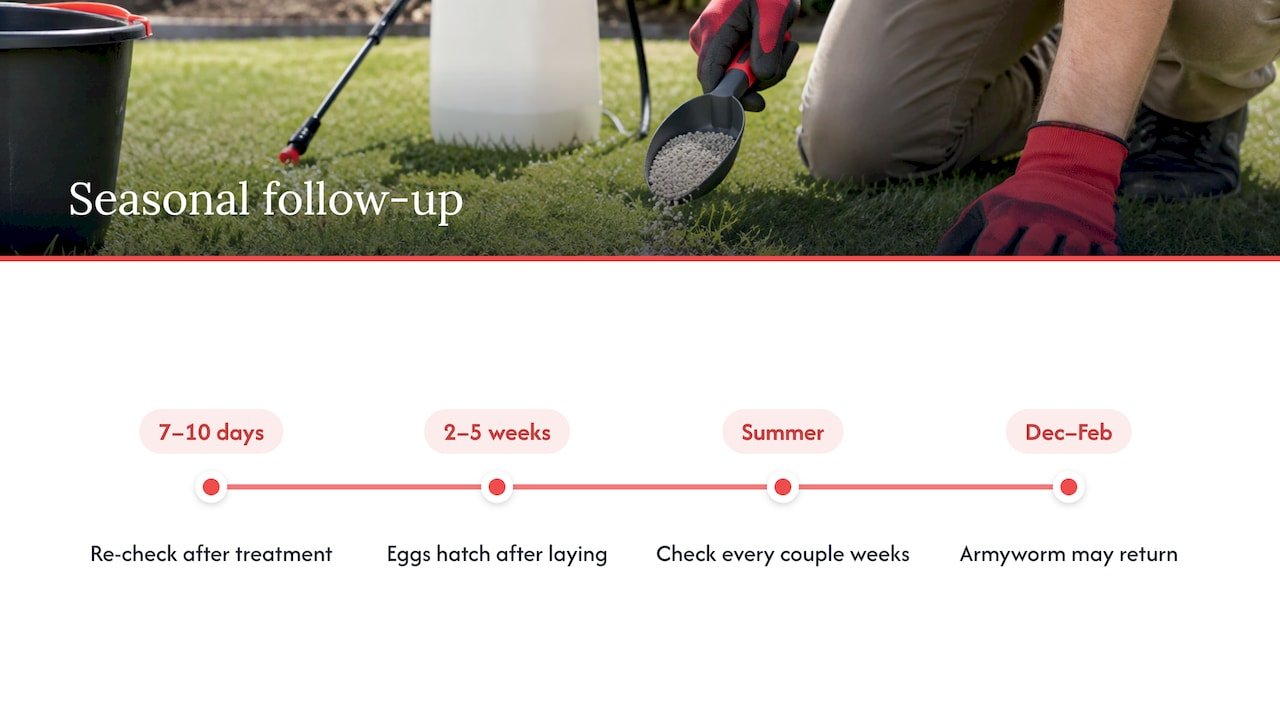
One application is not always the end. Eggs from a single laying period can take two to five weeks to hatch, so a second wave can appear after the first treatment. A good routine is to re-check the lawn with a soap flush or a dig test about 7 to 10 days after treatment, then again every couple of weeks through summer. Armyworm can produce more than one generation in a warm season, so a lawn that was clear in December may need attention again in February.
Repeated use of the same chemical group also matters. The Group 28 label carries a warning that resistant biotypes can come to dominate a population if the same chemistry is used repeatedly. That is a good reason to have a professional plan treatments across seasons, instead of repeating the same product every year.
Safer treatment for families and pets
Most people reading about grubs have children or dogs on the lawn. That is a fair concern, and it shapes how treatment is chosen and timed.
The NSW EPA describes integrated pest management as an approach that prioritizes the control methods with the least risk to the environment and human health. That means monitoring and early detection first, then targeted options, with broad spraying kept for when everything else has failed. Treating young grubs early fits that approach, because it needs less intervention than a late-season rescue.
In practice this means:
- Confirm the pest before anything goes on the lawn.
- Treat early, while a targeted product at a measured rate is enough.
- Water the product in as the label directs, so it moves into the root zone and off the leaf surface.
- Keep children and pets off the lawn for as long as the label for the product used requires.
Our technicians are licensed and insured, and our focus is on effective, responsible treatments for families, children and pets. We guarantee our treatments for effectiveness.
Recovering the lawn after treatment
A lot of lawns recover. The key distinction is that pest control and lawn repair are two separate stages: stop the damage first, then rebuild.
After the grubs are under control:
- Lightly rake out loose dead material, taking care not to strip the grass runners that can regrow.
- Water deeply and less often to encourage roots to go down.
- Raise the mower a notch until the lawn thickens, and keep foot traffic and cars off the weakest areas.
- Feed once the lawn has begun to green up, using a fertilizer that is not too high in nitrogen.
How quickly it comes back depends on the turf and the season. Turf suppliers advise that lawns with partial root damage can often recover once grubs are controlled, but bare areas or turf that peels off in sheets need patching with fresh turf. Recovery is faster in the warm months than in winter, so a lawn damaged in late autumn may sit brown until spring. Our guide to repairing lawn grub damage goes through the steps in more detail.
Why use a pest controller rather than guess the timing
The cost of getting timing wrong is high and easy to miss. Treat too early and the product may not cover the hatch. Treat too late and the larvae are large and the roots are gone. Treat the wrong pest and the lawn carries on dying while you wait for results.
A professional visit fixes the three hard parts of the job: identifying the insect, picking the window and checking the result. For homeowners it removes the guesswork. For real estate agents and property managers, it means a lawn is inspected and documented before it becomes a presentation problem. For business owners with turf frontages, it keeps a visible asset from failing in summer.
Our local guides cover the Canberra side in more depth: lawn grubs in Canberra and why turf lifts and when to treat.
Perspective
We have serviced more than 5,000 Canberra homes over 10+ years, and the lesson on lawn grubs is always the same: the lawn tells you late and the calendar tells you early.
Most calls reach us in summer, when a patch has already gone brown and spongy. Our view is that the better call is the one made in spring, when a licensed technician can inspect the turf, confirm what is in it and treat young grubs before they have eaten the roots. That is cheaper for you in repairs and kinder to the lawn.
We also think treatment should be matched to the household. Families with children and pets want a treatment that is effective and responsible, and a confirmed diagnosis and correct timing are what make that possible. When the lawn is already damaged, we treat the pest first and then you can rebuild the turf with confidence that the problem is gone.
navin
Book a lawn grub inspection and treatment
If you have brown patches, spongy turf or birds working over your lawn, we can inspect it, confirm whether grubs are the cause and treat them. Our technicians are licensed and insured, we offer same-day emergency service, and our treatments are guaranteed for effectiveness.

See our lawn grubs control service or browse all our pest control services to book.
FAQ
When is the best time to treat lawn grubs?
Treat before or at peak egg hatch, when larvae are small. Registered label guidance puts that around mid-September for African black beetle and mid-December for Argentinian scarab. If you confirm grubs at any other time of the warm season, treat promptly.
How often do I need to treat my lawn for grubs?
It depends on the pest and the season. One well-timed application can protect for months, but eggs hatch over several weeks and armyworm can have more than one generation. Re-check about 7 to 10 days after treatment and then every couple of weeks through summer.
Will my lawn recover from grub damage?
Often, yes. Once the grubs are controlled, lawns with partial root damage can fill back in with watering, feeding and careful mowing. Bare areas and turf that peels away in sheets usually need patching or replacing.
Can I treat lawn grubs in winter?
Winter is rarely the time to treat, because larvae are deeper and the lawn grows slowly. Old damage can stay brown until spring. If you are not sure whether live grubs are present, an inspection will tell you whether treatment or repair is the right step.
Sources
- Contrado insecticide label (APVMA web label, 07/2025)
- Lawn Grubs: How to Spot, Treat and Prevent Them, HG Turf Group
- Lawn grub information sheet, Ozbreed
- Lawn grub solutions, Better Homes and Gardens Australia
- Signs of Lawn Grubs, Southern Turf Supplies
- Integrated pest management, NSW EPA
- Agricultural and Veterinary Chemicals Code Regulations 1995, Federal Register of Legislation
- Lawn Grubs: Identification, Treatment and Prevention, Seed and Turf
Recommended
- Lawn Grubs in Canberra: How to Spot, Treat and Prevent Them
- Lawn Grub Treatment in Canberra: Test, Timing, Next Steps