A screen guard stops leaves and twigs. A micro mesh guard also stops the fine material that screens let through: pine needles, grit, seeds and pollen. The difference comes down to the size of the openings, and the right choice depends on what falls on your roof, how heavy your rain is and who fits the guard. Fitting matters as much as the product. A well-chosen guard that is badly installed still lets water spill over the front. Our gutter guard team in Canberra installs aluminium and metal gutter guards and can look at your roof before you decide.
TL;DR
- A screen is a coarse panel that blocks leaves and twigs. Micro mesh is a very fine stainless weave that also blocks needles, grit and seeds.
- Testers found micro mesh guards block fine particles that slip through screens, and handled simulated heavy rain without overflow.
- Micro mesh keeps the trough cleaner but collects debris on top, so an occasional brush or rinse is part of the deal. Screens let fine sediment settle inside the gutter.
- Trees overhead, roof pitch, bushfire exposure and installation quality should decide the choice, not the label on the box.
- Have the guard fitted by a licensed team who can read your roof and gutters. We do this across Canberra.
Table of Contents
- What the two terms actually mean
- How they compare on debris
- Water flow in heavy rain
- Maintenance and lifespan
- Property conditions that should decide it
- Why installation decides the result
- Our perspective
- Get a guard fitted properly
- FAQ
- Sources
What the two terms actually mean
People use “screen” and “mesh” loosely, which makes quotes hard to compare. In practice, a screen guard is a panel with a relatively coarse grid, holes or slots. It sits over the gutter, blocks big material and lets water fall through. A micro mesh guard uses a fine stainless steel weave, usually stretched over a supporting frame, with openings small enough to stop fine debris while water passes through by surface tension.
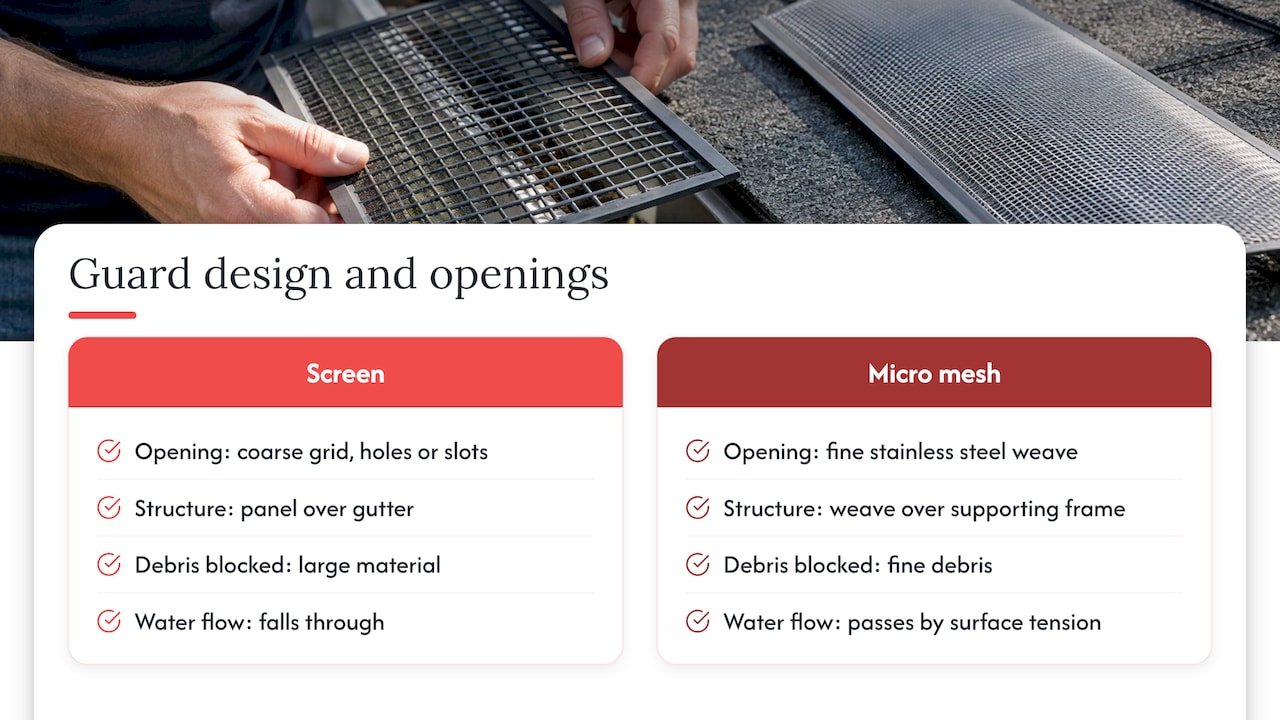
One way to think about it: a screen is tuned for easy drainage and simple fitting. Micro mesh is tuned for a spotless trough. Editorial comparisons describe it as a single trade-off driven by opening size, where neither type wins in the abstract. Each solves a different problem.
So the first question is not “which is better?” It is “what am I trying to keep out of my gutters?”
How they compare on debris
Both types block whole leaves, twigs and large seed pods. The gap opens with small material.
This Old House’s testing found that micro mesh blocks fine particles such as pine needles, seeds and shingle grit that pass through screens and brush guards. USA TODAY’s hands-on testing of six guard styles had a similar result: micro mesh options performed best overall, while the holes in screen guards were too large to stop pine needles or seed pods.
What does that mean in a Canberra street? Think of a yard with:
- Conifers or a neighbour’s pines: needles are thin enough to slip through a screen and pack around the downpipe outlet.
- Eucalypts and gum blossom: bark strips, gumnuts and flowers sit on top of either guard, but fine leaf litter and blossom parts can fall through a screen.
- Deciduous street trees in autumn: big leaves are blocked by both types, so the screen performs well when leaf size is the only issue.
- Tile or gritty roofs: grit sheds into the gutter, and only the finer opening keeps it out.
If your trees drop mostly large leaves, a screen can be perfectly adequate. If you have fine, mixed debris, finer openings pay off.
Water flow in heavy rain
A guard is only useful if water still gets into the gutter. Canberra storms can dump a lot of water quickly, and a guard that sheds water over the front lip defeats the purpose.
In This Old House’s heavy rain testing, a micro mesh guard with 275 micron stainless mesh handled simulated downpours without overflow and largely self-cleaned. The same test found screens handle heavy rain effectively but let small debris in and need more frequent cleaning.
The trade-off is the surface. When pollen, grit or a thin organic film coats fine mesh, water can bead and sheet across the top instead of soaking through. A mesh that stays clean in one yard may need rinsing a few times a year in another. You swap one problem (fine debris in the trough) for another (a film on top). That film is usually removed with a soft brush or a hose from above.
Maintenance and lifespan
Neither type is maintenance free. The question is where the maintenance happens.
| Screen guard | Micro mesh guard | |
|---|---|---|
| Opening size | Coarse grid, holes or slots | Very fine stainless weave |
| Blocks leaves and twigs | Yes | Yes |
| Blocks needles, grit, seeds | Often lets them through | Blocks nearly all |
| Where debris ends up | Fine sediment inside the gutter | On top of the guard |
| Typical upkeep | Scoop sediment from the trough | Brush or rinse the surface |
| Best suited to | Large-leaf trees, simple roofs | Mixed or fine debris, heavy rain |
USA TODAY reports that metal guards of aluminium or stainless steel can last 10 to 20 years, while plastic or PVC guards last 5 to 10. It also says good guards cut cleaning from at least twice a year to once every year or two, by brushing the top or hosing it down. Another comparison reaches the same conclusion: for most homes, either guard turns a chore that happens several times a year into an annual look.
Material matters more than the type name. Metal outlasts plastic, and that is where we focus: our installations use aluminium and metal guards.
Property conditions that should decide it
Here is the checklist we would walk through with you on site. No product comparison online can do this part, because it depends on your roof.
- What is overhead? Walk the block and note which trees overhang or sit upwind. Large leaves point to either type. Needles, blossom and seeds point to finer openings.
- Roof material and pitch. Tile and concrete roofs shed grit. A steep roof sends water at speed, so the guard needs to take a fast flow without it jumping the front edge.
- Gutter condition. Sagging, rusted or poorly sloped gutters should be sorted first. A guard fixed over a gutter that holds water will not fix the pooling.
- Bushfire exposure. If you are on the urban edge or near reserves, ember protection can be part of the decision. Metal mesh is the material to discuss with the installer, and your building certifier or insurer can tell you what applies to your property.
- Access and storeys. A two-storey home, a skylight or a solar panel array changes how safely the guard can be fitted and later cleaned.
- Who will do the cleaning? If you do not want to climb a ladder each year, say so. It affects what you choose and how the guard is fitted.
Working at heights is the risk in all of this, both for fitting and for cleaning. It is a good reason to have a trained installer do the fitting rather than learn on a ladder.
Why installation decides the result
Two guards of the same type can perform very differently. The angle the guard sits at, how it is fixed under the roof edge, how it meets the downpipe outlet and how it handles valleys where roof planes meet all affect whether water enters the gutter or runs past it. A guard sitting flat can trap debris and slow flow. One tilted to match the roof pitch can let leaves slide off.
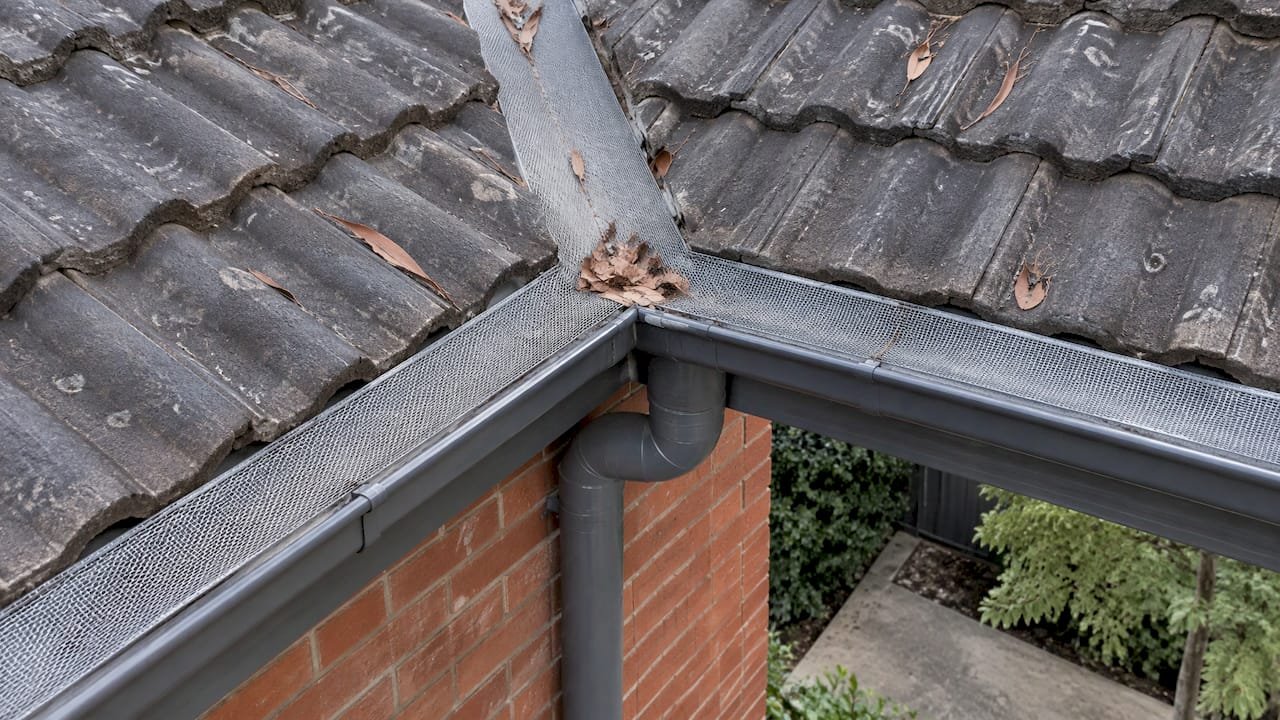
That is why a quote that names only a product, such as “micro mesh” or “screen”, tells you little. Ask what is being fitted, to what lengths, how it is fixed, and whether the gutters are checked first. We install on gutters across Canberra suburbs, and you can see local examples on pages such as aluminium gutter guard installation in Gungahlin and in Belconnen.
Our perspective
Most people ask us which mesh is best. We think the better question is what your gutters need to cope with, and who will fit the guard so it works for years.
We are a pest control and property protection company, so we look at a roof differently. We are already on the roof line for birds, solar panel proofing and inspections, and we see gutters as part of protecting a home. Clean, free-flowing gutters are part of a well-kept property.
Our approach to gutter guards is simple. Assess the trees, the roof and the gutters first. Fit metal guards properly, including aluminium. Make sure the water has somewhere to go. We install across Canberra and surrounding suburbs, with licensed and insured technicians, and our work is backed by 10+ years in the industry and 5,000+ Canberra homes serviced.
If you want finer protection against debris, we will talk you through it. If a simpler guard suits your trees, we will tell you that too. What matters is a result that still works after the next storm.
navin
Get a guard fitted properly
If you are weighing up micro mesh against a screen, the fastest route to a firm answer is to have the roof and gutters looked at. Our team installs aluminium and metal gutter guards for Canberra homes, and the gutter guard installation page explains how to start. If you also have birds nesting at the roof line or a solar array to protect, we can look at bird control and solar panel bird proofing on the same visit.

If you would rather not think about home maintenance piece by piece, our subscription plans cover ongoing pest protection. Bronze General Pest and Bronze Termite are each £-free at 29.98 AUD per month, Silver Combined is 55.98 AUD per month, and Gold Complete is 79.98 AUD per month.
FAQ
Is micro mesh always better than a screen?
Not always. Micro mesh blocks finer debris, so it suits yards with needles, blossom, seeds or gritty roofs. A screen can work well where trees drop mostly large leaves. The choice depends on your debris and your roof.
Will micro mesh clog in heavy rain?
A surface film of pollen or grit can make water sheet across fine mesh, so it needs an occasional brush or rinse. In heavy rain testing, a stainless micro mesh handled simulated downpours without overflow. Correct fitting angle helps water enter the gutter.
How often do gutters with guards need cleaning?
USA TODAY says good guards reduce cleaning to about once every year or two, by brushing the top or hosing it down. Heavy tree cover may need a little more attention.
Is a screen the same thing as a gutter guard?
A screen is one type of gutter guard. “Gutter guard” is the broad term, and micro mesh, screens, brushes and foam are different styles under it. When comparing quotes, check which style and material are being fitted.
Sources
- Best Gutter Guards of 2026, This Old House
- The Best Gutter Guards for Heavy Rain of 2026, This Old House
- 6 best gutter guards, USA TODAY Homefront
- Micro-Mesh vs Screen Gutter Guards: How They Compare, Eavescroft
Recommended
- Do Gutter Guards Work in Australia? Installers’ Pick: Metal Micro Mesh
- Stainless vs Plastic Gutter Guards: What Lasts in Australia
- Bushfire Gutter Guard in Australia: What Rated Mesh Is
- Canberra Gutter Guards: What They Stop and What They Don’t