Heat treatment can clear a bed bug infestation in a single day. A professional chemical program usually takes 2 to 6 weeks and multiple visits. DIY sprays and foggers often take longer than either and frequently fail outright. Whichever route you choose, expect follow-up inspections and some homework on your end, because eradication almost never happens after one treatment.
TL;DR:
- Heat treatment can eliminate bed bugs in a single day and does not require follow-up visits, but it demands full property access and preparation.
- Professional chemical treatments typically take 2 to 6 weeks, with multiple visits spaced about a week apart to account for egg hatching and insecticide resistance.
- DIY sprays and foggers are slower, often ineffective, and may scatter bugs into neighboring areas, making them unsuitable for complete eradication.
- Clutter, adjoining units, and incomplete prep increase treatment duration and the likelihood of needing additional visits beyond the average timeframe.
- Homeowners should follow detailed pre- and between-visit preparations, including laundering, vacuuming, and sealing items, to reduce the total number of visits required.
Table of Contents
- Bed Bug Treatment Timeline: What a Standard Program Looks Like Week by Week
- How Long Each Bed Bug Treatment Method Takes
- What Makes Bed Bug Treatment Take Longer Than Expected
- Getting Your Home Ready Between Visits
- When Can You Sleep in the Room Again?
- What Licensed Technicians Actually Do on the Job
- An Operator’s Honest Take on Realistic Timelines
- Ready for a Managed Bed Bug Treatment Plan?
- Sources
- FAQ
Bed Bug Treatment Timeline: What a Standard Program Looks Like Week by Week
A realistic bed bug treatment timeline follows a pattern licensed operators use across the industry, built around inspection, treatment, and at least one recheck. The AEPMA Code of Practice recommends a documented Bed Bug Eradication Management Plan before any product goes down, and that plan is what turns a vague promise into a schedule you can actually follow.
Here’s how a standard chemical treatment program typically unfolds:
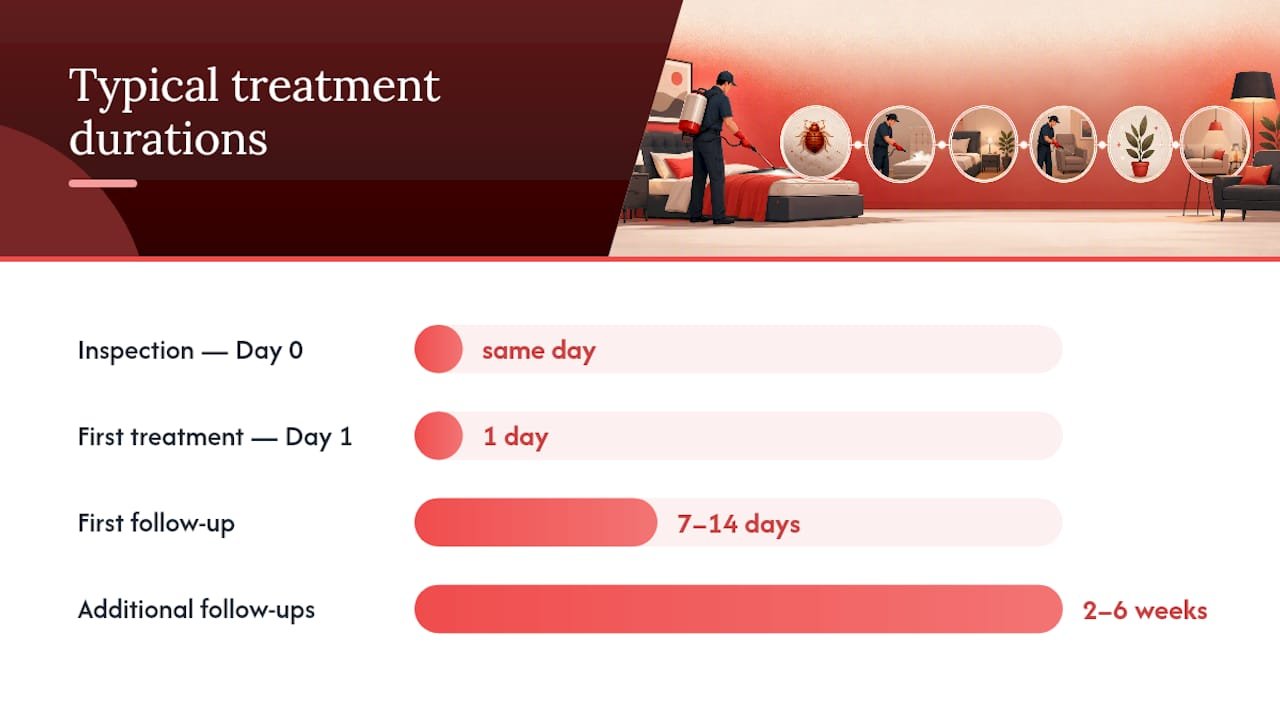
- Day 0: Inspection and the eradication plan. A technician checks mattress seams, bed frames, skirting boards, and furniture joints, then writes up an Eradication Management Plan listing what was found, which products or methods will be used, the follow-up schedule, and what you need to do before treatment day.
- Day 1: First treatment. This is when the bulk of the work happens: targeted insecticide application into cracks and harborages, steam or dust treatment of mattress seams, and instructions on what to launder immediately.
- Days 7 to 14: First follow-up. This visit exists because bed bug eggs can take up to two weeks to hatch, so a technician returns to catch anything that survived as an egg during the first pass.
- Weeks 2 to 6: Additional visits for heavier cases. Larger or long-standing infestations, or ones spread across multiple rooms, often need two or three follow-up treatments before an inspector calls it clear.
- Final clearance inspection. No live bugs, no fresh bites, and no fecal spotting on a final check is what signals the job is genuinely done, not just quiet for a week.
That 2 to 6 week window with follow-up visits about a week apart matches the standard guidance from Victoria’s health department on how professional programs are structured.
Heat treatment runs on a different clock entirely. A whole-room or whole-property heat treatment can be completed in a single day, since raising the space to a lethal temperature kills bugs, nymphs, and eggs in one pass rather than requiring a second visit for hatchlings. You’ll usually need to vacate the property for several hours during the heat cycle and a short cool-down period afterward, and there’s real prep work beforehand (removing heat-sensitive items like candles, aerosols, and some electronics). The trade-off is speed for logistics: heat is fast, but it needs full property access and isn’t always practical for every layout or budget.
How Long Each Bed Bug Treatment Method Takes
Not every method moves at the same pace, and knowing the differences helps you set expectations before you book anything.
- Heat treatment: One day, one visit, but it demands full access to the property and careful prep to protect heat-sensitive belongings.
- Professional chemical program: Typically 2 to 3 visits over 2 to 6 weeks. The spacing exists specifically because eggs hatch on a delay, and a technician needs to catch that second generation before calling the job done.
- Desiccant dusts and targeted crack treatments: These work more slowly than sprays but keep working for months in wall voids and skirting boards, which is why they’re often layered into a chemical program rather than used alone. They extend the “active” treatment window slightly but shrink the odds of needing extra visits later.
- Steam, laundering, and freezing: Steam applied directly to seams and folds kills on contact; laundering above 60°C and drying on hot for at least 30 minutes kills all life stages in fabric, according to Healthdirect. Freezing small items works but needs sustained sub-zero temperatures overnight, not just a quick trip to the freezer.
- DIY sprays and foggers: These are the slowest path of all, and often the least effective. Over-the-counter aerosols tend to scatter bugs into neighboring rooms or wall voids instead of killing them, which can turn a one-room problem into a multi-room one.
Pro Tip: If you’ve already used a store-bought spray before calling a technician, mention it at the inspection. Scattered bugs change where a technician needs to check, and skipping that detail can add an extra visit to your schedule.
Part of why DIY drags on is chemistry, not effort. Research on Australian bed bug populations has found widespread resistance to pyrethroid insecticides, the active ingredient in most supermarket sprays. Spraying a resistant population doesn’t just fail to help. It can also make bugs harder to kill on the next attempt.
What Makes Bed Bug Treatment Take Longer Than Expected
Several factors push a job past the typical 2 to 6 week window, and most of them are visible before treatment even starts.
- Egg timing. Eggs can take close to two weeks to hatch, which is the entire reason follow-up visits are scheduled roughly a week after initial treatment rather than immediately.
- Insecticide resistance. Widespread pyrethroid resistance in Australian bed bug populations means a single-product spray approach that might have worked a decade ago often needs to be replaced with an integrated strategy combining heat, dust, and rotated chemical classes.
- Clutter and hidden harborages. Piles of clothing, cluttered storage, and complex furniture with many joints and seams give bugs more places to hide and give technicians more ground to cover on each visit.
- Adjoining units. In townhouses and apartment blocks, bugs migrate through shared walls, power points, and skirting boards, so a unit can get reinfested from next door even after a clean inspection.
- Well-intentioned mistakes. Moving infested furniture into other rooms, or spraying random over-the-counter product between visits, can undo progress and scatter bugs into fresh territory.
An infestation with heavy clutter and a shared wall to a neighboring unit can easily run toward the long end of that 6 week window, or beyond it, simply because there’s more to inspect and more re-entry points to seal.
Getting Your Home Ready Between Visits
What you do before and between visits has a direct effect on how many visits you end up needing.
- Launder everything washable on the hottest setting your fabric allows, then dry on hot for at least 30 minutes. That combination kills all life stages in linens and clothing, per Healthdirect’s guidance. Bag laundered items in sealed plastic immediately so they don’t pick bugs back up on the way to storage.
- Vacuum mattress seams, skirting boards, and furniture joints thoroughly, but hold off on steam-cleaning or scrubbing treated surfaces afterward unless your technician tells you to. Over-cleaning can strip away the residual product that’s supposed to keep working for weeks.
- Freeze or seal small items you can’t launder, like books, small toys, or electronics, in sealed bags for at least several days if a wash isn’t practical.
- Pull furniture away from walls and clear under beds so the technician can reach every harborage without wasting time moving things themselves.
- Bag and label anything set aside for disposal, particularly heavily infested upholstered furniture that’s beyond saving. A furniture disposal checklist is worth reading before you drag a mattress to the curb, since improperly discarded furniture can reinfest a building.
Pro Tip: Resist the urge to deep-clean every surface right after a treatment visit. A technician relies on residual product staying put in cracks and joints between visits, and enthusiastic cleaning is one of the most common reasons a “successful” treatment needs a repeat.
When Can You Sleep in the Room Again?
Re-entry timing depends on the method used, and it’s worth confirming with your technician rather than guessing.
- Heat treatment: Most properties are safe to re-enter within hours, once temperatures drop and the space has aired out.
- Chemical treatment: Products vary, but many require the treated area to air out for a set period, sometimes a few hours, before beds are usable again.
- Seeing a bug after treatment isn’t automatically a failure. Eggs that were already laid before the visit can still hatch over the following one to two weeks, so a stray sighting a few days after treatment is common and expected.
- A genuine red flag looks different. Rapid spread to new rooms, growing bite counts, or bugs still visible after the scheduled follow-up and final inspection all warrant an immediate call back to your technician rather than waiting it out.
- Bite symptoms are usually mild and settle on their own with antiseptic cream; Healthdirect advises seeing a doctor only if a bite site looks infected or triggers a stronger reaction.
What Licensed Technicians Actually Do on the Job
A written Bed Bug Eradication Management Plan matters because it turns a vague timeline into a document both sides can point to: what was found, what will be treated, when the follow-up happens, and what’s expected of you as the homeowner. On a straightforward single-room case, that plan and one follow-up visit inside three weeks usually closes it out. Heavier, multi-room infestations with clutter or adjoining-unit exposure stretch closer to the 6 week mark and sometimes need a third visit.
Homeowner cooperation is the single biggest lever on how fast a job wraps up. Following the prep checklist, holding off on unauthorized sprays between visits, and showing up for the follow-up inspection all shorten the path to a clear result far more than any product choice does.
Licensed technicians use APVMA-registered products applied according to label directions, which is a safety detail worth confirming with any operator you engage for a bed bug treatment.
An Operator’s Honest Take on Realistic Timelines
Technicians plan follow-up visits on purpose, not because the first treatment failed. Egg timing makes a single visit unrealistic for most infestations, and pretending otherwise just sets homeowners up for disappointment around week two. What actually protects you is a clear plan on paper before treatment starts: what’s being done, when the next visit happens, and what you’re responsible for in between. That clarity is what keeps a 3 week job from quietly turning into a 6 week one.
— navin
Ready for a Managed Bed Bug Treatment Plan?
You’ve seen why DIY sprays often drag on for months and still fail. Professional pest control services often include an initial inspection followed by a written Bed Bug Eradication Management Plan spelling out exactly what will happen, when the follow-up visit is scheduled, and what homeowners need to do in between.

Booking typically starts with a phone call or online enquiry, followed by an inspection where a technician maps out every harborage in the property before quoting a treatment schedule. For your first visit, expect to run through the prep checklist above (laundry done, furniture pulled from walls, small items bagged) so the technician can get straight to work instead of losing time to setup. If bed bugs are the issue, start with the bed bug treatment service page to see what’s involved, or head to general pest control if you’re dealing with more than one pest problem at once and want it handled together.
Sources
- Health
- Bed bugs | healthdirect
- A code of practice for the control of bed bug infestations in Australia (AEPMA)
- Resistance profiling of Australian bed bug strains (aen.12268)
FAQ
How long does it realistically take to get rid of bed bugs?
Heat treatment can finish in a day, while a professional chemical program typically runs 2 to 6 weeks with multiple visits. DIY methods often take longer and frequently don’t finish the job at all.
Is it normal to still have bed bugs after three treatments?
Heavy or long-standing infestations, especially in cluttered homes or units adjoining other infested properties, can require more than the typical two or three visits before a final inspection comes back clear.
How soon can I sleep in my bed after bed bug treatment?
It depends on the method: heat-treated rooms are often usable again within hours once temperatures drop, while chemically treated rooms may need a few hours of airing out first, so confirm the exact timing with your technician.
Will I still see bed bugs after the first treatment?
Yes, this is common. Eggs already laid before treatment can hatch over the following one to two weeks, which is exactly why a follow-up visit is scheduled during that window rather than treatment being called complete after one pass.