Condensation mould grows when warm, moist indoor air hits a cold surface, turns to water and stays there long enough for mould to take hold. The moisture comes from everyday life: breathing, cooking, showering and drying washing indoors. The cold surface is usually a window, an external wall or a ceiling corner. Fix the moisture, the cold surface or the lack of airflow, and the mould has little left to feed on.
This guide explains each cause, how to tell condensation apart from a leak or rising damp, what actually prevents it, and when it is time to call a professional.
TL;DR
- Condensation forms when moist air touches a colder surface, and mould follows where the water sits and the air does not move.
- A household produces a lot of moisture every day, and about 10 litres of water vapour per person per day comes from simply living in a home.
- Cold surfaces (single glazing, uninsulated walls, thermal bridges) and poor ventilation turn that moisture into damp patches.
- Condensation shows up on windows, in corners and behind furniture. A leak or rising damp leaves a defined stain.
- Ventilate, dry washing outside where you can, keep heating steady, and treat a recurring problem at its source, not just the surface.
Table of Contents
- How condensation turns into mould
- The main causes of condensation mould
- Is it condensation, a leak or rising damp?
- How to prevent condensation mould
- Cleaning condensation mould safely
- Health and when to get help
- Get the mould and the cause dealt with
- FAQ
- Sources
How condensation turns into mould
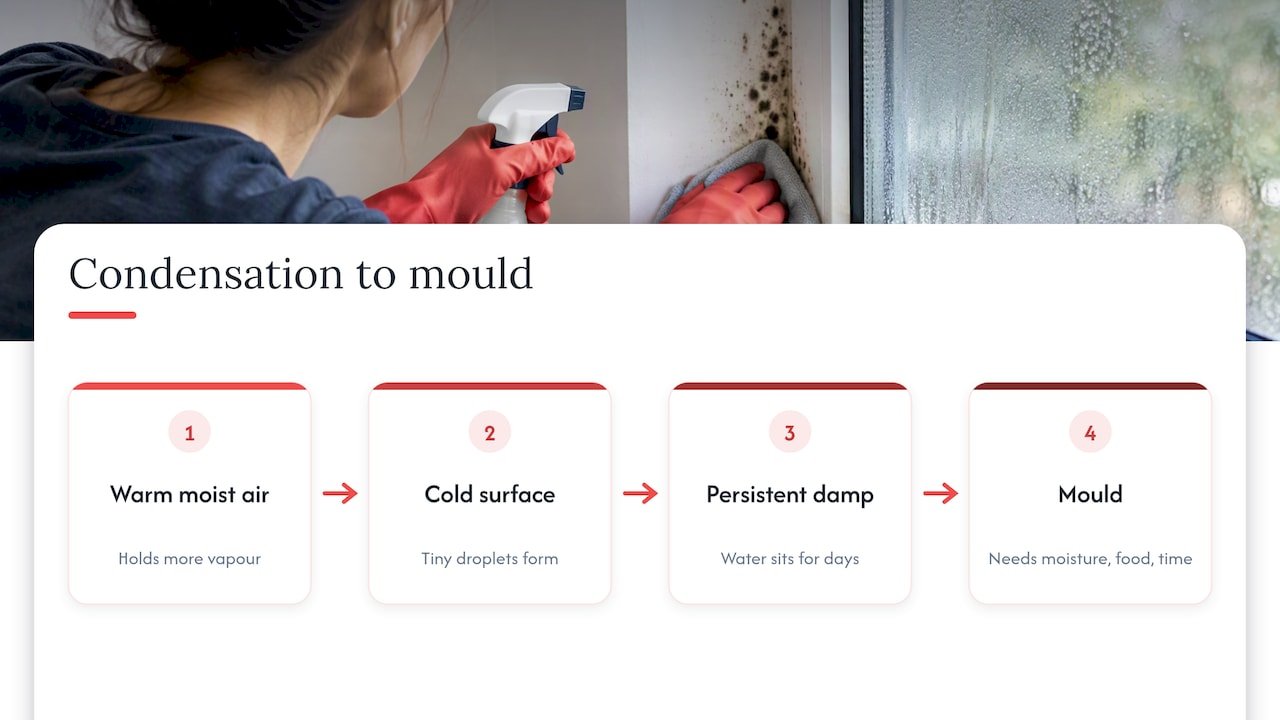
Air holds water vapour, and warm air holds more than cold air. When that warm, moist air meets a cold wall, window or mirror, it can no longer hold all of its moisture, and tiny droplets form on the surface. The Victorian Building Authority describes the same process: moisture from cooking, cleaning, bathing or drying clothes indoors condenses on cold surfaces, and heavy condensation can lead to damp and mould.
Mould needs three things: moisture, a food source and time. Paint, plasterboard, timber, window frames, curtains and even dust provide plenty of food. Water that sits on a surface for days supplies the rest. The same Victorian guide notes that mould grows best in damp, poorly ventilated areas, which is why a wet window sill in a closed bedroom is a classic spot.
One wipe of a foggy window does not create mould. A daily cycle of wet mornings, closed windows and stagnant air does.
The main causes of condensation mould
1. Everyday moisture inside the home
People are the first source. The Australian Building Codes Board states that occupants, through breathing, cooking, washing and bathing, generate approximately 10 litres of water vapour per person per day. A family of four therefore adds a considerable amount of water to the air every day, and that moisture has to go somewhere. If it is not expelled outdoors, it settles on the coolest surfaces it can find.
The biggest daily contributors in most homes are:
- Showers and baths without a working exhaust fan or an open window
- Cooking with pots uncovered and no rangehood in use
- Drying washing on racks or airers indoors
- Unflued gas heaters, which NSW Health lists among the sources to limit when you are trying to reduce indoor humidity and prevent mould
- Lots of indoor plants and fish tanks, which NSW Health also flags in the same advice
2. Cold surfaces
Moisture only condenses where a surface is cold enough. The government-backed YourHome guide explains that single glazing and uninsulated walls raise condensation risk, and that thermal bridges, such as framing or concrete elements that conduct cold through to interior surfaces, can increase it further.
This is why mould often appears:
- Along the bottom of single-glazed windows and on aluminium frames
- On external walls and in the corners where two external walls meet
- On ceilings under poorly insulated roof spaces
- Behind wardrobes and beds pushed against cold external walls
If you want to go deeper on the window case, we cover it in why wiping alone won’t stop window mould.
3. Poor ventilation and still air
Moisture that cannot leave builds up. The ABCB notes that opening windows and doors can significantly change how much moisture a building holds, and that moisture-laden air needs to be expelled outdoors to maintain indoor air quality. Tightly sealed homes, which are good for energy bills, make this even more important: YourHome describes managing condensation as a balance between ventilation and airtightness.
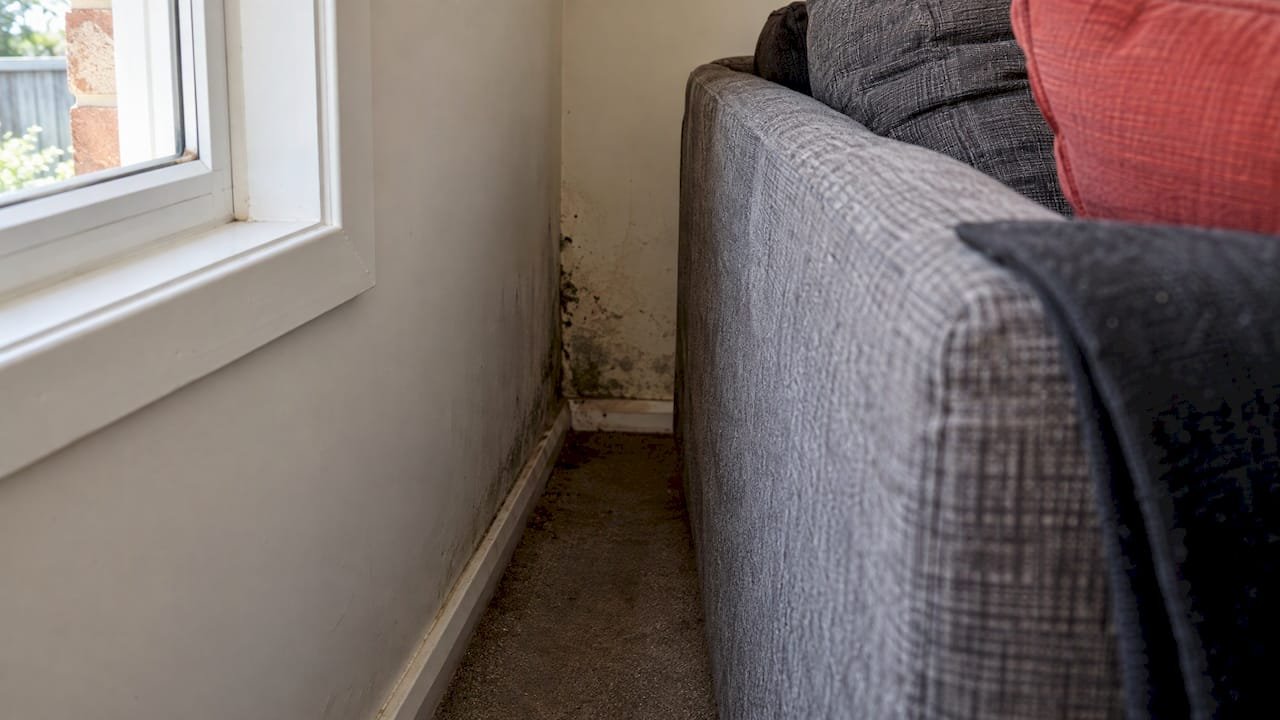
Still air is the other half of the problem. Condensation dampness commonly shows up in corners, cupboards, behind furniture and under work surfaces, wherever there is little air movement. A sofa tight against an external wall is an ideal mould site.
4. Hidden condensation inside the structure
Not all condensation happens where you can see it. YourHome explains that interstitial condensation can occur inside walls, ceilings or floors and can lead to mould, mildew and decay. The right membranes and insulation depend on the climate and location, so a fix that suits a coastal home will not automatically suit a cold inland one.
5. Uneven or intermittent heating
When rooms swing between cold and warm, surfaces stay cold while the air in the house gets damp. A closed, unheated spare room next to a warm living area is a common set-up: the warm, moist air drifts in, meets cold walls and leaves water behind. The Victorian guide points to reverse cycle air conditioning or mechanical dehumidification where available, and to maintaining heating and cooling systems according to the manufacturer’s instructions.
6. Air conditioning set too cold
Condensation is not only a winter problem. A consumer guide on protecting your home from damp and mould points out that setting air conditioning very cold on a hot day can cause condensation to form. Cold supply air and cold surfaces meeting humid outdoor air can leave water on windows and vents.
Is it condensation, a leak or rising damp?
The fix depends on the cause, so identify it first. Damp patches look similar, but they behave differently.
| Cause | Typical signs | Where it appears |
|---|---|---|
| Condensation | Beads of water on glass, black or grey speckled mould, worse on cold mornings and in winter | Windows, external walls, corners, behind furniture, inside cupboards |
| Leak | A defined stain that grows after rain or after the tap, shower or appliance is used | Under or near bathrooms, kitchens, roofs, window seals and pipes |
| Rising damp | A tide mark, usually up to about a metre high, with damaged paint or plaster | Lower sections of ground-floor walls |
The descriptions come from Surrey Heath Borough Council, which notes that leaking plumbing and leaking bath and window seals can cause damp, that rising damp usually leaves a tide mark up to about a metre, and that condensation tends to appear on colder external walls, around windows, in corners and behind furniture. A UK local authority fact sheet adds that structural dampness usually produces a defined stain that links back to a building defect.
A quick way to narrow it down
- Check the timing. Does it get worse on cold mornings, after showers or when the house is shut up? That points to condensation. Does it appear after rain or when a particular tap runs? That points to a leak.
- Look at the shape. Scattered speckles in cold corners suggest condensation. A single defined stain suggests a building defect.
- Check the height. A line at the base of a wall suggests rising damp, but be careful before accepting that diagnosis.
- Look for plumbing or seal faults. Check around baths, showers, window seals and under sinks.
On that third point, the Royal Institution of Chartered Surveyors cautions that “rising damp” is frequently misdiagnosed and that failure of a physical damp-proof course is rare, and it urges investigation of the real moisture source. For genuine rising or lateral damp, NSW Health recommends an experienced building consultant check the damp course and advise on the fix.
How to prevent condensation mould
Prevention works on three fronts: produce less moisture, remove it quickly and keep surfaces warmer.
Reduce the moisture you produce
- Dry clothes outside where possible. The Victorian Building Authority lists this first.
- Put lids on pots and use the rangehood when cooking.
- Limit unflued gas heaters, and keep the number of indoor plants and fish tanks reasonable, as NSW Health advises.
Get moisture out
- Use the exhaust fan or open a window in the bathroom and kitchen while showering or cooking, and leave it running for a while afterwards.
- Air the home regularly on warmer days, as the Victorian guide recommends.
- Pull furniture a few centimetres off external walls so air can circulate, and leave wardrobe doors ajar now and then.
- Use reverse cycle air conditioning or mechanical dehumidification if you have it, and service your systems according to the manufacturer’s instructions.
Silverfish and some other pests also thrive in damp, still wardrobes, so the same habits help there too. We explain the link in how to fix wardrobe humidity.
If you want to filter airborne particles as well, a guide to sizing air purifiers by CADR shows how to compare models on measurable performance. Remember that a purifier cleans the air but does not remove moisture, so it works alongside ventilation, not instead of it.
Keep surfaces warmer
- Keep a steady, moderate level of heating in the rooms that get damp, rather than short bursts of high heat.
- Look at insulation and glazing upgrades if the same windows or walls keep growing mould. YourHome stresses that insulation and membranes should suit your climate and be installed correctly.
- Avoid thermal bridges where possible, because they let cold reach interior surfaces.
What the building code says
New homes are covered by the National Construction Code. Part F8 addresses condensation management in residential buildings, and the ABCB’s page explains why moisture control is part of the code. If you are renovating or building, ask your builder how the design deals with condensation for your location.
Cleaning condensation mould safely
Small patches of surface mould on hard surfaces can usually be cleaned by the householder. A Western Australian government guide on dampness and mould suggests a solution of eight parts white vinegar to two parts water, applied with a microfibre cloth while wearing protective gloves and eyewear. Dry the area afterwards, because moisture left behind invites regrowth.
For porous materials, NSW Health advises completely cleaning and drying water-damaged carpets and building materials, and discarding anything that cannot be cleaned and dried completely.
We compare common cleaning options in vinegar vs bleach for mould. For ceilings, which carry extra risk because of the roof space above, read our guide to ceiling mould and the 1 square metre rule.
Cleaning removes what you can see. It does not fix why the mould grew. If it returns within weeks, the moisture source is still there.
Health and when to get help
Mould releases spores, and NSW Health advises that different types of indoor mould can cause health problems and recommends removing mould as soon as it appears and addressing the cause. A review of mould and the lungs in the medical literature notes that spores can be harmful when breathed in. If anyone in the home has asthma, another lung condition, a weakened immune system, or symptoms that improve when they leave the house, speak to your GP and tell them about the mould. Our article on mould health risks and who is most vulnerable goes through the symptoms in more detail.
Call in a professional when:
- Mould covers a large area or keeps coming back after cleaning
- You suspect a leak, hidden moisture in walls or ceilings, or rising damp (a building consultant or plumber diagnoses these)
- The mould is in the roof space, on ceilings or in wall cavities
- Someone in the household is vulnerable to respiratory problems
Our perspective
In Canberra homes we see the same pattern again and again: a bedroom that is closed up all day, a wardrobe against an external wall, washing drying on a rack in the lounge, and mould creeping along the window frame by winter. The household is rarely doing anything unusual. The house is simply holding moisture it has no easy way to release.
That is why we treat mould as a moisture problem first and a cleaning problem second. A surface treatment that is not paired with a plan for ventilation, humidity and the cold spots that started it will only buy you a few weeks.
Our approach is to find where the moisture is coming from, treat the affected areas with a focus on safe, responsible products around children and pets, and give you practical changes that keep the problem from returning. Our licensed technicians use modern detection methods, and we stand behind our treatments with a guarantee for effectiveness. Moisture also draws other pests such as silverfish and, in the wrong conditions, termites, so we look at the whole property, not just the visible patch.
navin
Get the mould and the cause dealt with
If your mould is spreading, keeps returning or sits somewhere you cannot easily reach, BugsPatrol offers mould treatment for homes and businesses across Canberra, with licensed technicians and a focus on treatments that suit families and pets. We can also check for the pests that follow damp conditions and set you up with ongoing protection.

See what we do and book a visit at BugsPatrol Canberra, or look at our maintenance plans if you want regular protection for your property.
FAQ
Does condensation always cause mould?
No. Occasional condensation that dries quickly, such as a foggy bathroom mirror that clears after the fan runs, is not a mould risk on its own. Trouble starts when moisture sits on surfaces for long periods in still, poorly ventilated areas. Mould grows best in exactly those conditions.
How do I tell condensation from rising damp?
Condensation usually appears on cold surfaces such as windows, external walls and corners, and it comes and goes with weather and household activity. Rising damp tends to leave a tide mark up to about a metre up the wall. Rising damp is also frequently misdiagnosed, so if you suspect it, ask an experienced building consultant to check before paying for a fix.
Is a dehumidifier or ventilation better for condensation?
Ventilation comes first, because it sends moist air outdoors. Use exhaust fans, open windows when cooking or showering and air the home on warmer days. If you have reverse cycle air conditioning or mechanical dehumidification, the Victorian Building Authority lists these as further tools for cutting moisture.
Is it safe to stay in a home with mould?
That depends on the amount of mould and who lives there. NSW Health advises removing mould as soon as it appears and fixing the cause. If someone has asthma, a lung condition, a weakened immune system or symptoms that ease when they are away from home, see your GP and have the mould dealt with promptly.
Sources
- Condensation, moisture damage and mould, Victorian Building Authority
- Part F8 Condensation management, Australian Building Codes Board
- Condensation, YourHome
- Mould, NSW Health
- Causes of damp, Surrey Heath Borough Council
- Dampness, condensation and mould growth advice, Exeter City Council
- Damp and mould, RICS
- Dampness and Mould, Government of Western Australia
- How to protect your home from damp, moisture and mould, CHOICE
- Mould, damp and the lungs, PMC
Recommended
- Wiping Alone Won’t Stop Window Mould in Australia
- Vinegar vs Bleach for Mould: What Works in Australian Homes
- 1 Square Metre Rule for Ceiling Mould in Australian Homes
- Mould Health Risks: Symptoms, Who’s Vulnerable and What to Do