A paper wasp nest is an exposed, gray papery comb of hexagonal cells hanging from a single stalk, usually tucked under eaves, pergolas, or window sills. If it’s high up and out of daily traffic, leave it alone. If it’s near a doorway, play area, or roof void, or if anyone in the house has an insect allergy, arrange a professional night treatment rather than disturbing it yourself.
TL;DR:
- Leave nests high up and away from high-traffic areas unless they are near doorways or pose allergy risks, in which case professional removal is recommended.
- Recognize nests by their exposed hexagonal combs attached by a single stalk, with common locations including eaves, pergolas, and window frames.
- Know that Polistes humilis is the typical open umbrella-shaped nest species, generally calm and measuring 10 to 15 millimeters, while others form more complex clusters.
- Act immediately if the nest is in a shared space or if anyone has a wasp allergy, but monitor and only consider removal if the nest is active and accessible.
- DIY treatment should only be attempted on small, visible nests at night with proper protective gear, and always confirm inactivity before removal; otherwise, hire professionals to reduce risks.
Table of Contents
- How to Identify a Paper Wasp Nest
- Paper Wasp Species and How Their Nests Differ
- Colony Behavior and the Seasonal Lifecycle
- Health Risks and When You Actually Need to Act
- Safe Removal: What You Can Do Yourself and When to Call a Professional
- Preventing Future Nests Around Your Property
- Signs a Paper Wasp Nest Is Abandoned or Inactive
- What Years in the Field Teach You About Paper Wasps
- Professional Wasp Removal When You’d Rather Not Risk It Yourself
- Where This Information Comes From
- Sources
How to Identify a Paper Wasp Nest
The giveaway is the exposed comb. Unlike hornets, paper wasps don’t wrap their nests in an outer papery shell, so you can see the hexagonal cells straight away, attached by a thin stalk called a peduncle. Shapes vary from a single umbrella-like disc to a mushroom cap or a flatter plate, depending on the species and how long it’s been active.
Look for these signs when scanning your property:
- Gray or brown papery texture, made from chewed wood fibers mixed with saliva
- A single stalk attachment point rather than a solid mass against the surface
- Common locations: eave corners, pergola beams, tree branches, fence rails, and window frames
- Wasps hovering near the nest with legs dangling during flight, a behavior distinct from the faster, tucked-leg flight of European wasps
- Slender bodies with narrow “waists” and long legs, rather than the stockier build of yellowjackets
If you’re unsure whether what you’re looking at is a paper wasp or something else entirely, a closer look at wasp species identification markers can save you a guessing game before you get too close.
Paper Wasp Species and How Their Nests Differ
Not every paper wasp nest looks the same, and knowing the species helps you judge how tricky removal might be. Polistes humilis, the Australian paper wasp, builds the classic open umbrella comb you picture when you hear “paper wasp.” Adults run 10 to 15 millimeters long, with yellow-black banding and a yellow face, and they’re generally calmer than European wasps unless the nest is bumped or sprayed carelessly.
Ropalidia romandi and Ropalidia plebeiana build differently. Their nests can appear as ribbon-like strands, covered combs, or dense aggregated clusters sometimes called nest cities, containing many individual nests packed into one sheltered site.
A few things worth knowing before you write a nest off as harmless:
- Nest form tracks substrate and climate, so the same species can look different on brick versus timber
- A weathered, grayed-out nest isn’t automatically dead. Some colonies reuse or overwinter in old structures
- Aggregated Ropalidia sites are harder to access and treat safely than a single Polistes comb, simply because of scale
Colony Behavior and the Seasonal Lifecycle
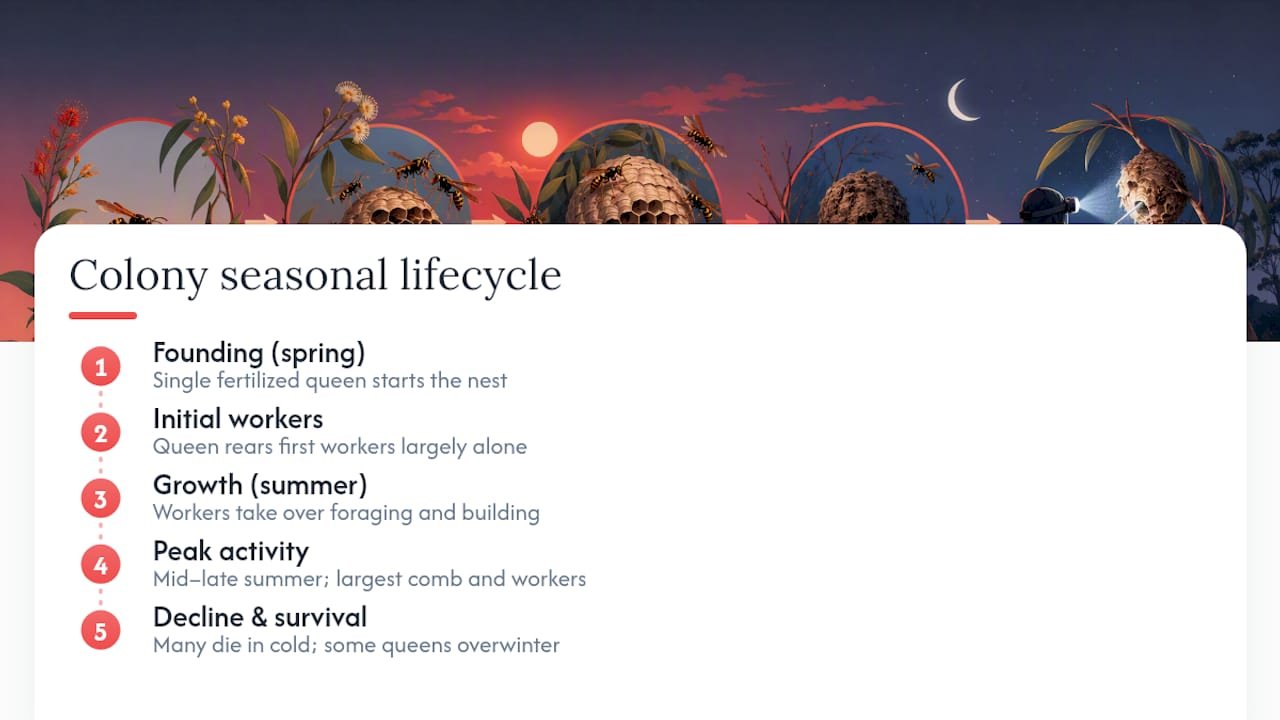
A paper wasp colony starts small. A single fertilized queen founds the nest in spring, laying the first batch of eggs and rearing the initial workers largely alone. Once those workers emerge, they take over foraging and construction, and the colony’s growth accelerates through the warmer months.
Peak activity usually hits in mid to late summer, when the comb is largest and worker numbers are at their highest. This is also when defensive behavior ramps up, since more wasps means more individuals ready to respond if the nest is jostled. Some colonies decline and die off with the cold, but nests aren’t always abandoned for good; certain queens survive winter and reoccupy old structures the following spring.
Watch for frequent traffic in and out of the entry point, wasps clustering visibly on the comb surface, and steady foraging trips nearby. That pattern tells you the colony is active and growing, not winding down.
Health Risks and When You Actually Need to Act
Paper wasps aren’t looking for a fight, but they will sting repeatedly if the nest is threatened, and a small number of people react with anaphylaxis rather than just local swelling. That risk alone is reason enough to treat any nest near shared spaces as a safety issue rather than a wait-and-see project.
Use this quick checklist to decide your next move:
- Act now if the nest sits above a doorway, path, deck, or play area where brushing against it is likely.
- Act now if it’s inside a roof void, wall cavity, or another space you can’t fully inspect.
- Act now if anyone in the household has a known wasp or bee allergy.
- Monitor only if the nest is high, isolated, and away from regular foot traffic, and no one nearby has allergy concerns.
Pro Tip: Never swat at a paper wasp near its nest. A single swipe can trigger a defensive response from the whole colony. Back away slowly and keep kids and pets clear of the area until you’ve decided on a plan.
Safe Removal: What You Can Do Yourself and When to Call a Professional
If you’re not confident about the nest’s size, location, or the temperament of the species involved, calling a professional is the safer default. DIY removal only makes sense for small, fully visible nests, with no allergy risk in the household and the right protective gear on hand.
Timing matters more than most people realize. Treating a nest at night or in the early morning catches the colony at its calmest, when foraging activity has stopped and most wasps are on the comb. Some technicians even work under red-filtered light during these visits, since wasps are far less responsive to red wavelengths than to white light or a bright torch beam.
If you decide to handle a small nest yourself, follow this sequence:
- Put on long sleeves, gloves, and eye protection before you approach.
- Use a registered wasp aerosol, spraying from the side of the nest rather than directly underneath.
- Plan your retreat route before you spray, and back away immediately after.
- Check the nest two nights later and repeat the treatment if you still see movement.
- Remove the physical nest only once you’ve confirmed no activity for several days.
Hand this off to a professional instead when the nest is hidden inside a roof or wall cavity, when it’s a large or aggregated Ropalidia site, when anyone in the home has allergies, or when you’ve already tried DIY treatment and wasps keep returning. A proper inspection identifies the entry point, the extent of the colony, and whether there’s a secondary nest you haven’t spotted, which cuts down the odds of the problem resurfacing a month later.
Pro Tip: If a treated nest still shows wasps flying in and out after 48 hours, don’t spray again on your own. Repeated home treatments without full nest removal can push a stressed colony to relocate somewhere less obvious, like inside a wall cavity.
Preventing Future Nests Around Your Property
A few habits go a long way toward keeping paper wasps from setting up near your doors and windows in the first place:
- Secure compost bins and clean up fallen fruit, both of which attract foraging wasps
- Seal gaps around roof voids and eaves before spring, when queens are scouting nest sites
- Inspect eaves, pergolas, and shed corners in early spring, before a nest grows past golf-ball size
- Keep dense shrubs or vines trimmed back from doorways and play areas, since thick foliage offers ideal shelter
Not every nest needs to go. If it’s tucked in a back corner of the yard, well away from foot traffic, it’s often worth leaving in place and simply checking on it every few weeks.
Signs a Paper Wasp Nest Is Abandoned or Inactive
Not every nest you find is a live one, and treating an empty comb is a waste of time and product. A few reliable signs point to an abandoned nest.
First, watch traffic. An active nest has wasps landing and departing regularly, especially in the morning and late afternoon. If you observe the nest for ten or fifteen minutes on a warm day and see no movement at all, that’s a strong signal it’s empty.
Second, check the cells themselves if you can do so safely from a distance with binoculars. Open, empty cells with no larvae or capped brood suggest the colony has either died off or moved on. A nest riddled with holes or partially collapsed has often been abandoned or predated by birds.
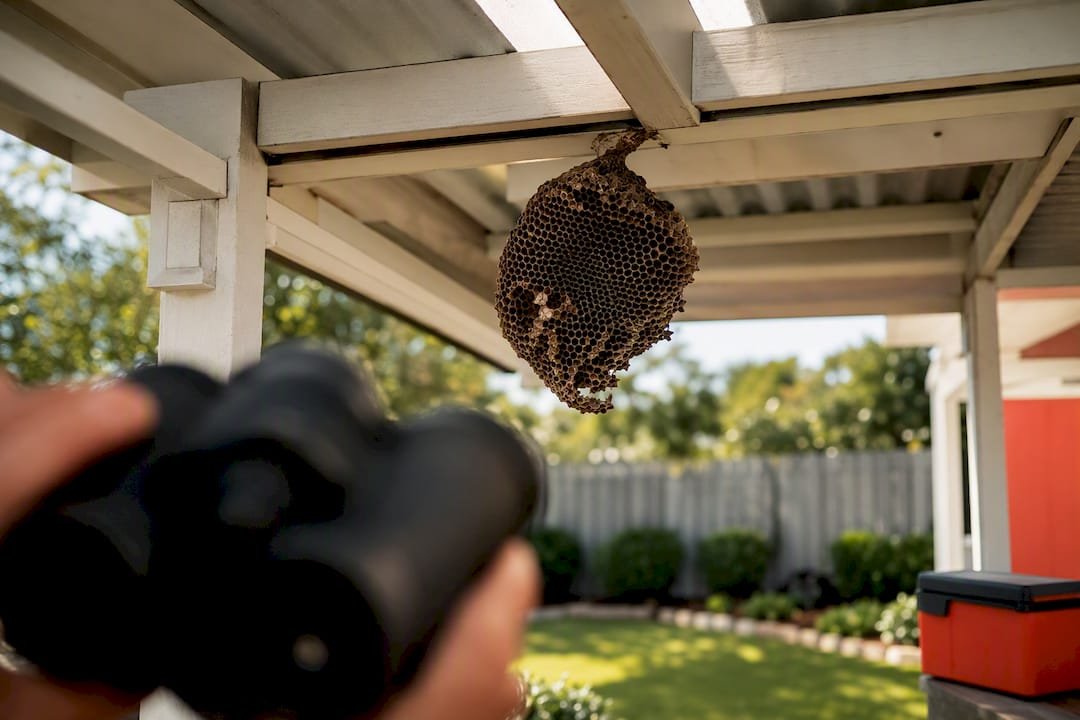
Third, consider the season. Late autumn and winter nests in cooler climates are frequently inactive, since most workers die off once temperatures drop, even though some queens survive to reuse the structure next spring. That caveat matters: don’t assume a winter nest will stay empty forever.
If you’re genuinely unsure, the safest test is distance and patience rather than a stick or a hose. Watch from several feet away over a few visits before deciding it’s safe to remove by hand. When in doubt, treat it as active until proven otherwise.
What Years in the Field Teach You About Paper Wasps
The mistake we see most often at Bugspatrol Pest Management is homeowners attempting removal in broad daylight, when the colony is most alert and most likely to defend itself. The second most common mistake is assuming a weathered nest is dead simply because it looks old. With 10+ years of experience and more than 5,000 Canberra homes serviced, our licensed technicians treat every nest as active until proven otherwise, and we plan every job around minimizing risk to your family and pets.
— navin
Professional Wasp Removal When You’d Rather Not Risk It Yourself
If any part of this guide left you thinking “that’s not a job I want to do at 9 p.m. with a torch,” that instinct is worth listening to. Bugspatrol Pest Management handles wasp nests the way the guidance above recommends: assessed and treated at night, by licensed technicians, using methods chosen to protect kids, pets, and anyone with allergy concerns in the household.

A typical visit starts with an on-site assessment to confirm the species and nest location, followed by a targeted treatment timed for low wasp activity, physical nest removal once it’s confirmed inactive, and practical advice on stopping a repeat nest from forming in the same spot, as part of general pest control Singapore practices. For larger properties or recurring pest issues, it’s also worth asking about a broader pest control service rather than treating each wasp nest as a one-off. If you’d rather not test your nerve against a live colony, book an inspection and let a trained technician handle it from here.
Where This Information Comes From
- Australian Museum for nest construction details and species-level biology.
- DPIRD/DPI NSW for Polistes humilis size, appearance, and behavior data.
- Victoria State Government health guidance for treatment timing and flight identification cues.
- Bugspatrol Pest Management’s own wasp nest removal and wasp nest safety guides for procedural detail specific to Canberra homes.
Sources
- Australian Government DPI NSW — Australian paper wasps
- Australian Museum — Paper wasps
- Victoria State Government — European wasps: pest control
- Entomological Society NSW — Ropalidia plebeiana nesting behaviours (GAE-53)
Recommended
- Wasp Control Services – Free Inspections
- Wasp Pest Control – Bugs Patrol Pest Management
- Wasp Control in Canberra – Bugs Patrol Pest Management
- Wasp Pest Control in Canberra – Bugs Patrol Pest Management