Most spiders you find indoors are harmless, useful predators that quietly clean up flies, moths, and other insects. The immediate move is simple: don’t handle or squash what you see. Contain it with a glass and paper if you want it gone, and take note if sightings keep repeating or you spot egg sacs, since that pattern is what actually warrants a closer look.
TL;DR:
- Most house spiders are harmless and primarily act as natural pest controllers by catching flying insects like flies and moths.
- Proper identification of species is key, with only funnel-webs and redbacks posing significant health risks requiring immediate professional intervention.
- Sealing entry points, removing webs, reducing clutter, and switching outdoor lights to yellow or sodium vapor bulbs effectively prevent repeated spider intrusions.
- Chemical sprays should be used sparingly and targeted, as regular indiscriminate treatment often fails to eliminate egg sacs and can harm beneficial insects.
- Call a professional if you find multiple webs, egg sacs, or experience bites, especially in homes with children, pets, or vulnerable residents.
Table of Contents
- How Do You Identify Common Spiders in the House?
- Why Do Spiders Come Inside in the First Place?
- How to Get Rid of Spiders and Keep Them Out
- When Should You Call a Professional for Spiders?
- What Happens During a Professional Spider Inspection?
- What Should You Do If You’re Bitten?
- Are the Common Spider Myths About Your House True?
- Do Spiders in the House Actually Help You?
- Publisher Perspective: Capture First, Chemicals Last
- How BugsPatrol Handles Spider Problems in Canberra
- Sources
- FAQ
How Do You Identify Common Spiders in the House?
Getting the species right matters more than getting rid of every spider on sight. Most house spiders are visually distinct enough to sort into “leave alone” and “watch closely” once you know what to look for.
Daddy-long-legs (Pholcus): thin, pale, spindly legs with a small tan body, usually hanging in loose, messy webs in ceiling corners, garages, and basements. Completely harmless to people, and one of the more common spiders in the house you’ll find in undisturbed rooms.
Black house spider (Badumna): dark brown to black, stocky body around 1 to 1.8 centimeters, builds thick lacy webs around window frames, sheds, and outdoor furniture. Bites can cause local pain and nausea but aren’t considered dangerous.
White-tailed spider: slate gray, cigar-shaped body with a distinctive white spot at the tip, often found under bark outdoors but wanders indoors at night. Bites can cause ongoing skin irritation, and Better Health Victoria has detailed guidance on symptoms worth knowing.
Huntsman: flat, gray to brown, legs spread crab-like and can reach 15 centimeters across. Startling to find behind curtains or sun visors, but its bite is mild and it actually hunts cockroaches and other pests.
Wolf and mouse spiders: brown or dark gray, robust and hairy, usually found on the ground or in low burrows rather than webs. Mouse spider bites can cause significant pain and swelling and deserve medical attention, even though serious reactions are uncommon.
Funnel-web (Atrax and related genera): black or dark brown, glossy, with a funnel-shaped burrow entrance, mostly found outdoors but occasionally wanders inside after rain. This is the one spider in the house that counts as a genuine emergency, and Environment NSW’s collection guidance explains how authorities want it handled if you find one.
The species that actually require caution, according to Better Health Victoria, are funnel-webs and redback spiders. Everything else on this list is a nuisance at worst. If you can’t confidently identify what you’re looking at, the safest default is to treat it as unknown, keep your distance, and photograph it rather than trap it by hand.
Why Do Spiders Come Inside in the First Place?
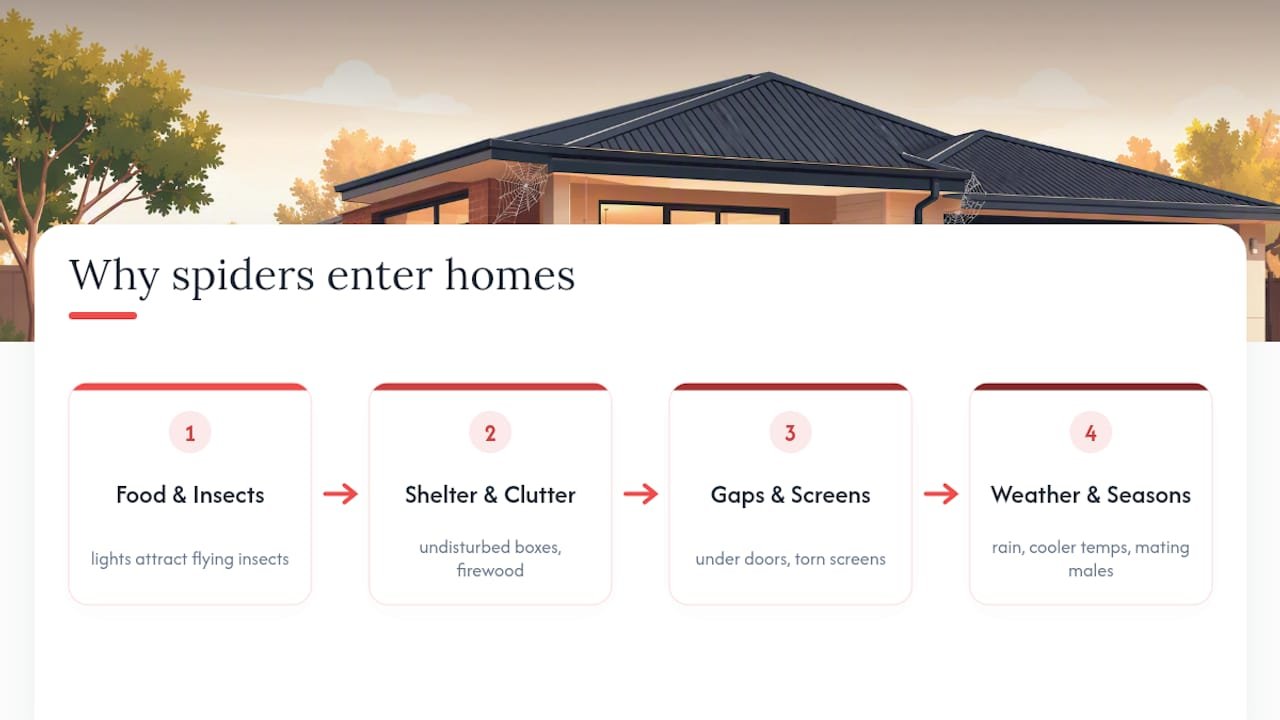
Spiders don’t wander into your house by accident. They’re following food, chasing shelter, or slipping through a gap they found while exploring your foundation.
Food is the biggest draw. Wherever flies, moths, ants, or silverfish gather, spiders follow. A porch light left on all night is basically a dinner bell for flying insects, and the spiders that build webs near doors and windows know it. Shelter matters just as much. Undisturbed boxes in the garage, stacks of firewood against the house, and cluttered corners of a shed give spiders exactly the quiet, dark space they want to build a web and lay eggs without being bothered.
Access ties it together. Gaps under doors, torn window screens, and unsealed vents are the entry points spiders actually use, and once inside, a spider that finds food and shelter has no reason to leave.
Seasonal patterns add another layer. Many species become more visible indoors in spring and summer when populations peak and males wander looking for mates. Others move inside after heavy rain, when their outdoor burrows flood and the driest nearby shelter happens to be your laundry room. Cooler weather in fall pushes a second wave indoors as insects retreat from dropping temperatures. Overflowing gutters, damp mulch beds against the foundation, and stored materials touching exterior walls all raise humidity and insect activity right where spiders are most likely to cross into your home.
How to Get Rid of Spiders and Keep Them Out
Removing a spider you can see is the easy part. Keeping new ones from showing up is where most homeowners fall short, usually because they reach for a spray can instead of fixing the actual attractors.
Immediate removal, done safely:
- Use the glass-and-paper method: place a cup or jar over the spider, slide a piece of stiff paper underneath, then carry it outside and release it away from the house.
- Vacuum visible webs and egg sacs directly, then empty the canister outside immediately so nothing hatches back into your living room.
- Before reaching into storage boxes, garages, or firewood piles, knock items together or use a stick to check for spiders first rather than grabbing blind.
Prevention is where the real payoff sits. Seal gaps around door thresholds, window frames, and utility penetrations, and repair torn screens rather than leaving them as an open invitation. A comparison of security versus insect screens is worth a look if your current screens are more decorative than functional, and simple door-seal upgrades from a guide on winterizing your doors close off another common entry route.
Beyond sealing, cut down the conditions spiders and their prey actually like. Switch outdoor bulbs to yellow or sodium-vapor lights, which attract far fewer flying insects than white LED or halogen bulbs. Keep firewood and bins at least a few feet from exterior walls. Reduce clutter in garages and basements, and vacuum regularly to clear webs before they’re established. RAC WA’s prevention guidance covers this exact combination of steps and consistently ranks it above chemical treatment for long-term results.
Pro Tip: Peppermint or eucalyptus oil sprays are popular homemade spider repellents, and spiders do seem to avoid the smell short-term, but the effect fades within a day or two and doesn’t reach spiders already established behind walls or under furniture. Treat these oils as a light touch-up, not a real control method.
Chemical sprays have a place, but only a narrow one. Health Victoria’s pest control guidance recommends targeted, limited use of approved products rather than routine spraying throughout the house, particularly where children or pets spend time. Indiscriminate spraying kills beneficial insects along with the spiders that eat them, and it rarely reaches egg sacs tucked into cracks, so populations often bounce back within weeks anyway.
When Should You Call a Professional for Spiders?
DIY handles most situations. A handful of signs mean it’s time to stop guessing and book an inspection instead.
- You suspect a funnel-web, based on the glossy black body and burrow-style web near the foundation or garden bed.
- Redback spiders keep turning up repeatedly in sheds, under outdoor furniture, or near meter boxes.
- You’re finding egg sacs or active webs in multiple rooms, which points to an established population rather than one wandering visitor.
- Someone in the house has an unexplained bite with swelling, spreading pain, or nausea.
- The property houses young children, elderly residents, pets, or anyone with a known allergy to insect or spider venom.
If you do call a pest company, ask direct questions before booking: what does the inspection actually cover, which products will be used, are they safe around kids and pets, can you get a written quote, and what does the follow-up schedule look like? Reasonable companies answer all four without hesitation, and you can check current spider infestation signs if you’re still on the fence about whether your situation qualifies.
What Happens During a Professional Spider Inspection?
A proper visit starts with an inspection, not a spray can. Licensed technicians walk the property to identify the species involved and pinpoint entry points, then build a customized treatment plan around what they actually find.
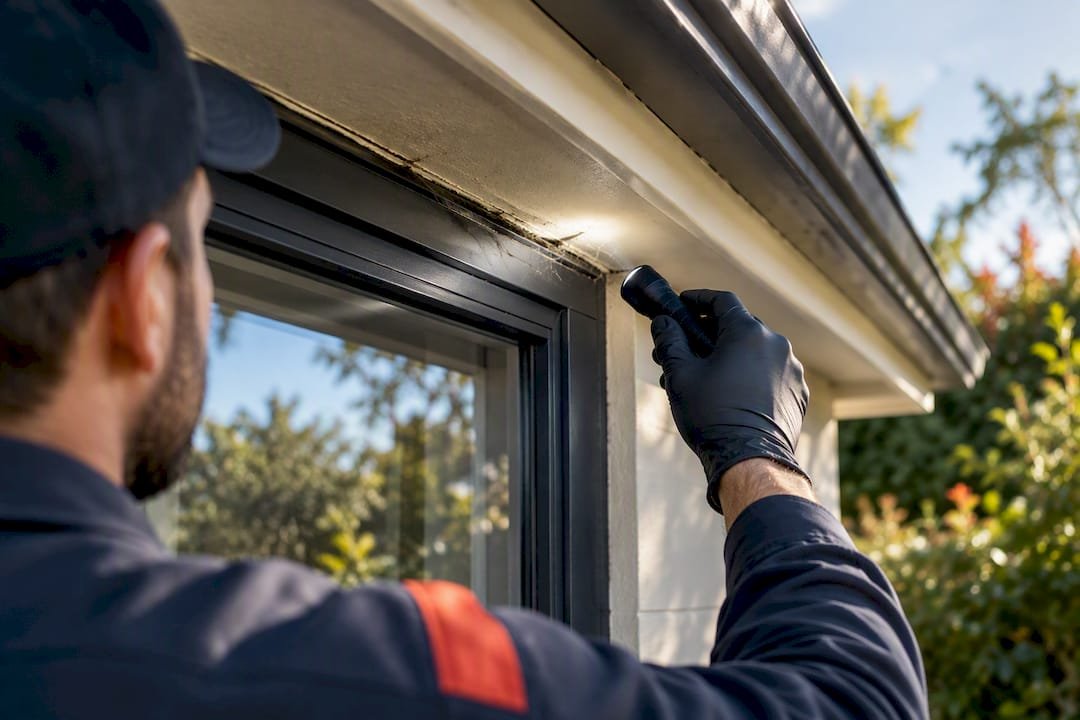
Webbing spiders typically get targeted residual treatment around eaves, window frames, and other web sites, while ground-dwelling species like wolf or mouse spiders call for baiting or soil-focused treatment near burrows instead. Either way, the plan should include exclusion advice, sealing the same gaps and torn screens covered earlier, plus a follow-up visit to confirm the treatment held. Ask any provider for a written quote and confirm they use lower-toxicity products rated safe for households with children and pets.
What Should You Do If You’re Bitten?
Most spider bites in a home setting cause nothing worse than a red mark, mild swelling, and some local pain that fades within a day or two. Wash the bite with soap and water, apply a cold pack to reduce swelling, and keep the area elevated if it’s on a limb.
Watch for warning signs that go beyond a routine bite: spreading redness, intense or worsening pain, nausea, sweating, muscle weakness, or difficulty breathing. Those symptoms point toward a medically significant species, and Better Health Victoria’s spider page lays out first-aid steps specific to redback and funnel-web bites, including the pressure-immobilization technique used for funnel-web suspected bites.
If you can safely capture the spider responsible, whether alive in a container or even dead, bring it with you to a medical facility. Positive identification changes treatment decisions, and guessing wastes time doctors would rather spend treating you. When in doubt about severity, treat it as urgent and seek medical care rather than waiting to see how symptoms develop overnight.
Are the Common Spider Myths About Your House True?
A lot of what people believe about house spiders doesn’t hold up once you check it against the actual biology.
Myth: All house spiders are dangerous. Fact: the overwhelming majority are harmless. Only funnel-webs and redbacks carry medical significance in typical Australian homes.
Myth: Spiders in the house mean the place is dirty. Fact: spiders show up wherever insects and shelter are available, which has more to do with clutter, lighting, and gaps than cleanliness. A spotless house with bright porch lights left on can attract just as many as a messier one.
Myth: Killing every spider you see keeps your home spider-free. Fact: it doesn’t address why they arrived, so new ones replace the ones you remove. Prevention beats extermination for long-term results.
Myth: Spiders actively seek out humans. Fact: spiders want food and shelter, not confrontation. Most bites happen when a spider is startled or trapped against skin, not because it went looking for a fight.
Myth: A big spider is automatically the dangerous one. Fact: huntsman spiders look intimidating at 15 centimeters across but are far less risky than a small redback. Size tells you almost nothing about venom potency.
Do Spiders in the House Actually Help You?
A spider working quietly in a ceiling corner is running free pest control you didn’t have to pay for. Every fly, moth, mosquito, and silverfish it catches is one less insect breeding in your kitchen or bedroom, and a single web can intercept dozens of flying insects over its lifespan.
House spiders also compete with each other for territory, which naturally limits how many anyone home ends up hosting. That self-regulating behavior is part of why most spiders in a home don’t require lethal control: the population tends to level off on its own once the food supply and shelter are limited.
There’s also a broader ecological angle worth knowing. Spiders sit in the middle of a food web, feeding on pest insects while serving as prey for birds and other predators. A house with a small, stable spider population is often a sign that the wider insect balance around the property is working the way it should, rather than a red flag about hygiene or maintenance.
Publisher Perspective: Capture First, Chemicals Last
Our view is straightforward: capture and release, then prevent, then escalate to lethal treatment only when safety or a genuine infestation calls for it. Most spiders don’t deserve to die for existing in a garage corner. But redbacks in the kids’ sandpit, or a suspected funnel-web near the back door, change the math immediately. That’s where local experience counts, and it’s the balance pest management professionals apply across the properties they service.
— navin
How BugsPatrol Handles Spider Problems in Canberra
Pest management professionals are the option for homeowners who’ve done the sealing, the vacuuming, and the light-swapping, and still have spiders showing up week after week. Where a spray can only guesses, technicians inspect first, identify the species involved, and build a treatment plan around your actual property instead of a generic checklist.

That plan typically covers targeted treatment for webbing spiders, ground-focused work for burrowers like wolf and mouse spiders, and exclusion advice for the gaps letting them in to begin with. Everything is chosen with families, kids, and pets in mind, and every job comes with a follow-up so you’re not calling back in a month with the same problem. Explore the spider control service page for what’s included, check the Canberra-specific spider control page if you want local scheduling details, or request a quote through the main site to get an inspection booked this week.
FAQ
What Does It Mean When You Have Spiders in the House?
It usually means your home has a reliable food source, like flies or moths, plus enough shelter and access points for spiders to settle in comfortably. It’s rarely a sign of a dirty house, and most of the time it means pest control is already happening for free.
How Do You Get Rid of Spiders in Your House?
Capture visible spiders with a cup and paper and release them outside, vacuum up webs and egg sacs, then seal gaps, repair screens, and switch to yellow outdoor lighting to cut off what’s attracting them. If sightings keep repeating despite these steps, a professional inspection targets the source directly.
Are Spiders Lucky to Have in the House?
Folklore in several cultures treats house spiders as good luck, but the practical benefit is real regardless of superstition: they eat mosquitoes, flies, and other pests for free. A small, stable population is generally a sign your home’s insect balance is working normally.
Is It Common to Find Spiders in Your House?
Yes, spider sightings indoors are common and become more frequent in spring and summer as populations peak, and again in fall as cooler weather pushes them inside. Occasional sightings are normal; repeated sightings in multiple rooms or egg sacs are the signal to check further.