If your new build sits in a termite-risk area, which covers most of Australia including the Australian Capital Territory, a code-compliant termite management system has to go in during construction, not after. The National Construction Code requires it for Class 1 and 10 buildings, and the system must meet AS 3660.1 or pass testing under AS 3660.3. Once it’s installed, you fix a durable notice in a prominent spot, keep the installation records, and put inspections on the calendar before handover.
TL;DR:
- Most Australian mainland areas require a complete, code-compliant termite management system installed during construction, not after, to meet NCC standards.
- Inspectable physical barriers like mesh or graded stone are preferred for long-term visibility and durability, but require precise installation before concrete pouring.
- Chemical soil treatments demand strict sequencing with slab installation, including thorough trenching, treatment, and immediate backfilling with a concrete cover strip at least 50 mm thick.
- Proper documentation, including a durable notice, installation record, and photographic evidence before concrete coverage, is essential for compliance and future inspections.
- Ongoing annual inspections are necessary to maintain warranty validity, especially for replenishable systems, while sealed barriers need less frequent checks.
Table of Contents
- What Counts as Pre Construction Termite Protection Under the NCC?
- Which Components and Systems Should Go on the Drawings?
- Physical Barriers vs Chemical Treatments: Which Fits Your Site?
- When Should You Book the Termite Installer, and What Do You Need at Handover?
- What Belongs on Your Compliance Checklist Before Sign-Off?
- How Often Should a New Build Get Inspected After Handover?
- What Canberra Builders Get Wrong on Termite Compliance
- What This Guide Gets Right That Most Advice Misses
- Book a Compliant Termite System Before Your Next Slab Pour
- Sources
- FAQ
What Counts as Pre Construction Termite Protection Under the NCC?
The trigger is straightforward: if your Class 1 or Class 10 building sits in a designated termite-risk area, the NCC requires a termite management system before the building gets occupied. Almost every part of the Australian mainland qualifies as risk territory, so the exemption is the rare exception, not the rule.
There’s an important distinction builders often blur: a “system” versus a “component.” A component is one physical element, a sheet of termite-resistant material, a strip of graded stone, a chemical-treated zone. A system is the complete, engineered combination of components that stops concealed termite entry across the whole building envelope. The NCC’s acceptable-solution tables recognize specific components as adequate on their own only in certain footing and slab configurations. In most other cases, you need a full system, not a single component doing the job alone.
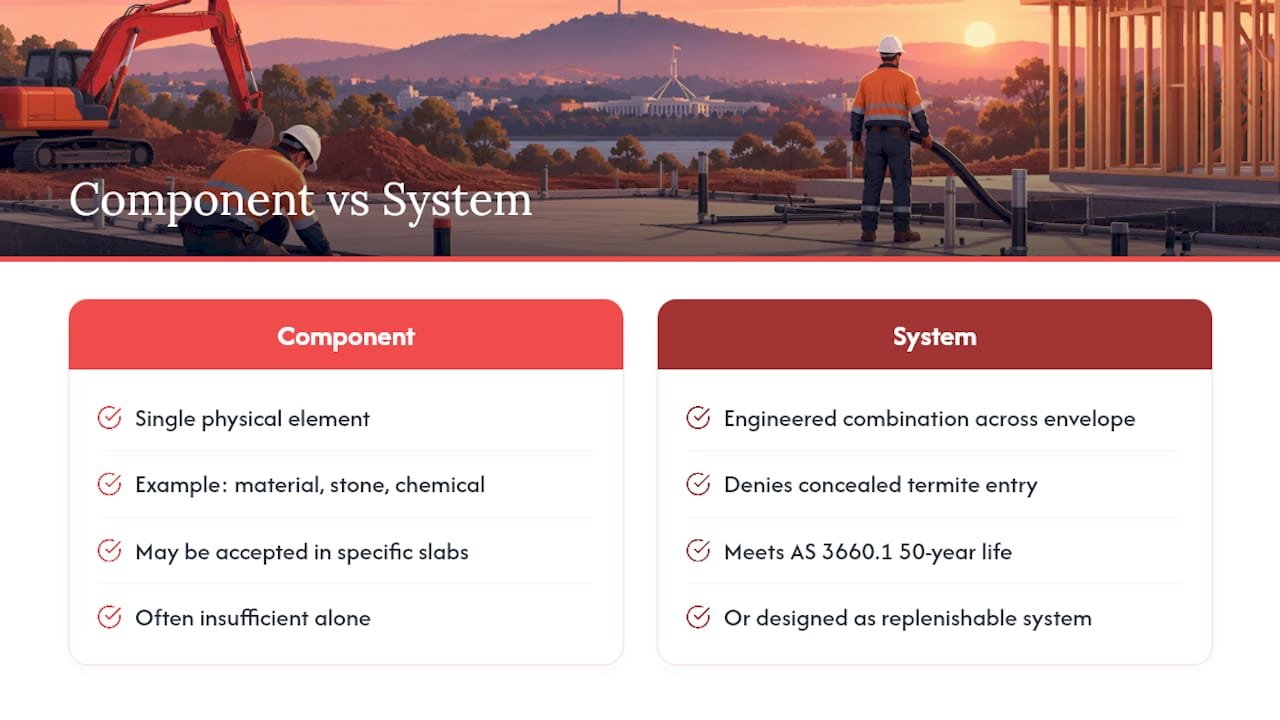
Design life matters just as much as the type of system. AS 3660.1 sets an expected working life of 50 years for compliant systems, unless the system is designed for replenishment or is genuinely accessible for inspection and future replacement. That’s the loophole worth understanding: a chemical soil treatment with a shorter product life can still satisfy the standard if it’s specified as a maintainable, replenishable system with documented reapplication intervals, rather than a “set and forget” 50-year claim it can’t actually meet. Installing a system doesn’t stop termites showing up on site. Its job is to deny them a hidden path into the structure, which is exactly why ongoing inspections stay part of the compliance picture long after handover.
Which Components and Systems Should Go on the Drawings?
Specification documents need to name the actual product and system type, not just “termite protection as required.” The components builders and certifiers see most often fall into a handful of categories:
- Slab-edge exposure: designing the slab so its edge stays visible for inspection, often the cheapest and most inspectable option on a standard footing.
- Physical sheet materials: graded stainless-steel mesh or specially formed sheet barriers fitted at penetrations, wall junctions and the slab perimeter to physically block entry points.
- Graded stone barriers: a particle size too coarse for termites to move or tunnel through, laid beneath and around the slab.
- Chemical soil treatments: a treated zone in the soil, either a full perimeter or the entire footprint beneath the slab, that termites must cross to reach the timber above.
- Collars and penetration seals: fitted around pipes, conduits and other services that pass through the slab or footing, since these are the most common failure points in an otherwise sound system.
The NCC’s acceptable-solution tables set out when the entire area beneath the slab must be treated rather than just the perimeter. That happens whenever the slab design doesn’t comply with AS 2870 (residential slabs and footings) or AS 3600 (concrete structures). In practice, this covers a lot of infill and sloping-block designs across Canberra, where a waffle pod or engineered slab variation takes it outside the standard footing profile. Every service penetration through that treated zone needs its own certified collar or seal, because a single unsealed pipe entry can undo an otherwise compliant barrier. A full system is really a combination: slab-edge visibility for inspection, plus a physical or chemical barrier for concealed paths, plus sealed penetrations, mapped against the NCC’s component tables for your specific footing type.
Physical Barriers vs Chemical Treatments: Which Fits Your Site?
Physical systems win on inspectability. A visible slab edge or an exposed mesh junction lets an inspector spot mud shelter tubes without pulling anything apart, and a correctly installed stainless-mesh or graded-stone barrier doesn’t degrade the way a chemical treatment eventually does. The tradeoff is installation precision: any gap, overlap error, or damaged section during later trades (plumbers cutting through mesh, for instance) creates a permanent weak point that’s expensive to fix once the slab is down.
Chemical perimeter systems solve some of those access problems but come with strict installation rules. Where a chemical barrier is used, especially in zones where the aggressive species Mastotermes darwiniensis is present, the process runs: excavate the trench, treat the exposed soil, backfill, then finish with a concrete cover strip at least 50 mm thick and 300 mm wide running along the external wall. Skip the cover strip, or pour it thinner than 50 mm, and the treatment fails compliance even if the chemical application itself was done correctly. Anyone using treated timber alongside these systems should also check it against the approved preservative formulations list, since retention rates below the approved minimum won’t hold up under scrutiny later.
- Physical barriers suit slabs where future inspection access is a priority and trade coordination can protect the barrier.
- Chemical systems suit full under-slab coverage on non-standard footing designs, but demand tight sequencing with the concreter.
- A combination of both is common and often the more resilient choice on complex or sloping sites.
Pro Tip: Get the termite installer on site before the concreter, not after. A chemical perimeter poured over without its cover strip, or a mesh barrier punched through by a later trade, is far cheaper to fix before the slab goes down than after.
When Should You Book the Termite Installer, and What Do You Need at Handover?
Termite protection isn’t a last-minute add-on before settlement. It needs a fixed slot in your build program, and missing that slot usually means a costly rework once services and concrete are locked in.
- Lock in the installer during site setup, before slab set-out, so the barrier design is confirmed against the actual footing type approved for the site.
- Sequence chemical perimeters correctly: excavate the trench, apply the treatment, backfill, then place the concrete cover strip immediately, so exposed treated soil isn’t left open to disturbance or weather.
- Coordinate penetrations with plumbers and electricians before the slab pour, so collars and seals go in while access is easy, not as a retrofit.
- Collect the durable notice, chemical label and life-expectancy documentation, and an installation diagram from the installer as part of handover, not as an afterthought chased up weeks later.
- Photograph the barrier before it’s covered by concrete or backfill, since this is often the only record a future certifier or owner will have of what’s actually beneath the slab.
What Belongs on Your Compliance Checklist Before Sign-Off?
A durable notice isn’t optional paperwork. The NCC requires one permanently fixed in a prominent, accessible location, typically the meter box, and it has to state the system type, installation date, and chemical life expectancy where relevant. The notice material itself has to survive decades without fading, so a printed paper sticker is a common and avoidable failure. Metal plates or UV-stable polymer with laser-etched or UV-stable ink hold up; standard inkjet labels don’t.
Before you sign off, confirm:
- The system installed matches AS 3660.1 compliance, or carries AS 3660.3 test results if it’s a non-standard product.
- The durable notice states system type, install date, chemical life expectancy (if applicable), and a recommended inspection schedule.
- Any deviation from standard provisions is documented as a Performance Solution, with test data or engineering assessment included, and approved before construction starts, not after.
That last point trips up more builders than any other item on this list. Performance Solutions that arrive post-construction are a documented failure pattern in ACT approvals, and rectifying a non-compliant termite system after the slab is poured can mean breaking concrete.
How Often Should a New Build Get Inspected After Handover?
Installing the system is the start of the compliance relationship, not the end of it. Annual professional inspections are the standard recommendation, and inspectors are checking for shelter tubes, moisture damage near the slab edge, and any physical damage to the barrier from landscaping or renovation work since the last visit, as detailed in guidance on old woodworm holes and their activity.
- Replenishable chemical systems need documented reapplication on a defined cycle to keep their design-life claim valid.
- Sealed 50-year systems (mesh, graded stone) still need inspection, but not chemical reapplication, since the barrier itself doesn’t degrade the same way.
- Inspection records become part of the property’s compliance history, which matters directly to warranty claims and to future owners relying on that 50-year design-life expectation.
Losing that inspection paper trail is one of the more common reasons a termite warranty gets disputed years down the track.
What Canberra Builders Get Wrong on Termite Compliance
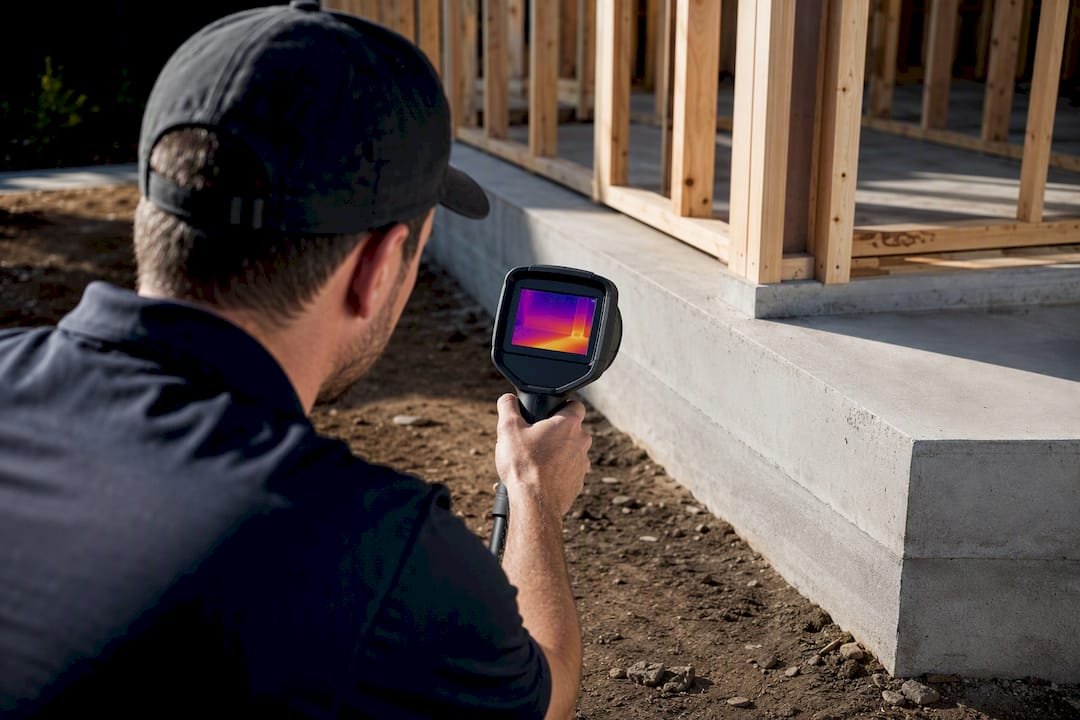
Licensed technicians using thermal imaging for termite inspections, backed by more than 10 years across 5,000-plus Canberra homes, tend to see the same three mistakes repeat on new builds. First, durable notices printed on materials that fade within a few years, failing later inspections outright. Second, mixing NCC 2022 and NCC 2025 provisions on the same job because nobody confirmed which edition applies to that specific approval. Third, Performance Solutions submitted after the slab is already down instead of before.
At handover, insist on a durable notice, product data sheet, installation diagram, and photographic evidence of the barrier before it was covered. That paper trail protects you and the eventual homeowner.
What This Guide Gets Right That Most Advice Misses
Most termite protection content treats compliance as a box to tick once at slab stage. That framing undersells the risk. The real failure point isn’t the initial installation, it’s the documentation gap that opens up months or years later when a certifier, a buyer’s inspector, or a warranty assessor asks for proof of what’s actually beneath the concrete and nobody can produce it.
The durable notice gets treated as a formality when it should be treated as the single most important artifact on the file. A faded sticker in a meter box isn’t a paperwork nitpick, it’s the difference between a defensible compliance position and a dispute that costs someone real money at settlement. The same goes for Performance Solutions submitted late: the documentation isn’t bureaucratic overhead, it’s the only thing standing between a builder and a rectification order months after the client has moved in.
If there’s one priority above all others here, it’s sequencing the installer’s work and paperwork into the build program at the same fixed point every time, not treating termite protection as something to sort out whenever the schedule allows. Builders who do this once, consistently, stop having termite compliance conversations at settlement.
— navin
Book a Compliant Termite System Before Your Next Slab Pour
Termite compliance can be managed by booking installers who provide certified installation, documentation, durable notices, product records, and installation diagrams ready for certifiers at handover.

Professional technicians experienced in termite inspections use thermal imaging and thorough documentation to reduce surprises at final inspection and provide a reliable paper trail for warranty questions. If you’re managing ongoing inspections across multiple builds or want to fold termite protection into a broader maintenance arrangement, the Bronze Termite plan covers ongoing termite-focused servicing for $29.98 AUD per month, while the Gold Complete plan bundles broader pest protection for $79.98 AUD per month if you’re handing over completed homes and want to offer buyers continuity of cover.
For a new build going into the ground now, get in touch through our termite control service page to book an installer into your program before slab set-out. That’s the single step that prevents almost every compliance headache covered above.
Sources
- Part 3.4 Termite risk management | NCC (ABCB) — 2025 edition
- AS 3660.1-2014 — Standards Australia catalog
- Approved timber permanent preservative formulations — Australian Government Department of Agriculture
- Construction Occupations Registrar — Performance solution guidance (Access Canberra)
FAQ
What Is the Australian Standard for Termite Protection?
AS 3660.1 is the Australian Standard covering termite management systems and components for new buildings, and it’s the recognized route to satisfying NCC termite requirements. A related standard, AS 3660.3, sets out test methods for systems that don’t fit the standard acceptable-solution tables.
Does Bunnings Sell Termidor?
Termidor and similar professional-grade termiticides are generally restricted to licensed pest control operators rather than sold over the counter at hardware retailers. Pre-construction chemical soil treatments need to be applied by a licensed installer anyway to meet the trenching, treatment and concrete cover strip requirements the NCC specifies.
What Is a Good Termite Pre-Treatment for Wood?
Timber used near ground contact or in structural applications should carry an approved preservative formulation at or above the minimum retention rate set by the Department of Agriculture. Pre-treated timber works alongside a slab or perimeter barrier system, but it doesn’t replace the need for a full termite management system under the NCC.
What Is the Most Effective Termite Treatment in Australia?
There’s no single “most effective” system across every site. Physical barriers like graded stone or stainless mesh offer better long-term inspectability and typically meet the 50-year design-life benchmark without reapplication, while chemical perimeter and under-slab systems suit non-standard slab designs where full-area coverage is required. The right choice depends on your footing type, slab design, and whether the site falls in a high-pressure termite zone.
How Much Does Termite Protection Cost for a New Build in Canberra?
Costs vary by system type, slab design, and site conditions, so current pricing is best confirmed directly through Bugspatrol Pest Management’s termite control page. Builders managing ongoing servicing across multiple properties can also look at the Bronze Termite maintenance plan at $29.98 AUD per month for continued inspection and compliance support after handover.