Mostly, no. A colony does not come back to the same nest the next year, and the old paper structure is usually empty by winter. But there are two catches that matter in Canberra. Australian paper wasps are an exception and can move back into an old nest. And even when a nest is never reused, a new queen will often choose the same sheltered spot, so you can end up with a fresh nest in the same place.
This guide explains what happens to a nest over the year, which wasps behave differently, what to do with an old nest, and when to call a professional.
TL;DR
- Most social wasps start a new nest each spring. The old nest is not reused by the same colony.
- Australian paper wasps are the exception: a trade guide for pest managers notes that a queen may overwinter, or new queens may start a colony in an old nest.
- European wasp nests can survive winter in warmer parts of Australia and keep growing, so an “old” nest may not be dead.
- Queens favor spots that already worked: eaves, wall cavities, ground holes. Seal and remove attractants after treatment.
- European wasp nests can hold thousands of wasps. Don’t treat them yourself.
Table of Contents
- The short answer: a nest is not reused, a site is
- Which wasp are you dealing with?
- Why wasps keep turning up in the same spot
- What to do with an old nest
- A season-by-season guide for Canberra
- Should you leave a wasp nest alone?
- Our perspective: treat the site, not just the nest
- Getting help in Canberra
- FAQ
- Sources
The short answer: a nest is not reused, a site is
The wasps you see in summer are the workers of one colony. When the season ends, the colony winds down. The males die off, and the newly mated queens leave to hibernate alone. Victoria’s health department technical note on European wasps describes this cycle: the fertilized queen hibernates through winter and starts a new nest the following spring.
Paper is fragile. It is chewed wood or plant fiber mixed with saliva, and it weathers and breaks down. That is why most pest advice says an old nest will not be moved back into.
What does carry over is the location. Western Australia’s agriculture department covers paper wasps, and its guidance points to the same pattern: nests tend to appear in the same sheltered places year after year. An old nest on your eave tells a queen that the spot is protected and suitable. So when people say “the wasps came back to the same nest”, what usually happened is a new queen built a new nest in the same place.
Which wasp are you dealing with?
The answer to “will they reuse it?” depends on the species. In Canberra you will mostly meet three kinds.
| Wasp | Typical nest | Reused? | Notes |
|---|---|---|---|
| European wasp | Usually underground, sometimes in wall or roof cavities | Not by a new queen, but a nest can survive winter and keep growing | Aggressive, can sting repeatedly |
| Australian paper wasp (Polistes) | Open, upside-down comb hanging from a stalk under eaves, branches or fence capping | Sometimes. Queens may overwinter in or return to an old nest | Usually less aggressive, but will defend the nest |
| Mud-dauber and potter wasps | Mud tubes or pots on walls and ceilings | Often reused or built on by the same kind of wasp | Solitary, low risk |
The last row is general knowledge rather than a Canberra-specific figure, so treat it as a rule of thumb. The first two rows are where the real decisions are.
European wasps: the old nest may not be dead
This is the case that surprises people. In cooler regions of Europe a nest dies each year. Australia’s milder climate changes that. Research on colonies in southern Australia found that a proportion of nests survive winter and continue to grow over several seasons. Some contained more than 27,500 cells, and overwintering nests can hold over 100,000 wasps.
Victoria’s health department makes the same point. European wasps have no natural predators here, and they are far more aggressive than native wasps.
So if you have noticed a lot of wasp traffic at the same hole in late autumn or even winter, do not assume the colony is finished. It might be a multi-season nest.
Paper wasps: the one that can move back in
Australian paper wasps are the real exception to the “never reused” rule. The trade publication linked above notes that they sometimes reuse old nests, either with a queen that overwintered or with new queens starting a colony in an old comb.
That is why leaving an old paper wasp nest on the eave is a bad plan. At best it signals a good site. At worst it is a ready-made start. Our own guide to night treatment for paper wasp nests covers how these nests are treated safely.
Why wasps keep turning up in the same spot
If you had a nest last year and see wasps again this spring, a few things are probably going on.
- The site is attractive. Eaves, wall voids, sheltered ground holes, rockeries and sheds suit queens looking for a protected place. Agriculture Victoria says about 80% of European wasp nests are in holes in the ground or close to it.
- Food is close by. European wasps go for sweet drinks, meat and pet food, according to the ACT Government. Fallen fruit, open compost and outdoor pet bowls keep a yard appealing.
- The nest you removed was not the only one. The City of Monash notes that people keep seeing wasps after a nest is “gone”, because the real source can be elsewhere or a new queen has already moved in.
- Foragers travel. European wasps forage up to 500 metres from the nest, so the wasps in your yard may come from a neighbor’s property or a nature strip.
The fourth point is why a nest next door can look like a nest of your own. Professionals follow flight paths to find the real entrance rather than treating where the activity is most visible.
What to do with an old nest
The answer depends on whether it is really old.
Step 1: Check whether it is active
Watch from a safe distance for 10 to 15 minutes on a warm day. A constant stream of wasps in and out means the nest is active. Do this from several metres away and never poke or block an entrance. If it is a hole in the ground or a gap in a wall, do not stand near it.
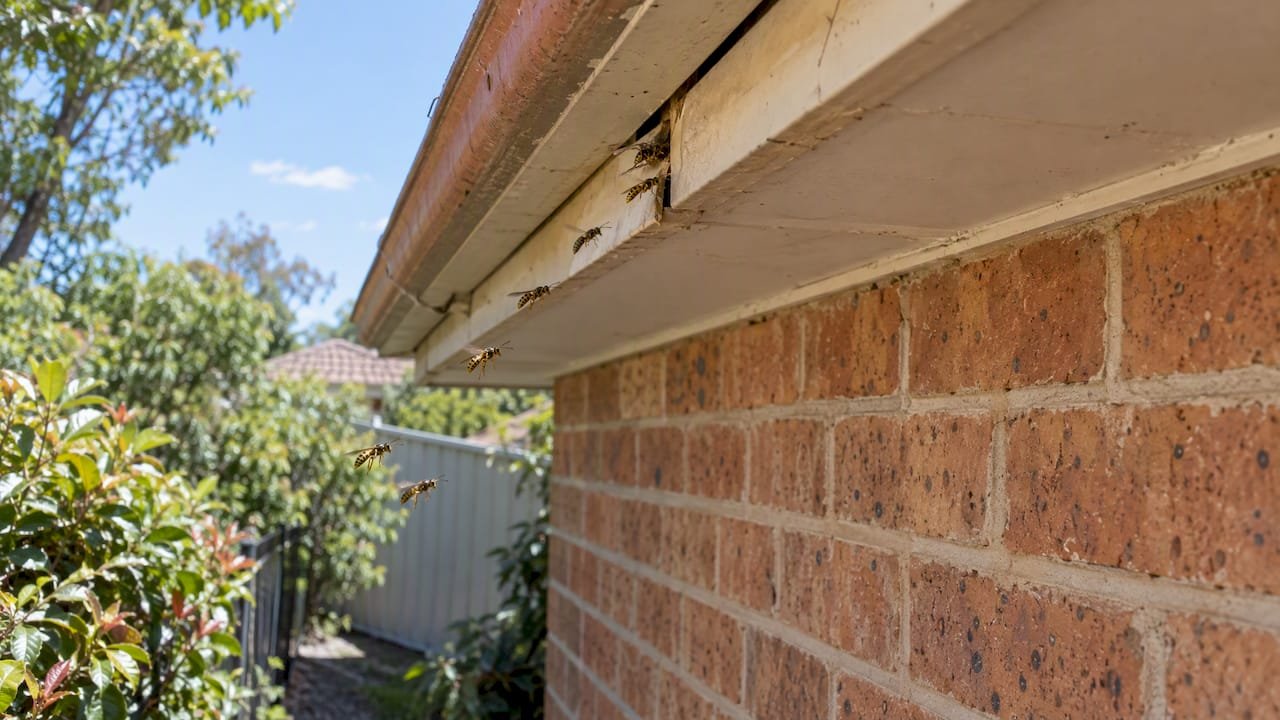
The ACT Government’s wasp page describes how to spot nests, including the steady flight line to and from a wall or roof cavity.
Step 2: If it is active, don’t DIY it
European wasps can sting many times, and a nest holds thousands of wasps. Victoria’s health department recommends professional treatment because multi-sting attacks can be life threatening. If you or someone in your household has had a severe reaction to a sting, such as swelling of the face or throat or trouble breathing, call 000 in an emergency and speak to your GP about an allergy plan.
On ACT Government land, such as a nature strip or park, you can report a nest to Access Canberra on 13 22 81. On your own block, you are responsible for it. Our guide to European wasps in Canberra and reporting through eWasp walks through both routes.
Step 3: If it is truly dead, remove it and seal the spot
An old, inactive nest does not need to be rushed out. The City of Monash advises waiting a few days after treatment before sealing a cavity or filling a ground hole, so late-returning workers aren’t trapped or missed. The nest itself only needs to come out if it blocks something or creates a sanitation problem.
For paper wasps, we would still take the comb down once it is confirmed empty (after a winter, or after treatment). It removes the cue that the site is suitable. Wear gloves and long sleeves, and check for activity first.
Step 4: Make the site less attractive
Agriculture Victoria’s neighbor in WA, the agriculture department, recommends looking at the whole property rather than just the nest. In practice:
- Pick up fallen fruit.
- Keep compost closed and bins lidded.
- Feed pets indoors while wasps are around.
- Seal gaps in eaves, fascia, wall vents and roof edges.
- Fill disused ground holes and level rockeries once you are sure they are empty.
- Check the same spots again in early spring.
A season-by-season guide for Canberra
Canberra’s cold winters help, but they do not guarantee a nest dies. Use this as a rough calendar.
| Season | What is happening | What you can do |
|---|---|---|
| Late winter to early spring | Queens leave hibernation and look for nest sites | Inspect eaves, sheds, fences and ground holes. Seal gaps. Remove old paper wasp combs |
| Spring | Queens start small nests. Few workers yet | The best time to get a nest dealt with, while it is small |
| Summer | Workers multiply fast. Nests grow | Watch for wasp traffic. Book a professional early rather than late |
| Autumn | Colonies peak. New queens are produced | Do not leave a nest “to die off” if it is on a busy path or near a door |
| Winter | Most nests are inactive, but some European wasp nests may survive | Still check for activity on warm days |
The timing is a general pattern drawn from the life cycle described above. Individual nests vary with weather and site.
Should you leave a wasp nest alone?
Sometimes you will hear that wasps are beneficial and a nest can be left. That is partly true for native species. They prey on garden pests. For European wasps, Biosecurity Tasmania treats them as a serious environmental and public safety pest, and the sensible approach is to have the nest identified and destroyed.
Here is a quick way to decide:
- Native paper wasp nest, high up, away from doors and paths: you may choose to leave it for the season. Remove it in winter.
- Paper wasp nest near a door, clothesline, letterbox or play area: treat it. Stings here are a matter of time.
- Any suspected European wasp nest: don’t wait. Get it identified.
- Wasps entering a wall or roof void: call a professional. Nests inside buildings can damage plasterboard as the colony expands.
Our 30-second guide to deciding when to remove a wasp nest goes further on this.
Our perspective: treat the site, not just the nest
We see the same pattern on Canberra jobs. A homeowner has a nest treated, relaxes, and the following spring a new nest is back in the same eave or the same garden bed. Nothing was wrong with the first treatment. The property simply still offered what a queen wants.
That is why we look at three things on every wasp job. First, positive identification, because the right method depends on whether it is a European wasp or a paper wasp. Second, finding the actual source, which for European wasps can be well away from where the wasps are most visible. Third, what the property is offering: gaps, sheltered voids, food and water.
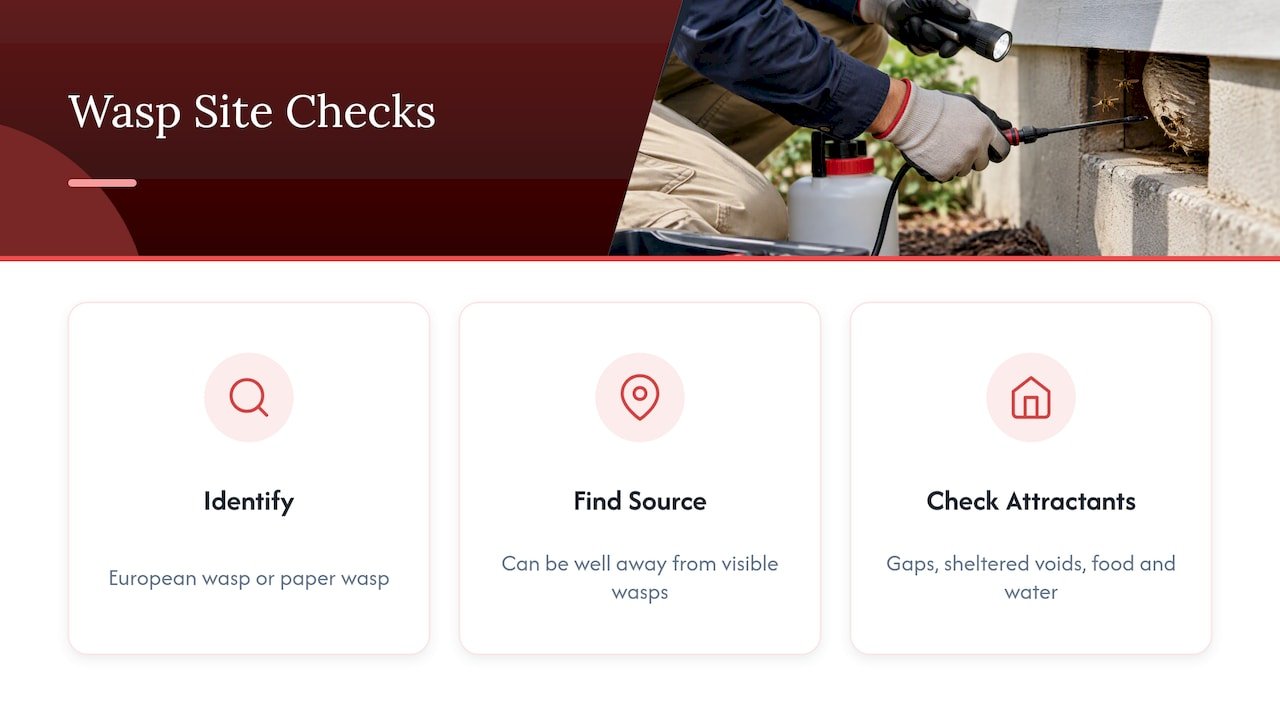
We use licensed technicians, and we choose treatments with families and pets in mind. For paper wasps we often work at night, when the colony is on the nest and calm. We also offer a same-day emergency response for nests in awkward places, and our treatments carry a guarantee for effectiveness.
If you take one thing from this article: do not leave a known nest in place hoping it will “expire”. Have it dealt with, then close the door on next year’s queen.
— navin
Getting help in Canberra
If you have an active nest, a nest inside a wall or roof, or wasps that keep returning after you thought the problem was solved, our team can inspect and treat it. We cover homes and businesses across Canberra and surrounding suburbs. See our wasp control service for free inspections and quotes.
If wasps are only one of several pests you deal with, our annual and monthly protection plans are worth a look. Gold Complete is 79.98 AUD per month, Silver Combined is 55.98 AUD per month, and Bronze General Pest and Bronze Termite are each 29.98 AUD per month. Check the plan page for what each one covers.
FAQ
Do wasps return to old nests?
Usually not the same colony. A new queen may build a fresh nest in the same sheltered spot, though, and Australian paper wasps can sometimes move into an old comb. Removing the old nest and sealing the spot reduces the chance.
Can a wasp nest survive winter in Australia?
A European wasp nest can. Research in southern Australia found that some nests overwinter and keep growing over multiple seasons, and they can become very large. Paper wasp nests are more fragile, but a queen may overwinter in one.
Is it safe to remove an old wasp nest myself?
Only if you have confirmed it is empty. Watch it on a warm day first, and wear gloves and long sleeves. If you see any wasp traffic, or it is a suspected European wasp nest or in a wall or ground hole, call a professional.
Why are wasps back after the nest was removed?
There may be a second nest, a nest at a neighbor’s, or a new queen who chose the same spot. Food sources like fallen fruit and pet bowls also keep wasps coming. Check the site again and remove attractants.
Sources
- Pest control technical note on European wasps, Victorian Department of Health
- European wasps pest control, Victorian Department of Health
- European wasp, Agriculture Victoria
- Colony characteristics of Vespula germanica in southern Australia, University of Adelaide
- European Wasps, City of Monash
- European and English wasps, Biosecurity Tasmania
- Wasps, ACT Government City Services
- Wasp nest identification, treatment and removal, Professional Pest Manager
Recommended
- European Wasps: Spot Nests in Canberra, Report via eWasp, Call a Pro
- Identify and Report Wasp Nests Safely in Australian Yards
- Wasp Control Services – Free Inspections
- Wasp Control Services – Free Quotes