Lawn grub damage usually shows up as yellow or brown patches that spread, turf that feels spongy or lifts like a carpet, and birds tearing at the grass. The cause is larvae feeding on grass roots or leaf blades. A lawn can often recover, but only once the grubs are dealt with first. If you are in Canberra, the main risk window is the warmer half of the year, so the sooner you confirm what is going on, the less turf you lose.
TL;DR
- Grub damage looks like irregular yellow, then brown, then dead patches that do not green up after watering.
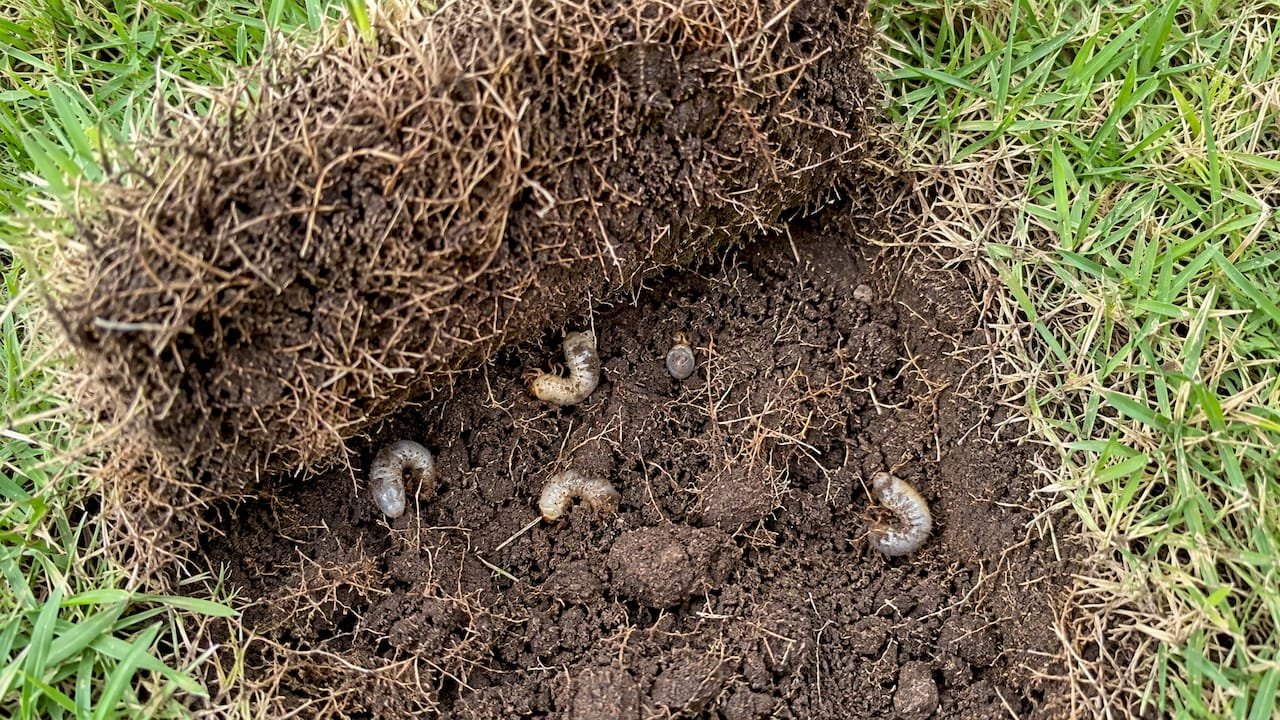
- The surest test is physical: peel back a patch of turf and look at the top few centimetres of soil for pale, C-shaped larvae.
- Lawn grubs are most active in the warmer months, traditionally October through March, so inspect weekly through spring and summer.
- Treat only when grubs are confirmed, then fertilize damaged patches lightly and re-seed or re-turf bare areas.
- If the patches keep spreading, book a professional inspection before the whole lawn is affected.
Table of Contents
- What lawn grubs actually are
- What lawn grubs do to grass and its roots
- Signs of lawn grubs: a field checklist
- How to tell grub damage from drought, disease or animals
- When lawn grubs are active in Canberra
- Monitor early, keep records
- How to repair a lawn after grub damage
- Preventing grub damage
- Perspective
- Get a professional to confirm and treat
- FAQ
- Sources
What lawn grubs actually are
“Lawn grub” is a catch-all term. It covers armyworm and sod-webworm larvae, plus the larvae or adults of African black beetle, Argentinian scarab and billbug. Some of these feed above ground on stems and leaf blades. Others, the curl grubs, feed on roots below the surface.
That difference matters because the damage looks different and the treatment is timed differently.
- Curl grubs (white grubs): pale cream or white, C-shaped, with six legs. They live in the soil and eat roots.
- Armyworms: grey-brown caterpillars with beige stripes that chew leaf blades and stems. They can strip a patch fast.
Curl grubs are the larvae of scarab beetles. Larvae of this group generally take 9 to 18 months to reach maturity, depending on the species, so a lawn can carry them for a long stretch before anything looks wrong. Northern Tablelands research from NSW Department of Primary Industries notes that scarab grubs feed on roots and humus, occur naturally in limited numbers, but cause serious damage when populations are dense. A few grubs are normal. A crowded lawn is a problem.
They are also not witchetty grubs. Those are larger and live in the roots of trees, not in turf.
What lawn grubs do to grass and its roots
The damage is a root problem first and a leaf problem second. According to the NSW DPI fact sheet, scarab grubs are most active in the top 1 to 2 cm of soil during warm spring, summer and autumn weather, which is exactly the layer your grass roots occupy.
Here is the sequence most homeowners see:
- Feeding starts below ground. The lawn looks fine, because the leaves are still green on a shrinking root system.
- Stress shows in hot, dry spells. Grass with fewer roots cannot take up enough water, so it wilts even when you water.
- Patches change color. Larval root feeding turns infested areas yellow, then brown and finally dead, and the larger, later-stage larvae are the ones that cause visible damage.
- Turf loses its grip. With heavy numbers, turf can be lifted easily from the soil because the root system is gone.
- Weeds move in. Feeding by white grubs weakens plants by cutting the root system, eventually killing them and letting weeds colonize the bare areas.
The bare, weedy end state is what most people notice. By then the grubs have usually been working for weeks.
Signs of lawn grubs: a field checklist
No single sign is proof. Look for several together.
Patches that do not respond to water
The early sign is the drying out of leaf blades in irregular patches, even when the soil is moist. If you water deeply, wait a few days, and the patch is still straw-colored, suspect roots. With armyworm, patches can die off seemingly overnight.
Birds working your lawn
Magpies, currawongs and ibis are good grub detectors. Insectivorous birds, including magpies and ibis, prey on white curl grubs, and ibis may uproot infested pasture and make the damage worse. Sudden, repeated bird visits to one spot, and small holes or churned soil, are a strong hint. That is also the answer to the common question about little mounds and holes in a lawn: bird probing and larval activity are both possible causes, so dig and check.
Moths or beetles at dusk
Increased moth or beetle activity around the lawn, especially at dusk or night, points to adults laying the next generation of eggs. Beetles clustering around outdoor lights is part of the same picture.
A spongy feel or turf that lifts
Walk the patch. If it feels spongy, or you can tug the grass up with little resistance, the roots have been eaten. A small irregular yellow or brown patch may include a brown spot up to 50 mm across with a central hole where grubs hide during the day.
How to tell grub damage from drought, disease or animals
Most wasted money on lawn treatments comes from a wrong diagnosis. NSW Government turf management guidance puts it plainly: accurate identification is critical if cost-effective control is to be achieved.
| What you see | More likely grubs | More likely something else |
|---|---|---|
| Patch pattern | Irregular, spreading, often at the edges of healthy grass | Even browning across the whole lawn suggests drought or heat |
| Response to watering | No recovery after a deep soak | Quick green-up suggests water stress only |
| Turf grip | Lifts like a rug, few or no roots | Firm roots with dead leaves suggests a leaf disease or dormancy |
| Soil check | Pale, C-shaped larvae in the top few cm | No larvae present |
| Birds and digging | Repeated pecking and uprooting in one area | Digging by other animals leaves larger holes |
Two things make the diagnosis more reliable.
The peel-back test. To check for underground grubs such as scarabs, peel back the turf and examine the soil. Do this at the edge of a patch, where grubs are still feeding on live roots, not in the dead center.
The soapy water flush for surface feeders. For armyworm and similar insects, NSW guidance describes using an irritating solution such as 20 ml of lemon-scented dishwashing liquid in 5 L of water to bring surface-feeding insects up so you can identify them. Note this is an identification trick. It is not a treatment.
One more factor: stress compounds the problem. Damage to turf and pasture is typically most severe in shallow soil where growth is already restricted by dry conditions or overgrazing. A thin, dry Canberra lawn on compacted clay-loam is more likely to show damage sooner than a deep, well-fed one.
When lawn grubs are active in Canberra
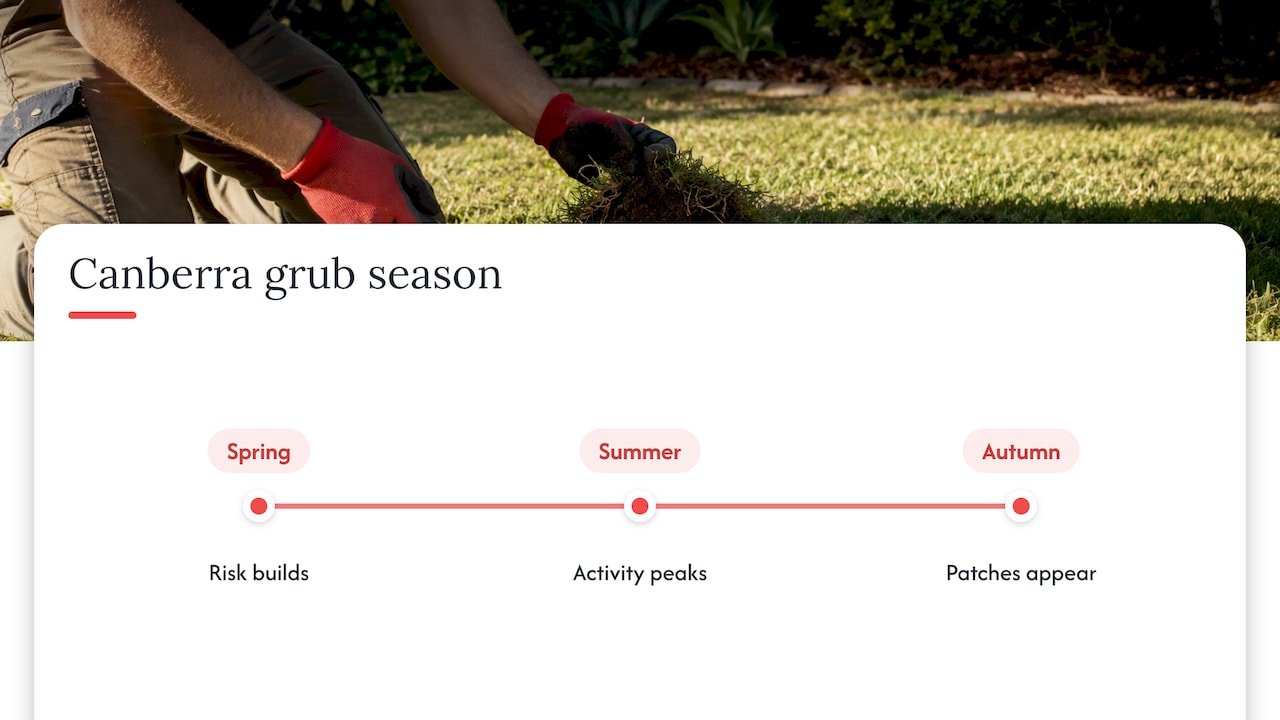
Lawn grubs are most active in warmer months, traditionally from October through March. In Canberra that means the risk builds from spring, peaks in summer and can show up as visible patches in autumn, after grubs have grown large enough to do real harm. Warm, humid, wet seasons tend to favor outbreaks, and recent media coverage has reported surging infestations after warmer winters, longer humid periods and increased rainfall. For a local view of the season, see our guide to lawn grub season in Canberra.
There is also natural control. Weather, disease, parasitic insects and insectivorous birds all help regulate scarab grub numbers. That is a reason not to spray on a hunch: you may remove helpers along with the pest.
Monitor early, keep records
Turf pest monitoring in NSW guidance means regular inspections, at least weekly and daily during key pest periods, with records kept. A home lawn does not need daily checks, but a weekly walk through spring and summer is realistic, and it pays to write down the date, the location of any patch and what you found under it. The same habit of routine inspection and record keeping is what keeps commercial facilities ahead of pest problems, and it works just as well on a suburban block.
A simple weekly routine:
- Walk the lawn at dusk and note any moths or beetles.
- Check for bird activity and new holes.
- Press your hand on any off-color patch for sponginess.
- Peel back one flap of turf at the edge of the patch and look.
- Note the result and photograph it, so you can compare next week.
How to repair a lawn after grub damage
Will grass recover? Often yes, if the grubs are gone and enough live roots remain. Heavily eaten areas with no roots will not come back on their own and need re-seeding or re-turfing.
Step 1: Confirm and deal with the grubs
Repair is wasted if grubs are still feeding. Once you have determined they are still present, treat them. If you use a product, spray only when grubs are present and necessary, and always follow label rates. Do not spray when bees and other beneficial insects are around. Treatment is where a licensed technician earns their fee: correct identification, correct product, correct timing, and care around children and pets.
Step 2: Feed lightly
To help recovery, fertilize the damaged patches lightly. Heavy feeding on stressed turf can do more harm than good.
Step 3: Rake out dead material and loosen the surface
Remove dead thatch and weeds from the bare patch. Loosen the top few centimetres of soil so new seed or turf roots can get in.
Step 4: Re-seed or re-turf
Small patches can be re-seeded with a variety that matches your existing lawn. Larger bare zones are faster to fix with offcuts of turf. Keep the area moist, not soaked, while new roots establish.
Step 5: Rebuild strength
A deep, healthy root system is your best protection against the next generation. Mow at the recommended height for your grass type, water deeply and less often, and avoid heavy feeding in summer.
Preventing grub damage
Prevention is mostly about timing and restraint.
- Fertilize correctly and avoid fertilizing in summer. That is the advice in a widely used turf growers’ guide.
- Inspect on a schedule through October to March, as above.
- Spray only on confirmed grubs, at label rates.
- Look after the soil. Thin, dry, compacted lawns show damage faster.
- Reduce beetle attraction. Turning off outdoor lights on warm nights cuts the number of adults hanging around the yard, which may reduce egg laying close to the house.
- Watch neighboring ground. Gardens, nature strips and sports fields next door all feed local beetle numbers.
If ants are also mounding in the lawn, that is a separate matter. Our article on ants in the lawn explains when to leave them and when to act.
Perspective
In our experience around Canberra, the lawns that suffer most are the ones where the problem was guessed at. A brown patch goes down as drought, gets more water, and the grubs keep eating. By the time the turf lifts, the repair is bigger and dearer than the treatment would have been.
We built our approach around proper identification first. Our licensed technicians inspect, confirm what is in the soil, and only then recommend a treatment. We keep a close eye on families, children and pets, and we favor responsible, targeted treatments over blanket spraying. Our treatments come with a guarantee for effectiveness.
We also look at the bigger picture. Lawn pests rarely arrive alone, and the same inspection that finds grubs can flag ants, spiders or other pests around the property. That is why we have serviced more than 5,000 Canberra homes with an eye on long-term protection rather than one-off spraying.
navin
Get a professional to confirm and treat
If your patches are spreading, birds will not leave the lawn alone, or you simply want a second opinion before you spend money on products, we can inspect and treat. Our team covers lawn grub control in Canberra as part of its wider pest services, and we offer same-day emergency response when an outbreak is moving fast.

If you would rather spread the cost of year-round protection, our maintenance plans start at $29.98 per month for Bronze General Pest, with Silver Combined at $55.98 per month and Gold Complete at $79.98 per month. You can see what each plan includes on the plans page, or start from our main site to request an inspection.
FAQ
Will grass recover after grub damage?
Often, yes, if the grubs are controlled and some live roots remain. Treat confirmed grubs first, then fertilize the patches lightly and keep them watered. Areas where the roots were completely eaten will need re-seeding or fresh turf.
What do lawn grubs do to a lawn?
Curl grubs eat grass roots, so the plants cannot take up water. Patches turn yellow, then brown, then die, and the turf can lift away from the soil. Armyworms instead chew the leaves and stems above ground.
How do I know if it is grubs or drought?
Water a patch deeply and wait a few days. If it does not green up, peel back the turf at the edge of the patch and look in the top few centimetres of soil for pale, C-shaped larvae. Spongy turf and birds digging are further clues.
When should I check for lawn grubs in Canberra?
Inspect weekly from spring through summer, which covers the traditional October to March activity period. Autumn is when late damage often becomes visible, so keep an eye out then as well.
Does soapy water kill lawn grubs?
It is used to flush surface-feeding insects such as armyworm to the top of the lawn so you can identify them, not as a treatment. For confirmed infestations, use a label-approved product at label rates or call a licensed technician.
Sources
- How to get rid of lawn grubs
- 5 Signs Your Lawn has a Grub Problem, myhomeTURF
- Scarab grubs in northern tableland pastures, NSW DPI
- Insect pests, QUT Digital Collections
- White Grubs in Turf Overview, Envu
- Improving the Environmental Management of New South Wales Golf Courses
- Lawn grubs guide, Daleys Turf
- Why commercial cleaning prevents pest issues
Recommended
- Lawn Grubs Control: Effective Methods for Success
- Lawn Grubs Control: Effective Methods for Success
- Lawn Grubs Control: Effective Methods for Success
- Ants in the Lawn: When to Leave Them Alone and When to Act