Emergency pest control is an urgent, fast-response treatment for pests that pose an immediate risk to health, safety or a business’s ability to operate: a wasp nest over the front door, rats in the roof, a venomous spider in a child’s room. It differs from routine pest control in timing and triage. A technician is dispatched quickly, makes the area safe first, and plans the longer-term fix afterwards. In Canberra, our licensed and insured technicians offer same-day emergency pest removal for homes and businesses.
TL;DR
- Emergency pest control means urgent, same-day response to pests that threaten health, safety or trading, not just pests that annoy you.
- Biting or stinging pests (wasps, bees, venomous spiders, rodents, bird mites) are the textbook cases, and NSW regulators treat them as emergency situations.
- After-hours work usually costs more, and the rate should be agreed before the technician is dispatched.
- Do not use bombs or aerosol sprays while you wait: for bed bugs they can scatter the infestation.
- Keep people and pets clear, take photos, and call as soon as you see the problem.
Table of Contents
- What emergency pest control actually means
- When a pest problem counts as an emergency
- What happens when a technician responds
- What to do while you wait
- Safety, products and your family
- What emergency pest control costs
- Who needs this most
- Perspective
- Getting help in Canberra
- FAQ
- Sources
What emergency pest control actually means
The phrase has no single legal definition that applies across Australia, but the clearest official wording comes from the NSW Environment Protection Authority. Its fact sheet describes an emergency pest situation as an infestation of biting or dangerous pests, such as wasps, bees, venomous spiders, rodents or bird mites, that may pose immediate health or safety risks. That is a NSW rule, but it is a useful yardstick for anyone in Canberra deciding whether a problem is urgent.
Three things separate an emergency from a routine job:
- The risk is immediate. Someone could be stung, bitten, made ill or injured now, not next month.
- Waiting makes it worse. Rodents breed, wasp nests grow and bed bugs spread through a home.
- The response is dispatched, not scheduled. You are not waiting for the next free slot in a diary.
Routine pest control, by contrast, is planned: a seasonal spray, a termite inspection, a maintenance visit. It prevents problems. Emergency work responds to one that has already arrived.
When a pest problem counts as an emergency
Use this as a quick test. If any of these apply, treat it as urgent.
| Situation | Why it is urgent |
|---|---|
| Wasp or bee nest near a door, path, play area or in a wall cavity | Stings can be serious, and children, pets and anyone with an allergy are at risk |
| Venomous spider indoors, especially where children sleep or play | Bite risk in a place you cannot avoid |
| Rats or mice in the roof, walls or kitchen | They contaminate food, chew wiring and multiply fast |
| Pests in a café, restaurant, childcare centre or food store | Hygiene breaches can force a business to close |
| Bed bugs discovered in bedrooms or rental units | Bites, sleeplessness and rapid spread between rooms and units |
| Infestation found before a sale, settlement or inspection | A deadline turns a nuisance into a financial problem |
| Any pest linked to a family member’s allergy or reaction | Health risk takes priority |
Other pests are serious but rarely minute-by-minute emergencies. Ants in the pantry, a few cockroaches or lawn grubs are best handled quickly, but a booked visit is usually enough. If you are unsure which side of the line you are on, our guide on when to call pest control walks through the signs.
Rental properties and urgent repairs
Tenants sometimes ask who must act. Consumer Affairs Victoria states that pests, infestations, mould and damp can make a property unsafe to live in, and in that case they are an urgent repair that has to be fixed immediately. That page covers Victorian tenancy law, so ACT tenants and landlords should confirm their own obligations with the ACT Government. Either way, the practical advice is the same: report signs in writing straight away and keep photos.
What happens when a technician responds
Emergency callouts follow a sensible order, and knowing it helps you prepare.
- You describe the problem. Say what you saw, where, and who is at risk. A photo helps the technician bring the right equipment.
- The rate is confirmed before dispatch. After-hours work can carry a premium, so ask for the callout fee and hourly rate up front.
- The technician arrives and assesses. They identify the pest, find the source of the activity (a nest, a harbourage, an entry point) and decide the safest method.
- Immediate treatment. The aim is to remove the hazard: a wasp nest treated and removed, rodent bait stations or traps placed, a targeted treatment applied.
- Advice before you re-enter. You should be told which products were used, where, and how long to keep people and pets out.
- A follow-up plan. Emergencies often reveal a cause, such as gaps in the roofline or food waste. A follow-up visit or maintenance plan deals with that.
NSW rules also show how seriously emergencies are taken on paper. In an emergency a technician does not need to give the usual five working days’ notice to neighbouring sensitive places, but must still give notice before starting and record the circumstances. A professional documents the job even when it is urgent.
Why professional methods matter in a hurry
The instinct under pressure is to grab a can of spray. For some pests that backfires. Dr Stephen Doggett, principal editor of the industry’s bed bug code of best practice, explains that pyrethroid aerosols and bombs do not reach the cracks where bed bugs hide, and their irritant effect flushes the insects out and disperses them. Targeted treatment of cracks, crevices and carpet edges by licensed technicians is the standard approach.
What to do while you wait
The minutes before the technician arrives matter. Sensible steps:
- Keep people and pets away from the nest, the spider or the rodent activity. Close the door to the room if you can.
- Do not poke, spray or burn a wasp nest. Disturbing it provokes the colony.
- Do not set off bug bombs or spray aerosols across bedding if you suspect bed bugs.
- Take clear photos and note where and when you saw the pest.
- Secure food in sealed containers and take out rubbish.
- Clear access to the roof manhole, the meter box area or the garden so the technician can start straight away.
If anyone has been stung or bitten and shows signs of a severe reaction, such as difficulty breathing, call triple zero (000) first. Pest control comes after medical care.
Safety, products and your family
Parents and pet owners rightly ask what is used in their home. Official guidance gives a clear framework.
Pesticide labels carry a toxicity schedule. Better Health Channel explains that the scale runs from unscheduled (lowest) through Schedule 5 “Caution”, Schedule 6 “Poison” and Schedule 7 “Dangerous poison”, and that household products should not be Schedule 7. Its advice is to choose the least toxic product and use the least amount possible.
The NSW EPA frames safety as risk equals hazard multiplied by exposure. Hazard is how toxic the chemical is, while exposure rises with concentration and time, so the practical levers are using the minimum amount and limiting the time people spend in treated areas. Its pre-treatment checklist for householders is worth following whoever does the work:
- Cover kitchen utensils and bench surfaces.
- Cover or remove bird cages and fish tanks.
- Move pets elsewhere.
- Leave the treatment area while it takes effect, and keep young children, pregnant women and the elderly away.
- Make sure the area is dry and ventilated before re-entering.
The same page suggests asking for the full product name and the safety data sheet for anything applied. Every pesticide sold in Australia must be registered by the national regulator, the APVMA. After the visit, our article on cleaning after pest control explains what to wipe down and what to leave alone.
If you suspect pesticide poisoning, seek urgent medical attention. In an emergency call 000 or see a doctor, and the Poisons Information Centre can be reached on 13 11 26, 24 hours a day.
Licensing and records in Canberra
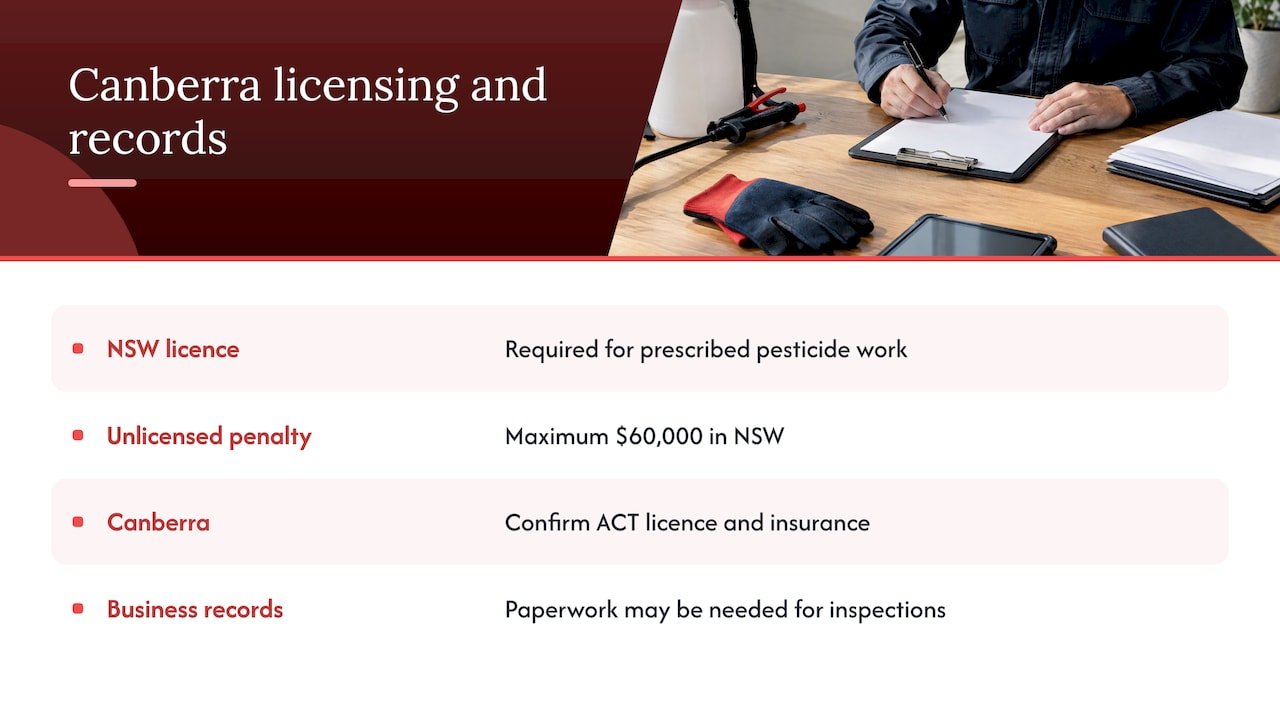
Licensing differs by state. In NSW, for example, the EPA states that prescribed pesticide work requires a licence and that the maximum penalty for unlicensed pest control is $60,000. Canberra’s rules are set by the ACT, so always ask a company to confirm it is licensed and insured. Our technicians are, and our piece on pest control records ACT inspectors ask to see is useful for business owners and property managers who need paperwork ready.
What emergency pest control costs
Expect a premium, and expect it to be explained. Tradie Scaler’s May 2026 Australian benchmarks put pest control hourly rates at roughly $90 to $120 at the entry level and $170 to $250 at the premium end, with callout fees of $85 to $150. The same benchmarks show after-hours work from 6pm to 10pm at about 1.5 times the normal rate, midnight and later at about 2 times, and public holidays at 2 to 2.5 times.
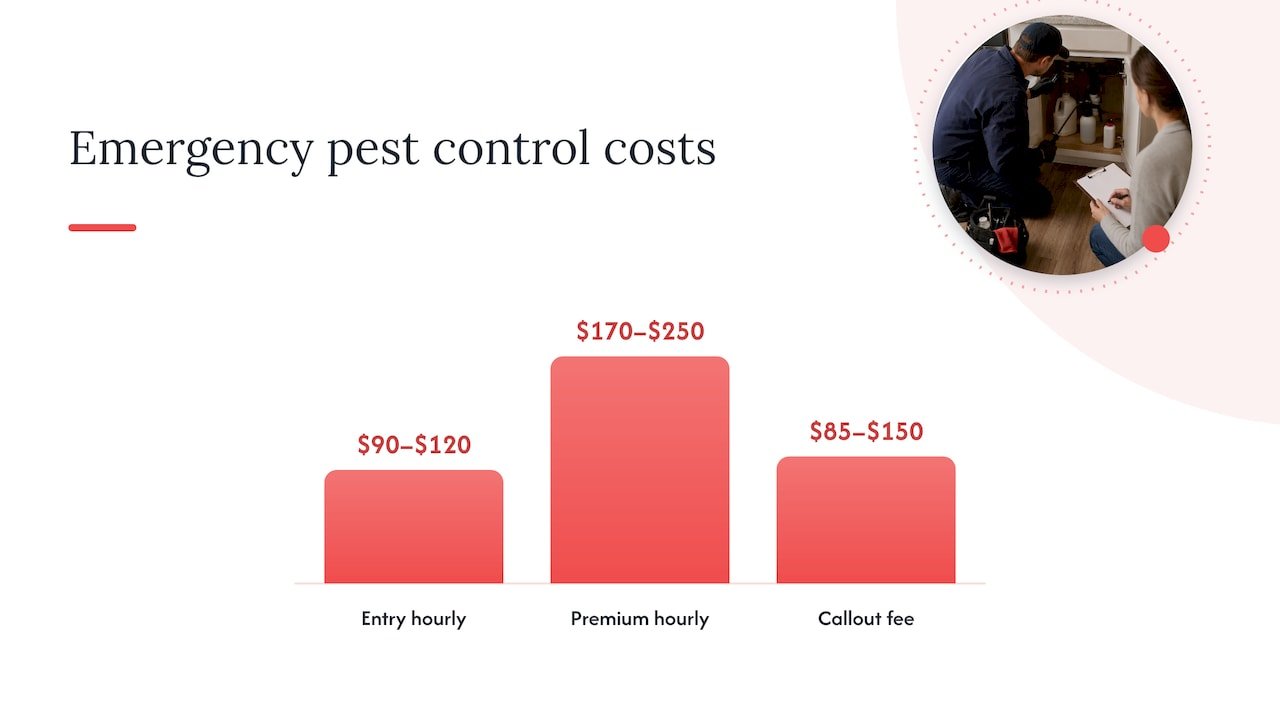
These are national trade figures for the period they cover, not a quote for Canberra, and they vary by pest, access and time of day. What matters most is that the rate is agreed before anyone is sent. The benchmarks note that most disputes arise when the emergency rate was never communicated upfront.
A few things push a bill up or down:
- Time of day. Evenings, nights, weekends and public holidays cost more.
- The pest. A single wasp nest on a low eave is a short job. Rodents in a double-storey roof void take longer.
- Access. Roof spaces, wall cavities and locked commercial premises add time.
- Follow-up. Rodent and bed bug jobs usually need a second visit to confirm the problem has gone.
If you want to avoid emergency pricing altogether, regular protection is the route. Our published monthly plans are Gold Complete at $79.98 per month, Silver Combined at $55.98, and Bronze Termite and Bronze General Pest at $29.98 each.
Who needs this most
Families
Children and pets spend time on floors, lawns and in gardens, which is exactly where spiders, wasps and rodents turn up. Families want a fast fix that is also careful. Ask what will be applied, where, and when it is safe to return.
Business owners
A pest sighting in a kitchen or customer area can cost a day’s trade. Speed and documentation both count. Keep a record of each visit, the products used and the follow-up so you can show an inspector what was done.
Real estate agents and property managers
A pest found shortly before a settlement or inspection needs fast, written evidence that it has been dealt with. Prompt treatment and a clear inspection report keep a sale on track and a tenant safe.
Perspective
Most emergencies we are called to started as small signs weeks earlier: droppings in the pantry, a few wasps around the eaves, a faint smell in the ceiling. By the time the phone rings, the family is worried and wants one thing, which is for the hazard to be gone today.
That is why we run same-day emergency service. Our licensed and insured technicians use modern detection methods, including thermal imaging for termite inspections, so we find the source of the problem rather than only the symptom. We focus on treatments that are effective and responsible around families, children and pets, and our treatments are guaranteed for effectiveness.
The best result, though, is the emergency that never happens. With more than 10 years in the industry and more than 5,000 Canberra homes serviced, we have found that a regular plan, with inspections and early treatment, takes most of the panic out of pest control. Call us at the first sign, not the fifth.
navin
Getting help in Canberra
If you have a pest that cannot wait, we can send a licensed technician the same day. We treat wasps, spiders, rodents, bed bugs, cockroaches, ants, flies and more across Canberra and surrounding suburbs, for homes and businesses alike. Start with our emergency pest removal service, or see rodent removal if the problem is in the roof or walls.
Once the emergency is over, our general pest control and termite control services, or one of the monthly protection plans, keep it from coming back. Our blog on emergency pest control in Canberra has more local detail.
FAQ
What is the definition of emergency pest control?
Emergency pest control is a rapid-response service that deals with pests posing an immediate threat to health, safety or business operations. Typical cases include wasps, venomous spiders, rodents and bed bugs. The technician is dispatched quickly, usually the same day, and removes the hazard before planning longer-term prevention.
How is emergency pest control different from regular pest control?
Regular pest control is scheduled and preventive, such as seasonal treatments or inspections. Emergency pest control responds to an active problem that cannot wait for the next available booking. It often costs more because of after-hours rates, and it usually ends with a follow-up plan.
Is an after-hours pest callout more expensive?
Usually, yes. Australian trade benchmarks for May 2026 show evening work at about 1.5 times the normal rate and midnight or public holiday work at 2 times or more. Ask for the callout fee and hourly rate before the technician is sent so there are no surprises.
Is emergency pest treatment safe for children and pets?
It can be, when the product is used correctly. Official guidance says to use the least toxic product and the smallest amount needed, keep young children, pregnant women, the elderly and pets away during treatment, and ventilate before re-entering. Ask your technician which products were applied and how long to stay out.
Should I use a bug bomb while I wait?
No. For bed bugs, aerosols and bombs do not reach the hiding places and can scatter the insects into other rooms. Keep people and pets away from the problem, take photos and wait for the technician.
Sources
- Pest management technicians, NSW EPA fact sheet (May 2025)
- Engaging a pest management technician, NSW EPA
- Pest control in the home, Better Health Channel
- Pests, infestations and mould, Consumer Affairs Victoria
- Industry Code of Best Practice for Bed Bug Management, AEPMA
- Tradie Hourly Rates by Trade, Australia (2026)
Recommended
- When to Call Pest Control: Clear Signs for Homeowners
- Real After-Hours Pest Control for Canberra Businesses
- Emergency Pest Removal Canberra