For full-area exclusion, taut wildlife-safe netting is the right call; for narrow ledges, signs or isolated perches, spikes do the job faster and cheaper. The best choice depends on the species you’re dealing with, how permanent you need the fix to be, and local wildlife-safety rules. Below, we break down the trade-offs, real costs, and a practical checklist for choosing between the two.
TL;DR:
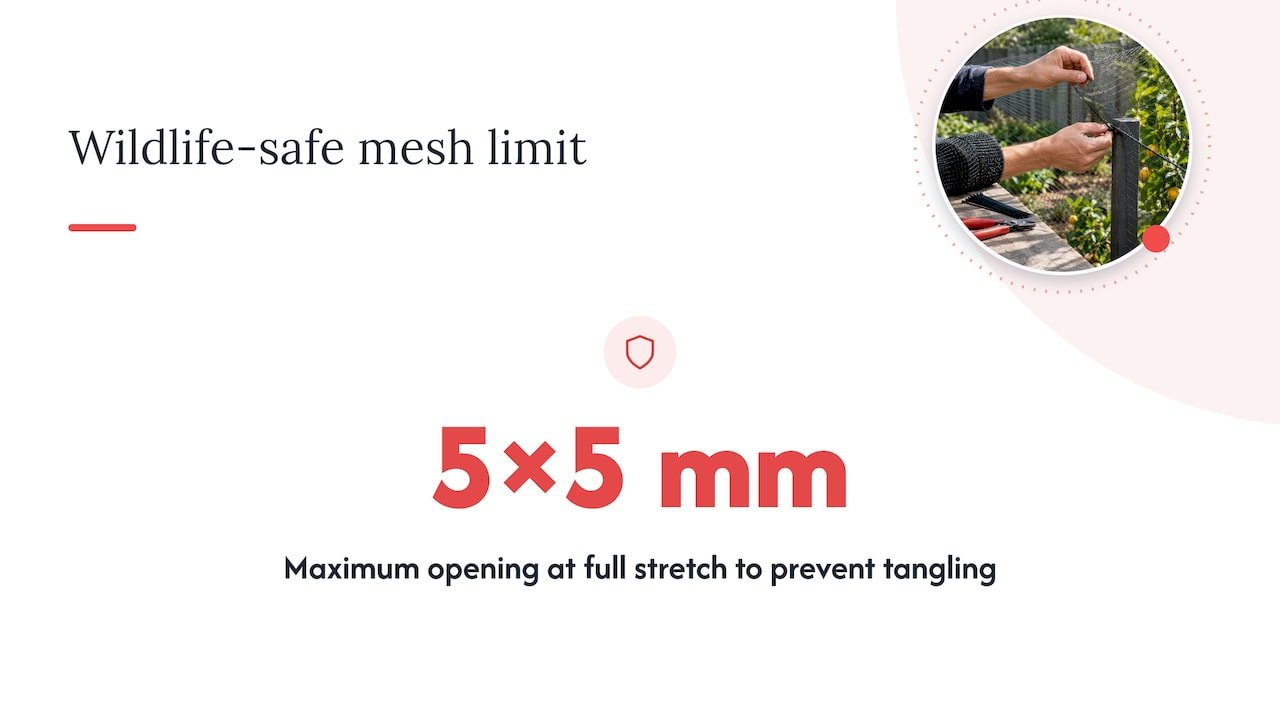
- Wildlife safe netting should use mesh no larger than 5 millimeters by 5 millimeters at full stretch, remain taut, and meet local rules.
- Choose spikes only for narrow ledges, signs, or fixtures; flocking birds and gaps between rows can make them ineffective on wider surfaces.
- Netting costs more upfront but usually needs only tension and anchor checks, while spikes cost less initially and may require repairs when birds exploit gaps.
- Before hiring an installer, get the mesh size in writing and ask how the net will be tensioned, anchored, inspected, and covered by a warranty.
Table of Contents
- Quick comparison and decision rules
- How bird netting works, types and common installations
- Netting pros, cons and common failure modes
- How bird spikes work and where they’re appropriate
- Spikes pros, cons and typical failure modes
- Cost, maintenance and total cost-of-ownership
- Checklist and exact questions to ask installers
- Wildlife safety and legal considerations
- Professional perspective and what a proper site check looks for
- What installers see go wrong, and the one thing to check first
- Bird proofing services that match what you’re dealing with
- FAQ
- Sources
Quick comparison and decision rules
Before getting into installation details, here’s how the two methods stack up against common property problems:
- Full exclusion (roofs, courtyards, solar arrays): netting wins, since it physically blocks access to the whole area rather than just one landing point.
- Targeted perching (ledges, signage, light fixtures): spikes win, because they’re faster to fit and cheaper for a single surface.
- Visibility: spikes are more visible and can affect building aesthetics; netting can be nearly invisible when tensioned well and color-matched.
- Maintenance: netting needs periodic tension and edge checks; spikes need occasional cleaning and replacement after impact or UV wear.
- Cost pattern: netting costs more to install but needs less ongoing labor; spikes cost less upfront but may need rework if birds find gaps.
The deciding factors are usually area size, how the species behaves (flocking versus solitary perchers), and whether welfare or regulatory constraints apply to your situation, something that matters more than most property owners expect once wildlife-friendly netting rules come into play.
How bird netting works, types and common installations
Bird netting creates a physical barrier that prevents birds from reaching a roof, courtyard, solar array or orchard frame in the first place. Most professional-grade netting is UV-stabilized polyethylene in a cross-weave pattern, which resists sun degradation and keeps its shape under tension better than knotted mesh.
Mesh size matters more than most people realize. Guidance from the ACT government on wildlife-friendly netting requires fruit and bird netting to use mesh no larger than 5 millimeters by 5 millimeters at full stretch, specifically to stop smaller animals and birds from getting tangled. Loose, large-gap netting is a common and avoidable hazard.
Netting shows up most often on flat or low-pitch roofs, courtyards with open sky access, solar panel arrays where birds nest underneath panels, and orchard frames protecting fruit crops. Installation typically uses either a rigid frame with the net stretched across it, or a draped system anchored to eaves, gutters and wall fixings.
The installation details that actually determine success: proper tensioning so the net doesn’t sag into a hammock birds can land on, secure fixings at every anchor point, and a weave tight enough to meet wildlife-safe standards. Netting becomes impractical on heavily treed properties, irregular rooflines, or sites where structural access for tensioning is too difficult.
Netting pros, cons and common failure modes
Netting’s biggest strength is reliability: once installed correctly, it keeps birds out entirely, which cuts nesting, droppings and the recurring labor of chasing birds off week after week. The tradeoff is a higher upfront cost and the need for occasional access to check tension and fixings.
The main risks are usually installer errors rather than the material itself:
- Sagging nets that create a pocket where birds can perch or get caught; fixed by re-tensioning or adding extra anchor points.
- Loose edges where the net meets a wall or frame, leaving a gap birds exploit within days.
- Wrong mesh size, which turns a safety feature into an entanglement risk for both target and non-target species.
Pro Tip: Ask any installer to specify the exact mesh dimension in writing before work begins, not just “wildlife-safe” as a general claim.
How bird spikes work and where they’re appropriate
Spikes work by removing the flat landing surface birds need, rather than blocking access to an area. Most are stainless steel or polycarbonate needle arrays, mounted either with adhesive for lighter applications or screwed down for permanent, higher-wind-exposure spots.
They’re most effective on ledges, gutter edges, signage, light fixtures and other narrow surfaces where a bird would otherwise land, rest, and eventually nest. Because the fix only needs to cover a strip a few inches wide, installation is quick and doesn’t usually require the structural planning netting does.
Where spikes fall short is open roosting or nesting areas. A flat roof, a wide ledge, or any surface broad enough for a bird to land beside or between the spike rows gives the bird somewhere to go anyway. Airport and infrastructure guidance treats anti-perching spikes as one tool among several for structures that can’t be physically removed, not as a stand-alone solution for large open areas.
Spikes pros, cons and typical failure modes
Spikes are the lower-cost, faster fix for a single ledge, sign or fixture, and they don’t require the frame work or tensioning netting does. That makes them a sensible choice when the problem is localized rather than area-wide.
The drawbacks show up over time rather than at installation:
- Gaps between rows that persistent birds learn to land in, especially on wider ledges.
- Debris buildup underneath and between spike rows, which can reduce their effective height.
- Vandalism or removal risk on accessible, street-level installations.
Flocking species often ignore spikes entirely when enough birds compete for the same perch, and some species will nest in the gaps between spike rows rather than being deterred by them. For a side-by-side look at how spikes compare with wire deterrents on real properties, our bird spikes versus wire write-up covers more specific scenarios.
Cost, maintenance and total cost-of-ownership
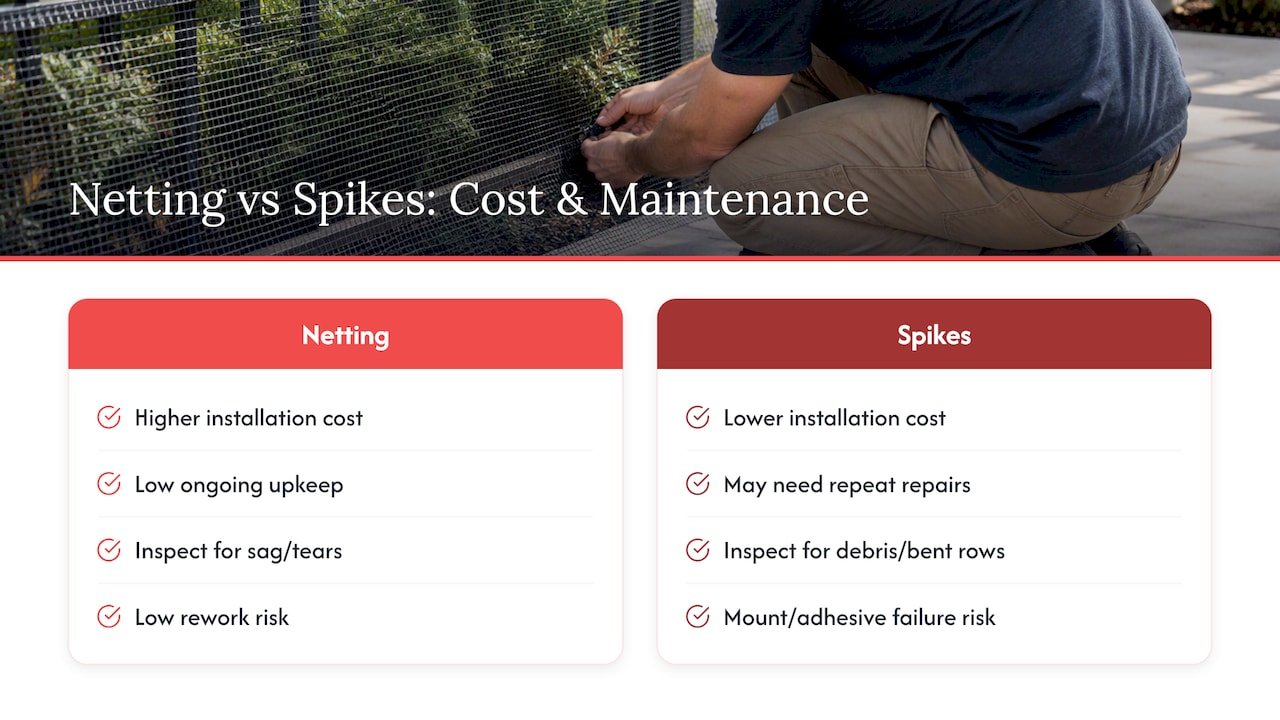
The cost pattern for each method runs in opposite directions over time. Netting typically costs more to install because of the materials, framing and labor involved, but it needs comparatively little upkeep afterward: periodic checks of tension and anchor points are usually enough. Spikes cost less to put in but can require rework if birds find gaps, if adhesive mounts fail, or if sections get knocked loose.
Both methods need routine inspection. Netting should be checked for sagging, torn sections and loose edges on a regular schedule, while spikes need a look for debris buildup, bent rows and secure mounting. Industry guidance on managing bird damage stresses that evaluating a deterrent by total cost of ownership, not just purchase price, gives a more honest picture: a higher netting install can end up cheaper over several years if it eliminates the recurring labor of cleanup, re-netting, or repeated spike repairs.
When estimating costs, factor in the damage you’re avoiding: corroded gutters from droppings, stained solar panels, and the labor hours spent on repeat callouts for a fix that didn’t hold.
Checklist and exact questions to ask installers
Before committing to either method, work through this sequence:
- Measure the area. A small ledge or sign points toward spikes; a whole roof or courtyard points toward netting.
- Identify the species. Flocking birds competing for space often defeat spikes; solitary perchers rarely need full netting.
- Decide on permanence. A multi-year fix favors netting’s lower maintenance; a short-term or rental situation may favor spikes.
- Check visual and heritage constraints. Netting can be less visible from a distance than rows of spikes on a facade.
- Confirm your maintenance capacity. Someone needs to check netting tension periodically.
When briefing an installer, ask for the exact mesh dimension in writing, how they tension and anchor the net, what warranty and inspection schedule comes with the job, and whether they carry insurance and can provide references.
Pro Tip: Walk away from any installer who can’t state the mesh size on request, that’s usually a sign the netting won’t meet wildlife-safe standards.
Red flags include visibly loose or sagging demo netting, vague answers about mesh specs, and no record of past jobs.
Wildlife safety and legal considerations
Mesh size is the single biggest safety variable in netting installation. Wildlife-friendly netting standards call for mesh no larger than 5 millimeters by 5 millimeters at full stretch, and non-compliant netting can carry penalties. Victorian guidance echoes this, noting that large-mesh netting has caused documented wildlife entanglements and recommending white, cross-weave netting specifically to reduce harm to animals that fly into it.
Beyond mesh size, welfare best practice means keeping netting taut (loose netting is far more likely to tangle a bird than a tight weave) and checking installations regularly for signs of entanglement. Rules vary by location, so check your local wildlife or environment authority before installing, and bring in a specialist when a site involves heritage surfaces, protected species, or anything you’re not confident assessing yourself.
Professional perspective and what a proper site check looks for
A proper assessment looks at species present, nearby food and water sources, structural limits, heritage surfaces, and solar panel layouts before recommending netting, spikes or both. Our technicians use thermal imaging and extensive experience to judge which approach actually holds up on a given property, rather than defaulting to one fix for every job.
What installers see go wrong, and the one thing to check first
In the field, the same mistakes repeat: mesh that’s too large, nets left slack instead of tensioned, and spikes stuck down with adhesive too weak for the surface. If you’re unsure which method fits your property, the simplest move is a proper site assessment before buying anything.
— navin
Bird proofing services that match what you’re dealing with
If your property needs more than a DIY fix, we handle both sides of this comparison directly. Our bird control and bird-proofing services cover spikes and deterrents for targeted perching problems, plus full netting installations for roofs and courtyards.
A site assessment looks at the same factors covered above — species, area size, structural access, and any heritage or visibility constraints — before we recommend a method. We also install solar panel bird proofing for panels birds nest under, and gutter guard installation to remove a common attractant alongside whichever deterrent fits your property.
- Bird spikes and deterrents for ledges, signs and fixtures
- Solar panel bird proofing for nesting and droppings under arrays
- Gutter guard installation to reduce debris and roosting spots
Request a quote through our subscription plans page if you want ongoing protection bundled with general pest control, or get in touch for a standalone bird-proofing assessment.
FAQ
What are the disadvantages of bird spikes?
Spikes can leave gaps that persistent or flocking birds learn to land in, especially on wider ledges where rows don’t fully cover the surface. They also collect debris over time, which reduces their effective height, and street-level installations face vandalism or removal risk.
What is the most effective bird deterrent?
There’s no single deterrent that fits every situation: netting is considered the most effective long-term solution for large-scale exclusion, while spikes are the better choice for targeted perch management on narrow surfaces. The right answer depends on the area size and the species involved.
Does bird netting actually work?
Yes, when installed with wildlife-safe mesh and kept taut, netting physically blocks access and is recognized as the most effective long-term exclusion method for large areas. Most failures come from loose installation or oversized mesh rather than the material itself.
Do bird spikes really work?
Spikes work well on narrow ledges, signs and fixtures where there’s no room for a bird to land beside them, but they’re less reliable on wide or open surfaces. Flocking species in particular may find gaps between spike rows and perch there anyway.
How do I know if I need professional installation instead of a DIY fix?
Consider professional help when the site involves heritage surfaces, hard-to-reach structures like tall facades, or any uncertainty about which method fits your property. Companies offering drone-based access for cleaning and inspection can also help assess or maintain installations on tall buildings without scaffolding.
Sources
- Wildlife friendly netting – ACT Government
- Guidelines for reducing cockatoo damage (VGLS source)
- Managing bird damage (PestSmart)
- Airport practice note on managing bird strike risk (APN-9 2024)
- Illegal fruit netting causes rapid rise in wildlife harm (Victoria)