The moment a dead rat smell hits you, stop looking for a way to mask it and start looking for the body. Open windows for cross ventilation, but leave central heating and cooling off so the odor doesn’t spread through the ducts. Don’t vacuum any dry debris near the smell, and if you get close enough to inspect, wear gloves and a snug P2 or N95 mask. If you can’t pinpoint the source within a day or two, call a professional before the smell gets worse.
TL;DR:
- Dead rat odors can shift from faint and sour to metallic and overwhelming within a day as decomposition accelerates, especially in warm, humid, and enclosed spaces.
- Most smells peak in three to five days and fade over one to two weeks, but carcasses in wall cavities or insulation can cause odors lasting three weeks or longer.
- Identifying the source involves methodically checking areas like roof voids, wall cavities, and behind appliances, with professional tools like thermal cameras and borescopes speeding the process.
- Handling carcass removal safely requires protective gear, disinfectant, and sealing the remains in bags, with professionals recommended for larger or inaccessible animals or when vulnerable household members are present.
- Permanent prevention depends on sealing entry points, maintaining good hygiene, and scheduling regular inspections to stop rodents from entering and dying unnoticed.
Table of Contents
- What Causes That Dead Rat Smell in the House
- How Long Does Dead Rat Smell Last?
- How Do You Find a Dead Rat in the Wall or Roof?
- How to Get Rid of Dead Rat Smell Safely
- Cleaning Up After the Smell Is Gone
- When Should You Call a Pest Professional?
- Stopping the Next Dead Rat Smell Before It Starts
- A Straight Take on DIY vs. Calling It In
- Get the Smell Handled Without Guesswork
- Where This Guidance Comes From
- Sources
- FAQ
What Causes That Dead Rat Smell in the House
A dead rat smell is sharper and more chemical than the musky, ammonia scent of a live rodent nest. It builds in waves: faint and sour at first, then thick, sweet, and almost metallic as decomposition accelerates. That shift happens because decomposing tissue releases a changing mix of volatile organic compounds, and flies and maggots speed up that chemical timeline once they colonize the carcass, which is part of why the smell can go from barely noticeable to overwhelming within a day.
A few conditions make it worse:
- Heat speeds up decomposition and pushes odor molecules into the air faster.
- Humidity helps bacteria thrive, intensifying the smell.
- Enclosed spaces like wall cavities trap gases with nowhere to disperse.
- Poor airflow in roof voids or subfloors lets odor concentrate instead of clearing.
How Long Does Dead Rat Smell Last?
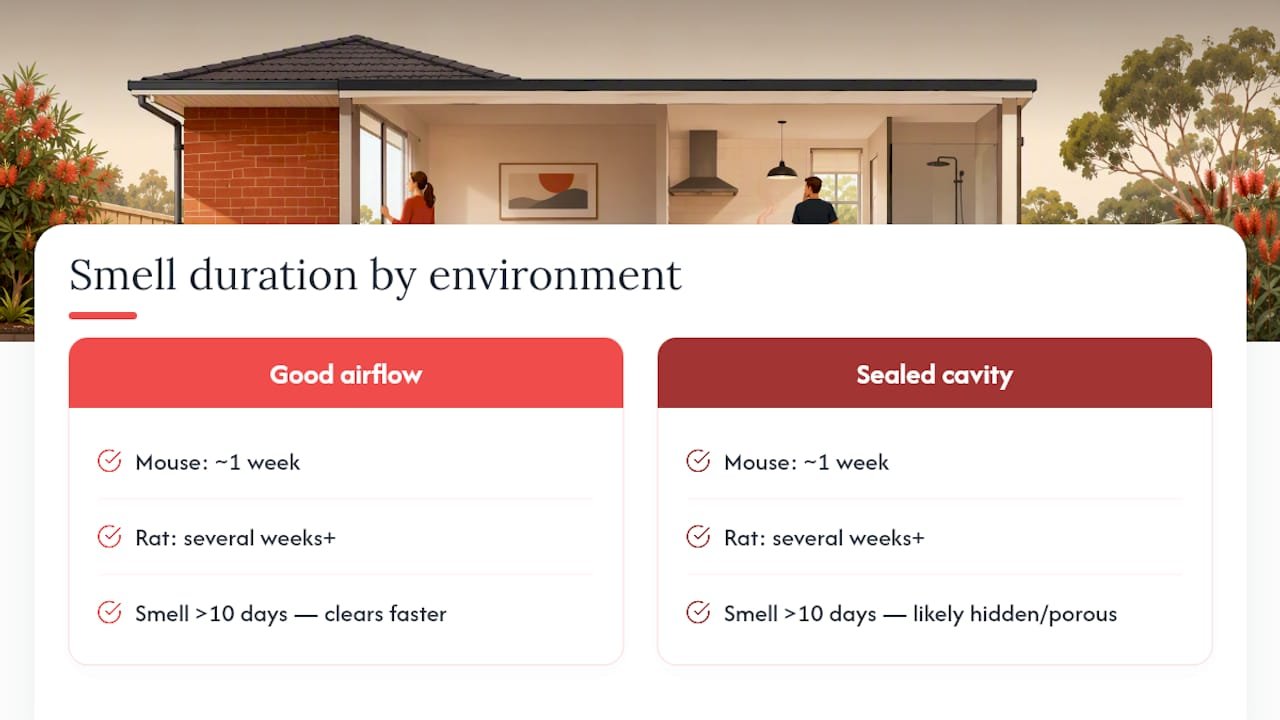
Most dead rat smells peak within a few days and fade over one to two weeks as the carcass dries out, though a rat decomposing in the open with good airflow can clear faster than one trapped in a wall. Indoors, heat and stagnant air intensify and speed up decay, while a carcass sealed inside insulation or wedged in a roof void can take considerably longer to fully break down and stop smelling.
Carcass size matters too. A mouse might stop smelling within about a week; a full-grown rat can linger for several weeks or more. If the smell is still strong after ten days, or it seems to be getting stronger rather than weaker, that usually means the carcass is somewhere you haven’t checked, or it’s decomposing into a porous material that’s now holding the odor on its own.
How Do You Find a Dead Rat in the Wall or Roof?
Finding the carcass fast is the difference between a two-day fix and a two week ordeal. Work through your home methodically instead of chasing your nose room by room.
- Walk the house slowly with doors closed, one room at a time, and note where the smell is strongest. Odor intensity is your best triangulation tool.
- Check for secondary clues: clustering flies on a window, small brown stains on a ceiling or wall, or a pet repeatedly sniffing and scratching at one spot.
- Feel for temperature and moisture changes along walls and ceilings. Decomposition can leave a faint warm or damp patch, especially in the first week.
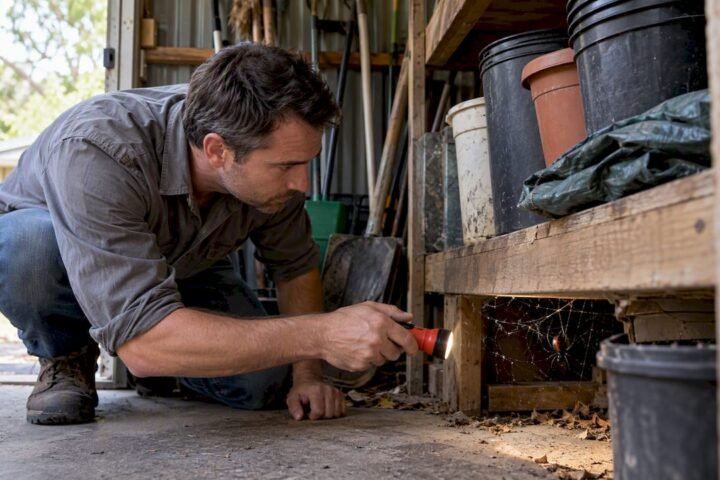
- Prioritize likely hiding spots: roof voids, wall cavities near pipe runs, subfloor areas, behind large appliances, and return air vents or ductwork.
- Stop before you cut into anything. If the smell traces to an inaccessible cavity, a contractor with a borescope or thermal imaging camera can find the exact location without opening up plaster or flooring unnecessarily.
How to Get Rid of Dead Rat Smell Safely
Small, exposed carcasses in accessible spots (a garage floor, under a shed, an open attic) are usually manageable yourself. Anything in a wall cavity, a large animal, or a situation involving a pregnant or immunosuppressed household member should go straight to a professional, since Health NSW specifically advises those groups against handling rodent carcasses.
If you’re clear to proceed, gather gloves, a waterproof outer layer, a P2 or N95 mask, long tongs or a scoop, sealable plastic bags, and a household disinfectant before you start.
- Ventilate the room and leave it for a few minutes before entering.
- Lightly wet the carcass and surrounding debris with a spray bottle of water and disinfectant. This is critical: dry droppings and desiccated remains can release contaminants into the air if disturbed, and NSW Health explicitly warns against sweeping or vacuuming dry rodent debris.
- Scoop, don’t grip. Use tongs or a dustpan to lift the carcass directly into a plastic bag without touching it.
- Double-bag it, tie it off, and place it in your general household waste bin. NSW EPA guidance confirms sealed bags in general waste are an accepted disposal method for small dead rodents.
- Disinfect every surface and tool that touched the area, then wash gloves before removing them and wash your hands thoroughly afterward.
Pro Tip: If you find the carcass but can’t remove it immediately, don’t leave it exposed. A sealed bag in a cool spot away from living areas for a few hours won’t accelerate the smell the way open air will.
Cleaning Up After the Smell Is Gone
Removing the carcass doesn’t always end the smell. Porous materials, carpet underlay, insulation batts, plasterboard, and untreated timber can absorb decomposition fluids and keep releasing odor long after the source is gone. Heavily soiled insulation or carpet in the immediate contamination zone often needs to be cut out and replaced rather than cleaned.
For anything salvageable:
- Enzyme-based cleaners break down the organic proteins and residues causing the smell, rather than masking them the way scented sprays do.
- Bleach-based disinfectants work well on hard, non-porous surfaces like tile and sealed concrete.
- Fabrics and washable linens should go through a hot wash cycle, ideally with an enzyme laundry additive.
- A carpet cleaning approach built around natural, residue-breaking solutions can help salvage carpet that wasn’t directly soiled but absorbed airborne odor.
Ozone treatment can neutralize stubborn smells, but it only works safely in sealed, unoccupied spaces under professional control. Consumer ozone generators run in an occupied home are a genuine respiratory hazard, not a shortcut worth taking. If the smell persists after enzyme cleaning and a few days of ventilation, that’s your signal to call in professional deodorizing rather than buying a stronger spray.
When Should You Call a Pest Professional?
Call a professional the moment any of these apply:
- The smell has lasted more than a week with no source found.
- You’ve traced it to a roof void, wall cavity, or subfloor you can’t safely access.
- The carcass appears to be a larger animal, not a rat or mouse.
- You’re now seeing secondary fly activity or maggots, which signals an active infestation building around the remains.
When you call, describe where the smell is strongest, how long you’ve noticed it, and any visible signs like stains or flies. A professional technician can then use tools like thermal imaging cameras, borescopes, and moisture meters to pinpoint the carcass location without cutting open walls on a guess. That targeted approach is faster and less destructive than trial-and-error demolition, and it typically includes enzyme treatment and odor neutralization once the remains are out. Bugspatrol Pest Management’s licensed technicians bring exactly this detection equipment and experience from servicing thousands of Canberra homes.
Stopping the Next Dead Rat Smell Before It Starts
The best fix for a dead rat smell is never having one. Rodents die where they nest, so sealing entry points stops the problem upstream.
- Seal pipe and cable penetrations under sinks, around the laundry, and where utility lines enter the house.
- Screen roof and eave vents with rodent-proof mesh, since roof voids are one of the most common places rats die undetected.
- Check gutters and rooflines seasonally. A gap where a gutter meets the fascia is an easy rat entry point.
- Tighten up bin management and remove pet food left outside overnight, since food access is what draws rodents in to begin with.
- Book a seasonal inspection rather than waiting for a smell to tell you there’s a problem. Consistent rodent proofing closes off the gaps homeowners typically miss on their own.
A Straight Take on DIY vs. Calling It In
Most guides oversell DIY removal because it feels empowering to say “just find it and bag it.” In practice, the rats homeowners can find easily are rarely the ones causing the worst smells. The bad cases are always the ones you can’t see: a rat that died three feet into a wall cavity, or one that expired in roof insulation above a bedroom. Cutting into drywall on a guess is expensive, messy, and sometimes wrong, which means you pay for the repair and still haven’t found the source.
The honest advice is to give yourself a short, defined window (a day, maybe two) to try the low-damage search steps above. If you don’t have a confirmed location by then, stop guessing and get someone with a thermal camera and a borescope. That single decision point, DIY search versus professional detection, is the one piece of advice that actually saves homeowners money and drywall.
— navin
Get the Smell Handled Without Guesswork
There’s a real cost to guessing wrong on a dead rat smell: cut-open walls that didn’t need cutting, sprays that mask the problem for a day and let it come back worse. Bugspatrol Pest Management brings the detection tools, licensed technicians, and hands-on experience from over 5,000 Canberra homes serviced to skip that guesswork entirely.

A typical booking starts with an inspection using thermal imaging or a borescope to confirm the carcass location before anything gets opened up, followed by targeted, low-damage removal and enzyme-based odor treatment. If insulation or flooring needs replacing, you’ll get straight advice on that too, not an upsell. If the smell keeps coming back season after season, consider ongoing pest management plans that include regular checks to catch rodent activity before it becomes a bigger issue. Book an inspection through the rodent removal service page and get a technician looking at the actual problem, not just another spray bottle.
Where This Guidance Comes From
Safety steps here draw on NSW Health’s rodent handling guidance, the NSW EPA disposal factsheet, and peer-reviewed decomposition research on buried rat carcasses.

This article is general information, not a substitute for advice from a qualified doctor. Consult a qualified healthcare professional about your own circumstances before acting on anything here.
Sources
- Staying healthy during a mouse plague — NSW Health
- Handling and disposal of dead mice — NSW EPA factsheet (PDF)
- Decomposition of buried rat carcasses — PMC study
- Disentangling the roles of age and insect colonization in the temporal succession of VOC profiles in rat decomposition — Springer Nature (2026)
FAQ
How Long Does Dead Rat Smell Last?
Most cases peak within three to five days and fade over one to two weeks, though a carcass trapped in a wall, roof void, or insulation can smell for three weeks or longer.
How Do You Get Rid of Dead Rat Smell if You Can’t Find It?
Ventilate the room without running central heating or cooling, narrow the search using temperature and odor intensity, and if you still can’t locate it within a day or two, call a professional who can use a thermal imaging camera or borescope to find the exact spot without cutting into walls on a guess.
Is Breathing In Dead Rat Smell Harmful?
Rodents can carry infections that spread to humans, so anyone with respiratory sensitivities, pregnant, or immunosuppressed should avoid prolonged close contact with the odor and let someone else handle the search and cleanup.
Will the Smell of a Dead Rat Keep Other Rats Away?
Not reliably. Decomposition odor doesn’t function as a rodent deterrent, and an unresolved entry point that let one rat in will let others in too, so sealing gaps matters more than the smell ever will.
Recommended
- Rodent Pest Removal
- Rodent Control Removal
- Rodent Pest Removal in Canberra
- Rodent Control Removal in Canberra