To clean up rat or mouse droppings safely, put on gloves and protective clothing, never sweep or vacuum the mess, wet and disinfect everything the rodents touched, bag the waste, and wash your hands thoroughly afterward. The steps are simple. The mistakes people make, like dry sweeping or skipping gloves, are what cause illness. This guide covers the full job for an Australian home, from what to wear to what to throw away, and explains when a small cleanup turns into a job for a licensed professional.
TL;DR
- Wear disposable gloves, waterproof clothing, closed shoes and preferably a face mask, and cover any cuts with a waterproof dressing.
- Never dry sweep or vacuum droppings, urine or nesting material, because it puts tiny contaminated droplets into the air.
- Clean first, then disinfect. Wash bedding and clothes in hot water with detergent, and steam clean carpet and upholstery.
- Bag dead rodents and waste, put them in the general waste bin, then wash your hands with soap and change your clothes.
- Cleaning does not fix the cause. If droppings keep appearing, find the entry points and book a licensed technician.
Table of Contents
- Why droppings are more than a mess
- Before you start: who should clean and what to wear
- The one rule: do not sweep or vacuum
- Step-by-step: cleaning hard surfaces
- Cleaning fabrics, bedding and upholstery
- Kitchens, pantries and food
- Dead rodents and nests
- Roof voids, sheds and heavy infestations
- Why cleaning alone is not the fix
- Our perspective
- How we can help
- After the cleanup: your own health
- FAQ
- Sources
Why droppings are more than a mess
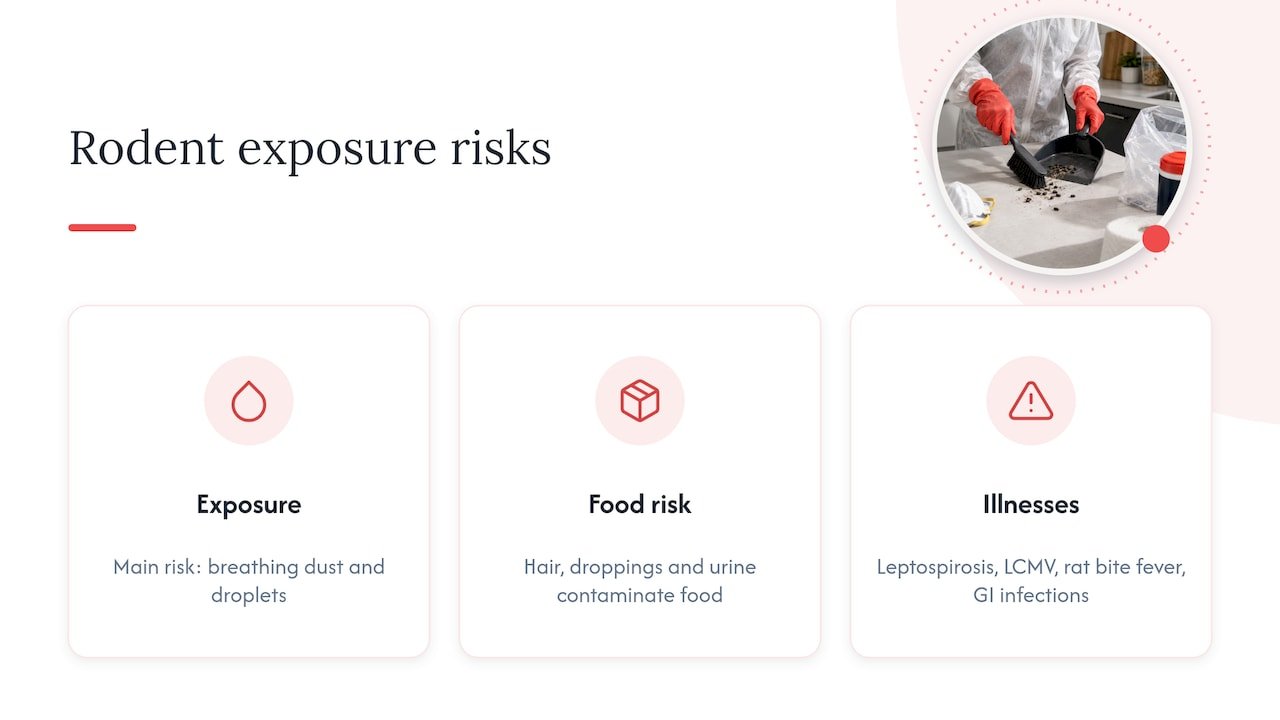
Rodents carry bacteria and viruses, and their urine, droppings and hair end up on food, benchtops and dust. The ACT Government notes that rodents can spread leptospirosis through their urine and contaminate food with hair, droppings and urine. NSW Health lists leptospirosis, lymphocytic choriomeningitis virus (LCMV), rat bite fever and gastrointestinal infections among the illnesses linked to rodent contact.
If you have read US guidance, you will see a lot about hantavirus. That advice exists because of American conditions, but the core safety rule travels well: the main risk is breathing in dust and droplets, which is why the first rule below is about not stirring anything up. In Australia the illnesses to know about are the ones NSW Health and the ACT Government name above.
The practical conclusion: treat every dropping as contaminated, and handle the job with the same care whether it is five pellets in a cupboard or a roof void full of them.
Before you start: who should clean and what to wear
Choose the right person
WA Health advises that the cleanup is best done by household members who are well and do not have a weak immune system. For dead rodents specifically, the NSW EPA says the job should not be done by pregnant women or immunosuppressed people. If that describes someone in your household, hand the task to another adult or to a professional.
Gear checklist
According to WA Health, you need:
- Disposable gloves
- Waterproof protective clothing
- Closed footwear
- A face mask, preferably
- A waterproof dressing over any cuts or abrasions
NSW Health gives the same core list of gloves, waterproof clothing and footwear, and a waterproof dressing on cuts and grazes. A few practical additions from our experience in the field: tie long hair back, keep pets and children out of the area, and open windows and doors before you begin so the space can air out.
If you have used rodent baits, WA Health also says to read the bait label, because some products carry extra protective equipment or disposal requirements.
The one rule: do not sweep or vacuum
Sweeping or vacuuming droppings, urine or nesting material can put tiny droplets containing viruses into the air, where they may be breathed in, according to the US Centers for Disease Control and Prevention. A broom flicks dried material into the air. A household vacuum cleaner passes fine particles straight through its filter and back into the room.
That is why every reputable guide, including the top-ranking ones for this topic, starts with the same instruction. Wet the area first, then wipe up with disposable material.
Step-by-step: cleaning hard surfaces
- Ventilate. Open windows and doors, and leave the area empty for a while if it is a small enclosed space such as a pantry or laundry.
- Put on your gear. Gloves, waterproof clothing, closed shoes and a mask, with cuts covered.
- Wet the droppings. Spray them with disinfectant so they are soaked and nothing is lifted into the air. Follow the product label for concentration and contact time. The Australian Government’s infection control guidance says to follow the manufacturer’s instructions when making and applying disinfectant.
- Wipe up with paper towel. Pick up the droppings and any nesting material with disposable towel, and put it straight into a bag.
- Clean, then disinfect. The same Australian Government guidance explains that dirt and grime reduce how well disinfectant works, so wash the surface with detergent and water first, then apply disinfectant.
- Mop and wipe. NSW Health says to mop floors and clean countertops with disinfectant or a bleach solution. WA Health recommends regularly removing droppings and disinfecting every area rats or mice have been.
- Seal the waste. Tie the bag, then put it inside a second bag if it is damp or heavy.
- Remove gloves, wash hands. Wash with soap and water, even if you wore gloves the whole time.
Do not mix bleach with other cleaning products, particularly ammonia-based ones. If you choose bleach, make it up the way the label says and ventilate well.
Cleaning fabrics, bedding and upholstery
Not everything can be wiped. For soft items, NSW Health says to:
- Wash bedding and clothing that has been exposed to rodent urine or droppings with laundry detergent in hot water.
- Steam clean or shampoo upholstered furniture and carpets that show signs of rodent exposure.
Shake nothing out. Carry contaminated linen to the machine in a bag or closed basket, and keep it away from clean laundry. Take clothing off after the job: WA Health advises changing your clothes after contact with rodents, their droppings or urine, and washing your hands thoroughly with soap.
A mattress or couch that has been heavily soiled and cannot be steam cleaned properly may be better replaced than kept. That is a judgment call, not an official rule, but if you cannot clean it thoroughly, do not keep sleeping on it.
Kitchens, pantries and food
This is where droppings matter most. The ACT Government advises you to:
- Throw away food or drink that may have come into contact with rodents or their urine or faeces
- Wash cookware and cutlery in warm soapy water
- Wash your hands before eating or preparing food
When in doubt, throw it out. Pet food in open bags, flour, cereal, rice and anything in thin cardboard or soft plastic should go if you see droppings nearby. Glass jars and sealed tins can be washed and disinfected on the outside before use.
Once cleaned, move dry goods into hard containers with tight lids. That also removes the food source that kept the rodents coming back.
Dead rodents and nests
If you find a dead rat or mouse, the NSW EPA says to handle it as little as possible, using gloves, clothing that covers bare skin, and a shovel, rake or dustpan. Afterward, wash your hands with soap and dry them with paper towel.
For disposal, WA Health says to seal the animal in a bag or wrap it in newspaper and place it in general waste. The NSW EPA adds that residents with council collection should put the sealed bag in the general waste bin, keep the bin cool and shaded, and keep the lid secured. Check your local council’s rules for the ACT, but a sealed bag in the general waste bin is the standard approach.
Spray nests with disinfectant before you touch them, and treat them like droppings: wet, wipe up with disposable material, bag, seal.
Roof voids, sheds and heavy infestations
Hard surfaces in a kitchen are one thing. A roof cavity with insulation full of droppings, urine staining and nesting material is another. Insulation cannot be wiped, you are working in a confined, dusty space, and you cannot easily avoid disturbing the material.
Call a professional when:
- Droppings are widespread in a roof void, wall cavity or under floors
- Insulation is soiled and needs removing or replacing
- You see fresh droppings again soon after cleaning, which means rodents are still getting in
- Anyone in the home is pregnant, immunosuppressed, or otherwise not well enough to do the cleanup
- There are dead rodents you cannot reach
The size of the droppings can help you work out what you are dealing with. Our guide to places in Australian homes to check for rats covers where to look, and our article on rats in the roof explains how to spot them and keep them out.
Why cleaning alone is not the fix
If you clean and the droppings return, rodents still have a way in and a reason to stay. WA Health says a technician’s treatment plan should address entry points, nest locations, waste containment, food sources, pesticide selection, pesticide precautions and disposal of deceased rodents. It also says the technician should be licensed and the business registered, with the right endorsement for applying rodent baits. Ask to see that before anyone sets bait in your home.
Cleaning, control and proofing are three separate jobs. You can read how baits, traps and sealing fit together in our rundown of rat control methods that work, and our rodent prevention tips cover the steps you can take around the house. For a Canberra home, our rodent proofing guide for Canberra is the local version.
Our perspective
We have serviced more than 5,000 Canberra homes, and the pattern is consistent: people call us after they have already cleaned up once and the droppings came back. The cleanup was fine. The entry point was still open.
So we look at cleanup as the last step of a job, not the first. We start by finding where rodents are getting in and where they are nesting, because a thorough clean of a space rodents still use only lasts until the next night. Our licensed technicians inspect roof voids, wall cavities and sub-floors, and our approach to treatment is built around families, children and pets, so we choose methods with that in mind.
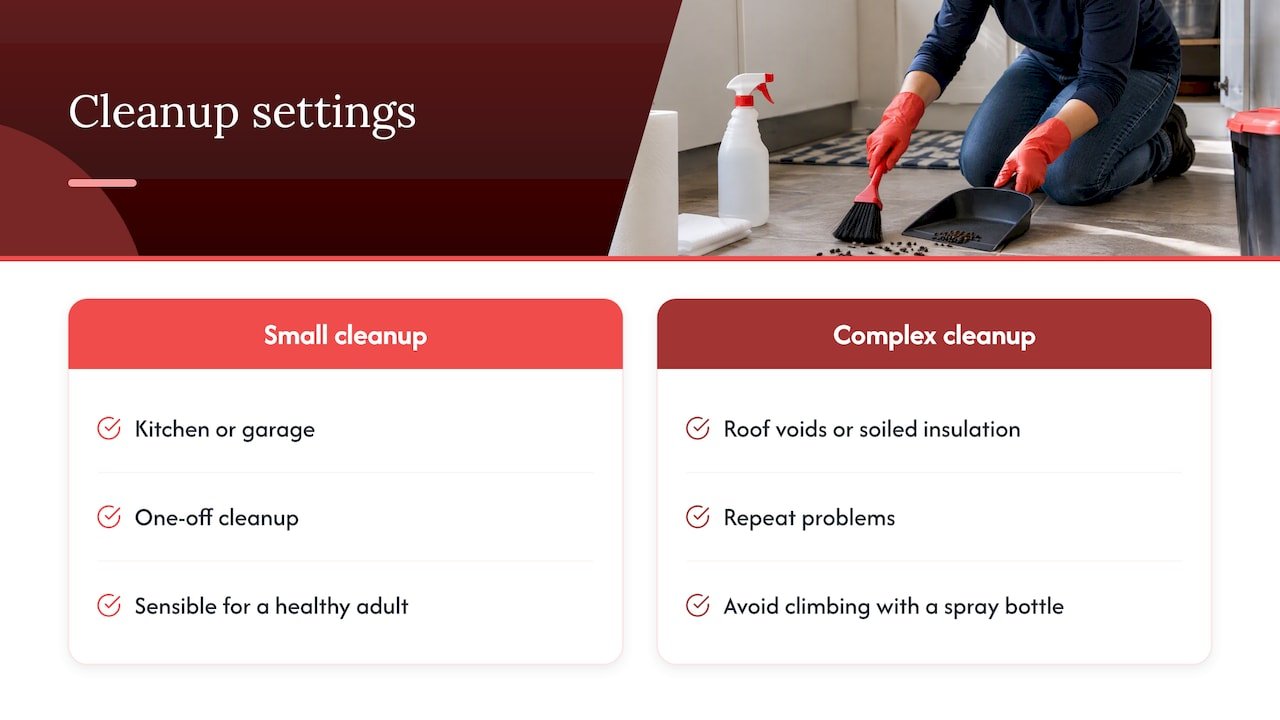
For small, one-off cleanups in a kitchen or garage, following the steps above is sensible and well within reach of a healthy adult. For roof voids, soiled insulation and repeat problems, we would rather you did not climb up there with a spray bottle. A cleanup in a space you cannot see properly is a cleanup you cannot trust.
— navin
How we can help
If droppings keep appearing or you have found them in the roof, our rodent removal service deals with the source: finding entry points, treating the infestation and advising on proofing. Canberra homeowners can also see our rodent removal in Canberra page.
If you would rather have regular protection than react to each problem, our maintenance plans start at $29.98 per month for Bronze General Pest. Bronze Termite is also $29.98 per month, Silver Combined is $55.98 per month and Gold Complete is $79.98 per month. We offer fast response and same-day emergency service, and our treatments are guaranteed for effectiveness.
After the cleanup: your own health
Wash your hands with soap and water, shower, and put the clothes you wore into the wash. NSW Health lists the symptoms linked to rodent-borne infections, and the ACT Government says anyone bitten by a rat or mouse should see a doctor promptly. If you feel unwell in the days or weeks after a cleanup or any rodent contact, tell your GP that you were exposed to rodent droppings or urine, so they can consider the right tests.
FAQ
Can I use a vacuum cleaner on mouse droppings?
No. Vacuuming or sweeping can put tiny contaminated droplets into the air where you can breathe them in. Wet the droppings with disinfectant and wipe them up with disposable paper towel instead.
Do I need a mask to clean up rat droppings?
WA Health recommends gloves, waterproof clothing, closed footwear and preferably a face mask. Cover cuts with a waterproof dressing too. If the area is a dusty roof void or heavily soiled, that is a good sign to call a professional rather than rely on a mask.
What should I do with clothes and bedding that touched droppings?
NSW Health says to wash them in hot water with laundry detergent. Carpets and upholstered furniture should be steam cleaned or shampooed. Handle the items carefully so you do not shake dust into the air.
Where do I put dead rodents and contaminated waste?
Seal them in a bag, or wrap a dead rodent in newspaper, then put it in your general waste bin. Keep the bin lid secured and the bin in a cool, shaded spot until collection. Wash your hands with soap straight afterward.
When should I call a pest professional instead?
Call one if droppings are in the roof or walls, if you keep finding fresh ones, or if anyone in your household is pregnant or has a weakened immune system. A licensed technician can also find and close the entry points, which cleaning cannot do.
Sources
- Health advisory: Mice infestations and pesticide safety, WA Health
- Staying healthy during a mouse plague, NSW Health
- How to Clean Up After Rodents, CDC
- Routine environmental cleaning and disinfection in the community, Australian Government Department of Health
- Rats and mice, ACT Government
- Guidance on the handling and disposal of dead mice, NSW EPA
- Keeping rats and mice under control, WA Health
Recommended
- Identify Rat vs Mouse Droppings for Homeowners
- 5 Places Australian Homes Should Check for Rats
- Rat in Roof: How to Spot, Remove, and Keep Them Out
- What to Do About Cleaning After Pest Control