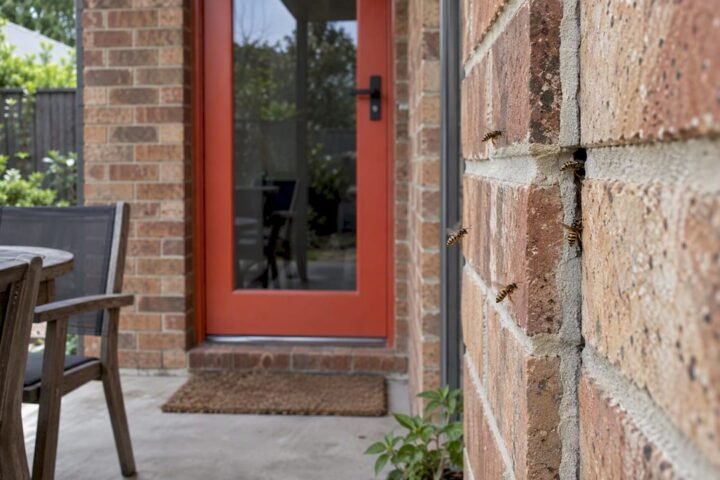
Bright yellow and black insects with yellow legs flying steadily to a single hole or crevice are very likely European wasps, the most common stinging pest reported across the ACT. If you see this pattern, treat the spot as an active nest: avoid disturbing it, and report it or call a licensed pest controller.
TL;DR:
- Look for steady traffic through one fixed entrance, bright yellow legs, and black dots within yellow body bands; avoid probing concealed cavities.
- Report nests on ACT Government land through eWasp or call 6258 5551; treatment typically takes 5 to 10 business days.
- Private property owners must arrange a licensed pest controller, since DIY treatments can leave the queen and brood alive and prompt rebuilding within weeks.
- Keep children and pets away, never block or disturb the entrance, and seek emergency care for breathing trouble or face or throat swelling.
Table of Contents
- How to identify a European wasp
- Where European wasps nest and signs of a hidden colony
- Seasonality, overwintering risk and ecological impact
- How to report a European wasp nest in the ACT
- What to do (and avoid) if you find a nest
- A licensed Canberra operator’s approach to wasp removal
- A Canberra resident’s view on staying vigilant
- Need wasp removal in Canberra? Here’s how we help
- FAQ
- Sources
How to identify a European wasp
European wasps (Vespula germanica) have a distinct look that sets them apart from bees and other local insects. The front half of the body is mostly black, while the back half carries bright yellow bands broken by small black dots, a marking pattern that ACT City Services uses as a key identification cue. Their legs are bright yellow, and their antennae are noticeably longer and thinner than a honey bee’s.
Behavior gives away just as much as appearance. Honey bees sting once and die; European wasps can sting repeatedly and become aggressive around food, sugary drinks and rubbish bins, especially in late summer and autumn. A few field cues make identification easier on the spot:
- A steady stream of wasps flying in and out of one fixed entrance, rather than random individual sightings.
- Strong interest in meat, sweet drinks and exposed food at barbecues or picnics.
- A flatter, more slender body shape than a bumblebee or native bee, with smoother, less hairy skin.
- Fast, direct flight paths compared to the slower, more erratic movement of many native wasps.
If several of these line up, assume you have found a nest entrance rather than a stray wasp.
Where European wasps nest and signs of a hidden colony
European wasps are opportunistic nesters, and in Canberra that means they turn up in places residents do not always check. Common sites include:
- Ground holes, often in lawns, garden beds or under paving, where the entrance looks like a small, unremarkable burrow.
- Wall and ceiling cavities, accessed through small gaps around weatherboards, eaves or vents.
- Roof voids, reached through broken tiles, gaps in flashing or unsealed roof penetrations.
- Dense conifers and shrubs, where the nest hangs hidden among foliage.
The clearest sign of a hidden nest is constant in-and-out traffic at one point, even when the entrance itself is small or partly obscured. Other signs include gnawed or stained plasterboard near a suspected cavity, and visible wasp trails along door frames, window sills or gutter lines. Because nests are often concealed inside structures, ACT guidance recommends watching from a safe distance rather than probing walls or roof spaces yourself.
Seasonality, overwintering risk and ecological impact
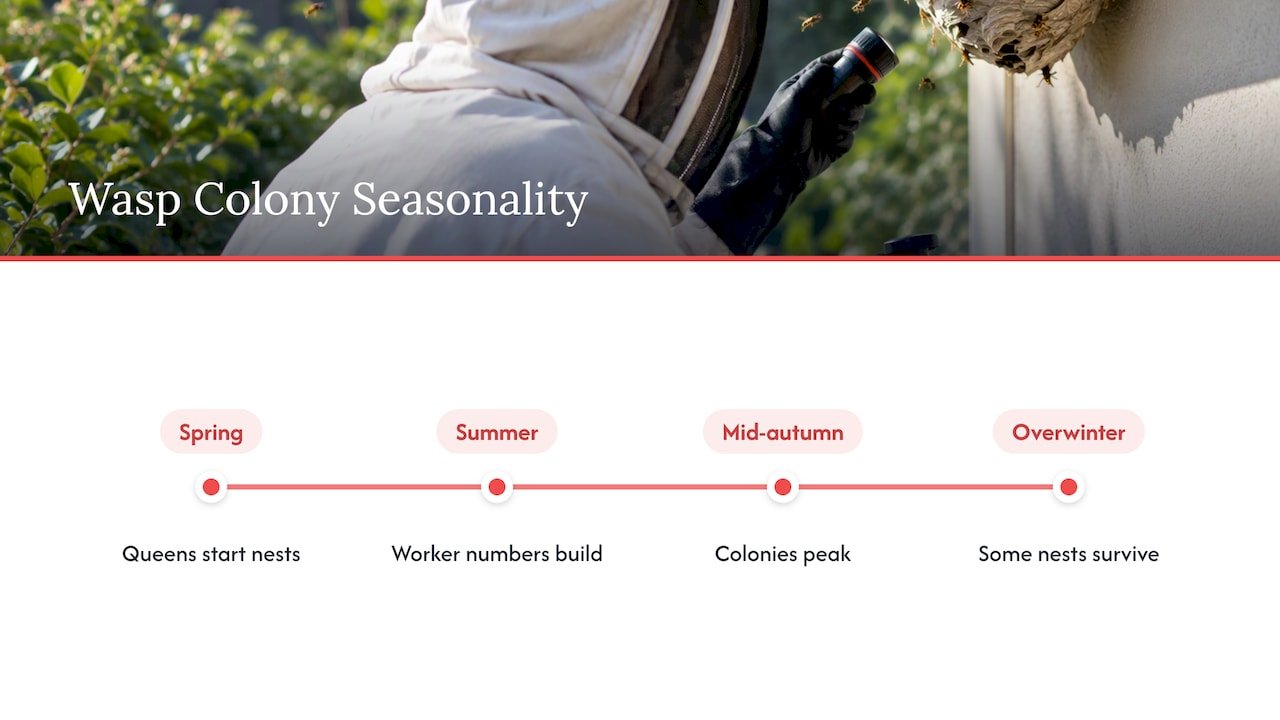
European wasp activity in Canberra follows a predictable yearly pattern. Queens emerge in spring to start new nests, worker numbers build steadily through summer, and colonies typically peak in mid-autumn, when nests are largest and workers are most defensive around food sources.
Some nests can overwinter in Australia’s milder climate, letting colonies survive year after year and grow far larger than a single-season nest would, according to ACT wildlife safety messaging. A successful overwintering nest can produce large numbers of new queens, which raises the risk of the species spreading into new areas the following spring.
The ecological stakes go beyond backyard annoyance. Research from the University of Sydney found that European wasps actively prey on native insects, competing with local species for food and disrupting parts of the ecosystem they were never part of. Acting on a nest early helps limit both the sting risk to people and the broader damage to Canberra’s native insect populations.
How to report a European wasp nest in the ACT
Reporting is quick and does not require you to get close to the nest. Residents can use either of two official channels:
- The eWasp app, which uses GPS and photo capture to pinpoint a nest location for ACT authorities.
- The European Wasp Hotline on 6258 5551, for residents who prefer to call directly.
When reporting, include the nest’s location, a photo if it is safe to take one, and a description of the entrance point. ACT Government policy treats nests found on ACT Government land, such as parks, reserves and nature strips, while nests on private property remain the owner’s responsibility and should be handled by a qualified, licensed pest controller.
| Nest location | Who handles treatment | Typical response window |
|---|---|---|
| ACT Government land (parks, reserves, nature strips) | ACT Government, after a public report | About 5 to 10 business days |
| Private property (homes, yards, businesses) | Property owner, via a licensed pest controller | Scheduled at booking |
What to do (and avoid) if you find a nest
Until a professional arrives, a few simple steps reduce the chance of anyone getting stung:
- Keep children, pets and visitors well away from the nest area, ideally inside with doors and windows closed.
- Avoid mowing, trimming or disturbing garden beds near a suspected ground nest.
- Do not swat at wasps or attempt to block the entrance, since this provokes defensive swarming.
- If you are stung, apply a cold pack to reduce swelling and watch for signs of a severe reaction.
- Seek urgent medical care immediately if someone has difficulty breathing, swelling of the face or throat, or any signs of anaphylaxis after a sting.
Pro Tip: Never pour petrol, boiling water or insecticide into a nest entrance yourself. These methods usually kill only the surface workers, leaving the queen and brood alive to rebuild a larger, more defensive colony.
DIY removal attempts are one of the most common reasons a nest comes back within weeks, often angrier than before.
A licensed Canberra operator’s approach to wasp removal
Author navin writes on pest topics for BugsPatrol Pest Management, which has serviced more than 5,000 homes across Canberra over 10-plus years in the industry. A licensed response to a reported wasp nest generally follows a consistent process:
- An initial inspection to confirm the species and locate the exact entrance point.
- A risk assessment that accounts for the nest’s position relative to doors, windows and foot traffic.
- Treatment chosen for effective results while limiting exposure risk to the household, with attention to family and pet safety throughout.
- A follow-up check to confirm the nest is inactive and to flag any entry points worth sealing.
Callers can expect a response from trained technicians and a clear explanation of what happens at each step. We do not promise results before an inspection confirms what we are dealing with.
A Canberra resident’s view on staying vigilant
Local sightings and community reports keep turning up nests in roof voids and wall cavities that homeowners never suspected. Reporting early and keeping kids and pets clear of active sites protects both people and neighbors.
— navin
Need wasp removal in Canberra? Here’s how we help
We handle European wasp nests across homes and businesses in Canberra, from a single ground nest in the backyard to a colony tucked inside a roof void. Licensed technicians inspect the site first, confirm the nest location, and apply treatment chosen for family and pet safety before confirming the nest is fully inactive.

If wasps are only part of a bigger pest concern around your property, our General Pest Control service and ongoing plans such as Silver Combined cover broader protection beyond a single callout. For a fast quote on wasp removal specifically, visit our wasp control services page or call to book an inspection.
FAQ
Are European wasps more aggressive than other wasps?
European wasps are considered more aggressive than many native wasps and honey bees, especially when defending a nest or competing for food near rubbish bins and picnic areas. Unlike honey bees, they can sting multiple times without dying, which adds to the risk around an active nest.
What smell do wasps hate?
Wasps tend to avoid strong smells like peppermint, clove and certain citrus scents, though these are not a reliable way to clear an established nest. For an active European wasp nest, reporting it through official ACT channels or booking a licensed pest controller remains the dependable option.
Are there other wasp species found in Australia besides European wasps?
Yes, Australia is home to a range of native wasp species alongside the introduced European wasp. Native wasps are generally less aggressive around food and rubbish and often look less uniformly yellow and black, which is one reason correct identification matters before assuming a sighting is a European wasp.
Will a wasp nest come back after it’s destroyed?
A nest itself will not regrow once properly treated, but new wasps can build a fresh nest nearby if the original queen or a satellite colony survives, which is common with DIY treatment attempts. A licensed pest controller aims to eliminate the whole colony, including the queen, to reduce the chance of reinfestation.
How long does it take for the ACT Government to respond to a reported wasp nest?
For nests reported on ACT Government land, the typical investigation and treatment window is about 5 to 10 business days, depending on public-safety priority. Nests on private property are not covered by this government timeline and should be booked directly with a licensed pest controller.
Sources
- Wasps – City Services
- Stay safe around wildlife this spring – Our Canberra
- Forget murder hornets — European wasps are beheading Aussie flies – University of Sydney
Recommended
- Identify and Report Wasp Nests Safely in Australian Yards
- Bugs Patrol Canberra – Professional Pest Control Services
- Wasp Control Services – Free Inspections
- Bugs Patrol Canberra – Professional Pest Control Services