
Gutter guards work best for homes with heavy leaf load, hard-to-reach rooflines, or ember exposure in bushfire zones, and metal micro-mesh or solid hood guards perform most reliably in those conditions. They are not a “never clean again” fix. Aperture size, installation quality, and local debris still decide whether a guard earns its keep or just becomes another thing clogged with grit.
TL;DR:
- Micro-mesh guards with approximately 0.4mm apertures perform best in heavy leaf and bushfire zones, preventing fine debris entry and reducing ember risk.
- Proper installation, including sealing and correct pitch, is crucial to prevent overflow and ensure the guard functions effectively.
- Guards require ongoing maintenance, such as annual cleaning or replacing components, and do not eliminate the need for gutter checks.
- Choosing the right guard depends on debris type, roof complexity, and fire risk, with professional assessment recommended before installation.
- Guards are most cost-effective when they prevent major blockages, saving money on cleaning and reducing ladder hazards, typically paying for themselves in three to six years.
Table of Contents
- Do Gutter Guards Work? The Main Types and What Each One Actually Does
- How Gutter Guards Work: Aperture, Surface Tension, and Water Flow
- The Real Benefits: Fewer Clogs, Less Ladder Time, Lower Ember Risk
- Why Some Homeowners Say Gutter Guards Don’t Work
- How to Choose the Right Gutter Guard for Your Home
- What Maintenance Still Looks Like After Installation
- What Installers See on the Ground
- The Bottom Line on Gutter Guards
- Why the “Set and Forget” Promise Is the Real Problem
- Get Your Gutters Assessed Before the Next Storm Season
- Sources
- FAQ
Do Gutter Guards Work? The Main Types and What Each One Actually Does
“Gutter guard” covers five genuinely different products, and lumping them together is why so many homeowners feel misled after installation. The standard industry term is gutter protection system, and it splits by material and mechanism, not marketing name.
- Micro-mesh (stainless steel, roughly 0.4mm aperture): blocks fine debris like eucalyptus seed pods and pine needles, and it’s the option specialists point to for heavy-leaf and bushfire-exposure areas because it’s non-combustible.
- Standard aluminium mesh (2 to 3.5mm): handles larger leaves and higher water flow, but let’s fine grit and needles through.
- Solid hood/surface-tension guards: a curved cover that uses water adhesion to pull rain into the gutter while leaves slide off the edge; effective on large leaves, less so on wind-blown debris.
- Brush guards: bristle inserts that catch leaves on top; they are cheap and easy to install, but trap organic matter that rots inside the bristles.
- Foam inserts: porous foam that sits in the channel; blocks debris on contact but compacts and degrades in sun within a few seasons.
Metal options generally outlast plastic ones and matter far more in fire-prone regions, where a professional installer should be consulted before choosing anything combustible.
How Gutter Guards Work: Aperture, Surface Tension, and Water Flow
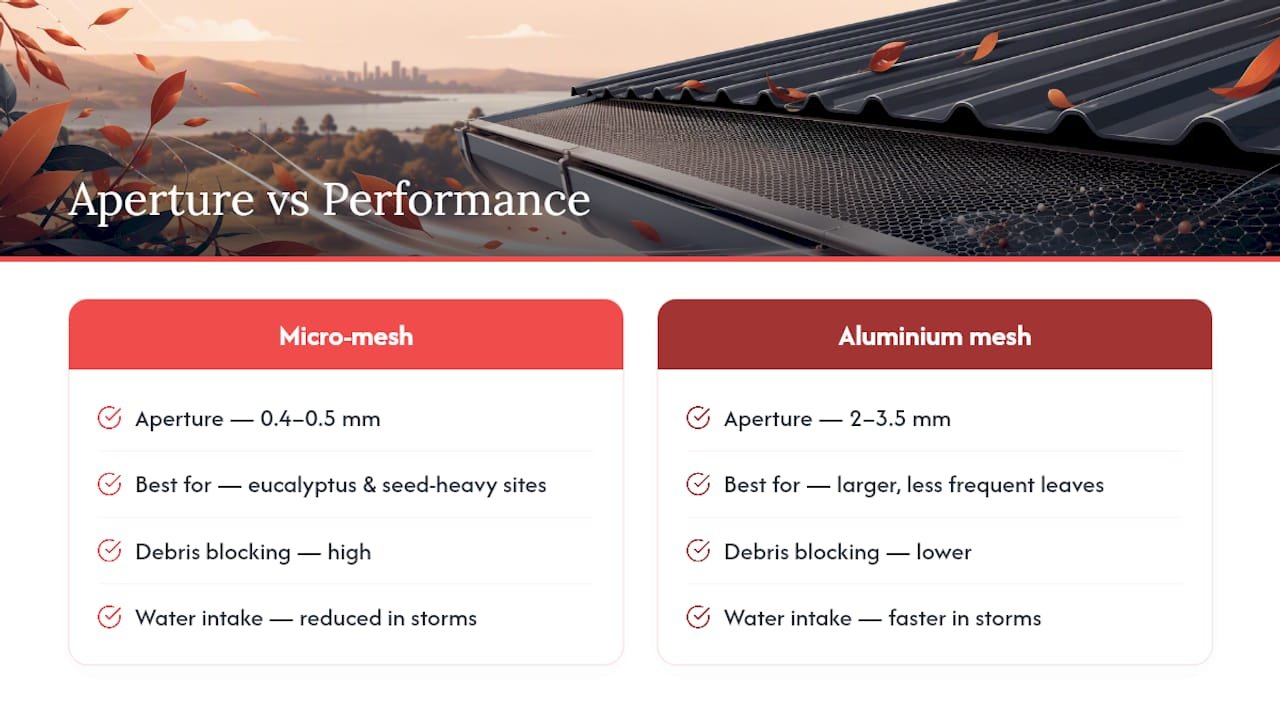
A guard’s effectiveness comes down to one number: the aperture, the gap size debris has to pass through. Smaller apertures block more, but they also slow water intake, which matters when a storm dumps heavy rain in a short window. Karben’s compliance guidance recommends matching aperture to environment: 0.4 to 0.5mm micro-mesh for eucalyptus and seed-heavy sites, 2 to 3.5mm aluminium mesh where leaves are larger and less frequent.
Surface-tension and slot systems work differently. Water clings to the guard’s curved surface and follows it down into the gutter channel while leaves shoot past on momentum. It’s a clever mechanism, but it depends on consistent water volume and a precise curve. In light drizzle or very heavy downpour, that tension breaks and water sheets over the guard entirely instead of channeling in.
Installation changes the math further. A guard mounted at the wrong pitch, on an undersized gutter, or without a sealed fit can cause water to overshoot the system rather than enter it, which raises overflow risk rather than reducing it. The guard itself might be excellent and still fail because of how it went on the roof.
The Real Benefits: Fewer Clogs, Less Ladder Time, Lower Ember Risk
The core benefit is straightforward: fewer major blockages and less water pooling against the fascia, which is what actually causes rot and roof damage over time.
- Cuts down the frequency of full gutter clogs that lead to overflow and water intrusion.
- Reduces how often you need to climb a ladder to check or clear gutters, which matters more than it sounds.
- Seals off nesting spots for birds, possums, and insects when the guard fits tightly against the gutter edge.
- Metal, non-combustible guards reduce the chance of embers lodging in dry leaf litter during bushfire conditions.
Ladder falls are a well-documented home-maintenance hazard, and safety reports on ladder injuries in New South Wales consistently flag gutter and roof work as a recurring cause of serious falls. Anything that cuts the number of times you’re on a ladder checking gutters has a real safety payoff, not just a convenience one.
Why Some Homeowners Say Gutter Guards Don’t Work
Most complaints trace back to a mismatch between the guard and the environment it’s protecting, not a failure of the concept itself.
- Fine grit, pollen, and small seeds still settle on top of mesh guards and eventually wash or blow into the channel below.
- Brush and foam guards trap organic debris inside the material itself, creating compost pockets that are harder to remove than an open gutter would have been.
- Reverse-curve and slot systems can overshoot in heavy downpours, sending water past the gutter instead of into it.
- Poor sealing at joints and end caps leaves gaps large enough for insects and small birds to get underneath.
- Cheap plastic and PVC guards degrade under UV exposure within a few years and are a genuine hazard in bushfire-prone zones rather than protection.
Pro Tip: If an installer quotes one guard type for your entire roofline regardless of tree species or roof section, get a second opinion. Different sides of the same house often need different apertures.
How to Choose the Right Gutter Guard for Your Home
Picking the right system is less about brand and more about matching the guard to your trees, your roof, and your risk profile.
- Identify your dominant debris type. Eucalyptus, pine, and other fine-seed trees call for micro-mesh around 0.4 to 0.5mm; broadleaf trees with fewer, larger leaves do fine with wider aluminium mesh.
- Assess roof access and complexity. Steep pitches, two-storey homes, and valley-heavy rooflines are not DIY installation jobs. A licensed installer avoids the sealing mistakes that cause overshoot.
- Check your bushfire attack level (BAL) rating. Anywhere with a meaningful ember risk should default to non-combustible metal guards, never plastic or foam, regardless of upfront cost.
- Run the numbers on cost versus cleaning. A typical home with heavy leaf load needs gutter cleaning three to four times a year at roughly $200 to $350 per clean. For homes with steep roofs or multiple storeys, quality metal mesh can pay for itself in three to six years against that ongoing cleaning bill.
- Ask installers pointed questions. What aperture size, what material, what warranty, and how they seal the leading edge against the roofline. Vague answers are a red flag.
Our guide on gutter guard types for different tree environments breaks this down further if your property has a mix of debris sources.
What Maintenance Still Looks Like After Installation
Guards change the maintenance schedule, they don’t erase it. Plan on an annual inspection at minimum, plus a check after any major storm, and expect the specific task to depend on the guard type installed.
- Micro-mesh: hose down or lightly brush the surface once or twice a year to clear pollen film and grit.
- Brush guards: pull the bristle insert out periodically and clean or replace it, since debris packs into the fibers over time.
- Solid hoods: sweep loose debris off the top surface, since nothing enters the channel to build up underneath.
- Foam inserts: expect to replace the foam every few years as it compacts and loses its filtering gaps.
Guarded gutters can actually cost more per service call than open gutters, because a technician has to remove or lift the guard system before clearing anything underneath. That’s worth budgeting for, and it’s another reason ladder work on a two-storey home is better left to a licensed professional rather than attempted solo.
What Installers See on the Ground
Most installation failures Bugspatrol Pest Management encounters trace back to two things: wrong aperture for the tree canopy, and gutters that were never properly sealed at the joints before the guard went on. Both are invisible until the next big storm.
- Two-storey homes, tile roofs, and complex valley sections should always go to a licensed installer. The fall risk and sealing precision required aren’t DIY territory.
- A guard installed over an already-damaged or poorly pitched gutter locks in that problem, since you can’t see or fix it without removing the guard again.
- Some technicians are licensed, have extensive experience, and have serviced many homes, using detection methods including thermal imaging where relevant to roof and pest inspections.
- Gutter guard installation is one of our standard property protection services, assessed alongside pest and bird activity already present in the roofline.
The Bottom Line on Gutter Guards
Metal micro-mesh or solid hood guards, professionally installed, are worth it for homes with heavy leaf load, difficult roof access, or ember risk. Start by assessing your debris type and roof complexity, then match the material, then book an inspection before committing. Skip guards entirely if your roof is simple, low-debris, and easy to clean without a ladder.
Why the “Set and Forget” Promise Is the Real Problem
The gutter guard industry has an honesty problem, and it’s not about whether the products work. It’s about how they’re sold. Too many homeowners are told guards mean never touching a ladder again, and that promise sets up disappointment the moment fine grit builds up in a micro-mesh channel after two dry seasons.
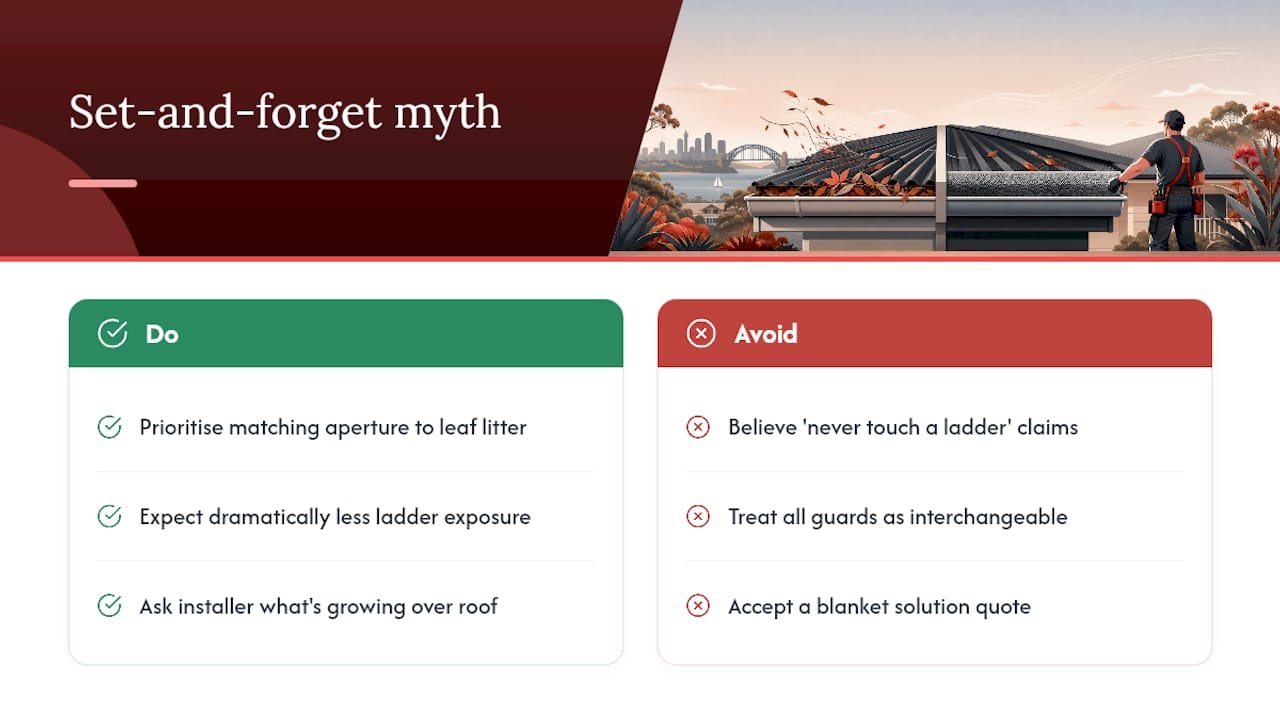
What the evidence actually supports is narrower and more useful: guards prevent the catastrophic failures, the total blockages that back water up under roof tiles or rot out fascia boards, and they cut ladder exposure dramatically. That’s a real win. It’s just not the same as zero maintenance.
Where conventional advice falls short is treating all guards as interchangeable. A $12-a-meter brush guard and a $45-a-meter stainless micro-mesh system solve different problems for different trees, and no installer should be quoting one blanket solution without asking what’s growing over your roof. If you take one thing from this guide, prioritize matching aperture to your actual leaf litter before you even compare brands. Get that wrong, and the best guard on the market will still disappoint you.
— navin
Get Your Gutters Assessed Before the Next Storm Season
Gutter guard systems can be installed as part of a broader property protection approach, which may include assessing gutter condition and observing pest and bird activity in clogged rooflines before installation. That’s the practical advantage over hiring a standalone gutter installer who won’t flag a wasp nest under the eaves or bird access points feeding debris into your gutters in the first place.

A professional inspection checks your existing gutter condition, roof pitch, tree canopy, and any bushfire attack level considerations before recommending a guard type. If you’re already covered under a maintenance plan like Gold Complete or Silver Combined, gutter checks can fold into your existing service schedule. Ready to find out which guard actually suits your roofline? Book a gutter guard installation assessment with Bugspatrol Pest Management and get a straight answer before you spend a dollar on the wrong system.
Sources
- Gutter Guards: Are They Beneficial? | AWS Roofing
- Are Leaf Guards Worth It Sydney? | Crown Roofers
- Gutter Guard vs No Gutter Guard: What the Numbers Show
FAQ
What Are the Downsides of Gutter Guards?
Fine grit, pollen, and small seeds still settle on top of most guards over time, and brush or foam inserts can trap organic matter that’s harder to clean than an open gutter. Poorly sealed installations also raise overflow risk during heavy rain, and cheap plastic guards degrade in sunlight and pose a fire hazard in bushfire-prone areas.
Are Gutter Guards Worth It?
For homes with heavy leaf load, difficult roof access, or ember exposure, quality metal mesh guards often pay for themselves within three to six years compared to repeated professional cleaning. For simple, low-debris, single-storey roofs, the payback is much less clear and regular cleaning may be more cost-effective.
Do You Still Have to Clean Gutters With Guards Installed?
Yes. No guard makes gutters fully maintenance-free, and fine debris still accumulates even with a well-fitted system in place. Plan on an annual inspection plus a check after major storms, with the exact task depending on the guard type.
Is There a Gutter Guard That Actually Works Well?
Stainless steel micro-mesh with roughly 0.4mm apertures is widely considered the most effective option for heavy-leaf and bushfire zones, since it blocks fine debris and is non-combustible. Performance still depends heavily on correct aperture selection and a properly sealed installation, which is why Bugspatrol Pest Management assesses your roof and tree canopy before recommending a specific system.

[…] Do Gutter Guards Work in Australia? Installers’ Pick: Metal Micro Mesh […]