
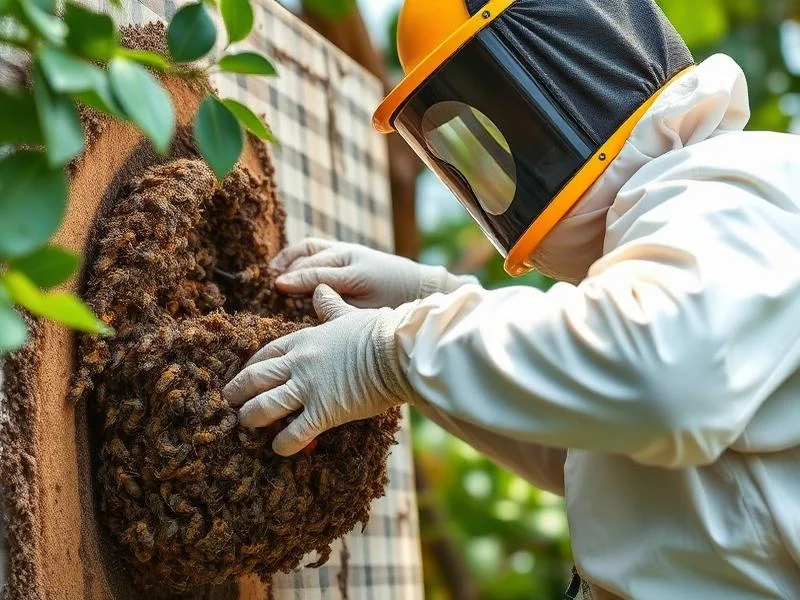
Important Safety Warning
Never attempt to remove a wasp nest if you or anyone in your household has a wasp sting allergy. Never use fire, boiling water, or petrol to destroy a nest. These methods are extremely dangerous and can cause property damage, burns, and provoke a mass attack.
Discovering a wasp nest on your property can be alarming, especially if it’s near a doorway, play area, or outdoor entertaining space. Your immediate reaction matters — the wrong move can turn a manageable situation into a dangerous one. This guide walks you through exactly what to do, step by step, when you find a wasp nest at your Canberra home.
Step 1: Don’t Panic — Assess from a Distance
The most important thing is to stay calm. Wasps are unlikely to sting unless they feel their nest is threatened. Step back to at least 3-5 metres from the nest and observe from a safe distance. Note the following: the nest’s size, location and height from the ground, how many wasps are entering and leaving, and the nest’s proximity to high-traffic areas.
If the nest is in a low-traffic area like a far corner of your garden and it’s small (under 10cm), it may not require immediate action. However, nests near doorways, children’s play areas, outdoor eating spaces, or in wall cavities need prompt attention.
Step 2: Identify the Species
The type of wasp determines the level of risk and the appropriate response:
Paper Wasps
- Open, umbrella-shaped nest with visible cells
- Usually under eaves, pergolas, fences
- Colonies of 20-200 wasps
- Defensive but usually only sting when nest is directly disturbed
- Native species play a role in pest control
European Wasps
- Enclosed, papery nest — often underground or in wall cavities
- Colonies of 1,000-10,000+ wasps
- Highly aggressive, especially in late summer
- Can sting multiple times
- Invasive species — ALWAYS requires professional removal
Step 3: Secure the Area
While you decide on a course of action, take these immediate precautions:
- Keep children and pets away from the nest area
- Warn family members and visitors about the nest location
- Avoid mowing, trimming, or using power tools near the nest
- Don’t leave sweet food or drinks uncovered outdoors
- Avoid wearing strong perfumes or bright colours near the nest
What NOT to Do
Every year, people are seriously injured attempting unsafe nest removal methods. The following should never be attempted:
Hit the nest with a stick or broom
Provokes mass attack. Hundreds of wasps can emerge in seconds.
Use fire or burning materials
Risk of property fire, burns, and enraged wasps. Many homes have been damaged.
Pour boiling water on the nest
Scald risk, incomplete kill, and provokes surviving wasps.
Seal the nest entrance
Trapped wasps find alternative exits — often inside your house.
Step 4: Call a Professional
For any European wasp nest, any nest larger than a golf ball, any nest in a wall cavity or roof space, any situation involving allergic individuals, or any nest you’re uncomfortable dealing with — professional removal is the safest option.
Professional wasp removal involves applying insecticidal dust or liquid directly into the nest during low-activity periods (usually early morning or dusk). The treatment kills wasps on contact and continues working as returning wasps enter the nest. Most nests are completely eliminated within 24-48 hours.
At Bugs Patrol, we carry full personal protective equipment, commercial-grade products, and the experience to handle nests in even the most difficult locations. We also check for secondary nests on the property — it’s common to find more than one, particularly with European wasps.
After the Nest is Removed
Once the nest is treated and wasps have ceased activity (usually 24-48 hours), the nest structure can be removed. Returning wasps that were away from the nest during treatment will attempt to find the nest, but without a colony to sustain them, they’ll disperse within a few days. Avoid disturbing the area for at least 48 hours after treatment.
Found a Wasp Nest? We Can Help Today
Bugs Patrol provides same-day wasp nest removal across Canberra. Licensed, insured, and equipped for nests in any location — including walls, roofs, and underground.
Still have questions?
The best pest control company will solve your issue for a long time. Bugs Patrol is Canberra’s trusted choice for professional wasp control with lasting results.
Frequently Asked Questions
Small paper wasp nests (under 10cm) in accessible locations can sometimes be removed by confident homeowners using commercial wasp spray at dusk. However, European wasp nests, large paper wasp nests, nests in wall cavities or roof spaces, and any nest near allergic individuals should always be handled by a licensed professional. Disturbing a wasp nest incorrectly can trigger a mass attack.
Professional wasp nest removal in Canberra typically costs $150-$350 depending on nest location and accessibility. Nests in difficult locations (wall cavities, high rooflines, underground) may cost more. This includes treatment, nest removal where accessible, and a follow-up check. The cost is minor compared to potential hospital bills from multiple stings.
For normal reactions: remove the stinger if visible, apply ice, take antihistamines for swelling, and monitor for worsening symptoms. For allergic reactions (difficulty breathing, swelling of face/throat, dizziness, rapid heartbeat): use an EpiPen if available and call 000 immediately. Multiple stings can cause serious reactions even in non-allergic people.
Wasps are most aggressive in late summer and autumn (February-April) when colony sizes peak and food sources diminish. They become more defensive of their nest and more likely to sting when disturbed. This is also when they’re most attracted to sweet foods and drinks at outdoor gatherings.

[…] Pest Management’s own wasp nest removal and wasp nest safety guides for procedural detail specific to Canberra […]
[…] guide to wasp nest safety covers this in more depth if you want the full reasoning before deciding what to do next. While you […]