If a nest sits near a doorway, play area, or indoor cavity, or if anyone in the home has a sting allergy, it needs removal now rather than later. The safest window for treatment is dusk or early night when wasps are least active. When a nest is large, hard to reach, or shows heavy traffic, call a licensed pest controller instead of handling it yourself.
TL;DR:
- An isolated, small nest can be monitored for a week, but rising entrance traffic, closer foraging, or visible weekly growth signals expansion.
- In mild winter regions, European wasp colonies can persist across seasons, so a nest spotted late in the year may still be growing.
- While awaiting treatment, keep children and pets away, remove exposed food and drink, and photograph the nest without approaching it for the technician.
- After treatment, leave the nest undisturbed for several days, confirm there is no activity, then seal entry gaps to deter reoccupation.
- If a sting causes breathing difficulty, facial or throat swelling, dizziness, or a spreading rash, use an available adrenaline autoinjector and call emergency services immediately.
Table of Contents
- When to remove a wasp nest: timing, seasonal risks, and risk factors
- How to identify a wasp nest and where to look
- Safe removal options and limits of DIY
- What happens during professional treatment and aftercare
- Why choose a licensed pest controller for wasp removal
- What to do if someone is stung (including anaphylaxis guidance)
- A 30-second checklist for deciding what to do next
- Licensed wasp nest removal services
- FAQ
- Sources
When to remove a wasp nest: timing, seasonal risks, and risk factors
Wasps are far less active after dark, which is why treating a nest at dusk or night works better and more safely than a daytime attempt. Most of the colony is inside the nest at that hour, so a treatment reaches more wasps at once and provokes less defensive flying. In regions with mild winters, European wasp colonies can persist across seasons instead of dying off, which means a nest spotted late in the year can still be growing rather than winding down.
Some nests call for action immediately, not monitoring. Watch for these signals:
- The nest sits near a door, window, path, or outdoor seating area people use daily.
- It is within reach of children’s play equipment, a sandpit, or a pool deck.
- It is inside a wall cavity, roof void, or other enclosed space in the house.
- It has grown large or shows multiple entrance and exit holes.
- Someone in the household has a known wasp sting allergy.
Short of those triggers, a nest in a rarely used corner of the yard can sometimes be watched rather than treated right away. The things to track are rising traffic in and out of the entrance, wasps foraging closer to the house over time, and visible growth in the nest’s size from one week to the next. Any of those trends is a sign the colony is expanding and that the window for easy, low-risk removal is closing.
How to identify a wasp nest and where to look
Not every nest behaves the same way, and knowing the type helps judge how urgent removal is.
- Paper (umbrella) nests hang from a single stalk, look like an open umbrella of hexagonal cells, and are usually built by paper wasps in sheltered, exposed spots.
- Enclosed paper nests, built by species like European wasps, look like a grey papery ball or mass and are often tucked into cavities rather than hanging in the open.
- Ground or underground nests are hidden in holes, under paving, or in old rodent burrows, with wasps flying in and out of what looks like a small gap in the soil.
- Solitary wasp nests, built by species that do not live in colonies, are small, scattered, and rarely pose the same risk as a social nest.
Common sites include eaves, roof voids, wall cavities, fence posts, hollow garden features, holes in the ground, and tree hollows or branches. A nest in a roof void or wall cavity is often the hardest to judge from the outside, since the only visible clue is wasps disappearing into a small gap.
When a nest is not visible but wasp activity is obvious, a simple non-invasive tracking method helps locate it. Placing a small food source outside and watching the direction wasps fly off in a straight line can reveal roughly where the nest sits, since foraging wasps tend to return to the nest on a direct path. This should be done from a distance, without disturbing the insects, and is best treated as a clue for a professional rather than an invitation to approach the nest itself.
Safe removal options and limits of DIY
There is a useful line between what a homeowner can reasonably do and what should be left to a licensed technician. On the safe side of that line: restrict access to the area, remove uncovered food and drink that might attract foraging wasps, keep children and pets well away from the nest, and take photos of its location and size to show a pest controller.
On the other side of the line, some actions carry real risk and should be avoided:
- Never poke, probe, or spray into a nest entrance without registered insecticide and protective clothing.
- Never attempt to dig out or flood a ground nest, since disturbing it often triggers a mass defensive response.
- Avoid using unregistered sprays or home remedies, which can provoke wasps without reliably killing the colony.
- Do not attempt removal of any kind if someone in the household has a known allergy to wasp stings.
Pro Tip: Keep a photo of the nest’s size and entrance count on your phone. It gives a pest controller everything needed to plan treatment before they even arrive.
Certain signs point straight to calling a professional rather than weighing a DIY attempt. Public health guidance recommends professional treatment whenever a nest location is unclear, hard to reach, large, or near people who could be stung during an amateur attempt. A nest in a wall or roof void, one with several visible exits, or one generating repeated wasp traffic near a back door or patio all fall into that category. Councils generally recommend a licensed pest controller for nest removal on private property rather than handling it without the right equipment. For a closer look at telling a wasp nest apart from a bee hive before deciding how to respond, see our guide to identifying wasp nests.
What happens during professional treatment and aftercare
Licensed technicians treat active nests at night for the same reason a cautious homeowner should wait until dusk: wasps are far less active after dark, which lowers the chance of a defensive swarm during treatment. Before any physical removal, a technician typically confirms the nest is inactive rather than assuming treatment worked on the first pass.
A typical professional treatment follows a few steps:
- Apply a registered insecticide dust at the nest entrance, timed for dusk or night when most wasps are inside.
- Follow up with a residual spray around the nest area to catch wasps returning over the following days.
- Leave the nest undisturbed for a short period, then re-check for activity before removing or sealing it.
- Seal entry points once the nest is confirmed inactive, to stop another colony from reoccupying the same spot.
Local council guidance describes this same sequence for anyone treating a nest themselves: dust at the entrance, protective clothing, a red-filtered light if working at night, and leaving the dust undisturbed for several days before checking again. After treatment, a homeowner’s role is mostly about prevention: re-checking the area after a few days, sealing gaps in eaves, vents, or foundations that could invite a new nest, and keeping food and rubbish bins covered outdoors. For more detail on how night treatment works in practice, see our overview of wasp nest removal.
Why choose a licensed pest controller for wasp removal
We bring extensive pest control experience and have serviced many homes, which means our technicians have handled nests in a wide variety of locations properties can present, from roof voids to underground burrows. Our technicians are trained and treatments are chosen with families and pets in mind.
A typical engagement starts with an inspection to confirm the nest type and location, followed by a treatment recommendation suited to where it sits. Active nests are scheduled for night treatment, when wasps are less active and the job is safer for everyone nearby. After treatment, we return to confirm the nest is inactive and offer prevention advice to reduce the chance of a repeat nest in the same spot. Treatments are performed with care to provide effective control, and follow-up visits may be part of the service if a nest proves more stubborn than expected.
What to do if someone is stung (including anaphylaxis guidance)
Most wasp stings cause pain, redness, and swelling that settles within a few hours and can be managed with a cold compress and standard pain relief. Healthdirect’s guidance on stings recommends washing the area, applying a cold pack, and watching for signs that a reaction is becoming more serious.
Anaphylaxis is a different situation and needs an immediate response. Signs include difficulty breathing, swelling of the face or throat, dizziness, or a rash spreading away from the sting site. If someone shows these signs, use an adrenaline autoinjector right away if one is available and call emergency services without delay. Anyone with a known wasp allergy should carry an autoinjector and follow an ASCIA action plan, since a second sting can trigger a faster, more severe reaction than the first. Because of this risk, no one with a known allergy should be anywhere near an active nest during treatment or removal.
A 30-second checklist for deciding what to do next
Here is the quickest way I’d judge a nest: if it’s near a doorway, play area, or indoor wall, or anyone nearby has an allergy, call a licensed controller today. If it’s small, out of the way, and showing no growth, keep an eye on it for a week before deciding anything.
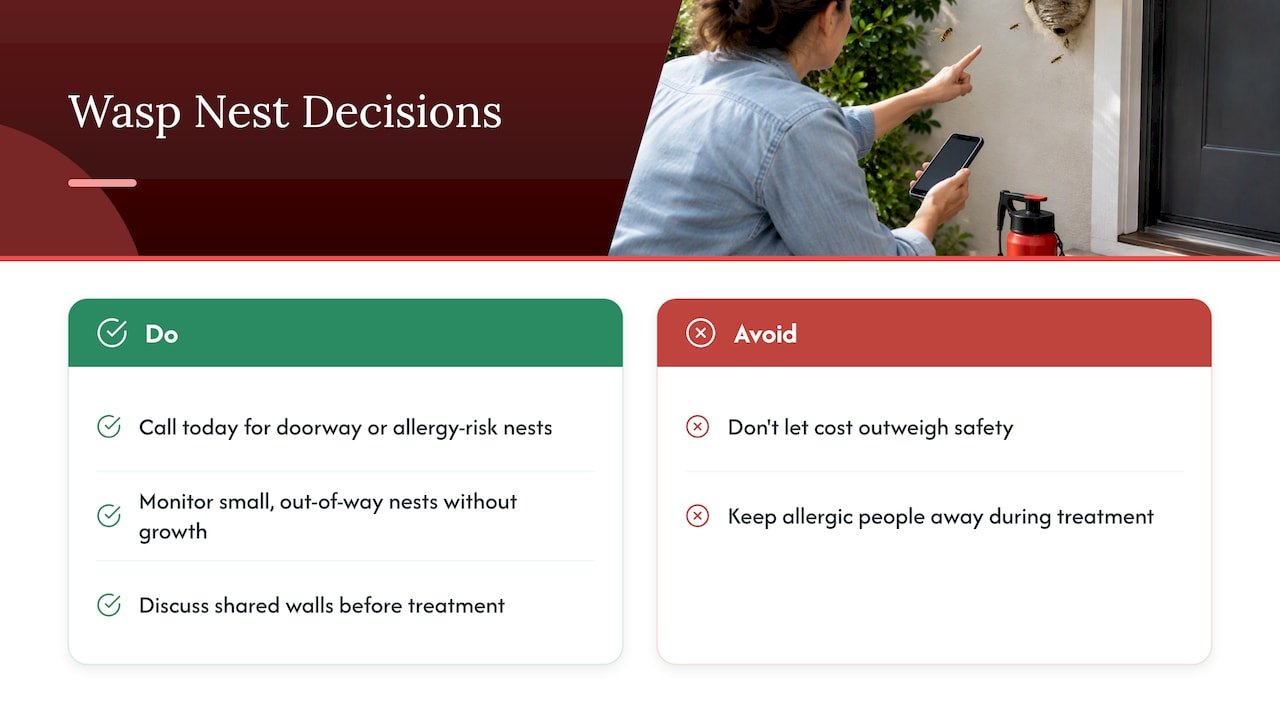
Shared fences and boundary lines complicate this. A nest sitting right on a shared wall or overhanging a neighbor’s yard is worth a quick conversation before treatment, since the flight path and risk extend past your own property line.
The one rule I’d never bend: never let cost decide this over safety. A nest near kids, pets, or an allergic household member is a job for a professional, full stop, regardless of how small it looks today.
— navin
Licensed wasp nest removal services
We offer wasp removal services that use night treatment, family- and pet-safe methods, and aim to respond promptly when a nest requires attention. Booking typically starts with an inspection to confirm the nest type and location and discuss treatment timing before any on-site work.

What to expect once you book:
- A straightforward inspection to confirm nest type, location, and urgency.
- A treatment plan scheduled for dusk or night when it’s safest to act.
- A follow-up check to confirm the nest is inactive and offer prevention tips.
If a nest near your home fits any of the high-risk signs above, book a wasp control inspection and we’ll take it from there.
This article is general information, not a substitute for advice from a qualified doctor. Consult a qualified healthcare professional about your own circumstances before acting on anything here.
FAQ
What is the best time to get rid of a wasp nest?
Dusk or night is the best time, since most wasps are inside the nest and far less active then. Treating during the day risks provoking foraging wasps that are out and about, which increases the chance of stings.
What does a wasp nest look like?
A paper wasp nest looks like an open umbrella of hexagonal cells hanging from a single stalk, while nests built by species like European wasps often look like a grey papery ball tucked into a cavity. Ground nests show up only as wasps flying in and out of a small hole in the soil or under paving.
What do wasps absolutely hate?
Wasps respond defensively to vibration, sudden movement, and disturbance near the nest entrance, which is why guidance consistently warns against poking or probing a nest. Red-filtered light is used by professionals at night because wasps are less sensitive to it, allowing inspection with less risk of triggering a swarm.
Should I kill a queen wasp?
A single queen found in early spring, before she has founded a colony, generally poses little risk and is best left alone unless she is inside a living space. Once a nest with workers is established, the decision is about the nest as a whole rather than the queen individually, and professional treatment is the safer route for any established colony.
Sources
These are the official health, agriculture, and council pages that inform the guidance in this article, useful for anyone who wants the primary source behind a specific recommendation.
- Health
- European wasp | Priority pest insects and mites | Agriculture Victoria
- European wasps | City of Monash
- Bee and wasp stings (Healthdirect)
Recommended
- 24–48 Hours to Stop a Wasp Nest in Your Wall, Australian Homeowners
- Identify and Report Wasp Nests Safely in Australian Yards
- Polistes & Ropalidia: Night Treatment for Paper Wasp Nests in Australia
- Homeowners: Tell a Wasp Nest From a Bee Hive Without Getting Close