Condensation is the usual cause of window mold, so wipe away visible moisture and clean any growth now, then stop the moisture source at its root. Government health guidance calls for physical cleaning with detergent and warm water, and pest professionals treat and prevent this kind of mold in homes regularly. Improve ventilation, run a fan or dehumidifier, and dry laundry outside. If mold keeps returning after that, book a professional inspection.
TL;DR:
- Keep relative humidity below about 65% for extended periods, and run exhaust fans during cooking or showering and for 15 to 20 minutes afterward.
- Use detergent and warm water before considering disinfectant, and reserve diluted bleach for ventilated rooms and hard, nonporous surfaces such as glass or sealed frames.
- Arrange professional assessment for mold covering more than about one square meter, recurring growth, suspected leaks, or persistent musty odors without visible mold.
- If several windows stay wet despite better ventilation, ask a glazier to assess glazing and frames; failed seals may need replacement, not resealing.
Table of Contents
- Why Condensation Forms on Windows and What Triggers It
- Health and Property Risks of Window Mold
- How to Remove Mold From Window Glass, Frames and Sills Safely
- Preventing Mold From Coming Back
- When Glazing, Frames or Seals Are the Permanent Fix
- When to Book a Professional Inspection or Mold Treatment
- Identifying the Types of Mold Found on Windows
- What Happens When Window Mold and Condensation Go Untreated
- Professional Mold Treatment Options and When to Seek Expert Help
- A Local, Practical Perspective on Window Mold
- Get a Professional Mold Inspection and Treatment
- FAQ
- Sources
Why Condensation Forms on Windows and What Triggers It
Condensation happens when warm, moist indoor air touches a cold surface and cools below its dew point, the temperature at which air can no longer hold its water vapor and releases it as liquid. Windows are usually the coldest surfaces in a room, so they are where this shows up first, long before walls or ceilings display the same moisture.
Everyday household activities generate far more water vapor than most people realize. According to the Victorian Building Authority, an adult breathing produces roughly 0.1 liters of water vapor per hour, while showering, cooking and drying laundry indoors can add somewhere between 1.5 and 10 liters per hour.
Drying laundry indoors can release a substantial amount of water vapor into the air, enough moisture to fog every cold window in a small home overnight, according to the Victorian Building Authority.
Several building factors make this worse:
- Thermal bridging, where metal frames or uninsulated sections conduct cold straight through to the interior surface
- Single glazing, which offers little resistance to heat loss and stays close to outdoor temperature
- Failed or perished seals around sashes and frames, letting cold air sit against the glass
- Poor airflow behind curtains or blinds, trapping humid air against the cold pane
Not all moisture at a window is condensation. If staining appears at the base of a frame after rain, if a musty smell persists even in dry weather, or if the sill feels wet when no cooking or showering has occurred nearby, water ingress from a leaking seal, roof, or cracked render is a more likely cause. The YourHome condensation guidance notes that windows are typically the coldest internal surface in a house, which is exactly why they are the first place condensation becomes visible even when the rest of the room seems fine.
Health and Property Risks of Window Mold
Mold around windows is not just cosmetic. The WA Government’s indoor mould guidance recommends removing visible mold promptly and notes there is no agreed numeric “safe” level of indoor mold exposure, so the practical approach is to clean it up and stop the moisture feeding it rather than wait to see how much is too much.
Some people are more sensitive to mold exposure than others:
- People with asthma or existing respiratory conditions often notice worsened symptoms near moldy windows
- Those with allergies may experience sneezing, itchy eyes or skin irritation
- Immunocompromised individuals and young children are generally considered more vulnerable to indoor mold exposure
- Common symptoms to watch for include a persistent cough, nasal congestion and headaches that ease when away from the home
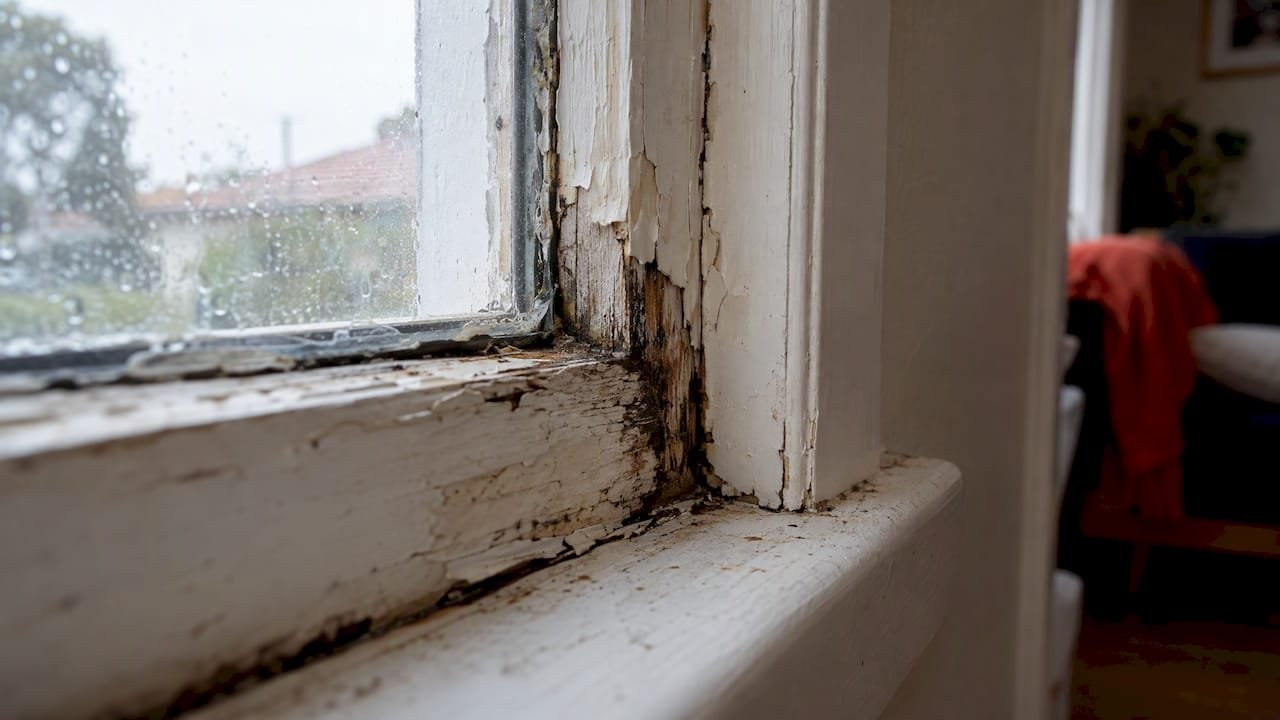
Left untreated, moisture at windows also damages the building itself. Paint and plaster near frames begin to bubble and peel, timber sashes and sills can soften and rot, and insulation touching a damp wall loses much of its effectiveness, which in turn makes the cold spot worse and feeds the cycle.
How to Remove Mold From Window Glass, Frames and Sills Safely
Before touching anything, gather a few basic supplies: a damp microfiber cloth, a soft non-abrasive brush, rubber gloves, eye protection and, for larger patches, a P2 mask. Government cleaning and disinfection guidance is consistent on one point: physically clean with detergent and warm water before any disinfection step, since dirt and grime left behind can reduce how well a disinfectant works and damp cleaning limits spores becoming airborne.
- Open a window or door nearby for airflow and lay down an old towel to catch drips.
- Wipe down visible mold and condensation with a cloth dampened in warm water and a few drops of dish detergent, working from the top of the frame downward.
- Use the soft brush on grooves, corners and rubber seals where mold tends to collect.
- Rinse the cloth frequently and dry the entire area thoroughly with a clean towel, since leftover moisture invites regrowth within days.
- If a musty smell lingers or staining returns within a week, consider a diluted household bleach solution on non-porous surfaces only, always with the room ventilated and the label’s dilution followed exactly.
- Check the same spot again after a few days to confirm the mold has not returned.
Different window materials need slightly different handling. Glass and most uPVC or plastic frames tolerate a damp detergent clean and light disinfection without issue. Timber frames are more delicate: avoid soaking them, since excess water can swell or warp the wood, and dry them promptly after cleaning. Porous trim and unpainted timber sills absorb moisture and mold spores more deeply, so a light, repeated cleaning routine works better than one aggressive scrub.
Bleach and other biocides are appropriate for hard, non-porous surfaces like glass and sealed frames, but they are not a substitute for removing the moisture source, and they are generally unsuitable for timber or painted plaster where they can bleach or damage the finish without reaching mold growing beneath the surface.
Pro Tip: Clean windows on a dry, mild morning with the window open. Fresh air speeds drying and stops condensation from reforming while you work.
If mold keeps coming back in the same spot within a few weeks despite cleaning and improved ventilation, or if you notice a musty odor without visible growth, that often points to hidden moisture inside the wall cavity or frame, and it is a reasonable point to stop DIY efforts and get a professional opinion.
Preventing Mold From Coming Back
Stopping recurrence matters more than any single clean, since mold regrows quickly whenever humidity and a cold surface meet again. Guidance from WA Health recommends keeping indoor relative humidity generally below about 65% for extended periods, and aiming lower where practical gives an extra buffer on cold nights when window surfaces drop closest to dew point.
A few daily habits make a real difference:
- Run bathroom and kitchen exhaust fans during and for 15 to 20 minutes after showering or cooking
- Open windows for cross-ventilation on dry days, even briefly, to flush out humid indoor air
- Keep lids on pots while cooking and close the bathroom door while showering to contain steam
- Dry laundry outside or in a vented space rather than on indoor racks
Everyday behavior changes such as using exhaust fans and adjusting drying habits are frequently enough to prevent mold recurrence, according to WA Health guidelines, and they cost nothing beyond a slightly higher power bill from running a fan longer.
Other adjustments help too: pulling furniture a few inches away from cold exterior walls lets air circulate and prevents damp patches forming behind sofas and wardrobes, and keeping houseplants to modest numbers in small, poorly ventilated rooms avoids adding unnecessary moisture to the air.
When these steps are not enough, mechanical solutions are worth considering. A dehumidifier sized to the room, roughly matched to square footage and typical humidity readings, can pull several liters of water from the air daily in a damp bedroom or living room. Running reverse-cycle air conditioning on a mild heat setting also reduces relative humidity as a side effect of warming the air, which can be useful in rooms already fitted with a unit. In newer, well-sealed homes, the YourHome ventilation guidance points out that improving airtightness without adding controlled ventilation can actually raise mold risk, and mechanical ventilation with heat recovery (MVHR) is a more durable fix in that situation since it exchanges stale humid air for fresh air without losing heat.
For short-term relief while working on bigger fixes, disposable moisture absorbers placed on windowsills, a daily wipe-down routine each morning, and draught-proofing strips around loose-fitting sashes all help reduce the cold spots and standing moisture that let mold take hold. For readers who want a deeper look at humidity targets and whole-home dehumidification options, this guide to ideal indoor humidity covers the HVAC side in more detail.
When Glazing, Frames or Seals Are the Permanent Fix
Cleaning and ventilation manage condensation, but some homes need a structural fix because the window itself is too cold relative to the room. Insulated glazing units, meaning double or triple glazing with a sealed air or gas gap between panes, raise the interior glass surface temperature significantly compared to a single pane, which keeps it further from the dew point on cold nights. NCC condensation guidance identifies low-U-value glazing and thermally broken frames as effective design measures for reducing condensation risk in the building fabric.
Frame material matters as much as the glass:
- Standard aluminium conducts heat and cold efficiently, making it one of the coldest frame options and a common site for condensation
- Thermally broken aluminium includes an insulating barrier within the frame, cutting that heat transfer substantially
- uPVC frames are naturally poor conductors and tend to stay warmer to the touch
- Timber frames also insulate well but need regular maintenance to prevent swelling or rot from moisture exposure
Sealed glazing units can fail over time: a cloudy or foggy appearance between panes, visible moisture trapped inside the unit, or a cracked spacer bar all signal that the seal or internal desiccant has given out, and in that case, the whole glazing unit typically needs replacing rather than resealing. According to YourHome’s condensation guidance, many persistent condensation problems trace back to thermal bridging at the frame, and upgrading to a thermally broken frame often resolves issues that cleaning and ventilation alone cannot touch.
Simple repairs, such as replacing a perished rubber seal or adding draught-proofing strips, are often enough for a single drafty window. Full glazing replacement makes more sense when multiple windows in a home show condensation despite good ventilation habits, in which case a glazier or building consultant can assess the frames and recommend the right upgrade.
When to Book a Professional Inspection or Mold Treatment
A few situations call for professional help rather than continued DIY effort:
- Mold growth larger than about one square meter on any single surface
- Mold that returns within weeks despite cleaning and improved ventilation
- Signs of a leak or structural moisture source, such as staining, swelling or a persistent musty smell
- A household member with asthma, allergies or a compromised immune system affected by ongoing exposure
A professional mold inspection typically includes a visual assessment of affected areas, humidity readings around the home, identification of the moisture source, and a tailored treatment plan rather than a generic spray-and-leave approach. Before the visit, it helps to take photos of the affected areas, note any recent leaks or water events, list which rooms are affected, and summarize what cleaning or ventilation changes have already been tried.
Identifying the Types of Mold Found on Windows
Window mold usually falls into a few visually distinct categories. Black mold, often Cladosporium or similar species, appears as dark speckled or sooty patches on sills, frame corners and rubber seals, and it is the most commonly reported type on condensation-affected windows. Pink or orange-tinted growth is frequently bacterial slime rather than true mold, though it still signals excess moisture and benefits from the same cleaning approach. Green or gray fuzzy patches, sometimes Aspergillus or Penicillium, tend to show up on painted wood or plaster trim where moisture has lingered longest. White, powdery mold is less common on glass itself but can appear on timber sills and is sometimes mistaken for efflorescence, a harmless mineral deposit from masonry. Regardless of color or species, the WA Health guidance treats all visible mold the same way: clean it promptly and address the underlying moisture, since home identification of species is rarely necessary or practical.
What Happens When Window Mold and Condensation Go Untreated
Left alone, condensation and mold do more than stain a windowsill. Paint and primer on frames begin to blister and flake within months of repeated wetting, exposing bare timber or metal underneath. Timber sashes and sills absorb moisture over successive seasons, softening and eventually rotting at joints, which can require full sash replacement rather than a simple repaint. Rubber and silicone seals harden, crack or lose their grip faster when constantly damp, which widens gaps and lets in more cold air, worsening the very condensation that damaged them. Metal fittings, hinges and locks corrode more quickly in a persistently humid micro-environment near the frame. Beyond the window itself, moisture migrating into adjacent wall cavities can degrade insulation and invite mold growth in spaces that are far harder and more costly to access and remediate than the glass and frame were in the first place.
Professional Mold Treatment Options and When to Seek Expert Help
Professional mold treatment typically starts with the same clean-before-disinfect sequence recommended for DIY work, scaled up with commercial-grade detergents and, where appropriate, antimicrobial treatments suited to the surface involved. For larger infestations, technicians may use HEPA-filtered extraction to contain spores during removal, followed by a moisture assessment to identify and address the source, whether that is a ventilation gap, a failed seal or a structural leak. Professional technicians combine this kind of assessment with practical treatment methods, aiming to resolve the mold and the moisture problem behind it in the same visit. Expert help is worth seeking once mold covers a significant area, returns repeatedly despite your own efforts, or coincides with a household member experiencing ongoing respiratory symptoms, since at that point identifying and fixing the root moisture source usually requires equipment and experience beyond a typical home toolkit.
A Local, Practical Perspective on Window Mold
Professionals have spent many years treating pest and moisture issues in thousands of homes, and window mold is a common issue encountered, often alongside the seasonal issues covered in our guide to pest-proofing a home for winter. Mold rarely stays confined to one spot: readers dealing with it on ceilings as well as windows may find our ceiling mold guide useful, and persistent humidity in enclosed spaces like wardrobes can also attract other issues, as we cover in our piece on silverfish in wardrobes. Every treatment we carry out follows safe practices, because a mold or moisture fix should never introduce a new hazard into the home.
— navin
Get a Professional Mold Inspection and Treatment
If window mold keeps returning despite cleaning and better ventilation, we offer professional inspection and treatment that gets to the moisture source rather than just the surface stain. Our licensed technicians use modern detection methods and family and pet-safe treatments, with every job backed by our guarantee of effectiveness.

Beyond mold, we also handle related property protection work, including gutter guard installation to reduce water ingress around rooflines and general pest control for the pest issues that often follow damp conditions. For ongoing protection, our subscription plans, including Gold Complete at $79.98 AUD per month, Silver Combined at $55.98 AUD per month, Bronze Termite at $29.98 AUD per month and Bronze General Pest at $29.98 AUD per month, cover regular inspections so moisture and pest problems get caught early. Visit our professional pest control services page to request a quote or book an inspection today.
FAQ
How do I stop condensation on windows from turning into mold?
Wipe condensation from glass and frames daily, especially after showering or cooking, and dry the area fully so spores have no moisture to grow on. Running an exhaust fan during and after these activities and keeping indoor humidity below about 65%, as recommended by WA Health guidance, prevents most window mold before it starts.
How can I remove mold from condensation on my windows?
Clean the affected area with detergent and warm water first, since government guidance advises physical cleaning before any disinfection step. Dry the surface thoroughly afterward, and for stubborn glass or frame staining, a diluted bleach solution can be used on non-porous surfaces in a ventilated room.
Is condensation mold harmful to health?
Mold exposure can worsen symptoms for people with asthma, allergies or weakened immune systems, and the WA Government’s mould guidance notes there is no agreed safe numeric exposure level. For most healthy adults, prompt cleaning and moisture control limit any meaningful health impact.
Does condensation on windows mean my house is too cold?
Not necessarily. Condensation forms when warm, moist indoor air meets a cold surface like window glass, which can happen even in an adequately heated home if ventilation is poor or the glazing and frames are highly conductive, according to passive design guidance. Improving ventilation and reducing moisture sources often resolves it without raising the thermostat.
Sources
- Victorian Building Authority — condensation and moisture guidance
- Australian Government Department of Health — cleaning and disinfection guidance
- YourHome — condensation and passive design guidance
- WA Government — Indoor mould: health risk assessment and management
- NCC 2025 condensation in building handbook (Australian Building Codes Board)
Recommended
- 1 Square Metre Rule for Ceiling Mould in Australian Homes
- Homeowners: Fix Wardrobe Humidity to Stop Silverfish, Quarantine 2–3 Weeks
- Homeowners: Stop Bathroom Drain Flies in a Week by Scrubbing Biofilm