The fastest way to stop pigeons on a roof is to combine physical exclusion, like spikes, netting, or bird wire, on their exact perching spots with removing whatever food or water is drawing them there in the first place. Exclusion works because it takes away the landing platform pigeons want. Cutting off food and water stops new birds from moving in once the first ones leave. Skip either half and the fix rarely lasts.
Here’s where to start this weekend:
- Watch your roof for a day or two and note the exact ledges, ridges, or eaves pigeons favor.
- Check those spots for nests, eggs, or chicks before touching anything.
- Walk your property for spilled birdseed, uncovered compost, or a leaky tap that gives birds a reason to stay.
Pro Tip: Pigeons return to the same ledge for years once they’ve nested there. If you can identify their favorite perch, you’ve already done half the work of solving the problem.
Key Takeaways
Physical exclusion targeted at the exact perch, paired with removing food and water sources, is what actually stops pigeons from returning to a roof.
| Point | Details |
|---|---|
| Target the exact perch | Install spikes, netting, or wire at the precise landing edge, not a few inches back. |
| Combine methods | Exclusion alone often just relocates birds; pair it with removing food and water sources. |
| Check before removing nests | Confirm no eggs or chicks are present, since active nests are protected in many areas. |
| Clean safely | Wet droppings before removing them and wear PPE to avoid inhaling dried spores. |
| Escalate when needed | Bugspatrol offers licensed proofing, solar-panel skirts, and guano cleanup for established problems. |
Table of Contents
- Quick DIY Deterrents to Try First
- Long-Term Proofing That Actually Stops Pigeons
- When Should You Call a Professional?
- Cleaning and Repairing Roof Damage Safely
- Stopping Pigeons From Coming Back
- Frequently Asked Questions
- Sources
Quick DIY Deterrents to Try First
Before you invest in permanent proofing, a few low-cost deterrents can buy you time. None of them solve the problem alone, but they slow things down while you plan something more durable.
- Reflective tape or old CDs hung near roosting spots can spook pigeons short term, though most birds get used to the movement within a couple of weeks.
- Scare devices like fake owls or hawks work briefly, but pigeons are smart enough to figure out a decoy that never moves.
- Sticky anti-roosting gels discourage landing on ledges, though they need reapplying after heavy rain or dust buildup.
- Copper or plastic spike strips sold at hardware stores can help, but only if set at the front edge where birds actually try to land.
The most common installation mistake, according to homeowner discussions on the Bunnings Workshop forum, is placing deterrents a few inches back from the true landing edge. Pigeons simply perch in front of the barrier, and the fix looks like it failed when it was just installed wrong.
If you find droppings while installing any of these, wear gloves and a mask before cleaning. Dried pigeon guano can carry pathogens and fungal spores that become airborne when disturbed. And if you spot eggs or chicks anywhere near your deterrents, stop and wait. More on the legal side of that shortly.
Pro Tip: Test a small section of sticky gel or tape before committing to a whole roofline. Some products discolor tile or metal roofing over time.
Long-Term Proofing That Actually Stops Pigeons
DIY tricks buy time. Physical exclusion is what actually ends the problem, and it’s the same principle wildlife management groups have pushed for years: change the surface so a pigeon can’t land or nest on it in the first place, according to the Internet Center for Wildlife Damage Management.
Four methods cover most residential roofs:
- Bird spikes along ledges, ridge caps, and gutter edges, placed at the exact leading edge pigeons use to land.
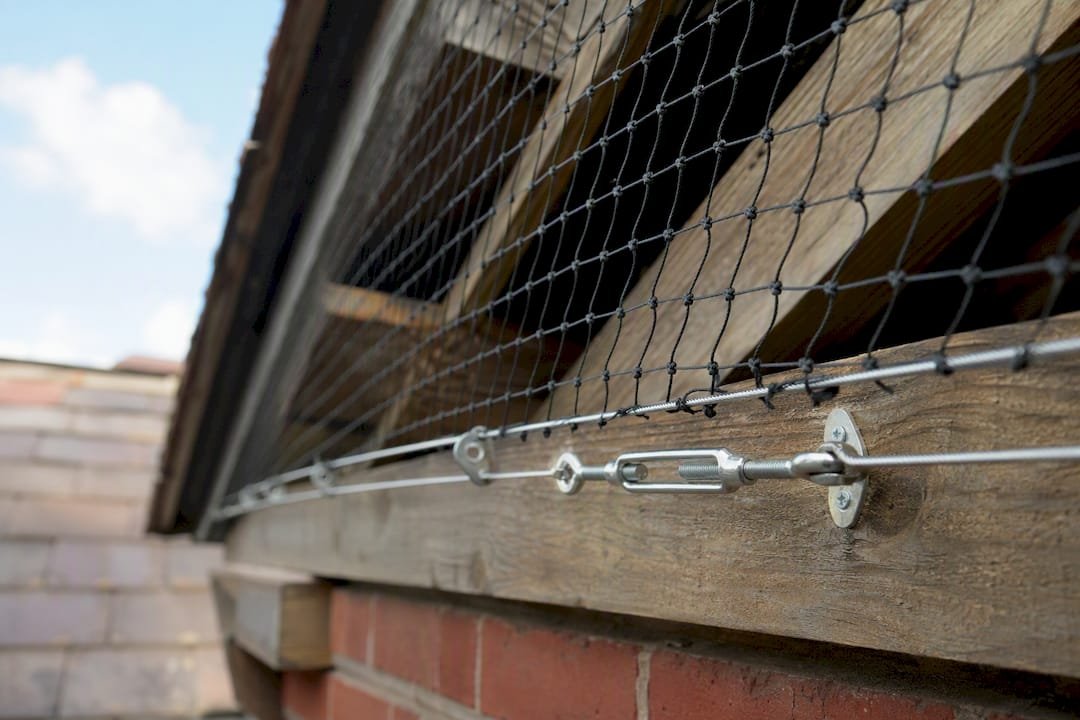
- Bird netting stretched across large open areas like eaves, patios, or gaps between roof sections.
- Bird wire (anti-roost coil) run along narrow ledges and parapets where spikes look too bulky.
- Mesh skirts under solar panels, since the gap beneath an array is one of the most common nesting spots on modern roofs, according to Pest Solutions.
Suitability depends heavily on your roof’s shape. Tiled roofs with exposed ridges do well with spikes. Flat eaves and open patios usually need netting. Solar arrays need a purpose-built mesh skirt, not a generic net, because standard netting sags and traps birds against the panel frame.
| Method | DIY cost | Professional cost | Maintenance | Best suited for |
|---|---|---|---|---|
| Bird spikes | Low | Moderate | Occasional replacement after storms | Ledges, ridge caps, gutter edges |
| Bird netting | Moderate | Moderate to high | Requires tensioning checks yearly | Large open eaves, patios |
| Bird wire/coil | Moderate | Moderate | Low once installed correctly | Narrow ledges, parapets |
| Solar panel mesh | Low to moderate | Moderate | Low, occasional edge inspection | Underside of solar arrays |
Netting is the trickiest to get right yourself. Loose or improperly anchored netting is the top reason DIY jobs fail, since without steel cables and turnbuckles the material sags, which can actually trap birds instead of excluding them. You can also spray-paint netting to match your roofline. Black netting tends to disappear visually while still doing its job.
Pro Tip: If you’re proofing a solar array, check that your installer doesn’t void your panel warranty by drilling into the frame. Clip-on mesh skirts avoid that problem entirely.
When Should You Call a Professional?
Some situations go beyond a weekend project. If you’re dealing with an established colony, a roof cavity pigeons have already gotten into, or heavy guano buildup on a solar array or in a roof void, it’s worth getting a professional inspection before you spend money on materials that won’t fix the real problem.
Call a pro when you notice:
- A large colony that’s been nesting for more than a season, not just a few visiting birds.
- Pigeons getting into the roof cavity itself, not just perching outside.
- Guano thick enough to hide potential structural damage underneath.
- A solar array that needs proofing without voiding the manufacturer’s warranty.
A professional visit usually starts with an inspection to confirm where birds are entering and nesting, followed by a proofing plan matched to your roof type, safe nest removal where legal, full cleanup, and a workmanship warranty on the installation. Licensed technicians with hands-on local experience tend to catch problems a homeowner would miss, like a gap near a gutter that’s letting birds into the eave cavity. When you call around for quotes, ask what proofing materials they use, whether the work carries a warranty, and how they handle nests that still contain eggs or chicks.
Pro Tip: Ask any pest control company whether they combine proofing with attractant removal as part of the visit. A company that only installs spikes without addressing food sources nearby is treating half the problem.
Cleaning and Repairing Roof Damage Safely
Pigeon droppings are acidic enough to corrode gutters, flashing, and even roofing metal over time, and dried guano can release fungal spores when disturbed. Wet the area down before scraping or sweeping. Never dry-brush dried droppings, since that’s exactly when spores go airborne. Wear gloves, a mask, and eye protection, and bag the waste for disposal rather than hosing it into a garden bed.
Once the roof is clear, run through this checklist each season:
- Clear gutters of nesting debris and droppings before rain season.
- Check flashing and vents for gaps a pigeon could squeeze into.
- Inspect shingles or tiles near old nesting spots for corrosion or soft rot.
Roofers who deal with this regularly point out that heavy guano buildup often hides real structural damage underneath, and catching it early is far cheaper than repairing rotted decking or corroded gutters later, according to Roof Mason.
Stopping Pigeons From Coming Back
Proofing alone often just pushes birds to your neighbor’s roof instead of solving the problem, so pair any exclusion work with removing what attracted them in the first place.
- Secure trash bins and stop any intentional feeding on or near your property.
- Clear spilled birdseed, pet food, or compost that gives pigeons an easy meal.
- Trim overhanging branches pigeons use as a staging perch before landing on your roof.
- Seal gaps as small as a dime, since that’s enough room for a pigeon to squeeze into a roof cavity.
- Do a quick binocular or camera check each season to catch new activity before it becomes a colony.
A Local Pest Team’s Honest Take on What Actually Works
Most call-outs we get are for spikes installed a few inches too far back, or netting that sagged within a year because nobody tensioned it properly. Get the placement right the first time and skip the do-over. Always check for eggs or chicks before removing an active nest. Handling that incorrectly can mean breaking wildlife protection rules that vary by location, and it’s not worth the risk.
Getting a Professional Bird-Proofing Quote
If your roof has an established pigeon problem, or you’d rather not spend a weekend on a ladder testing spike placement, a professional visit takes the guesswork out of it. Bugspatrol handles bird control and proofing, solar-panel bird proofing, gutter cleaning, and guano remediation as part of the same visit, so you’re not paying separately for cleanup and installation.

Licensed technicians inspect the roof, identify the exact entry and roosting points, and recommend the method that fits your roof type rather than a one-size-fits-all kit from a hardware store. If you’re weighing a DIY spike kit against a proofed solution that comes with a workmanship warranty, it’s worth requesting a quote and comparing the real numbers before you decide. For readers evaluating operational trade-offs between quick fixes and full proofing, this pest control industry guide is a useful outside read.
Frequently Asked Questions
Do bird spikes actually hurt pigeons?
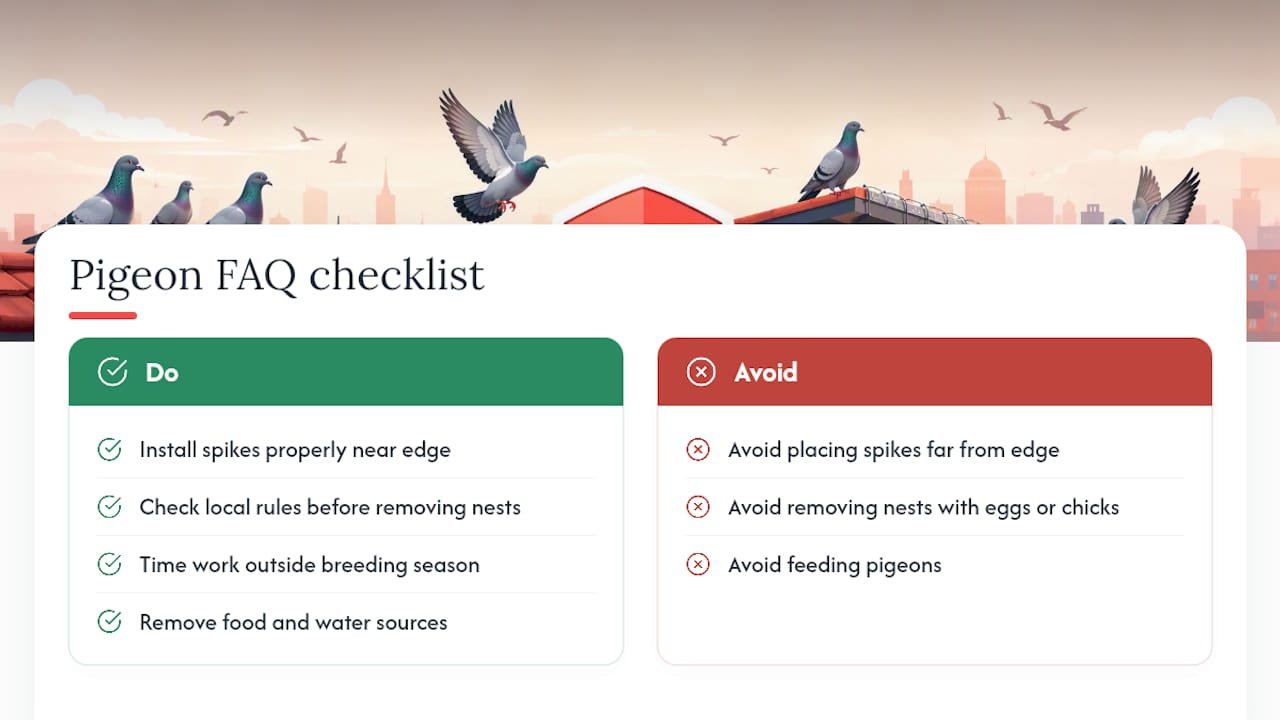
No. Properly installed spikes only block landing space; they don’t injure birds. They fail when placed too far from the landing edge, not because pigeons push through them.
Is it legal to remove a pigeon nest from my roof?
It depends on your location and whether the nest is active. Many areas protect wild birds and restrict removing nests with eggs or chicks, so check local rules and time your work outside breeding season when possible.
How much does professional pigeon proofing cost?
Costs vary by roof size, the method used, and whether solar panels are involved. A licensed technician can give you an accurate estimate after inspecting your specific roof.
Will feeding pigeons less actually reduce roosting?
Yes. Removing food and water sources is one of the most effective ways to stop pigeons from re-establishing on a roof once you’ve installed exclusion devices.
Sources
- Feral pigeons — SA Health (management and control)
- Pigeon damage control and prevention methods — ICWDM (Internet Center for Wildlife Damage Management)
- How Do You Remove Pigeons from Your Roof Space? — Roof Mason
Recommended
- Bugs Patrol Canberra – Professional Pest Control Services
- Bugs Patrol Canberra – Professional Pest Control Services
- Bugs Patrol Canberra – Professional Pest Control Services
- Bugs Patrol Canberra – Professional Pest Control Services