If you hear or see birds in your roof, act tonight: confirm the species and how active the nest is, then either wait for lawful timing or call a licensed pro. Don’t force entry into a vent or roof void to pull material out. That’s how people get scratched, exposed to droppings, or end up prosecuted for disturbing a protected species without realizing it.
Before you do anything else, run through this:
- Listen at dawn and dusk. That’s when roof-nesting birds are most active.
- Watch one entry point for 15 minutes. If birds keep flying in and out, the nest is active.
- Check indoor ceilings and vents for droppings or staining. That signals the nest is close to living space.
- Do not poke, block, or spray anything into the cavity until you know what species you’re dealing with.
Species identification matters because pest birds like pigeons and starlings carry far fewer legal restrictions than native species. BirdLife maintains species profiles that help with quick identification, and state wildlife agencies (in New South Wales, for example, the guidance on pest birds) spell out which birds are exempt from protection.
Pro Tip: If you hear continuous daytime activity and see birds coming and going on a regular flight path, treat it as an active nest. Pause any DIY removal until you’ve confirmed the species and its legal status.
Key Takeaways
Resolving birds in a roof safely and permanently requires confirming species and legal status first, then combining humane eviction with immediate, durable exclusion.
| Point | Details |
|---|---|
| Confirm species before acting | Pest species like pigeons and mynas carry fewer legal restrictions than native birds. |
| Check breeding timing | Disturbing native nests during breeding season can bring fines or prosecution. |
| Use PPE for cleanup | Respirators and gloves prevent exposure to biological hazards in droppings and debris. |
| Seal the entry point immediately | Exclusion without sealing invites birds straight back within days. |
| Call Bugspatrol for coordinated service | Bugspatrol combines inspection, humane eviction, and permanent proofing in one licensed visit. |
Table of Contents
- How Do You Know If Birds Are Nesting in Your Roof?
- Are the Birds in Your Roof Legally Protected?
- How Do You Safely Evict Birds From a Roof?
- What Stops Birds From Coming Back to Your Roof?
- Should You Handle It Yourself or Call a Pro?
- How Much Does Bird Removal From a Roof Cost, and How Long Does It Take?
- What Should You Never Do When Birds Are in Your Roof?
- How Does a Licensed Pro Actually Handle a Roof Bird Job?
- Get Birds Out of Your Roof and Keep Them Out for Good
- Where to Verify the Rules Before You Act
- Frequently Asked Questions About Birds in Roofs
- Sources
How Do You Know If Birds Are Nesting in Your Roof?
The most reliable signs are auditory, not visual. Scratching, chirping, or fluttering that peaks around sunrise and again at dusk usually means birds are settled in for the night, not just passing through. Visible nesting material poking out of gable vents, ridge caps, or gutter lines is the next giveaway, along with feathers caught on roof edges and a buildup of droppings that streaks siding or fascia boards. Over time, that acidic buildup can actually degrade roofing material, not just look unsightly.
Species matters for what happens next:
- Pigeons leave larger, more concentrated droppings and make heavy flapping noise when entering roof cavities.
- House sparrows and European starlings aggressively pack nesting material into vents and gaps, often reusing the same site year after year.
- Indian mynas colonize aggressively under eaves and around roof edges, frequently pushing out smaller native species.
Confirming an active nest requires more than hearing noise once. Look for repeated visits to the same gap, visible eggs or chicks if you can safely see inside, and consistent flight patterns at the same times each day. A phone photo of the bird or nesting material, cross-checked against BirdLife’s species pages, is often enough to narrow things down before you call anyone.
Are the Birds in Your Roof Legally Protected?
This is the step homeowners skip, and it’s the one that gets them in trouble. In Australia, pigeons, Indian mynas, and European starlings are commonly classified as pest species and often lack the same legal protections given to native birds, which in many cases allows removal without a permit. Native species are a different story entirely.
Removing an active nest of a protected native species without a proper licence can lead to prosecution or significant fines, regardless of whether the homeowner realized the bird was protected.
Timing compounds the problem. State wildlife legislation sets breeding windows for native species, and specialists generally advise against disturbing a nest during peak breeding months unless there’s an immediate safety threat. A nest that’s legal to remove in April might not be in October.
Health risks run alongside the legal ones. Dried droppings and nesting debris can carry biological hazards and respiratory disease risks for anyone disturbing a contaminated roof space without a respirator and gloves. Add fire risk: dry nesting material packed near wiring, downlights, or solar inverters is a genuine ignition hazard, active nest or not.
Homeowners frequently assume every bird is protected, which either scares them into inaction or, worse, the opposite: assuming none of them are. Verify the species first. When you’re not sure, stop and call a licensed professional who can identify it correctly.
How Do You Safely Evict Birds From a Roof?
Once you’ve confirmed the species is a pest bird (not protected) and the timing is legal, the process follows a specific order:
- Confirm activity and species using the observation steps above, ideally with photos.
- Choose lawful timing. If it’s a pest species with no eggs or chicks visible, proceed. If you see eggs or hear chicks, wait, unless there’s an immediate hazard like exposed wiring.
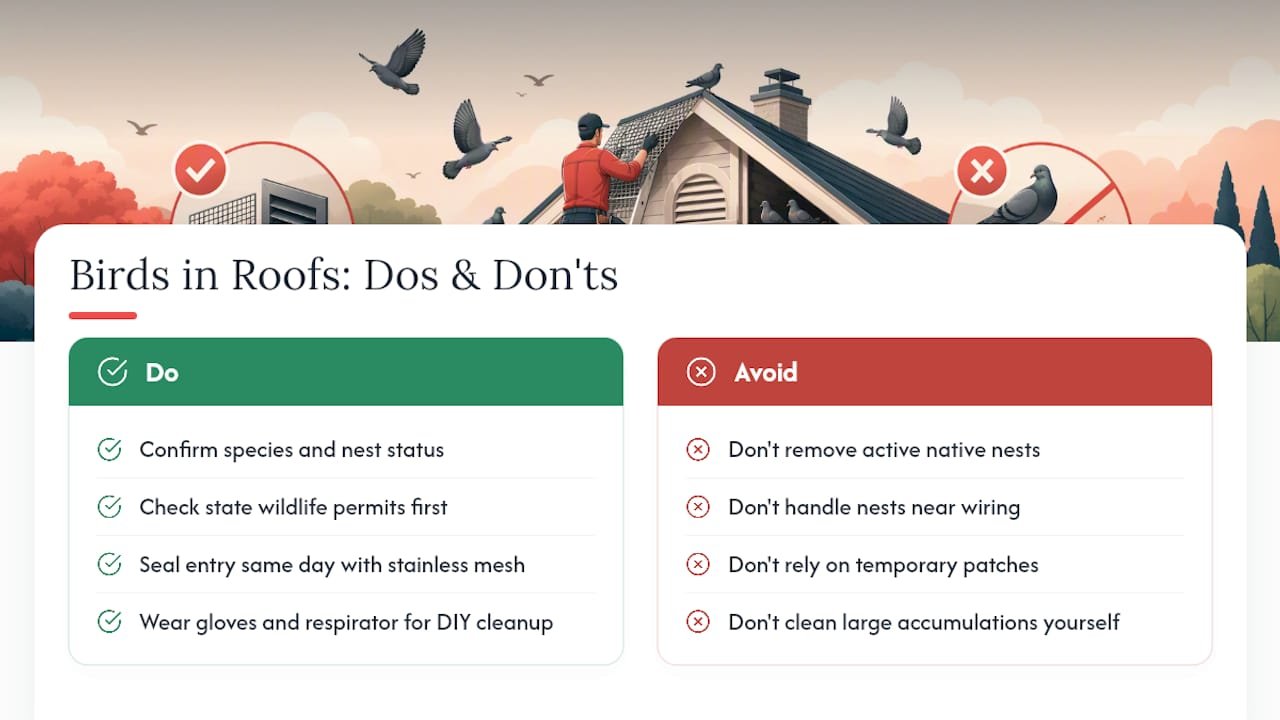
- Install one-way exclusion devices at the entry point so birds can leave but not re-enter, rather than physically extracting them.
- Block interior access points temporarily, sealing vents or grilles that lead into living spaces.
- Remove attractants like accessible food, water, or pet dishes near rooflines that keep drawing birds back.
- Keep family and pets away from the affected roof section until sanitization is complete.
None of this works without proper gear. A respirator rated for particulates, gloves, eye protection, and disposable overalls are the minimum before anyone climbs near a nest cavity. Skipping sanitization afterward isn’t just unpleasant, it leaves behind the exact biological hazards WorkSafe guidance warns about.
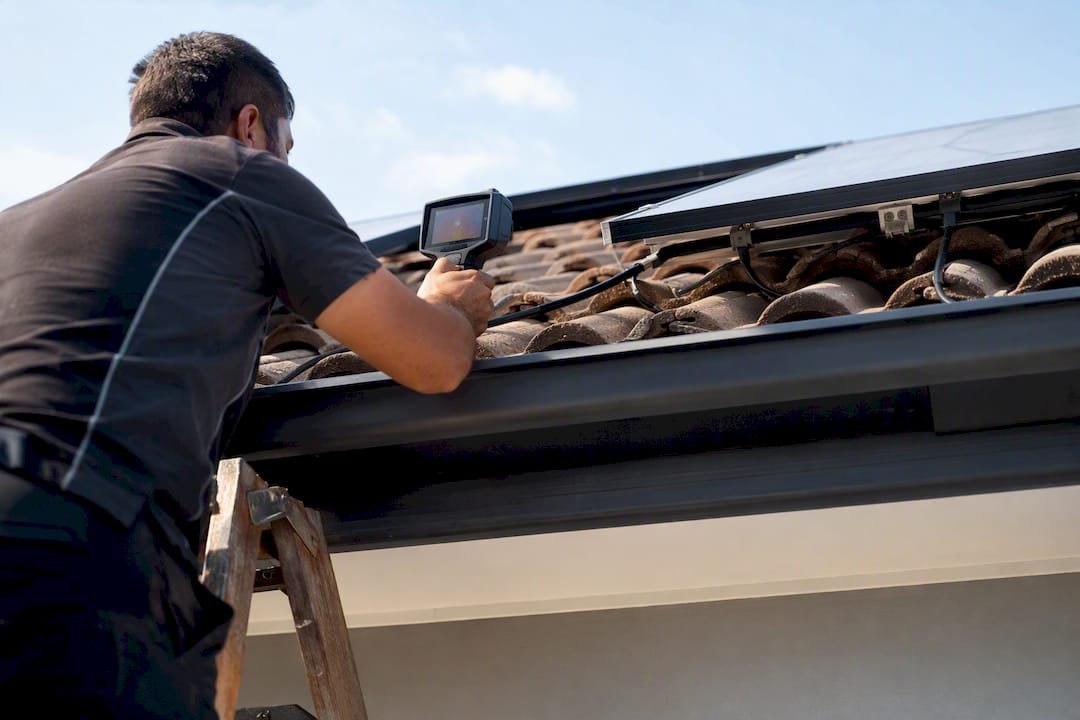
There’s a hard limit to what a homeowner should do alone. One-way exclusion works for vents and gaps you can reach safely from a ladder or roof access hatch. Once the nest is behind tile, inside a wall cavity, or near solar wiring, that’s specialist territory, and thermal imaging is often the only way to locate the cavity without pulling up roofing material.
Pro Tip: Never treat eviction as the finish line. Sealing the entry point the same day you confirm the birds are gone is what actually prevents them from coming right back within the week.
What Stops Birds From Coming Back to Your Roof?
Deterrents buy time. Exclusion is what actually works long-term. The most effective approach starts with finding every entry point, not just the obvious one, then sealing each with a physical barrier: stainless steel mesh or galvanized hardware cloth installed as part of a proper multi-stage proofing process that pairs inspection with humane eviction and permanent sealing.
| Method | Best For | Trade-Off |
|---|---|---|
| Stainless steel mesh | Vents, gable gaps, roof void openings | Durable and allows airflow, but needs precise fitting |
| Galvanized hardware cloth | Larger structural gaps | Strong and long-lasting, heavier to install than mesh |
| Plastic bird netting | Open eaves, temporary coverage | Cheap upfront, degrades in UV and wind within a couple of seasons |
| Bird spikes | Flat perching ledges, ridge lines | Effective deterrent for landing birds, doesn’t stop nesting in cavities |
| Gutter guards | Gutter lines prone to debris and nesting | Reduces nesting material buildup, requires periodic clearing |
Solar panels need their own approach. Bird proofing mesh installed around panel edges stops nesting underneath, where droppings and debris can actually cut into panel output over time.
Twice-yearly roof inspections, cleared gutters, and trimmed branches overhanging the roofline keep proofing effective. Physical barriers only work as long as the structural gaps behind them stay sealed; a torn section of mesh is functionally the same as no mesh at all.
Pro Tip: Skip the temptation to patch a gap with steel wool or expanding foam. Neither holds up outdoors, and birds will work through both within a season.
Should You Handle It Yourself or Call a Pro?
Run through this before deciding:
- How high and how accessible is the entry point? A single-story eave is a different job than a two-story tile roof.
- Is the species protected, or confirmed pest status?
- Are there visible eggs or chicks?
- Is the nest near electrical wiring, downlights, or solar equipment?
- Have birds returned to this spot before?
If you answered yes to protected species, proximity to wiring, or repeat infestation, stop and call a licensed pest or wildlife professional. Before booking, ask:
- Are you licensed and insured for wildlife or pest removal work?
- What does your inspection process look for?
- Do you use one-way exclusion devices, and how do you sanitize afterward?
- What proofing materials do you install, and is there a warranty?
Look for a provider offering inspection, eviction, and exclusion as one coordinated service rather than three separate bookings. Piecemeal work is how gaps get missed.
How Much Does Bird Removal From a Roof Cost, and How Long Does It Take?
Most jobs follow a similar rhythm: a same-week inspection if the situation is urgent, eviction that takes anywhere from a few days to a couple of weeks depending on nesting status, then proofing and repairs over a few more days, including sanitization and a follow-up check.
Cost swings on a handful of factors:
- Roof access difficulty, tile versus metal, height, pitch.
- Species and how complex the nest removal is.
- Whether structural repairs or solar panel mesh are needed alongside proofing.
- Sanitization and debris disposal.
- Local labor rates.
Sealing the entry point immediately after eviction is what keeps costs from climbing. A missed gap means a repeat callout and, often, additional structural damage that wasn’t there the first time. Get at least two written quotes, and confirm licensing and insurance before signing anything.
What Should You Never Do When Birds Are in Your Roof?
Some mistakes here aren’t just ineffective, they’re illegal or dangerous.
- Never remove an active nest of a protected native species without confirming its legal status first.
- Never use poison or glue traps. Both are inhumane and often illegal for bird control.
- Never attempt high-roof work without proper fall protection, a ladder alone isn’t enough on a pitched roof.
- Never pack out nesting material without a respirator and gloves.
- Skipping sanitization leaves behind the exact fire and disease risks this whole process is meant to eliminate.
If you’re not certain whether a bird is protected, or you’re not confident working safely at height, stop. That single pause is cheaper than a fine or a fall.
Sonic deterrents used incorrectly, or attempts to kill birds or destroy nests outright, can also backfire legally and simply don’t solve the underlying access problem.
How Does a Licensed Pro Actually Handle a Roof Bird Job?
A properly run job follows a consistent sequence:
- Site inspection and species identification, often the difference between a legal removal and a costly mistake.
- Eviction timed to the species, using one-way devices where lawful, or scheduling around breeding windows.
- Full removal of nesting material and sanitization of the affected roof space.
- Permanent exclusion and repair with mesh or hardware cloth at every entry point found.
- Follow-up check to confirm the birds haven’t returned.
Trust signals worth checking for before you book anyone: a valid pest control license, a written quote before work starts, before-and-after photos of the job, and a repair or workmanship guarantee backed by real local experience. Complex roofs, tiled sections, or nests tucked behind solar panels sometimes call for thermal imaging to find the cavity without tearing into roofing material unnecessarily.
A Note From the Field
The mistake I see most is homeowners waiting until droppings are dripping through a ceiling before calling anyone. An early inspection, even just a look with a torch and a ladder, catches small gaps before they become a nesting colony. BugsPatrol backs its roof exclusion work with written guarantees for exactly that reason.
Get Birds Out of Your Roof and Keep Them Out for Good
If you’ve made it this far and you’re still hearing scratching at 5 AM, the DIY window has probably closed. Bugspatrol handles the entire sequence in one visit: a proper inspection to find every entry point, humane eviction using one-way exclusion where it’s lawful, and permanent proofing with stainless mesh or hardware cloth so the same gap doesn’t reopen next season.
What separates this from a one-off deterrent purchase is the guarantee behind the work. Licensed technicians document the job with before-and-after photos, and the exclusion materials installed are built to outlast a bird spike kit from a hardware store. If your roof has solar panels, that proofing gets addressed in the same visit instead of a separate callout later.
Start with a site inspection and written quote so you know exactly what’s nesting up there and what it’ll take to seal it out permanently.
Where to Verify the Rules Before You Act
- Check your state wildlife agency for species protections and licensing rules, such as NSW’s pest bird guidance.
- Review WorkSafe Queensland’s guidance on biological hazards before any cleanup.
- Use BirdLife resources to identify species before deciding on removal.
- Save any contractor’s license number and confirm it before booking work.
Frequently Asked Questions About Birds in Roofs
How do I know if it’s birds and not something else, like possums or rats, in my roof?
Birds are active during the day, especially at dawn and dusk, while possums and rats are typically nocturnal. Bird activity also comes with visible nesting material at vents and eaves rather than gnawed wiring or greasy rub marks along beams.
Can I just leave the birds alone until they move out on their own?
If it’s a pest species with no eggs or chicks and no fire or health risk nearby, waiting is an option, though the nest cycle can repeat. If it’s a protected species or near wiring, get it assessed rather than guessing.
Do I need a permit to remove birds nesting in my roof?
It depends on species. Common pest birds like pigeons and starlings often don’t require a permit, but native species usually do, and removing an active native nest without one can lead to fines. Check your state wildlife agency’s current rules first.
What’s the fastest way to stop birds from returning after removal?
Seal the entry point the same day the birds are confirmed gone, using stainless mesh or hardware cloth rather than a temporary patch. That single step prevents most repeat infestations.
Is it safe to clean bird droppings from my roof myself?
Small, dried deposits on an accessible area can be cleaned with gloves, a respirator, and a disinfectant spray. Larger accumulations inside roof cavities carry higher exposure risk and are better handled by a professional with proper sanitization equipment.
This article is general information, not a substitute for advice from a qualified lawyer. Consult a qualified legal professional about your own circumstances before acting on anything here.
Sources
- Pest birds (NSW Government)
- Diseases from animals — WorkSafe Queensland
- NSW biodiversity conservation legislation (example)
- BirdLife International
- Indian myna invasive species guidance (Business Queensland)
Recommended
- Bugs Patrol Canberra – Professional Pest Control Services
- Bugs Patrol Canberra – Professional Pest Control Services
- Pest Control For Birds Casey – Bugs Patrol Pest Management
- Bugs Patrol Canberra – Professional Pest Control Services