You spot a spider in your garage and freeze. Is it dangerous? Should you grab a shoe, a glass, or your phone? If you’ve ever stood in that moment of uncertainty, you’re not alone, and honestly, most Canberra homeowners have been there.
Here’s the thing: most spiders you’ll encounter around your home are completely harmless and more interested in catching flies than bothering you. But a small number of species found in the ACT genuinely do warrant a professional response, and knowing the difference could matter more than you’d think.
This guide cuts through the usual fear-based content and gives you something more useful: a practical, no-nonsense framework for spider control in Canberra. We’ll walk you through the species you can safely relocate yourself, the ones that deserve a bit more caution, and the rare few that should have you calling a professional rather than reaching for a spray can. By the end, you’ll know exactly how to identify what you’re dealing with and what your next step should be. No entomology degree required.
Most Canberra Spiders Are Harmless. Here Is How to Tell the Difference.
Most of Canberra’s spiders are not your enemy. The ACT sits in eastern Australia’s temperate zone, and that climate supports a wide variety of spider species. The overwhelming majority of them pose no meaningful threat to humans.
The ones that do matter fall into a specific group: medically significant species such as redbacks, white-tails, funnel-webs, and mouse spiders. The rest, including common house spiders, daddy-long-legs, and huntsmen, are nuisance species at worst.
The problem is that most spider content online treats every eight-legged visitor like a crisis. That leads to two bad outcomes: unnecessary household pest control costs for harmless species, and under-reaction to the ones that genuinely warrant attention.
This guide takes a different approach. Each species likely to turn up in a Canberra home or yard is ranked by a simple threat-level framework covering three things: what it looks like, where it tends to live, and what risk it actually carries. That gives you one clear decision point at the end of each entry: reach for the vacuum cleaner, or reach for the phone.
BugsPatrol is based in Canberra and services the ACT and surrounding regions, so the species covered here reflect what local homeowners actually encounter, not a generic national list.
The Spiders You Can Safely Ignore (or Relocate Yourself)
Let’s start with the good news. The CSIRO’s guide to spiders of the ACT confirms that the vast majority of species you will encounter in and around your home are harmless and actually help keep insect numbers down. Here are the four you are most likely to meet.
Daddy-long-legs are probably already living in your ceiling corners right now. Despite the persistent myth that they carry potent venom, they pose zero risk to humans and are best left alone or relocated.
Huntsmen are the ones that cause the most fright. Their leg span is impressively large, which is genuinely alarming on a bedroom wall at 11pm. However, they are non-aggressive, rarely bite, and earn their keep by hunting cockroaches and other insects inside your home.
Common house spiders (Badumna and Parasteatoda species) spin the untidy, grey cobwebs you find in window frames and behind furniture. Bites are uncommon, and where they do occur, effects are generally mild.
Garden orb-weavers build those impressive circular webs in backyards across the warmer months. They are not medically significant and will go out of their way to avoid you.
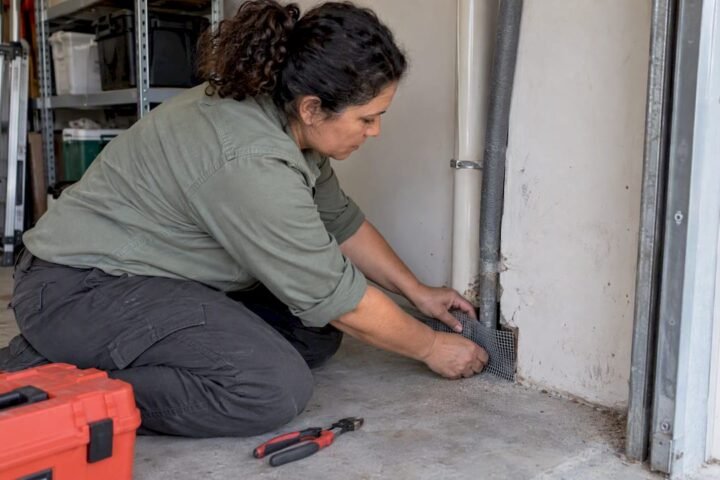
For all four, the DIY response is straightforward. Use a container and a piece of card to relocate live spiders outdoors. Remove existing webs with a vacuum or broom. Then seal the entry points: gaps around window frames, door seals, and any utility penetrations through walls. This last step is the one most Canberra homeowners skip, and it is where keeping pests out of your home for the long term actually starts.
Redback Spiders in Canberra: Recognise Them Before You Reach In
Not every spider you find around the yard deserves the same response, and redbacks are the first species where that calculation changes.
Redback spiders (Latrodectus hasselti) are straightforward to identify: females are dark with a distinctive red or orange marking on the abdomen, if you see that marking, stop what you are doing.
Where they hide on Canberra properties
Redbacks favour dry, sheltered spots close to the ground: underneath outdoor furniture, inside letterboxes, along retaining walls, in garden sheds, and among stored items in garages. These are places Canberra homeowners reach into daily without thinking.
That ground-level nesting habit is what makes redbacks higher-risk than most other species. Bites typically happen when a hand or foot disturbs a concealed spider, not from a spider actively seeking contact.
What a bite actually means
Redback bites cause progressive pain at the site, often spreading alongside sweating and nausea. Fatalities are extremely rare, but untreated envenomation can cause significant illness over hours. Seek medical attention promptly if a bite is suspected.
When to call a professional
Wear gloves when gardening, check shoes left outside overnight, and clear debris from the base of walls. These measures limit accidental encounters but will not eliminate an established population nesting in your shed or under a deck.
Professional treatment is the right call when redbacks appear inside the home, in areas used by children or pets, or anywhere you cannot safely inspect without placing your hands near potential nesting sites. Much like a termite inspection in Canberra reveals damage hidden behind walls, a professional spider assessment finds harbouring sites that a quick visual sweep will miss.
White-Tail Spiders: What the Evidence Actually Says About Their Bite
White-tails sit a step down the concern ladder from redbacks, but they carry their own confusion, mostly because of a stubborn myth that has circulated for decades.
What they look like: Lampona cylindrata and Lampona murina are slender, dark grey to black spiders, roughly 1 to 2 cm in body length, with a single white spot at the tip of the abdomen.
Where you find them: White-tails don’t build webs. They hunt actively and roam at night, which is how they end up in bedrooms and bathrooms. Clothing or towels left on the floor are a common entry point into close human contact.
The necrosis myth: The idea that white-tail bites cause flesh-eating wounds became widespread, but the evidence doesn’t support it. A prospective study of 130 confirmed bites published in the Medical Journal of Australia found that most bites resulted in localised pain, redness, and blistering, not ulceration. The necrosis link has been widely challenged in the scientific literature.
Still worth taking seriously: White-tails bite when trapped against skin. Anyone with a notable reaction should seek medical attention, particularly children or people with compromised immune systems. Repeated indoor sightings in a home with vulnerable occupants is a reasonable trigger for professional spider pest control in Canberra.
Practical DIY steps: Reduce floor clutter, shake out clothing and bedding before use, and fit door seals to limit how easily they move through the house.
Funnel-Web Spiders in the ACT: The One Species That Changes Everything
White-tails are unsettling but rarely dangerous. Funnel-webs are a different matter entirely.
Australia has 38 described funnel-web species across three genera: Hadronyche, Atrax, and Illawarra. Hadronyche species have been documented in parts of eastern Australia near the ACT, making these a possible local consideration.
How to recognise one
Look for these features:
- Body length: 1 to 5 cm
- Carapace: Glossy, sparsely haired, hard upper body with a deeply curved groove (the fovea) running across the top
- Males: A distinctive conical projection on the second leg
That glossy, almost lacquered appearance is the standout visual cue.
Why they matter
The Sydney Funnel-web (Atrax robustus) is responsible for the majority of the 13 recorded funnel-web fatalities in Australian history. No deaths have been recorded since antivenom became available in 1981. Fast treatment works. Delayed treatment does not. The venom is capable of causing death if untreated.
Where you will find them
Funnel-webs prefer moist, sheltered spots: rockeries, dense mulch, under logs and timber. Wandering males appear most often in late summer and autumn and are more venomous than females, which is unusual among spider species.
If a bite occurs
Call 000 immediately. Apply a pressure immobilisation bandage, keep the patient completely still, and do not handle the spider bare-handed.
The property response
A suspected funnel-web is not a vacuum-cleaner situation. Professional spider pest control from a licensed Canberra operator is the only appropriate response. Just as you would not ignore a potential termite problem after reading about what Canberra homeowners need to know about termite treatment, do not leave a suspected funnel-web sighting unverified.
Mouse Spiders and Trapdoor Spiders: The Species Most Often Mistaken for Funnel-Webs
Funnel-webs aren’t the only spiders that will stop you in your tracks. Two other species regularly cause genuine confusion, and getting them mixed up has real consequences.
Mouse spiders (Missulena species) are large, dark, robust spiders that can be difficult to distinguish from funnel-webs. Because field identification is unreliable, any bite from a suspected mouse spider should be assessed urgently at a hospital, err on the side of caution. This is precisely the situation where spider identification in Canberra gets complicated enough that a professional assessment earns its value well beyond the treatment itself.
Trapdoor spiders are another frequent case of mistaken identity. They’re dark, solid-looking spiders that tend to wander after rain when they venture out from their burrows. Trapdoor spiders are not considered as medically significant as funnel-webs, but confident field identification remains difficult. Up close, trapdoor spiders have a dustier appearance with faint abdominal markings, rather than the glossy carapace of a funnel-web, but that distinction is easy to miss under stress.
Both species live and hunt at ground level. Expect encounters in gardens, along retaining walls, and at the base of walls or steps rather than indoors.
The Decision Framework: Vacuum Cleaner or Phone Call?
So now that you know which species sit at which end of the threat scale, here is the practical summary.
Handle it yourself if:
- The spider is a daddy-long-legs, huntsman, garden orb-weaver, or common house spider
- It is in a low-traffic area away from children and pets
- You can remove or relocate it using a container and card, without placing hands near it
Call a professional if:
- You have identified or strongly suspect a redback, white-tail (with repeated indoor sightings), funnel-web, or mouse spider
- The spider is somewhere accessible to children or pets
- You genuinely cannot identify the species; uncertainty alone is a valid reason to call
Call 000 immediately if:
- A bite has occurred and the spider was large, dark, glossy, and robust
- Symptoms include progressive pain, sweating, muscle spasms, or rapid deterioration
- Do not wait to book a pest inspection; this is a medical emergency first
Reduce spider pressure across the board with these everyday measures:
- Seal gaps around windows, doors, and pipes
- Switch off or reduce outdoor lighting that draws insects (spiders follow their food source)
- Keep woodpiles, garden debris, and stored items clear of the house wall
Where DIY falls short is persistence. Licensed operators apply treatments to eaves, window frames, exterior walls, and subfloor zones, the areas that matter most for established populations, and they locate nesting sites not visible from inside.
When a Canberra Spider Warrants More Than a Spray Can
Choosing when to go beyond a hardware store spray can comes down to one question: do you want to knock down the spiders you can see, or eliminate the population behind them?
Off-the-shelf sprays are a contact solution only. They address visible spiders but don’t target the harbouring sites, entry points, or nesting zones where populations originate.
Licensed operators apply professional-grade residual insecticides to the areas that actually matter: eaves, window frames, exterior walls, and subfloor zones. These are the primary harbourage and entry routes for redbacks, funnel-webs, and other medically significant species, not the surfaces a consumer spray typically reaches.
BugsPatrol’s team is Canberra-based and understands the local species profile and the property types where significant spiders establish most readily. That local knowledge shapes where treatment is applied, not just how.
Spider treatments are available as part of broader household pest control plans, covering the ACT and surrounding NSW regions, with 12-month warranties and flexible monthly payment options so there is no upfront cost barrier. A one-off treatment resolves an active problem; a year-round household pest control plan keeps protection in place across spider season and reduces re-infestation between visits.
If you cannot confidently identify what you have found, a professional inspection settles the question. Knowing whether the spider in your shed is a redback or a common house spider is not a small distinction; it determines everything that follows.
The Bottom Line on Spider Control in Canberra
The decision framework and prevention steps above cover the specifics, the short version is that most species are harmless, a handful are not, and uncertainty is a valid reason to call. Off-the-shelf sprays address visible spiders but don’t target the harbouring sites and entry points that matter; professional treatment does.
If you are unsure what you are dealing with, that uncertainty itself is a reason to call. BugsPatrol is proudly serving Canberra and surrounds and can tell you exactly what you have found and what, if anything, needs to be done about it.
Conclusion
The real value in knowing the difference is confidence. You stop reacting to every spider you see and start making decisions based on actual risk. If you’ve spotted something that doesn’t match the harmless category, BugsPatrol can give you a clear answer. Reach out today for professional identification and targeted treatment across Canberra and surrounding areas.