Mould in a home is usually a nuisance for healthy adults and a real problem for people with asthma, allergies or weakened immunity. According to NSW Health, most people have no health effects from contact with mould, because spores are everywhere in the environment. But in a damp house the spore load rises, and sensitive people can get a blocked nose, sneezing, coughing, wheezing, and irritated eyes or skin. This guide covers what the symptoms look like, who should worry, how to clean safely, and why mould and bird droppings often turn up in the same damp, neglected corners of a Canberra home.
TL;DR
- Mould spores and fragments can trigger nasal congestion, sneezing, coughing, wheezing and respiratory infections, and can worsen asthma.
- Most healthy people are not affected. Children, older people and anyone with asthma, allergies, chronic lung disease or a weakened immune system are the ones to protect.
- Cleaning without fixing the moisture source means the mould returns. Leaks, condensation and poor ventilation are the real problem.
- Use a properly fitted P2 or N95 mask, not a surgical or cloth one, and never dry-brush mould.
- Bird droppings are a separate hazard. Psittacosis is caught by breathing in dust from feathers, secretions and droppings.
Table of Contents
- What mould does to the body
- Who is most at risk
- Where mould hides in Canberra homes
- How to clean mould safely
- Bird droppings: a different health risk, often in the same places
- Our perspective: damp, pests and birds are one problem
- Prevention checklist for a mould-free, bird-free home
- How we can help
- FAQ
- Sources
What mould does to the body
Mould is a fungus. It grows where moisture sits, and it reproduces by releasing spores that travel through the air and settle on damp surfaces. The health effects come mostly from breathing in those spores and fragments. Australia’s enHealth guidance says people are exposed mainly by inhaling and swallowing.
The usual effects are allergic and irritant rather than dramatic:
- a runny or blocked nose and sneezing
- coughing and throat irritation
- wheezing and chest tightness
- itchy or watery eyes
- skin irritation
The Better Health Channel and health departments add that mould in buildings can also contribute to respiratory infections in some people. What it does not do, for the large majority of households, is cause serious illness. That is worth saying plainly, because online articles about “toxic black mould” scare people more than the evidence supports.
What about mycotoxins?
Some moulds produce toxins called mycotoxins. The enHealth guidance notes that people are mostly exposed to them by eating contaminated food, and that Australia limits this through a hygienic food supply chain. The US National Institute of Environmental Health Sciences makes the same distinction: mycotoxins can cause severe illness if ingested, while airborne spores mainly irritate the nose and lungs. So the colour of the mould on your bathroom ceiling is not a reliable guide to danger. The amount, how long it has been there and who lives in the house matter more.
Who is most at risk
Public health guidance singles out a few groups:
- People with asthma. Mould is a recognised trigger. Asthma Australia describes it as a health danger for people with diagnosed and undiagnosed asthma, particularly after wet periods. NSW Health says inhaling spores can cause severe flare-ups in people with pre-existing conditions.
- People with allergies or hay fever. Spores add to the load of allergens that keep nasal and eye symptoms going.
- People with chronic lung disease or a compromised immune system. NSW Health advises that people in these groups, and those with severe asthma, should not be present while mould is being removed.
- Babies, young children and older adults. Their airways or defences are less robust. If you care for an older relative living alone, a home safety audit checklist for older adults living solo is a sensible companion to a mould check, since damp bathrooms and cluttered cupboards are both hazards.
How to tell if mould is making you sick
There is no blood test that proves your house is the cause. Doctors usually work from your symptoms and history. A pattern is the clue: symptoms that ease when you leave the house for a few days, or that are worse in one room, such as a bedroom with a mouldy wardrobe. If you suspect an allergy, healthdirect explains that skin prick tests and blood tests are the usual ways to find the trigger. Book a GP visit rather than guessing, especially if you or a child are wheezing at night.
Call a doctor promptly, or emergency services if breathing is difficult. Do not wait for the mould to be removed first.
Where mould hides in Canberra homes
NSW Health lists the usual places: walls and wallpaper, ceilings, bathroom tiles, carpets (especially with jute backing), insulation and wood. The less obvious spots are the ones that cause long exposure. The Asthma Australia Healthy Homes guide points to areas with little airflow: behind curtains, behind bed heads, inside wardrobes and behind wall hangings, where mould can grow unnoticed for months.
Canberra’s cold winters make condensation a common cause. Warm indoor air meets a cold window or an uninsulated ceiling and water forms. We have written separately about why wiping alone won’t stop window mould and how to judge ceiling mould using the one square metre rule.
Smell and humidity as early warnings
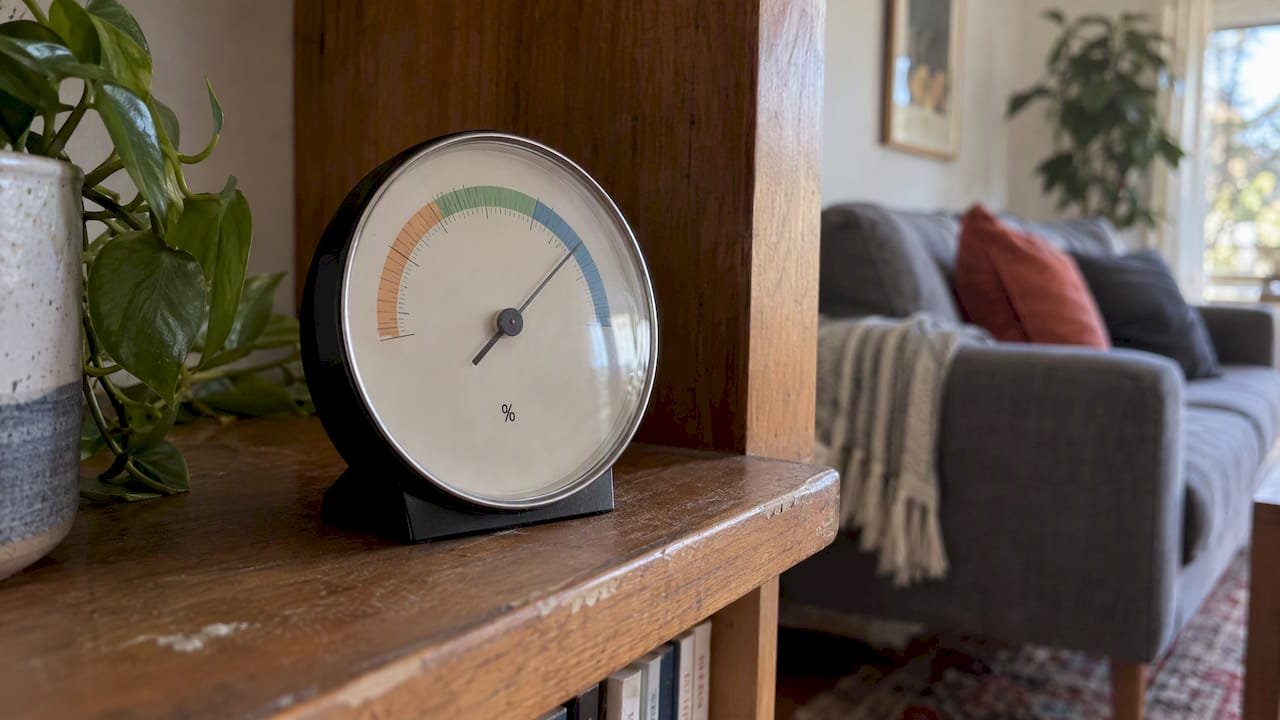
A musty smell with no visible source usually means hidden moisture. A cheap hygrometer helps: the Healthy Homes guide recommends keeping indoor humidity between 30% and 60%, the range in which mould and dust mites struggle to thrive.
How to clean mould safely
Small patches on hard surfaces are a job most healthy adults can do. The method matters, because poor cleaning throws spores into the air.
- Fix the moisture first. Health authorities stress that mould signals an underlying moisture problem. If the leak, condensation or poor ventilation stays, so does the mould.
- Protect yourself. Open windows and wear gloves, eye protection and a P2 or N95 mask. Better Health also suggests overalls and a head covering for larger jobs. Surgical and fabric masks give no protection against spores.
- Fit-check the mask. Breathe in: the mask should pull toward your face. Beards and some face shapes break the seal. Replace the mask if it gets damp or after about four hours of use, according to Better Health.
- Use a simple solution. NSW Health recommends vinegar and water for routine mould, with bleach (250 ml in 4 L of water) for stubborn mould, in a well-ventilated space. Never mix bleach with vinegar or other cleaners. A SESLHD poster gives a step-by-step with about 500 ml of vinegar and 500 ml of water in a spray bottle.
- Do not dry-brush. Spray first and wipe, so spores stay out of the air.
- Keep vulnerable people away. Anyone with severe asthma, lung disease or a weakened immune system should be out of the house or well away during the job.
Throw out porous materials that stay mouldy, such as soaked carpet underlay or plasterboard. If the mould covers a large area, keeps returning, or you cannot find the water source, stop and get help.
When to call a professional
For a large area, a hidden leak or suspected mould inside walls, a professional is the safer option. The NSW Health fact sheet says home test kits are generally unnecessary. Where a source can’t be identified, it points to occupational hygienists for specialist testing and advice. A pest and property protection company like ours can treat visible mould and look for the conditions around it, but we do not replace a plumber for a leak or a doctor for symptoms.
Bird droppings: a different health risk, often in the same places
People searching for mould risks often also ask whether pigeon or other bird droppings are dangerous. They are not the same hazard, but they share a lot of ground. Both build up in roof voids, gutters, eaves and sheltered corners that nobody checks.
The best-documented risk in Australia is psittacosis. NSW Health explains it is a disease caused by the bacterium Chlamydia psittaci, carried by birds, and that people most commonly catch it by inhaling dust containing feathers, secretions and droppings. Its control guideline advises gloves, dust masks or P2 respirators and disinfectant when cleaning up after birds. Psittacosis is mostly linked to parrots and pet birds, so don’t assume every pigeon on your roof carries it. The sensible point is the same as for mould: dried material turns into dust, and breathing that dust is how trouble starts.
There are other infections associated with large, old accumulations of droppings. If you have a heavy build-up and a weakened immune system, ask your GP before doing the cleanup yourself.
Safe handling of droppings
- Wear gloves and a P2 or N95 mask, as for mould.
- Avoid sweeping or blowing dry droppings. Dampen them first so dust does not rise.
- Bag the waste, clean the surface with disinfectant and wash your hands.
- For roof voids, solar panel gaps or high gutters, don’t climb up yourself. Falls are a bigger risk than the droppings.
Prevention beats cleanup. If birds are roosting under your solar panels or along your eaves, the droppings will return until access is blocked.
Our perspective: damp, pests and birds are one problem
We have serviced more than 5,000 Canberra homes over 10+ years, and the same pattern keeps showing up. Mould rarely arrives alone. A blocked gutter overflows, the eave stays damp, birds nest in the gap, and a few months later there is staining on the ceiling and droppings in the roof void. Termites and borers like damp timber too. When we do an inspection, we are reading the whole building for moisture and access points, not just the pest that was reported.
Three things we tell customers:
- Treat the cause. A bleach wipe on a ceiling stain is cosmetic if the gutter above it still overflows. Gutter guards, clear downpipes and sealed gaps do more for your lungs than any spray.
- Keep the response proportionate. Most mould is not an emergency. Most large droppings piles are not either. But a household with an asthmatic child, an elderly parent or someone on immunosuppressants should treat both seriously and early.
- Choose treatments with the household in mind. Our approach centres on families, children and pets, and we use thermal imaging in termite inspections to find moisture and activity without cutting into walls blindly. Ask any provider you hire what they use, where, and when it is safe to re-enter.
We would rather you fix a leak and never call us than pay for treatment that fails in six months.
— navin
Prevention checklist for a mould-free, bird-free home
| Area | What to do | Why it helps |
|---|---|---|
| Bathrooms and laundry | Run the exhaust fan during and after use; wipe walls and glass | Removes the steam that feeds mould |
| Bedrooms | Pull wardrobes and bed heads away from outside walls; air them out | Limits hidden growth where air is still |
| Windows | Wipe condensation each morning and improve airflow | Stops water sitting on frames |
| Gutters and downpipes | Keep clear; consider gutter guards | Prevents overflow into eaves and ceilings |
| Roof and eaves | Seal gaps and fit bird deterrents | Removes roosting spots and droppings |
| Solar panels | Fit mesh proofing around the edge | Stops birds nesting underneath |
| Indoor air | Use a hygrometer, aim for 30% to 60% humidity | Makes conditions poor for mould and dust mites |
| Air cleaning | A HEPA air purifier can help with mould-related symptoms; avoid ionising models | Asthma Australia’s guidance |
The Healthy Homes guide says a HEPA purifier is a good place to start, but it is a support measure, not a fix for the damp.
How we can help
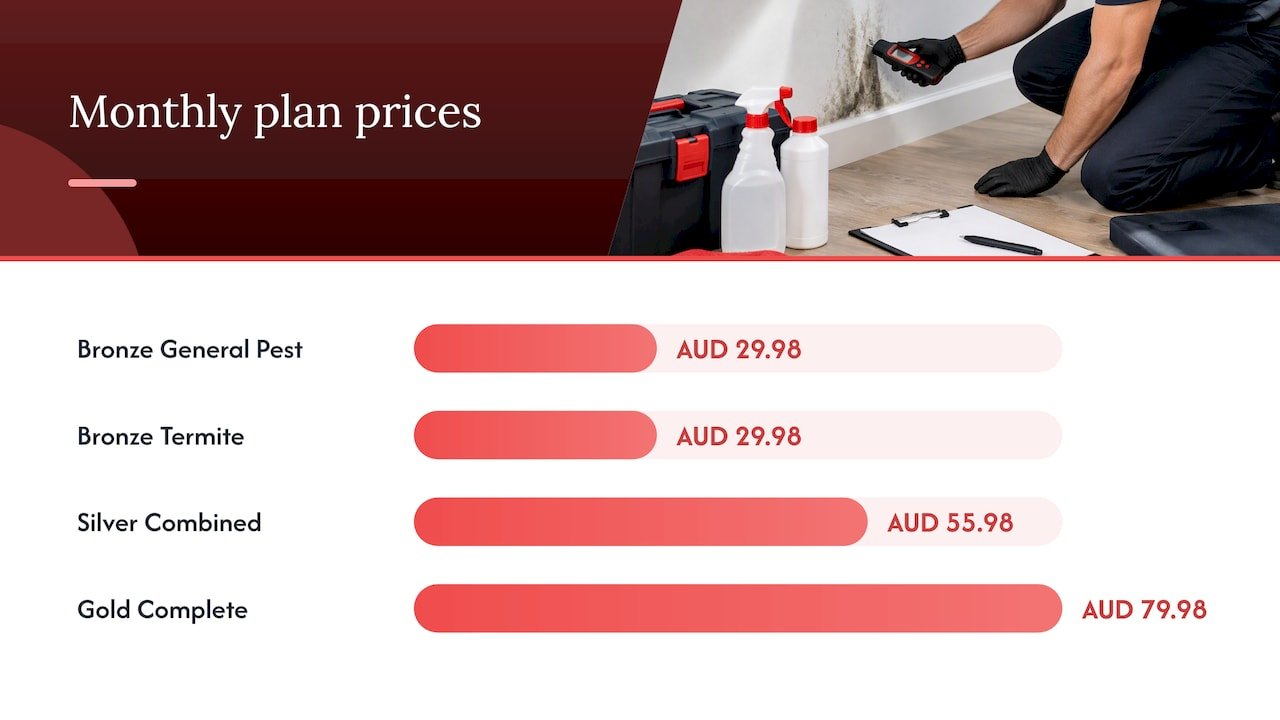
If your concern is the pests and property damage that go with damp and birds, we can help. Our bird control work covers bird spikes and deterrents and solar panel bird proofing, and our gutter guard installation reduces the overflow that feeds damp eaves. For routine protection against the pests that thrive in damp homes, our maintenance plans start at 29.98 AUD per month for Bronze General Pest or Bronze Termite, with Silver Combined at 55.98 AUD per month and Gold Complete at 79.98 AUD per month. We also treat mould and offer emergency pest removal across Canberra. For a home you are buying, see our pest inspection checklist for buyers.
FAQ
Is mould dangerous?
For most healthy people, no. Health authorities say most people have no reaction to the mould they meet day to day. It becomes a concern for people with asthma, allergies, chronic lung disease or weakened immunity, and when growth is heavy or long-lasting.
What are the symptoms of mould exposure?
Typical signs are a blocked or runny nose, sneezing, cough, wheeze, itchy eyes and skin irritation. They may be worse indoors or in a particular room. If you have wheezing, chest tightness or trouble breathing, see a doctor.
Is bird poop dangerous?
It can be, mainly when dry droppings turn to dust and are inhaled. NSW Health links psittacosis to inhaling dust containing feathers, secretions and droppings. Wear a P2 or N95 mask and gloves, dampen the droppings first, and leave roof and high-gutter jobs to professionals.
Can I get sick from mould in my house?
Yes, if you are sensitive. Allergy-type symptoms and asthma flare-ups are the usual effects. Fix the moisture source, clean small patches safely, and speak to your GP if symptoms continue.
Sources
- Mould, NSW Health
- enHealth guidance: potential health effects of mould in the environment
- Mould removal at home, Better Health Channel
- Mold, National Institute of Environmental Health Sciences
- Managing asthma triggered by mould, Asthma Australia
- Healthy Homes guide for homeowners, Asthma Australia
- Got Mould? poster, South Eastern Sydney Local Health District
- Allergy testing, healthdirect
- Psittacosis fact sheet, NSW Health
- Psittacosis control guideline, NSW Health
Recommended
- 1 Square Metre Rule for Ceiling Mould in Australian Homes
- Wiping Alone Won’t Stop Window Mould in Australia