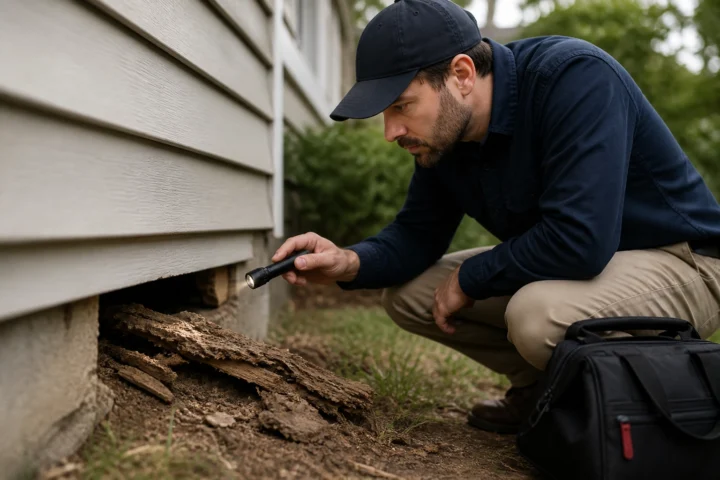
A single termite inspection can tell you what is happening in a Canberra home on one particular day. It cannot tell you what happened last season, what the barrier is doing now, or whether the conditions that allow subterranean termites to move from soil to timber have quietly changed. That is why treating an inspection as a one-off event leaves a gap between the protection you think you have and the protection that is actually being verified.
For a Canberra home, the answer is not a generic calendar reminder but a calibrated schedule shaped by local pressure zones, slab types and construction detail. An annual termite inspection is the mechanism that keeps protection, treatment history and warranty cover intact, because a barrier is only as good as the monitoring that checks it.
This analysis explains what a single visit can and cannot see, why the interval matters more than the visit itself, and how the national risk map and AS 3660.2 fit into local judgement. You will also learn the three variables a Canberra schedule should follow and how records and treatment history keep the cycle, and your warranty, meaningful.
A Termite Inspection Is a Snapshot, Not a System
An annual termite inspection records what is visible on the day it happens. Termites do not operate on an appointment schedule, so a clear report is evidence of a moment, not a guarantee for the year ahead. CSIRO’s termite management guide puts Australia’s count above 350 termite species, with only about 20 causing significant damage to human-made structures. Subterranean termites cause most structural damage and usually forage within 30 metres of the nest, occasionally 100 metres or more, so the colony feeding a Canberra home is not necessarily on the block being inspected. That is why the visit produces evidence, while the interval produces protection. A maintenance habit built on a generic calendar reminder is not calibrated to local pressure, slab detail or treatment history. For the mechanics of a visit, see what a professional inspection involves. The distinction matters because a barrier or baiting system is only as good as the monitoring that verifies it.
What a Single Visit Can See and What It Cannot
That snapshot is limited by what the building lets an inspector see. Subterranean termites build shelter tubes over concrete, brickwork and durable timber to travel without sunlight. These tubes often run along the slab edge, the exposed concrete strip at the base of walls, and the perimeter, the continuous soil and foundation line around the outside. Monitoring must cover both, not only visible timber. A wall cavity or finished floor can sit between the termite and the inspector, so concealed routes can remain out of sight even during a careful walk-around. Termites may also seal small gaps and crevices in timber with mud, hiding activity from a casual visual check. This is why timing matters: a colony that sealed evidence on the day of the visit and a colony that had not yet arrived both photograph the same way. An inspection is not a treatment. A treatment leaves a barrier or bait station in place; the inspection verifies whether it is still working. Mud sealing can resemble other damage, so it helps to know how to tell borer damage apart.
Why the Interval Matters More Than the Visit
Termites forage back into the same zone, so pressure recurs along the same slab edge or perimeter. The gap between checks is therefore the risk window: the period in which returning activity goes unrecorded.
A cleared inspection describes the building, not the surrounding soil.
Swarming adds a seasonal trigger. Alates disperse during humid periods in warmer months, often at dusk, and CSIRO does not specify Canberra’s swarming months, so treat seasonality as a principle to calibrate, not a fixed date. A guide to Canberra’s swarm season covers local timing. The same source notes environmental change may shift termite distribution in future and recommends risk-reduction measures across Australia, which argues against a permanently fixed habit.
A barrier is only as good as the monitoring that verifies it.
The Three Variables a Canberra Schedule Should Follow
Verification is not a mood. It is a schedule with reasons attached, and in Canberra those reasons come from three variables.
First, local pressure. CSIRO’s national gradient shows risk rising northward, highest in subtropical and tropical areas, but it does not classify the ACT. For a Canberra home, the honest basis is local evidence: known pressure streets and suburbs, plus an inspector’s records, not a guessed rating.
Second, construction detail. Slab types and suspended floors change where a termite can travel and hide. The slab edge, the exposed perimeter where slab meets soil and wall, is a check point in every case, while a suspended floor adds bearers, joists and subfloor voids to inspect. Access differs; concealment differs.
Third, season and recent conditions. Warmer, humid periods drive swarming and activity, while local rain and drainage determine where soil stays favourable. Track conditions, not a birthday reminder.
These variables set the interval as a principle, not a fixed number. Confirm any specific month or frequency against current local guidance rather than assuming it.
A schedule is a date plus a reason. Record why each check was placed where it was, then use a Canberra inspection report guide to interpret findings.
What the National Risk Map Does and Does Not Tell You
Those variables explain why a national map is only a starting point. CSIRO’s guidance says termite risk on mainland Australia generally rises in a northerly direction, with the highest risk in the subtropics and tropics. Most states and territories carry moderate to very high risk, while Tasmania has negligible risk.
The same source does not classify the ACT. A Canberra homeowner therefore cannot read a Canberra rating off that map, and should not assume proximity to a high-risk zone transfers to their block. The gradient is best used as a reminder that risk is environmental, not a property-specific verdict. Local construction detail and soil conditions change the answer from street to street, which is why a Canberra termite inspection should begin with the block rather than a national average.
That is one more reason to recalibrate the annual termite inspection rather than lock in a decade-long habit. The map can tell you the broad setting. It cannot give you a Canberra number or a suburb ranking, and it should not be made to.
For a local view of the pests that share that environment, see Canberra’s common pest pressures.
What AS 3660.2 Covers and What It Leaves to Local Judgement
Since a national map cannot rate your block, the next question is what the written framework actually requires. AS 3660.2-2017, Termite Management – In and Around Existing Buildings and Structures, is the Australian Standard for managing termites in existing buildings. It was updated in 2017, and the edition applicable in 2026 should be confirmed with your practitioner or the standard itself. The standard sets a framework for management and documentation, while frequency still turns on construction detail and local pressure. This caution protects you from false assurance. A schedule that cites a standard but ignores slab type, drainage or known pressure is compliance theatre, not monitoring. Ask an inspector which edition they work to and what the written report will document, including findings, treatment history and areas inspected. Industry bodies such as AEPMA publish consumer guidance and practitioner search tools, giving you a route to check credentials. For the same reason, understand why store-bought baiting falls short of a managed, documented program before you substitute a kit for a schedule.
Keeping the Cycle Intact: Records, Treatment History and Warranty Cover
Those written reports are only useful if they are kept together. A folder of invoices proves work was paid for; a treatment history lets a later inspection interpret what is now visible. Previous findings, treatment type, barrier or bait install dates and documented changes tell the inspector whether the current pattern is new or a recurrence.
A treatment must be verifiable and monitored for the record chain to stay meaningful. It is not the enthusiasm of the original job. The interval itself is not a universal warranty condition; read your own terms, and if you are reviewing commercial terms, start by scrutinising pest control contracts.
Keep a simple record: date of each check, areas inspected, findings, products or systems in place, and any excavation, landscaping or renovation that disturbed the treated zone. Works that disturb the treated zone can breach it, so re-baseline the cycle after them.
For a Canberra option, BugsPatrol offers year-round protection plans with 12-month warranties, monthly payments, no upfront fees and rolling cover.
The next check should read the record, not just the house.
Common Questions About Annual Termite Inspections
Records settle what happened. These questions settle what to do next.
Is an annual termite inspection enough? A yearly termite inspection is a starting interval rather than proof of sufficient cover, so adjust it for construction detail, local pressure and treatment history.
Do I need more frequent inspections in Canberra? The honest answer depends on pressure on the block and the slab type. CSIRO’s risk gradient does not rate the ACT, so a local assessment, not a national label, is the input.
What is the difference between a yearly termite inspection and a termite inspection service under a plan? A one-off check records a moment. Termite inspection services under a plan carry records, treatment history and monitoring continuity, so each visit can interpret the last.
How long does an inspection take and what should the report contain? Duration varies with size, access and slab detail, so ask before booking. Ask for written findings rather than a verbal all clear.
Can I just buy a barrier or baiting system and skip the checks? No. A barrier is only as good as the monitoring that verifies it. If paperwork is missing, learn whether termite barriers expire and what re-treatment involves.
The Schedule Is the Protection Mechanism
One inspection is evidence, but the cycle is the system that keeps that evidence useful. Three actions make that cycle real:
- Set the first date with a reason attached, whether that reason is local pressure, slab detail or a prior finding.
- Record findings and any works that disturb the treated zone, including landscaping, paving or extensions.
- Revisit the interval when construction, landscaping or local pressure changes.
Confirm which inspection standard and edition your practitioner works to, and read your own cover terms rather than assuming what triggers a claim. An interval calibrated to a Canberra block, its slab and its pressure history does more work than any single visit.
Conclusion
A yearly termite inspection is a snapshot, so attach a clear reason to the date, whether that reason is local pressure, slab detail or a prior finding. The next step is simple: book your next inspection with BugsPatrol and let one calibrated booking start the cycle.