
Most Australian backyards hide common nest types such as small papery paper-wasp nests tucked under eaves, mud tubes built by solitary mud daubers, or larger underground nests that may be European wasps. If you find any of these, do not poke, spray, or hose it. Keep people and pets clear, and call a licensed pest control operator for anything large, underground, or unfamiliar. The checklist and safety sections below cover the details.
TL;DR:
- Large underground nests, such as European wasps, require professional removal due to their size, location, and aggressive behavior.
- Native paper wasp nests are usually small, above-ground, and rarely exceed side-plate size, making them less of a threat if left undisturbed at night.
- Tracking European wasps with bait during dusk or early morning helps locate hidden underground nests without direct approach.
- Stings from European wasps can cause serious reactions, especially if the nest is disturbed, requiring immediate first-aid and medical attention for allergies.
- Report uncertain, active, or large nests to licensed pest control operators rather than attempt DIY removal to prevent injuries or improper handling.
Table of Contents
- Quick visual checklist for spotting a wasp nest
- Common Australian wasp species and their nest types
- Where wasps build nests and how to find them safely
- Wasp sting risks and first-aid steps to know
- How to report a suspected nest and when to call a professional
- What a professional wasp inspection actually involves
- A straight answer for Canberra homeowners
- Get a professional wasp inspection in Canberra
- FAQ
- Sources
Quick visual checklist for spotting a wasp nest
Before calling anyone, a quick look can narrow down what you are dealing with. Nest shape, size, and location tell you most of what you need to know.
- Small, open honeycomb shape hanging under eaves, in shrubs, or on fences, usually golf-ball to dinner-plate sized: likely a native paper wasp nest.
- Large papery mass or heavy wasp traffic at a hole in the ground, often football sized or bigger: possible European wasp nest, a high priority for professional attention.
- Mud tubes or small pot shapes stuck to brick, timber, or sheltered ledges: mud daubers or potter wasps, generally solitary and far less defensive.
- Legs dangling in flight points to a native paper wasp, while legs tucked close to the body is more typical of a European wasp.
European wasp nests are usually built underground and can grow to a large size similar to a football,. Paper wasp nests stay above ground and rarely exceed side-plate size. That size and location gap is often the fastest way to tell the two apart. paper wasp nests stay above ground and rarely exceed side-plate size. That size and location gap is often the fastest way to tell the two apart.
Common Australian wasp species and their nest types
Matching what you see to a species group helps you judge the risk before you get close.
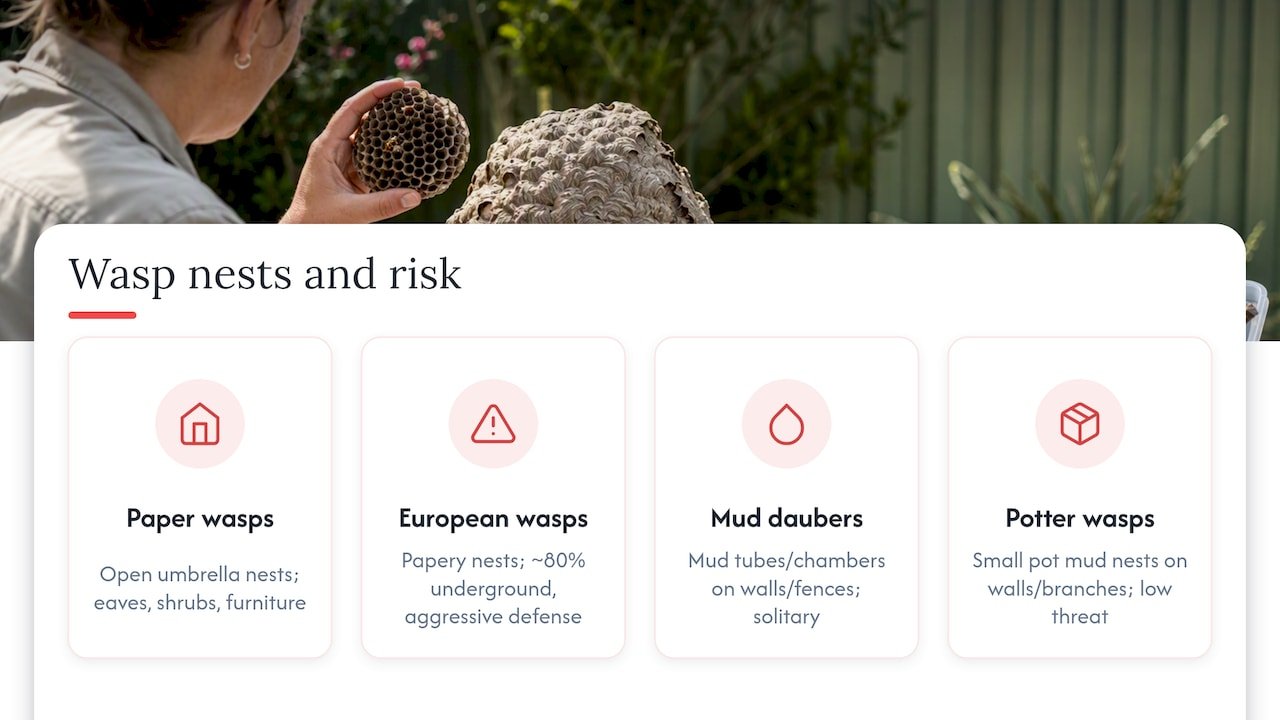
Paper wasps (including Polistes species and other native paper wasps) have slender bodies and orange to yellow antennae. Their nests are small, open umbrella shapes with visible cells, usually built above ground under eaves, in shrubs, or on outdoor furniture. A small, clearly inactive nest can sometimes be knocked down safely at night from a distance, but an active one is best left to a professional.
European wasps (Vespula germanica) are heavier bodied with sharp yellow and black banding and yellow legs. Their nests are papery like a paper wasp’s, but about 80% are built underground, with the rest turning up in wall cavities, roof voids, and other enclosed spaces. They defend aggressively in numbers, which is why several states treat them as a high-risk invasive species.
Mud daubers (Sceliphron and related genera) work alone. They build mud nests made of tube or chamber bundles stuck to walls, fences, and sheltered ledges. Research on Sceliphron formosum nest ecology shows these wasps mainly hunt spiders and rarely sting unless handled directly.
Potter wasps build similarly small, pot-shaped mud nests, often just one or two chambers attached to a wall or branch. Like mud daubers, they are solitary and pose a low threat to people going about normal yard work.
When a nest does not fit neatly into one of these categories, lean on behavior rather than guesswork. Flight pattern and leg position are usually more reliable in the field than nest shape alone, since nests can be partly hidden or easy to misidentify from a distance.
Where wasps build nests and how to find them safely
Wasps favor spots that are sheltered, undisturbed, and close to a food source. A sweep of these common sites covers most backyard situations:
- Ground level: holes in lawns, under compost heaps, along hedge lines, at the base of trees, and inside rockeries or retaining walls.
- Roof and wall spaces: roof voids, wall cavities, under eaves, inside fence capping, hollow trees, and climbing plants on arbors or pergolas.
For suspected European wasps, the recommended tracking method is to place a small piece of meat or pet food in an open, visible spot, then watch which direction the wasps fly once they take the bait. Moving the bait a short distance and repeating the observation can help you trace a rough flight line back toward the nest without approaching it directly.
Pro Tip: Do your tracking at dusk or early morning when wasp activity drops off, and leave the final confirmation and removal to a licensed technician.
Wasp sting risks and first-aid steps to know
European wasps can attack in numbers when a nest is disturbed, and multiple stings raise the risk of a serious reaction, particularly for anyone with an insect allergy. Accidental disturbance often happens during gardening or when a hose or mower gets too close to a hidden nest.
For a sting, HealthDirect recommends washing the area with soap and water, then applying an ice pack to ease pain and swelling.
- Watch for breathing difficulty, swelling of the mouth or throat, or signs of a whole-body reaction.
- Use an adrenaline autoinjector straight away if one has been prescribed, and call 000 for any airway symptoms or suspected anaphylaxis.
- Unlike bees, wasps generally do not leave a stinger behind, so there is usually no need to search the skin for one.
Wasps rarely leave a stinger lodged in the skin after stinging, unlike honeybees, according to HealthDirect’s guidance on bee and wasp stings. That difference matters because it means first aid can focus straight on cleaning and cooling the area rather than removal. Anyone wanting more confidence handling a reaction can look into a first-aid course covering anaphylaxis management.
How to report a suspected nest and when to call a professional
Documenting a nest from a distance helps whoever responds, whether that is a government program or a pest technician.
- Photograph the nest entrance, surrounding area, and a close-up of a single wasp from several meters away, never by approaching the nest itself.
- In the ACT, City Services handles wasp reports on private and public land, and other states run their own biosecurity or council reporting pages for declared pests like the European wasp.
- Call a licensed pest control operator whenever the nest type is uncertain, the colony looks large, or the nest sits inside an occupied building, and have the nest’s location, size, and activity level ready to describe.
What a professional wasp inspection actually involves
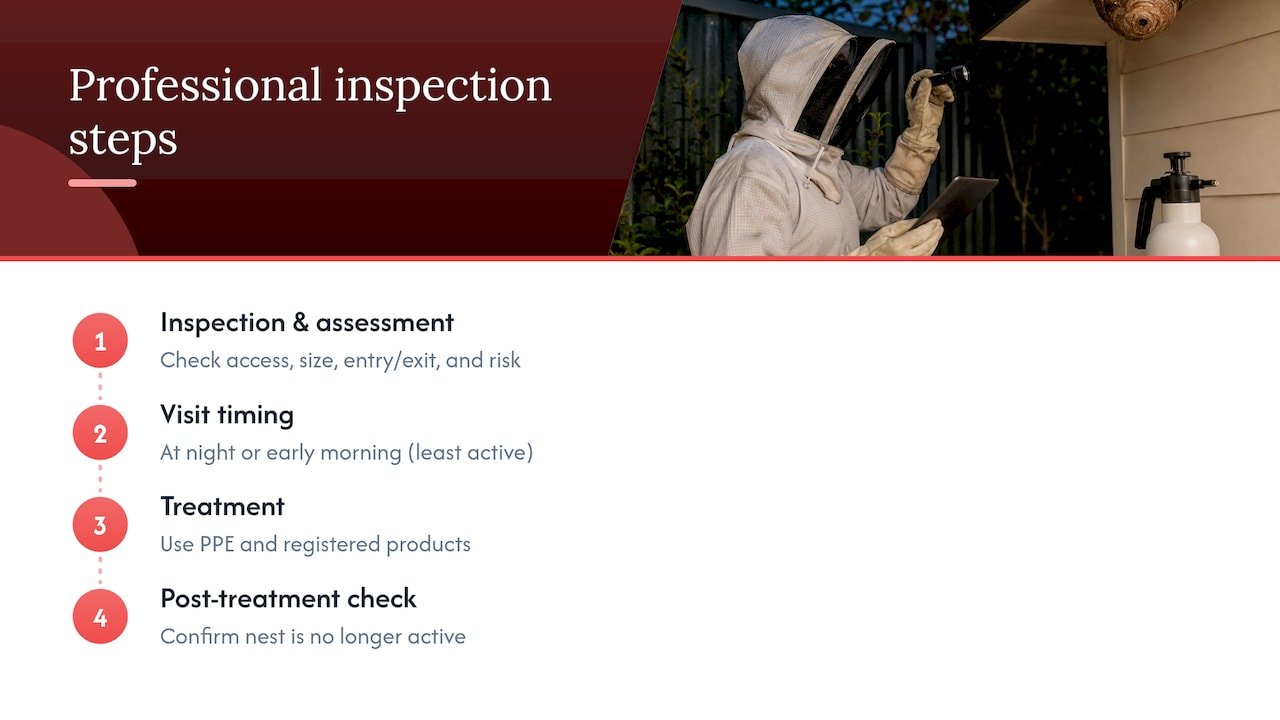
A licensed technician checks nest access, likely nest size, entry and exit points, and the risk to people and pets before touching anything. Treatments are generally timed for night or early morning when wasps are the least active, carried out with protective equipment and registered products, and followed by a check to confirm the nest is no longer active. For details on what an inspection and treatment visit covers, see this guide on wasp nest removal and this Canberra-specific safety advice.
A straight answer for Canberra homeowners
Treat any ground or underground nest as a job for a professional, not a weekend project. Document it, tell your neighbors if it is near a shared fence line, and report suspected European wasps rather than guessing.
— navin
Get a professional wasp inspection in Canberra
A misidentified nest is how most backyard wasp injuries happen, and a wrong guess about whether you are looking at paper wasps or European wasps can turn a simple job into a hospital visit. A licensed pest control company runs wasp control for homes and businesses in the Canberra area, with technicians trained to confirm species, locate hidden nests, and treat them with the right timing and equipment.

A typical visit covers an inspection of the nest and surrounding structure, treatment carried out with registered products, and a follow-up check to confirm the colony is gone. If you are dealing with a nest you cannot confidently identify, book an inspection through BugsPatrol’s wasp control service or browse the full range of pest control services for ongoing protection.
FAQ
Should you destroy wasp nests yourself?
No, destroying a nest yourself is risky, especially with European wasps, which can swarm in large numbers when disturbed. City Services ACT recommends leaving nest removal on private property to a qualified pest control operator.
How can you tell what kind of wasp nest it is?
Check the nest’s size, material, and location: small open paper nests above ground point to paper wasps, while large nests underground or in wall cavities point to European wasps. Mud tube or pot-shaped nests on walls belong to solitary mud daubers or potter wasps.
What does WD-40 do to wasps?
WD-40 is not a registered insecticide and is not a recommended or tested treatment for wasp nests. Disturbing an active nest with any improvised spray risks provoking an attack, which is why professional advice points toward licensed pest control professionals.
What kills a wasp nest instantly?
There is no instant, safe fix for an active nest, particularly an underground European wasp colony. Licensed technicians use registered insecticides applied at night when activity is lowest, followed by a check to confirm the nest is no longer active.
When should you call emergency services for a wasp sting?
Call 000 if someone shows breathing difficulty, swelling of the mouth or throat, or other signs of a severe allergic reaction after a wasp sting. HealthDirect’s first-aid guidance also recommends using a prescribed adrenaline autoinjector immediately if one is available.
Sources
- Wasps – City Services
- Bee and wasp stings – treatment | healthdirect
- Pest control technical note – European wasps (Health Victoria)
- European wasp ID card (DPIRD WA)
Recommended
- Wasp Control Services – Free Inspections
- Wasp Pest Control
- Wasp Control in Canberra
- Wasp Pest Control in Canberra

[…] Identify and Report Wasp Nests Safely in Australian Yards […]